
Category: RKBA
Do rights granted under the U.S. Constitution end at the border of one state when a citizen enters another? Generally speaking, no. The privileges and immunities clause of Article IV, Section 2, of the Constitution says that citizens of one state are “entitled to all Privileges and Immunities of Citizens” in other states. This includes the right to travel for employment and recreation. However, there are limitations.
The scope of the Second Amendment’s right to keep and bear arms for self-defense across state lines is the issue at the heart of a case filed on January 7, 2025, against Bob Jacobson, in his official capacity as commissioner of the Minnesota Department of Public Safety.
The complaint challenges Minnesota’s refusal to recognize lawfully issued firearms permits of other states, including those held by plaintiffs David McCoy and Jeffrey Johnson in their home states of Texas and Georgia, respectively. Johnson also holds a permit from Florida, where he used to live.
The plaintiffs are professional long-haul 18-wheel truck drivers who crisscross the country, 300 days a year. According to the complaint, both maintain firearm competency with safety courses and memberships in various firearms organizations. Each regularly passes background checks required by their employment. Neither has any history of violence, felony convictions, or class one misdemeanors. Their backgrounds include experience as firefighters and emergency medical technicians.
The men consider themselves good Samaritans, their “personal ethos” impelling them to “make the road a little safer” by “helping stranded motorists, coming to the aid of accidents, assisting law enforcement and emergency workers.”
While driving, McCoy and Johnson regularly carry firearms for the purposes of self-defense, as well as defense of others, their home, and cargo. But whenever they reach the Minnesota border, Minnesota law requires them to unload their firearms and stow them in a closed, fastened container, rendering them not readily accessible. Other states have analogous restrictions.
Trump Skips Guns in Flurry of Day One Executive Orders
Gun policy did not factor into the new President’s immediate priorities.
Shortly after President Donald Trump officially swore in for his second term on Monday, he quickly signed dozens of sweeping executive orders to walk back several Biden-era policies and fulfill multiple prominent campaign promises. His actions included declaring a “national energy emergency,” a bid to end birthright citizenship, withdrawal from the World Health Organization and Paris Climate Agreement, a full pardon for roughly 1,500 January 6th defendants, and more.
Left out of the policy blitz was anything having to do with advancing gun-rights priorities or rescinding the Biden Administration’s gun-control policy achievements. The Trump Administration also left the Second Amendment and gun policy off of its revamped “priorities” page on the White House website.
The omission of any gun policy action comes despite the President pledging speedy reversals of former President Biden’s executive orders to gun-rights supporters on the campaign trail earlier this year.
“Every single Biden attack on gun owners and manufacturers will be terminated my very first week back in office,” Trump told a crowd of NRA members at the group’s Great American Outdoor Show last February.
His decision not to do so on day one places him on the clock to make good on those promises to gun voters the same way he did to immigration hawks and other key MAGA constituencies. If he chooses not to, it could be another sign that guns are low in the pecking order amongst the second Trump Administration’s prerogatives.
For instance, though some of the President’s Day One executive orders were sweeping representations of longstanding Trumpian concerns, others were relative novelties, including directives to rename the Gulf of Mexico and Alaska’s Denali mountain and promote beautiful architecture.
At the same time, some of the moves Trump pledged to gun-rights advocates were already accomplished by the time he got to the Oval Office on Monday. During a speech at the NRA annual meeting last May, he promised NRA members he would fire Steven Dettelbach, Biden’s chosen director of the Bureau of Alcohol, Tobacco, Firearms and Explosives (ATF), on “day one.” Before he could do so, however, Dettelbach preemptively tendered his resignation effective January 18.
Others may be happening without any formal publicity. Shortly after his reelection in November, the National Shooting Sports Foundation called on Trump to dismantle the White House Office of Gun Violence Prevention, an executive body created by his predecessor to promote gun-control measures. Though he did not issue any public directive on the matter, the office’s website appears to have been taken offline shortly after his inauguration. Although, many other sections of the White House website also appear to be down and it’s unclear what the status of the office is today.
The Trump White House did not respond to a request for comment.
Still, the President appears yet to have taken action to spur some of the more far-reaching instances of rolling back Biden’s gun policies. These more closely-watched options could include orders directing the ATF to rescind agency regulations that banned so-called ghost gun kits, reclassified pistols equipped with stabilizing braces as short-barreled rifles, and expanded criteria for who must be federally licensed to sell used guns adopted under the prior administration that have rankled gun-rights advocates and resulted in prolonged courtroom fights.
While the road to rescinding those rules will likely be long and bumpy, initiating the process could be as simple as a stroke of the President’s pen–in the same way they were first set into motion.
2A Breaking: SCOTUS just relisted Snope and Ocean State Tactical as expected for January 24. We need a cert grant by midnight January 24 or we are toast for this term imho
— Mark W. Smith/#2A Scholar (@fourboxesdiner) January 21, 2025
Lawmakers Introduce Measure Outlawing Federal Gun Registry
The threat of gun registration has long been a concern for U.S. gun owners, and for a very good reason: registration always leads to confiscation. Now, two U.S. lawmakers have introduced legislation to prevent any potential gun registration schemes in the future.
On January 16, U.S. Sen. Jim Risch, R-Idaho, and Rep. Michael Cloud, R-Texas, introduced the “No Retaining Every Gun In a System that Restricts Your (REGISTRY) Rights Act.” Although its name is somewhat awkward, this legislation is commendable as it would prevent the U.S. government from establishing a federal firearms registry.
Among other things, the act would require the Bureau of Alcohol, Tobacco, Firearms and Explosives (ATF) to eliminate all existing firearm transaction records, permit federal firearms licensees (FFLs) to destroy transaction records upon going out of business and prevent the ATF from establishing or maintaining a firearms registry in the future.
The weaponized ATF’s overreach in implementing several new final rules under the Biden Administration was the impetus for the introduction of the measure.
“The ATF’s excessive overreach has gone unchecked for too long,” Sen. Risch said in a press release announcing the legislation. “Idaho’s law-abiding gun owners should not be subject to an already illegal federal firearms registry. The Second Amendment is not conditional to a list of guns in circulation and their owners. All law-abiding Americans have the undeniable right to keep and bear arms. My No REGISTRY Rights Act will safeguard this essential liberty for generations to come.”
Rep. Cloud, the measure’s sponsor in the U.S. House of Representatives, said that Americans’ right to keep and bear arms should not be subject to a government inventory.
“The Second Amendment is a cornerstone of individual liberty, and no administration—Republican or Democrat—should have the ability to compile a list of law-abiding gun owners,” Cloud said. “The Biden administration’s backdoor attempts to create a federal firearms registry are a clear threat to Americans’ privacy and constitutional freedoms. The No REGISTRY Rights Act will dismantle the ATF’s existing database and ensure such a registry can never be implemented.”
In April 2022, the Biden Administration issued a final rule requiring that FFLs retain all firearm transaction records indefinitely. Since 1984, federal regulations have permitted FFLs to discard records older than 20 years, as the “time-to-crime”—the interval between a firearm’s last known legal sale and its use in a crime—rarely exceeds two decades.
Risch and Cloud were joined in introducing the No REGISTRY Rights Act by Republican U.S. senators Mike Crapo of Idaho, Cynthia Lummis of Wyoming, Steve Daines and Tim Sheehy of Montana, Roger Marshall of Kansas), Pete Ricketts of Nebraska, Markwayne Mullin of Oklahoma, Cindy Hyde-Smith of Mississippi and 47 members of the House of Representatives.
What SCOTUS doesn't have much time for: most Second Amendment questions, even though they have taken very few such cases in their history.
What SCOTUS does have time for: pic.twitter.com/FpwnydnvO1
— Kostas Moros (@MorosKostas) January 17, 2025
Supreme Court Second Amendment Update 1-17-2025
In my last update, I wrote, “If a cert petition reaches its scheduled conference date without a justice requesting a response, then we know it was placed on the deadlist and never voted on. It was simply denied.” That remains true. Every Second Amendment cert petition that went into last Friday’s SCOTUS conference, where the respondents had either filed a waiver or did not file any response, was denied. In one case, the Feds asked for the cert petition to be granted, the lower court’s decision vacated, and the case remanded (GVR’d) back to the lower court for proceedings consistent with US v. Rahimi. With only one exception that I can recall when the Feds ask for a GVR, they get it.
I also wrote The “assault rifle” and “large capacity” magazine cert petitions were today relisted to this Friday’s SCOTUS conference of January 10th.” They survived that conference and were relisted to today’s conference. We won’t know until Tuesday whether they and the other petitions scheduled for today’s conference survived.
A response was requested for one of the petitions scheduled for today’s conference, but the Second Amendment was just one of three questions presented to the justices. I suspect that one of the other questions (most likely question 3) in Jarvis Parker, Petitioner v. Florida No. 24-6146 resulted in a response being requested.
In any event, when a justice requests a response after a waiver has been filed and the response hasn’t been filed before the petition goes to its scheduled conference, the petition survives that conference.
Last Friday’s SCOTUS conference resulted in 13 denials, 1 GVR, and two relists.
The petitions that were scheduled for today’s conference are:
Congressman Ben Cline Reintroduces Hearing Protection Act
Washington, January 15, 2025
Today, Congressman Ben Cline (R-VA) reintroduced the Hearing Protection Act (HPA). This legislation reduces the overly burdensome barriers required to purchase a firearm suppressor to ease access for law-abiding citizens simply trying to obtain the hearing protection they need.
“Americans who enjoy hunting and target shooting should be able to do so safely and legally without facing burdensome government regulations,” said Rep. Cline. “The Hearing Protection Act will reclassify suppressors, making it easier for law-abiding gun owners to protect their hearing while enjoying recreational activities. It’s time to ensure that our Second Amendment rights are upheld, allowing responsible citizens to enjoy their freedoms without unnecessary obstacles.”
Congressman Cline was joined by Rep. August Pfluger (R-TX), Rep. Ron Estes (R-KS), Rep. Riley Moore (R-WV), Rep. Aaron Bean (R-FL), Rep. Claudia Tenney (R-NY), Rep. Randy Weber (R-TX), Rep. Barry Moore (R-AL), Rep. Troy Nehls (R-TX), Rep. Burgess Owens (R-UT), Rep. GT Thompson (R-PA), Rep. Rob Wittman (R-VA), Rep. Richard Hudson (R-NC), Rep. Anna Paulina Luna (R-FL), Rep. Kat Cammack (R-FL), Rep. Buddy Carter (R-GA), Rep. Scott Perry (R-PA), Rep. Michael Bost (R-IL), Rep. Jack Bergman (R-MI), Rep. Brad Finstad (R-MN), Rep. Mike Collins (R-GA), Rep. Sam Graves (R-MO), Rep. Chuck Fleischmann (R-TN), Rep. Fulcher (R-ID), Rep. Gus Bilirakis (R-FL), Rep. John McGuire (R-VA), Rep. Robert Aderholt (R-AL), Rep. Addison McDowell (R-NC), Rep. Andy Harris (R-MD), Rep. Tim Burchett (R-TN), Rep. David Kustoff (R-TN), Rep. William Timmons (R-SC), Rep. Barry Loudermilk (R-GA), Rep. Jeff Crank (R-CO), Rep. Morgan Griffith (R-VA), Rep. Kevin Hern (R-OK), Rep. Steve Womack (R-AR), Rep. Brian Babin (R-TX), and Rep. Celeste Maloy (R-UT) as original cosponsors.
The Hearing Protection Act is supported by the American Suppressor Association (ASA), the National Shooting Sports Foundation (NSSF), the National Rifle Association (NRA), the Congressional Sportsmen’s Foundation (CSF), and the Academy of Doctors of Audiology (ADA).
“The Hearing Protection Act is the epitome of commonsense legislation. Law-abiding citizens should not have to pay a tax to protect their hearing when they exercise their Second Amendment rights. The American Suppressor Association applauds Rep. Cline for his leadership and willingness to fight for the rights of gunowners across the United States,” said Knox Williams, ASA President and Executive Director.
“Congressman Cline’s Hearing Protection Act will have the federal government recognize firearm suppressors for what they are. These are accessories to a firearm that make recreational shooting and hunting a safer experience,” said Lawrence G. Keane, NSSF Senior Vice President and General Counsel. “These safety devices reduce the report of a firearm to a level that won’t cause instant and permanent hearing damage. Despite Hollywood’s depictions, they do not mask the sound of a firearm. The focus should be on removing barriers to safe and responsible use of firearms and dedicating resources to ensuring firearms are safeguarded from those who should never possess them. Strict regulatory control of firearm accessories, and the parts of those accessories that have no bearing on the function of a firearm, is unnecessary and not the wisest use of federal resources. NSSF thanks Congressman Cline for his leadership for ensuring safe and responsible use of firearms and dedicating necessary resources where they are most needed.”
“Onerous and unnecessary government regulation shouldn’t prevent America’s hunters and recreational shooters from protecting their hearing while exercising their constitutionally protected freedoms,” said John Commerford, Executive Director of NRA-ILA. “Suppressors do not silence firearms, but they are proven to reduce the severity of hearing loss. On behalf of our millions of members, NRA thanks Representative Ben Cline for introducing the Hearing Protection Act.”
“The Hearing Protection Act has been a longstanding priority for the Congressional Sportsmen’s Foundation (CSF), and we are excited to see this legislation reintroduced. Suppressors are one of the fastest growing and most popular accessories for sportsmen and women, unfortunately, current law makes acquiring suppressors an overly burdensome process, which would be addressed by this legislation. CSF thanks Congressional Sportsmen’s Caucus Member Rep. Ben Cline for introducing this legislation, and we look forward to working with him in the 119th Congress to improve the suppressor purchasing process,” said CSF President and CEO Jeff Crane.
Read the full text of the bill here.
Congressman Ben Cline represents the Sixth Congressional District of Virginia. He previously was an attorney in private practice and served both as an assistant prosecutor and Member of the Virginia House of Delegates. Cline and his wife, Elizabeth, live in Botetourt County with their two children.
President Trump Can Lead in Fight Against State-Level 2nd Amendment Infringements
“Karina’s Bill, Named For Little Village Mom Slain By Husband, Heads To Pritzker’s Desk,” Block Club Chicago reported Thursday. “The proposed legislation would clarify the process for confiscating a person’s gun when they are served an order of protection during instances of domestic violence.” (Note: Signing the bill into law has not happened yet at this writing. It may be a done deal when this is posted.)
“The bill [passed] the House with an 80-33 vote and the Senate in a 43-10 vote,” Chicago’s WGN9 reports. “Pritzker said Wednesday he intends to sign it, calling it ‘the right idea’ and ‘the right thing to do.’”
Is it? Either?
Per Fox 32 Chicago, chief co-sponsor Rep. Abdelnasser Rashid calls it “a critical step towards protecting survivors of domestic violence and making our communities safer. Together, we will continue to push to end gun violence and ensure that everyone in Illinois can live free from fear in their own home.” And it’s “a pivotal victory,” Lt. Governor Julian Stratton chimes in.
How?
“Karina’s Bill will require firearms to be removed from an alleged abuser when a victim is granted an emergency order of protection,” she assures us.
“Alleged abuser?” So not only hasn’t the person been tried and convicted, but they may also not have even been charged yet? How is that remotely constitutional? Or effective?
Per a 2023 Block Club Chicago article recounting the murders:
“Jose Alvarez [The husband] sought mental health treatment but was put on a wait list… Alvarez owns a Glock 17 9mm-handgun and had a previously valid FOID card, but it was revoked with the order of protection, McCord said. McCord and Alvarez’s attorney said the order of protection was never served to him.”
It appears the state dropped the ball more than once. And ignored the basic truth that anyone who can’t be trusted with a gun can’t be trusted without a custodian.
If there were actionable evidence and charges against Alvarez, he could have been afforded full due process, brought to trial, and convicted. But that requires work, and it’s much easier for a government that chafes at such bonds to just issue a blanket diktat that makes mere accusations sufficient “justification” to usurp more powers and ignore more rights.
And besides, you’ll note none of the proponents of such edicts do anything but deny the reality demonstrated by economist and author John Lott of the Crime Prevention Research Center, that “Murder isn’t a nationwide problem. It’s a problem in a small set of urban areas, and even in those counties, murders are concentrated in small areas inside them.”
How will the most dangerous offenders, the criminal population that does not obey gun laws or apply for FOID cards to identify themselves to the state, be affected by this new “law”? The answer is, they won’t be.
Instead, a net will be cast that will scoop up the innocent along with the guilty and do further injury to freedom. As colleague Darwin Nercesian, News Field Editor for Firearms News (full disclosure, I am the magazine’s Political Field Editor) reports in his analysis of Karina’s Bill:
“To truly understand the depths of Democrat legislative depravity, let’s first look at the method by which the bill was passed… Just six minutes before the scheduled commencement of the Illinois Executive Committee, the bill was posted, having been stripped completely of its language after the enacting title and replaced with what is called ‘Karina’s Bill.’ The move, executed before the sitting ‘Lame Duck’ session, is called a striking amendment, which differs from a floor amendment proposed in a legislative chamber in that it removes everything after the title and inserts a whole new bill.”
“Karina’s Bill advocates for the use of ex parte hearings to obtain orders of protection, immediately triggering a warrant to confiscate the subject’s firearms and ammunition,” Nercesian notes, explaining “Ex parte… refers to a legal proceeding by which one party communicates directly with a judge without notice to or knowledge of the other party, removing the respondent’s ability to be represented or present their side of a case prior to being stripped of their rights and property.”
The assaults on freedom will “obliterat[e] the Second, Fifth, and Fourteenth Amendments,” Nercesian observes, noting the burden of regaining rights is on individuals victimized by the edict, which “holds agencies completely without liability for damage or destruction to property while it is in their custody.”
Recall how Donald Trump has in the past (in contrast to grandiose campaign promises to enthusiastic gun owners) entertained the prospects for all kinds of “gun control” and specifically advocated “Take the guns first, go through due process second.” Recall how his choice for attorney general, Pam Bondi, has, among other citizen disarmament mandates, been “one of Florida’s biggest proponents of red flag laws.” Nercesian therefore asks a key question:
“What are you going to do about it, President Trump?”
Some may wonder what he can do. After all, these are state laws, the president isn’t supposed to be a dictator, and federalism is supposed to limit how much power the national government can exert over the states. And don’t forget the Tenth Amendment, reserving power “to the States respectively, or to the people.”
First, states have agreed the Constitution is “the supreme Law of the Land” and “the Members of the several State Legislatures, and all executive and judicial Officers… of the several States, shall be bound by Oath or Affirmation, to support this Constitution.” They can no more legitimately violate the Second Amendment than they can any other right.
And as I proposed in a November Firearms News column:
“Imagine now the Department of Justice under an actual Second Amendment advocate, and what it could do fighting infringements and prohibitionist lawfare waged by states with unlimited tax war chests in tandem with Astroturf prohibitionist groups funded by antigun elites. Right now, the costs to defend against these innumerable assaults on all levels are borne by gun rights groups and members of mostly modest means who can only support a fraction of what is needed. That equation could be turned on its head.”
And that would include enforcing the Second Amendment against state infringements, exactly as precedent has been established against abridgments of other civil rights.
Or we could listen to NRA instead and “Take Action Now!” by politely asking Illinois Democrats not to vote for the bill.
Too late, they already have. So, the question now becomes “Will President Trump do anything about it?”
We’ll get a better answer after Inauguration Day. And the way to press for that is via the much-touted-during-the-campaign “Gun Owners for Trump.” If that was more than just a discardable PR vehicle, the named leaders would have the president’s ear to advise on bills, lawsuits, regulations, judicial and other federal nominees, and provide a conduit for gun owners to express their concerns.
Because there’s one thing that needs to be understood in no uncertain terms and we shouldn’t have to apologize for: Donald Trump and Republicans owe gun owners, and it’s time to collect.
Gun sales: lies, damned lies and statistics
With Donald Trump about to regain the White House and Republicans in control—barely—of both houses of Congress, gun owners and Americans who think they might want to be gun owners someday can relax, right? Right? Beginning January 20, 2025, the federal government probably won’t be harassing gun dealers or trying to write extra-constitutional rules to turn millions of Americans into instant felons for possession of guns or accessories that were lawful the day before, right? Let’s review the status quo on the way to an answer.
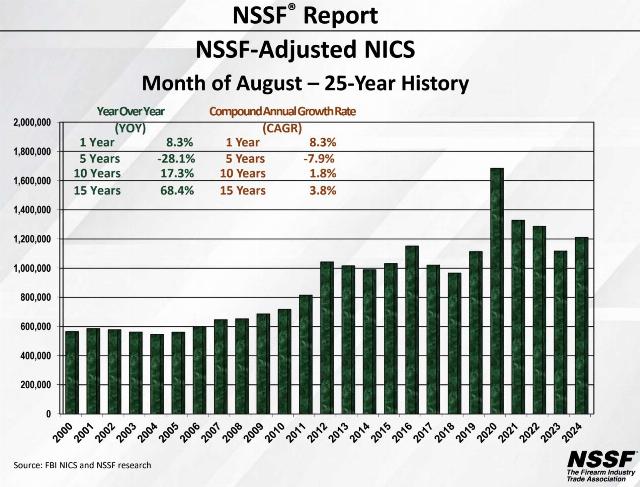
For 65 consecutive months, Americans have bought more than a million guns. That’s measured by NCIC record checks mandatory whenever one buys a gun—or guns—from a federally licensed gun dealer after filling out the standard ATF Form 4473. Private sales surely count for many more, but aren’t recorded.
After 2024 monthly gun sales — as measured by adjusted NICS data — trailing 2023 for most of the year, they started to accelerate in July and jumped even more in August. This may be due, at least in part, to the impending election. Americans tend to hedge their bets every four years by stocking up on firearms and related gear. And then there’s the general state of society that seems to have an increasing number of people concerned about self-defense.
Graphic: FBI data via NSSF. Public Domain.
SCOTUS Rejects Multiple Second Amendment Cases, Relists Gun Ban Challenges
On a day when gun-rights advocates hoped that the Supreme Court would announce its next big Second Amendment case, it only informed them which ones it was turning away.
On Monday, the High Court denied petitions for certiorari in Maryland Shall Issue v. Moore and Gray v. Jennings. The cases challenged Maryland’s handgun-purchase licensing requirements and the preliminary injunction standard set in the case against Delaware’s sales ban on “assault weapons” and “large-capacity” ammunition magazines.
None of the justices wrote separately to explain or dissent from the denials.
Monday’s orders list dashes the hopes of gun-rights activists looking to overturn lower court decisions upholding the gun-control laws in question. It continues the Supreme Court’s recent streak of rejecting Second Amendment petitions, even as it agrees to hear government requests for review of decisions striking gun laws down. It could fuel further concern among gun-rights activists about the Court’s resolve to expand on the standard it set in 2022’s New York State Rifle and Pistol Association v. Bruen and address state-level gun bans or several other of its longest-standing constitutional concerns.
However, the Court left open the possibility it would take some of the highest-profile gun cases still pending before it. The Court relisted two other closely watched Second Amendment cases, Snope v. Brown and Ocean State Tactical v. Rhode Island, to be considered again at this Friday’s conference. That keeps gun-rights supporters’ hopes alive for a Supreme Court grant of review of state bans on so-called assault weapons and large-capacity magazines.
With no guidance on how the justices feel about those two cases and the possibility that the Court could relist them multiple times before deciding whether to take them up, those wondering about the future of Second Amendment jurisprudence face an uncertain timeline for further clarity. Still, Monday’s order list indicated what areas of gun law the Court won’t expound upon for the foreseeable future.
This isn’t “Doooooom!”.
The Machine Gun Win Now Before the 10th Circuit Court of Appeals
United States v. Morgan (24-3141)
Charles Nichols
Last August, Federal District Court Judge John W. Broomes issued two findings. The first was that the two machine guns the defendant was charged with illegally possessing are ““bearable arms within the original meaning of the [Second” amendment.” The second was “the government has failed to establish that this nation’s history of gun regulation justifies the application of 18 U.S.C. § 922(o) to Defendant.”
Judge Broomes then dismissed the charges. The Federal government filed a timely appeal, and filed its opening brief on appeal on December 12th. On December 29th, the Brady Center to Prevent Gun Violence filed an Amicus brief in support of the government. On Monday, January 6th, the Defendant filed a disfavored (but unopposed) motion for a thirty-day extension to file his answering brief on appeal. The motion was granted the same day. I am reliably informed that an Amicus brief will be filed in support of the Defendant.
Judge Broomes also said that some kinds of machine guns are not arms protected by the Second Amendment, and his decision says nothing about what restrictions or prohibitions the government could place on the carrying (bearing) of machine guns because the Federal law only makes it a crime to possess unregistered machine guns, not carry them.
Additionally, this is an interesting case because the case was prosecuted in the district court, and the opening brief on appeal was filed by the Biden administration. The reply brief and all further proceedings from January 20th onward will be by the Trump administration. The Trump DOJ attorney can simply acquiesce in the case, meaning he can concede that the law is unconstitutional but assert that President Trump will continue to enforce the law, including in this case. The latter is particularly important because if the President does not aver that he will continue to enforce the law, including against the Defendant, then the Court of Appeals could simply dismiss the appeal without deciding the case for lack of a “live case or controversy.”
Putting machine guns to the side for the moment, this quote from the Defendant’s motion for an extension of time is particularly telling, “The government’s brief is 36 pages long. The table of authorities is an additional 15 pages long and includes citations to roughly 200 cases, statutes, and legal texts. Many of the sources relied on by the government are hundreds of years old and were not cited by the government in the district court.”
The Federal criminal court system is rigged against defendants. Had the Defendant’s attorney failed to cite authorities or make properly worded objections in the proper manner at the appropriate time(s) in the trial court, then his failure would be subject to what is called “plain error review” on appeal, and he would almost certainly lose.
Will the 10th Circuit Court of Appeals afford the Federal government a more deferential standard of review? Will the Court of Appeals contrive some way around the NYSRPA v. Bruen mandate that the burden of proof lies with the government?
Time will tell. The appeal should be fully briefed in two months, after which the Court of Appeals can make a decision at any time.
You can read many of the briefs for free from CourtListener at the following links.
United States v. Morgan (24-3141) 10th Circuit Court of Appeals Docket.
United States v. Morgan (6:23-cr-10047) District Court, D. Kansas Docket.
On Wednesday, Jan. 8, 2025, Gov. Mike DeWine signed Senate Bill 58, which prohibits requiring firearm liability insurance or being required to pay a fee for the possession of a firearm, part of a firearm, its components, its ammunition, or a knife.
Senate Bill 148, which was amended into SB 58, prohibits financial institutions from tracking firearms purchases and prohibits government entities from maintaining a registry of firearms or firearm owners.
Both SB 58, sponsored by Sens. Terry Johnson (R-McDermott) and Theresa Gavarone (R-Huron), and SB 148, sponsored by Sen. Terry Johnson, fight recent efforts by gun control advocates to make gun ownership more expensive and less private for law-abiding gun owners instead of cracking down on the actual criminal misuse of firearms.
Buckeye Firearms Association strongly backed both bills and thanks the governor for signing these vital pieces of legislation. These new laws go into effect in 90 days.
You can read BFA’s testimony for these bills here.
🚨BREAKING NEWS🚨
S. 65, the Constitutional Concealed Carry Reciprocity Act, has JUST been introduced in the Senate with 41 cosponsors.
President Trump has promised to sign the GOA-backed bill. THE MOMENTUM IS BUILDING.pic.twitter.com/MYuglNaWYf
— Gun Owners of America (@GunOwners) January 9, 2025
Lawsuit Challenges Minnesota’s Gun Permit Restrictions For Truckers
The Liberty Justice Center filed a federal lawsuit on Tuesday challenging Minnesota’s refusal to recognize firearm permits from other states, a policy the nonprofit argues violates the Second Amendment rights of interstate truck drivers.
The lawsuit, McCoy v. Jacobson, was filed in the U.S. District Court for the District of Minnesota on behalf of two truckers, David McCoy and Jeffrey Johnson, who claim the law infringes on their constitutional right to bear arms while working across state borders.
David McCoy, a Texas-based trucker, and Jeffrey Johnson, who holds firearm permits from Florida and Georgia, both legally carry firearms for self-defense in many states. However, Minnesota law prohibits them from carrying firearms in public or in their trucks without a Minnesota-issued permit or one recognized by the state.
Minnesota currently excludes permits from 29 states, including Texas, Georgia, and Florida, leaving McCoy and Johnson unable to legally defend themselves while in the state.
If the underlying laws and regulations are not also dealt with, the enforcement of them will simply fall to another bunch of bureaucraps.
Otherwise, it’s just another example of Political Kabuki Theater.
Rep. Lauren Boebert Introduces Bill to Abolish the ATF
Rep. Lauren Boebert (R) has introduced legislation to abolish the Bureau of Alcohol, Tobacco, Firearms, and Explosives (ATF).
The bill is H.R. 129 and it comes at a point when Republicans are just weeks away from holding the House, Senate and White House.
Newsweek noted Boebert’s push to do away with the agency is the latest in line of Republican pushes to see the agency undone.
For example, in November 2024, Rep. Eric Burlison (R) called for the agency to be abolished as well.
On November 25, 2024, Breitbart News reported that Burlison told FOX News the ATF is “a disaster.”
He said, “For several decades they’ve been a disaster agency [which has] been violating the Second Amendment.”
The ATF issued numerous rules during the Biden/Harris administration, one of which criminalized owners of legally purchased AR-pistol stabilizer braces. Another one of the ATF’s rules declared that 80 percent complete firearm frames are firearms and therefore can only be acquired via background checks. Yet another ATF rule circumvented Congress via new regulations against private gun sales.
On January 2, 2024, Breitbart News pointed out that Biden’s ATF director, Steven Dettelbach, tendered his resignation effective January 18, 2025, two days before Trump retakes the White House.
Citizens Committee for the Right to Keep and Bear Arms chairman Alan Gottlieb cheered the resignation, saying, “That’s one less person Trump will have to fire after he takes office, and it is one less gun prohibition lobbyist on the government payroll.”
SCOTUS Distributes 2A Cases for Friday Conference
The U.S. Supreme Court has distributed a couple of important Second Amendment cases for conference this Friday, and all eyes will be watching to see whether oral arguments are scheduled as a result.
According to SCOTUSblog, the cases of Snope v. Brown and Maryland Shall Issue v. Moore both challenge Maryland’s restrictive gun control laws.
Snope is a case brought by the Second Amendment Foundation, Citizens Committee for the Right to Keep and Bear Arms, the Firearms Policy Coalition, and private citizen, David Snope. It challenges Maryland’s ban on so-called “assault weapons” and this would be the third time the case has been brought to the high court for review.
SAF, CCRKBA and FPC contend the ban is unconstitutional on the grounds that the Second Amendment makes no distinction between the types of “arms” it protects. The modern semiautomatic rifle, epitomized by the AR-15 and its clones, is the most popular rifle in America. Millions are owned and used b y law-abiding citizens for hunting, competition, recreation, predator control and personal and home defense.
According to a SAF news release Tuesday, “SAF sought cert after the Fourth U.S. Circuit Court of Appeals ruled en banc that the modern semiautomatic rifles banned by Maryland fall outside the protection of the Second Amendment because they are too similar to military arms. SAF and its partners contend this reasoning “is becoming a commonplace misapplication” of Supreme Court precedents established by the 2008 Heller ruling, 2010 McDonald decision and 2022 Bruen decision.
“Snope provides the Supreme Court with an excellent vehicle to correct the widespread misapplication of the Court’s precedent regarding these firearms and the Second Amendment, itself,” said SAF Executive Director Adam Kraut. “The case is on appeal from final judgment with an en banc decision of a circuit court. Moreover, the specific type of firearm in question is commonly owned across the country, placing it well within the scope and protection of the Second Amendment. By granting cert in Snope, the high court can help settle the matter once and for all.”
Moore challenges Maryland’s licensing requirement to even own a gun. As noted by SCOTUSblog, “Moreover, they contend that Justice Thomas’s footnote in Bruen was limited to licenses to carry guns in public and does not apply to laws, like Maryland’s, which require a license to own a gun at all. But in any event, the challengers argue that the state’s requirements are “abusive” because they collectively impose an excessive delay: up to a month for a background check to obtain a license, up to a week for a second background check to purchase a gun, and additional time to complete a firearm-safety course.”
This case should have the attention of gun rights activists and anti-gunners in Oregon and Washington, where the effort is ongoing to require people to get a permit to purchase from the police prior to being able to buy a gun.
If the Court grants certiorari in these cases, the outcome could have a devastating effect on gun control in the United States. Several states have banned so-called “assault weapons,” and a ruling that modern semi-autos are protected by the Second Amendment would almost certainly nullify those bans.
Another case up for consideration is Gray v. Jennings, involving SAF, FPC and others, challenges a ban on so-called “assault weapons” and “large-capacity magazines” in Delaware. There is no small irony in this case, as it seeks to undo a gun control law in the home state of departing President Joe Biden, a career gun control proponent who leaves the White House Jan. 20 as former President Donald Trump returns for a second term.
“GOOD MEN PROJECT” (My Foot)
Author thinks inanimate objects are more of a problem than those with evil intent
Gary Whittenberger, Reducing Gun Violence in the United States
Gary Whittenberger is a retired psychologist and freelance writer known for his thoughtful contributions to discussions on psychology, philosophy, science, and religion. Holding a doctorate in clinical psychology from Florida State University, he worked as a psychologist in federal prisons for 23 years. Whittenberger is an active member of the freethought community and co-directed the Tallahassee Freethinkers’ Forum. He has authored several works, including God Wants YOU to be an Atheist, and has written for Skeptic Magazine, Free Inquiry, and other publications. His articles often tackle complex topics such as personhood, free will, and gun violence prevention.
Scott Douglas Jacobsen: Quick backdrop questions, what have the work in clinical psychology, in federal prisons, and freethought activism, taught about the American culture’s psyche around guns–the heart of the matter?
Dr. Gary Whittenberger: Scott, I want to thank you for this opportunity to talk about my article “A Comprehensive Program for Reducing Gun Violence in the US” which appeared in the October/November 2024 issue of Free Inquiry magazine. Also, I compliment you on the great work you are doing with The Good Men Project. We need more journalism, analysis, and commentary like that.
Turning to your question: I think Americans have an obsession with guns which is unhealthy. I think it has roots in the founding of a new country, exploring and settling the western frontier, and rebellion against old governments, all of which occurred a few centuries ago. Fear and anger at levels higher in our country than what are found in other countries stimulate the ownership, purchase, and use of firearms. Part of the solution is to lower these emotions and part of it is to reduce the access to and the number of firearms in the country.
Jacobsen: In the Uvalde case, what were the failures of law enforcement?
Whittenberger: Law enforcement officers failed to confront the shooter as soon as they could have and should have. In my opinion, whenever there are at least two officers who have firearms on the scene, they should call for backup but begin to engage the shooter. This response needs to be stipulated in policies, laws, and training. Officers who do not have the willingness or courage to act to defend others in stressful situations should not be in law enforcement.
Jacobsen: How can gun regulations balance with Second Amendment rights?
Whittenberger: As I said in my article, the Second Amendment needs to be amended. Although American citizens should have a right to possess, own, and use guns, this right should not be absolute. The right should be regulated, restricted, and limited for the common good, especially to minimize unjustified aggression. I have suggested that ordinary citizens be limited to three firearms. Nobody needs an armory. I think “military type” guns should be held from the public. I believe that five different groups of persons should be prohibited from having guns. Any ethical, well-trained, and responsible firearms user has no good reason to oppose these reforms.
Jacobsen: What is the importance of considering mental health in approach reduction of gun violence?
Whittenberger: I think it is extremely important, but I don’t agree with the more conservative pundits who think it should be the only approach to reducing gun violence. The more guns there are in a society, the more unjustified gun violence there will be. The more guns are accessible to people likely to misuse them, the more unjustified violence there will be. Yes, treating mental health problems is necessary, but not sufficient. We need to identify, diagnose, and treat mental health problems early, during childhood, and this is why we need so many more social workers, counselors, and psychologists to work with children in our schools.
Jacobsen: What community intervention efforts can mitigate gun-related violence?
Whittenberger: I think politicians, office holders, nonprofits, and all citizens of a community should strongly advocate for and support gun control policies, as I have outlined in my article. We all need to commit ourselves to slightly reducing our freedoms to possess, own, and use guns in order to reduce gun violence and promote the common good. Give up a little in order to gain so much more! I support buy-back programs conducted by cities and counties.
Jacobsen: What other training or preparedness might help law enforcement agencies?
Whittenberger: Law enforcement agencies need to improve both their employee selection procedures and their training. Officers need to use their agency-issued firearms in a prudent, rational, ethical, and legal manner. Over-use and under-use of firearms by officers are both problems which need to be corrected. We saw in the Uvalde situation that officers took up to 75 minutes to mount their counter-attack, which was way too long. On the other hand, we have seen in other kinds of situations that officers are too prone to use their firearms too quickly to resolve a situation.
Jacobsen: What other reasonable and unreasonable approaches to the reduction of gun violence are being proposed other than, for example, pray?
Whittenberger: I think I have mentioned most of the reasonable approaches in my article. Banning firearms for private citizens in the US would be an unreasonable approach. I think more than half the citizens do have legitimate uses for the ownership of firearms for protection, hunting, and target practice, but ownership of firearms by some citizens, of military-grade guns, and more than three guns is not reasonable.
Jacobsen: What would be a reasonable estimate of efficacy of these proposition to reduce gun violence?
Whittenberger: I think full implementation of the practical steps I have recommended would reduce gun violence by 90%.
Jacobsen: What might be some criticisms of your approach?
Whittenberger: A common criticism is “Implementation of your recommended gun regulation program would lead to the banning and confiscation of guns among private citizens.” This is a slippery slope argument which is used to scare people and arouse resistance to gun regulation. My approach is a common sense and gradual approach which would not be fully in place for about 75 years. And yet, reductions in gun violence will gradually dissipate over that time period. Responsible users of firearms should be willing to sacrifice just a little of their freedom for the common good which comes from a reduction of gun violence in our society.
Jacobsen: What might be barriers to implementation at the state of the federal level?
Whittenberger: Extreme selfishness, fear, the NRA, and owners of large numbers of guns would be barriers to implementation.
Jacobsen: Thank you for the opportunity and your time, Gary.
Whittenberger: You are welcome. And thank you for bringing wider exposure to my article and my many ideas about gun control. Gun violence is rampant in our society and we need to solve the problem! “Thoughts and prayers” for victims just don’t cut it. Please continue your excellent work with The Good Men Project.