Not surprisingly, a bill has earlier been filed in the state legislature to increase the ration of gun buys to 3 a month.


Final Judgement from 9th Circuit Strikes Down California Gun Rationing Law

The most left-leaning federal appeals court in the nation on Thursday closed the coffin lid on California’s controversial “one-gun-per-month” law.

In June, a unanimous three-judge panel of the U.S. Ninth Circuit Court of Appeals upheld a lower court ruling and struck down the limit as not in line with the right to keep and bear arms. The case, Nguyen v. Bonta, challenged California’s 2019 ban on purchasing more than one handgun or semi-automatic centerfire rifle inside a 30-day period.

The same court this week issued a mandate that the judgment takes effect as of Aug. 14. The state had until Aug. 6 to request a rehearing in the case, but did not file, effectively waving a white flag on defending the law. 

The case was filed by six individuals and supported by a variety of pro-gun groups, including the Firearms Policy Coalition, the San Diego County Gun Owners Political Action Committee, and the Second Amendment Foundation.

The gun rights groups characterized the win this week as a historic precedent.

“Today’s mandate issued by the Ninth Circuit marks the first time the court has issued a final decision striking down a law for infringing on the Second Amendment,” said SAF Executive Director Adam Kraut in an email to Guns.com. “Between Heller and Bruen, every case heard by a panel which concluded the law was contrary to the Second Amendment was reheard en banc by the court and ultimately upheld. This is a historic victory for Second Amendment rights in the Ninth Circuit and marks a measurable defeat for Governor Newsom and the legislature’s attempts to curtail the exercise of the right to keep and bear arms in California.”

Moral Imperative: After Senate Vote, North Carolina House Needs to Override Governor’s Veto of Permitless Carry.

North Carolina gun owners are watching closely to see where their elected officials stand. Will they cave to gun control pressure or stand with law-abiding citizens exercising their rights?

In June, North Carolina Gov. Josh Stein vetoed SB 50, the legislation that would allow permitless concealed carry, or constitutional carry, of firearms by law-abiding North Carolinians. By the end of July, the Tarheel State Senate countered by overriding the governor’s original veto.

Needless to say, gun control activists and antigun groups aren’t happy about that development. They prefer infringing on Second Amendment rights and penalizing law-abiding Americans instead of holding criminals accountable for their actions when they break the law. Gun control advocates are putting pressure on N.C. state lawmakers as the bill heads back to the House at the end of August where, if the lower chamber also overrides Gov. Stein’s veto, Constitutional carry will become law.

Joining the Crowd

In North Carolina, opponents of SB 50 are crowing about public safety and the “potential for increased gun violence.” Gun control groups would prefer to leave responsible Americans defenseless and their continued shouts of “increased gun violence” ring hollow. After all, that was the playbook run after the landmark 2022 U.S. Supreme Court Bruen decision striking down New York’s subjective and overly burdensome “may issue” concealed carry permit requirements. Americans approved of the Bruen decision by a large margin. Still, several states reexamined gun control laws despite the fact that law-abiding gun owners weren’t the criminal nemesis gun control advocates predicted they would become overnight.

Now, North Carolina is at a crossroad. Lawmakers can trust those who overwhelmingly obey the law or cave to gun control pressure.

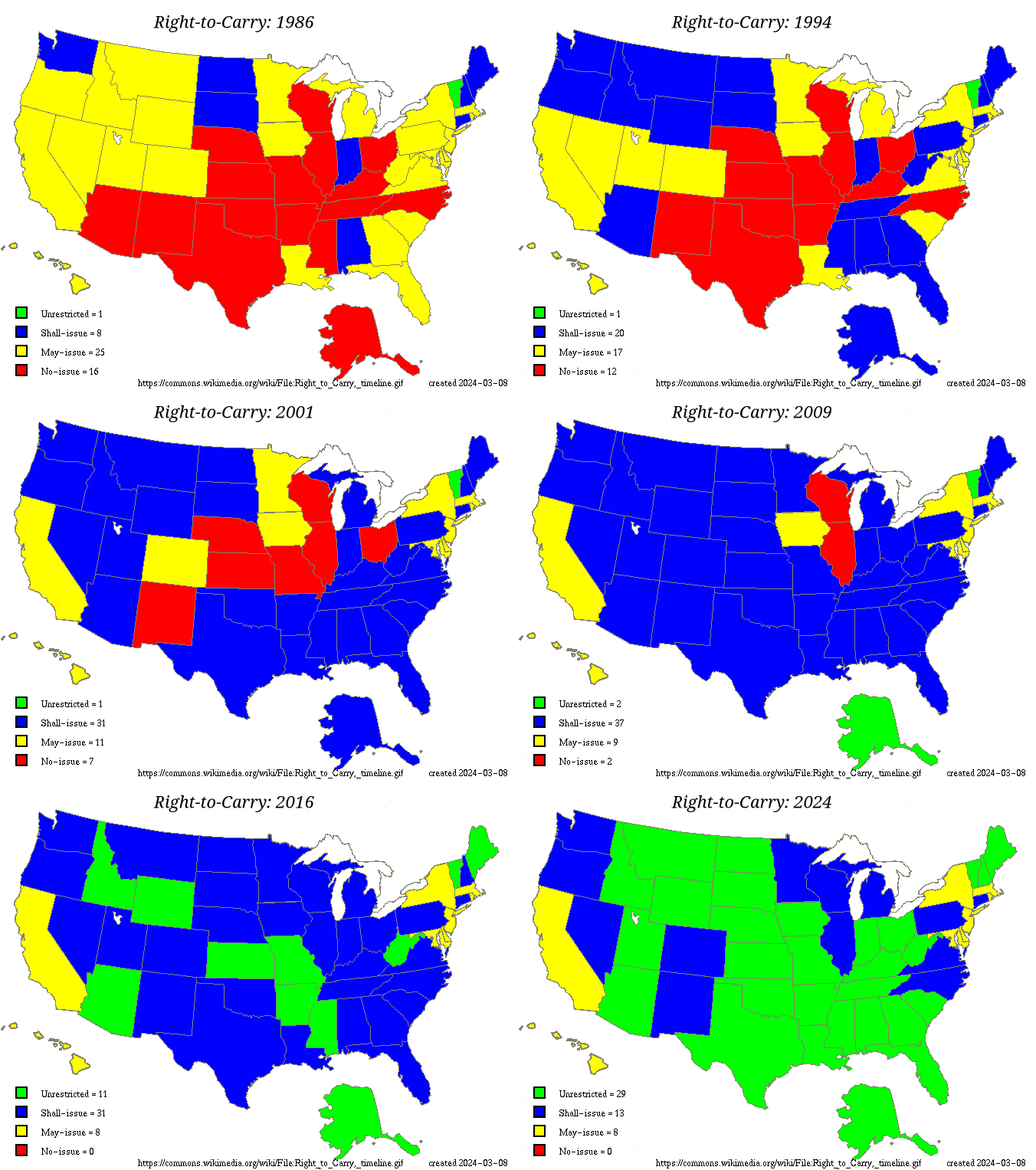
Supporters of SB 50 agree the bill protects individual liberties enshrined in the U.S. Constitution’s Second Amendment. If the House follows the Senate and overrides Gov. Stein’s veto, it would make North Carolina the 30th Constitutional carry state. Other states that have adopted such freedom include Alabama, Alaska, Arizona, Arkansas, Florida, Georgia, Idaho, Indiana, Iowa, Kansas, Kentucky, Louisiana, Maine, Mississippi, Missouri, Montana, Nebraska, New Hampshire, North Dakota, Ohio, Oklahoma, South Carolina, South Dakota, Tennessee, Texas, Utah, Vermont, West Virginia and Wyoming.

The House veto override vote could come as early as August, but – given the close margin in the state’s lower chamber – is not a done deal.

‘Safety Precautions’ for Whom?

Like clockwork, the gun control group Everytown for Gun Safety is now declaring that the North Carolina House overriding Gov. Stein’s veto of SB 50 would “eliminate the safety precautions that are currently in place,” and that in the last several years, criminal misuse of a firearm has increased. Notably, they make no mention of the bail reform policies and soft-on-criminal prosecutors in North Carolina cities that have contributed to the surge in criminal violence.

That’s unsurprising. Gun control advocates have never been bothered over taking away Constitutional freedoms from law-abiding Americans. They grasp onto the misguided belief that guns are the root of evil, not the craven hearts of those who have no respect for the law. They would uproot the rights of those who obey the law even as they ignore criminals illegally obtaining firearms for illicit purposes, and policies which put these same criminals back onto our streets.

Taking away Constitutional rights – and the natural right to self-defense – isn’t going to stop criminals. Only enforcing the law will do that. Recent history shows that law -abiding Americans from all walks of life choose to exercise their right to keep and bear arms over surrendering to fear of crime.

No Time for Facts

Gun ownership among law-abiding Americans has surged in the last five years, including through the addition of at least 26 million new first-time gun owners since 2020. While crime spiked nationwide in the early 2020s – including in North Carolina – these high marks have come down since a few years ago. Moreover, these declines have taken place at the same time that firearm ownership increased, and more states have adopted permitless carry freedoms.

In a recent podcast from The Reload, Jeff Asher of AH Datalytics spoke about how the murder rate is down overall, and how it will likely continue to drop through the end of the year.

“Murder peaked sometime at the end of 2022. In 2023, it had the largest one-year decline ever recorded,” Asher explained. “In 2024, it had the largest one-year decline ever recorded – likely – we don’t have the FBI’s 2024 numbers yet. And 2025 we’re seeing the largest one-year decline ever recorded. So, an even larger decline than what we saw last year in our sample.”

The Reload’s Stephen Gutowski added, “and one of the most under-covered stories out there is this crime trend of just huge decreases in murder, to the point where we’re getting it seems like we’re on track, right, to have the lowest murder rate, perhaps in recorded history.”

So, while gun control activists, antigun politicians and the media continue to portray “gun violence” as an interchangeable issue with lawful gun ownership, the actual trends belie their hyperbolic predictions. Lawful gun owners simply won’t become overnight criminals if North Carolina’s House overrides Gov. Stein’s SB 50 veto.

Here’s the real truth that’s been proven in 29 other states that already adopted Constitutional or permitless carry laws. If the North Carolina House votes to override Gov. Stein’s veto, it will mean North Carolinians will have more options to exercise their Second Amendment rights and protect their families, homes and businesses from criminals that blatantly and openly ignore the laws.


Second Amendment rights must apply to our military service members | PHIL WILLIAMS

Gun control laws continue to fail.

And where gun control laws make the least amount of sense are on U.S. military installations ― policy that must change.

The world turned its attention recently to an active shooter incident in Manhattan. A depraved individual drove to the heart of New York City, walked calmly into a downtown high rise, killed five people and took his own life. No one knows why a bad guy took up arms and committed heinous acts of terror.

Just weeks before the New York shooting, we saw the heroism of a former Marine named Derrick Perry in Michigan, who pulled his concealed-carry firearm and saved innocent bystanders from a knife-wielding madman who had just stabbed multiple people at random. A good guy who took up arms and stopped heinous acts of terror.

In reality, it is not guns that are bad. It is bad people with guns who are bad. Let’s keep in mind that both New York and Michigan have stringent gun control laws. Gun control did not stop the loss of life in Manhattan. Gun control laws did not stop the violence in Michigan.

More recently, another episode of gun violence erupted at the U.S. Army’s Fort Stewart, Georgia. Army Sgt. Quornelius Radford, using a personal weapon, opened fire on fellow soldiers, wounding five. He was stopped by other servicemembers who have since been decorated for their bravery.

But none of the responding soldiers could be called “good guys with guns.” Why? Because the U.S. military has the most draconian gun control laws in the nation.

Let that sink in.

Fort Stewart is home to the legendary 3rd Infantry Division, whose exploits include those of Audie Murphy. It’s the same Fort Stewart with two Armored Brigade Combat Teams, and its nearby sister installation Hunter Army Airfield, which houses the 1st Ranger Battalion. Soldiers who are trained as experts in the use of firearms, yet they cannot have their own firearms on post. Unless of course they are a bad guy who snuck it in with intent to do harm.

What about red state Alabama whose state motto resounds “We Dare Defend Our Rights?” All personal firearms on Alabama’s Redstone Arsenal must be registered or be subject to confiscation. Outside the gate, Alabama citizens may freely open carry a firearm, and concealed carry no longer requires a permit. But on Redstone Arsenal, where soldiers have far more firearms training than the average citizen, that freedom is curtailed. The same is true for Alabama’s Fort Rucker.

Consider the disparity in treatment here. Outside the gate, civilians freely exercise their Second Amendment right to bear arms. They do so with no prerequisite training or conditioning. There are no mandatory gun safety course. There are no annual weapons qualification requirements for civilians.

But on an Army installation, soldiers have all of the above: Basic training with firearms, advanced training, reflexive fire training, annual qualification and awards for marksmanship. And yet, they must face the complete curtailing of their Second Amendment rights.

In 2016, President Donald Trump called for the military gun control policies to be rescinded. Retired Army Gen. Mark Milley opposed the idea. Go figure.

Firearms are not scary. People are scary. Period.

Aside from noise and a general lack of familiarity, most people are more concerned about the manner in which firearms are used, maintained or handled, which are issues of purely HUMAN fault. Those are issues for which the U.S. military is more than qualified to address.

I bear the surgical scars from someone being lax with firearm safety. Despite getting shot by one of those evil firearms I was able to separate the causation from the instrument. It was not the shotgun that shot me in and of itself. Rather, it was the knuckleheaded laxity of the guy who shot me and who should have known better.

And soldiers? They know better than most.

Soldiers know how to handle firearms. Breach load, bolt action, magazine fed and pump. Holographic sights, iron sights, and no sights. Holstered, unholstered and slung. Long guns, sidearms and scatter shots. They are trained to carry them in combat. Trusted in every respect. Except when they are in garrison on the Army installations to which they are assigned.

“You don’t forfeit all of your rights when you enter the military,” Carpenter said. “Outside of a military situation, the service member has just as much Second Amendment right as anyone else.” Referencing the recent shooting at Fort Stewart, Carpenter also said, “All those rules aren’t going to prevent someone from doing what the guy did today,”

Guns are not scary. People are scary. GOOD people with guns are what often stands between potential victims and bad people with guns. And our U.S. servicemembers are among the best. We trust them with our lives and swear them to an oath before taking up arms. It is time that we looked them in the eye and told them that we trust them with their rights.

Let’s restore the Second Amendment for our military. They’ve earned it.

Phil Williams is a former state senator from District 10 (which includes Etowah County), retired Army colonel and combat veteran, and a practicing attorney. He previously served with the leadership of the Alabama Policy Institute in Birmingham. He currently hosts the conservative news/talk show Rightside Radio on multiple channels throughout north Alabama. The opinions expressed are his own.

Cornyn Called Out Over Short Memory on Gun Control

Members of Congress pop off on X, formerly Twitter, all the time. It’s one of the more important uses of the platform for them, but there’s a risk there.

See, you can chirp all you want, but people get to chirp back. You’re not really immune from criticism and it’s really kind of impossible to create a true echo chamber, even if that’s your desire. People will still say what they want to say and say it where you can see it, at least until you mute or block them or something.

That’s a lesson Sen. John Cornyn of Texas was reminded of on Wednesday evening.

After trying to get a dig in at his primary opponent, Texas AG Ken Paxton, he was asked a simple question based on the wording.

I mean, it wasn’t that long ago, so the smart move would have been to just ignore it.

Cornyn, however, isn’t that smart.

Seriously?

If that’s true, his mind is as gone as Biden’s.

Luckily, Texas Gun Rights was happy to remind him.

That’s right, Cornyn was the primary reason we got saddled with the Bipartisan Safer Communities Act. He rallied enough Republican votes to break the filibuster, thus foisting gun control onto the American people, which came with a lot of issues that we’re still trying to deal with.

Cornyn was awfully proud of it at the time. He celebrated it. He bragged about his efforts.

It wasn’t until after that that he suddenly started trying to play damage control.

Now, he’s just trying to pretend it never happened. Of all the tactics for deflecting criticism for bad decisions, that’s certainly one of them.

I get that Cornyn doesn’t want to have to defend his Second Amendment record in Texas, of all places, and that’s one area where Paxton is going to eat his lunch and everyone knows it. It’s obvious that on this issue in particular, he’s going to lose.

But could he (or at least his social media team) have just ignored the comment? Absolutely. The smart move would have just pretended he didn’t see it. I’d imagine a senator’s X notifications get a lot of comments, so it’s easy to legitimately miss things. Pretending that’s what happened would have been cowardly, but still smart.

Or, he could have tried to defend it, or admitted that he screwed up royally. I’d have at least respected the latter, at least. I’d still want him gone because there’s no way I’d trust him not to screw up like that again, but I respect a lawmaker admitting they made an error, if for no other reason than it’s so rare. He didn’t do that, though.

Instead, he just played Biden…I mean, dumb (same thing, really).

Well, Cornyn might have a short memory–I don’t buy it, but let’s play like he’s being honest here–but the internet doesn’t. He did Biden’s bidding to help get the Bipartisan Safer Communities Act passed, was proud of the effort, and now he’s playing dumb because his constituents aren’t happy about it and he thinks so little of them that he thinks a denial like this will work.

Voter Registration vs. Gun Registration: Should We Register Both?

The debate over firearm registration often includes a familiar analogy: “We register to vote, so why not register to own a gun?”

At first glance, the comparison appears simple—both voting and keeping arms are rights protected by the Constitution. However, a closer look at the legal, historical, and functional differences between these rights reveals why the analogy is flawed.


The Constitutional Foundations

  • Multiple constitutional amendments (15th, 19th, 24th, 26th) protect voting, which is recognized as a cornerstone of representative democracy.
  • The Right to Keep and Bear Arms is explicitly protected by the Second Amendment, with the clear directive that it “shall not be infringed.”

While both rights are essential to liberty, the Second Amendment contains an unusually strong prohibition on government interference—language not mirrored in voting amendments. This distinction matters: it shows the framers saw the keeping of arms as a safeguard against government overreach, not just a civic process to be managed.

The Purpose of Registration in Each Context

  • Voter Registration exists to confirm eligibility: age, residency, citizenship, and prevention of fraud. It does not restrict the existence or possession of the right itself; it simply manages when and where it is exercised.
  • Gun Registration, by contrast, involves cataloging the private ownership of specific tools that can be physically seized. This creates a direct pathway to confiscation—something voting registration does not enable.

In practical terms, voter rolls are lists of people eligible to cast a ballot; they are not inventories of ballots stored in citizens’ homes. A firearm registry is an inventory—linking specific tools to specific individuals—making the potential for abuse much higher.

Historical Risks of Gun Registration

Throughout the 20th century, authoritarian regimes often began disarming citizens by first requiring registration. Historical examples from Germany, the Soviet Union, and other nations illustrate how such registries became tools for confiscation, leaving the population defenseless against state power.

Voter registration lists have never been used to prevent lawful citizens from casting ballots in a similar sweeping, physical manner. While voter suppression exists as a political problem, it is not comparable to the armed seizure of constitutionally protected property.

The Role of Government Trust

Supporters of gun registration argue it could help law enforcement assess risk before responding to dangerous calls. Opponents note that it requires a level of trust in government that the Second Amendment was specifically designed to limit.

Voting rights advocates may accept government control over voter rolls because the act of voting inherently depends on a centralized process—elections. Gun ownership, however, exists independent of the state and is meant, in part, to provide a counterbalance to it.


Key Differences in Liberty Impact

Aspect Voter Registration Gun Registration
Purpose Verify eligibility Track possession of physical property
Risk of Abuse Administrative errors, targeted suppression, corruption by non-citizens Enables confiscation, historically misused by authoritarian regimes
Dependency on the State Inherent—elections are state-run Independent—firearms are privately held
Constitutional Language Multiple amendments, no “shall not be infringed” Explicit “shall not be infringed” directive
Effect of Registry Removal Harder to confirm eligibility Removes pathway to confiscation

Conclusion

The analogy between voter registration and gun registration oversimplifies two fundamentally different systems. Voter registration is an administrative safeguard for a state-run process; gun registration is a list of private arms held by citizens—precisely the kind of record history shows can be turned against the people.

In a free society, protecting the right to vote matters greatly. But, protecting the right to keep and bear arms is what ensures all other rights—including voting—remain secure.

Lawsuit: The Regulation Of Untaxed Firearms Under Federal Law Is Unconstitutional

Several Second Amendment advocacy groups, including the National Rifle Association (NRA), have filed a lawsuit to challenge the constitutionality of the National Firearms Act of 1934 (NFA).

President Trump’s One Big, Beautiful Bill erased the NFA’s $200 stamp tax on short-barreled rifles, short-barreled shotguns, any firearm classified by the Bureau of Alcohol, Tobacco, and Firearms (ATF) as “other,” and suppressors starting Jan. 1, 2026. However, “the firearms are still required to be registered and are subject to” regulations designed to enforce the “now-extinct” tax, the lawsuit says. This “regulatory regime” no longer comports with Congress’ constitutional authority, plaintiffs claim. The lawsuit also argues that “the NFA’s regulation of suppressors and short-barreled rifles violates the Second Amendment.”

The National Firearms Act’s registration scheme only exists to ensure that the tax on NFA firearms was paid,” Adam Kraut, the Second Amendment Foundation’s (SAF) executive director, said in a press release. “With Congress removing the tax on silencers, short-barreled firearms, and ‘any other weapons,’ the continued inclusion of these items in the NFA serves no purpose, except continuing to retain an impermissible hurdle to the exercise of one’s constitutional right to keep and bear arms.”

The lawsuit, Brown v. ATF, was filed on August 1 in the U.S. District Court for the Eastern District of Missouri. The plaintiffs are the NRA, the American Suppressor Association (ASA), SAF, the Firearms Policy Coalition (FPC), Prime Protection STL Tactical Boutique, and two individual members of these organizations. They are suing both the ATF and the DOJ. The lawsuit asks the court to declare NFA regulations “relating to making, transferring, receiving, possessing, or otherwise using” the untaxed firearms and suppressors unlawful and to block anyone from enforcing the challenged portions of the law.

Continue reading “”

Minnesota Supreme Court rules it is legal to possess ‘ghost guns’ without serial numbers

The Minnesota Supreme Court ruled in a split decision Wednesday that it is legal for Minnesotans to possess ghost guns without a serial number because current state law does not clearly restrict it.

Justice Paul Thissen’s majority opinion delves into the intersection between federal law around what firearms require a serial number and the Minnesota legal statute for felony possession of a firearm without a serial number.

It was not a unanimous opinion. Thissen was joined by Justices Anne McKeig, Gordon Moore and Sarah Hennesy. Chief Justice Natalie Hudson wrote the dissent, which was joined by Justice Karl Procaccini. Justice Theodora Gaïtas recused herself from participating in the case.

The case stemmed from a single vehicle car crash in Fridley in 2022. A Minnesota state trooper who arrived on the scene saw a gun magazine inside the car and the driver told the trooper he had a pistol.

The trooper found a black 9 mm Glock 19 without a serial number and identified it as a privately made firearm, which are commonly called ghost guns.

The driver was charged with possessing a firearm without a serial number and filed a motion to dismiss the charge. An Anoka County judge agreed, ruling that state law was “unconstitutionally vague.” The state appealed that ruling; the Court of Appeals reversed the decision and said Minnesota’s legal statute prohibiting possession of a firearm without a serial number “plainly applies to any firearm.”

The Supreme Court disagreed.

The opinion focuses on how Minnesota’s legal statute came to lean on federal law to interpret the phrase “serial number or other identification” and how, in the absence of clearer state laws, the court needs to use federal laws to consider whether the possession of a ghost gun without a serial number is a felony.

Continue reading “”

Sen. Murphy’s Crushing NFA Tax Proposal is Really a Preview

The firearm industry and gun owners just got a preview of what’s in store should antigun politicians again be able to force through punitive gun control measures.

It’s a daunting – if not egregious – example of just how much contempt some elected officials have for Second Amendment rights.
U.S. Sen. Chris Murphy (D-Conn.) slipped in a proposed amendment to a Defense spending bill that would skyrocket the National Firearms Act (NFA) tax to $4,709. That proposal comes just weeks after Congress reduced the tax to $0 from the previous $200 requirement that was in place since 1934.

Gun control advocates like Sen. Murphy don’t just recoil at the idea of lawful gun ownership. Politicians like him, bought and paid for by billionaire gun control benefactors, absolutely loathe the Second Amendment. And they’re willing to make gun owners pay the price. Literally.

Sen. Murphy slipped his proposed amendment into the U.S. House of Representatives spending bill for Military Construction, Veterans Affairs, and Related Agencies. That bill, H.R. 3944, is being considered in the U.S. Senate. That’s where Sen. Murphy proposed Senate Amendment 2973, which states, “There shall be levied, collected, and paid on firearms transferred a tax at the rate of $4,709 for each firearm transferred.” That’s specific to the tax allowed by the 1934 NFA, so it would apply to tax stamps for suppressors, short-barrel rifles, short-barrel shotguns and the $5 tax on “Any Other Weapon” would increase to $55 from the current $5 tax.

That’s a 4,709 percent increase from what gun owners are expecting to pay now, and a 2,254.5 percent increase from what gun owners were paying when the $200 tax was in effect. Sen. Murphy didn’t feel the need to punish gun owners for exercising their Second Amendment rights when they were paying the $200 tax. It’s only now that the tax is lifted is he reacting to his frustrations that he couldn’t prevent the changes in the One, Big Beautiful Bill.

More importantly, Sen. Murphy is revealing what he – and his antigun partners – will do if they are in a position to force through unfettered gun control policies. Sen. Murphy would punish law-abiding gun owners, and the firearm industry that serves them, with burdensome policies that would price out everyday Americans from lawful firearm ownership.

If Sen. Murphy were to get his way, Second Amendment rights would become a right in name only. It would “only” be for the elite few who could afford the punitive tax. It would be “only” for those the government deems are affluent enough to afford it and it would “only” be a right that would be accessible until the next time gun control elites raise the price and the bar once again.

States Already Doing It
Critics who scoff at this notion that government officials bent on denying Second Amendment rights would twist the law to make lawful firearm ownership unaffordable aren’t just in a squeeze attempting to explaining Sen. Murphy’s proposal to levy nearly $5,000 each and every time a law-abiding citizen wants to purchase a suppressor, short-barreled rifle or short-barreled shotgun. Those critics know they can’t explain away the fact that there are antigun legislatures in the states that are already doing this.

Currently, California adds an 11 percent excise tax on firearms, firearm parts and ammunition. Colorado passed legislation to add a 6.5 percent excise tax on firearm and ammunition sales. Several other state legislatures – including Maryland, Massachusetts, New Mexico, New York and Washington have proposed similar “sin taxes” on law-abiding citizens seeking to lawfully exercise their Constitutionally-protected rights to keep and bear arms.

Firearm and ammunition manufacturers already pay a 11 and 10 percent federal excise tax on firearms and ammunition, which funds wildlife conservation, habitat restoration, public land access, construction of public recreational marksmanship ranges and hunter education in all 50 states. This “user-pays” system has generated over $29 billion, when adjusted for inflation, for conservation through the Pittman-Robertson excise tax since its inception in 1937. The industry asked Congress to have this excise tax used for conservation as wildlife populations at the time were struggling. The Pittman-Robertson excise tax enhances the exercise of the Second Amendment rights and enables passing on the American heritage of hunting and recreational sports shooting to the next generation.

In contrast, Sen. Murphy’s $1,000 tax, like one previously proposed by U.S. Rep. Don Beyer (D-Va.), is unconstitutional because they are transparently intended to suppress the exercise of a constitutional right. Imagine a $1,000 tax on purchasing a book that certain politicians don’t want you to read.

Reps. Darrell Issa (R-Calif.) and Richard Hudson (R-N.C.), along with U.S. Sen. Jim Risch (R-Idaho), introduced federal legislation to keep antigun politicians from pricing lawful gun ownership out of reach for Americans through “sin taxes.” They introduced the NSSF-supported Unfair Gun Taxes Act as H.R. 2442 and S. 1169, respectively.

The bicameral legislation would prohibit states from implementing excise taxes on firearms and ammunition to fund gun control programs.

Pass HPA & SHORT Act
There’s yet another way Congress can prevent Sen. Murphy from running rampant over Second Amendment rights by jacking up taxes. Congress can take up and pass the Hearing Protect Action (HPA), introduced in the House of Representatives as H.R. 404 by Rep. Ben Cline (R-Va.) and in the Senate by Sen. Mike Crapo (R-Idaho) as S. 364 and the Stop Harassing Owners of Rifles Today (SHORT) Act as H.R. 2395 by Rep. Andrew Clyde (R-Ga.) and S. 1162 by Sen. Roger Marshall (R-Kan.). Those bills remain an NSSF priority.

HPA would remove suppressors from the National Firearms Act (NFA) and make them accessible for purchase in the same manner as a firearm. That means no more tax stamp requirement (which is currently $0, but which couldn’t be raised to $4,709 by a future antigun Congress in a reconciliation package), fingerprint and photo submissions, redundant background checks, notification to the chief law enforcement officer and, importantly, no registration with the federal government. Suppressors would be available for purchase at retail with a simple Form 4473 and FBI National Instant Criminal Background Check System (NICS) verification the same way actual firearms are purchased and transferred. Suppressors would be on display right next to choke tubes.

The SHORT Act would do the same for short-barreled rifles, short-barreled shotguns and “any other weapons” that are regulated by the NFA.

The hurdle remains high. It takes 60 votes to clear the filibuster in the Senate. Right now, only 53 senators could be counted on to protect Second Amendment rights. If Sen. Murphy is willing to punish law-abiding American gun owners with thousands of dollars in punitive taxes to put Second Amendment rights beyond their financial means, he assuredly would block HPA or SHORT Act in the Senate. That’s why gun owners must not risk their rights and #GUNVOTE in elections.

Right to bear arms also a responsibility

A violent attack in Traverse City, Michigan, would not have been prevented by any of the myriad proposals for more intrusive “gun control” — the attack, in which 11 people were viciously stabbed, was carried out with a folding knife.

Instead the first gun at the scene of the attack, which authorities are seeking to define as terrorism, was carried by a law-abiding citizen, who helped defuse the situation and coax the alleged perpetrator into surrendering.

The citizen, a retired Marine bearing arms in concordance with the Second Amendment rights we frequently defend in our editorials, acknowledged in an interview with the Detroit Free Press that the Second Amendment is as much a responsibility as a right.

“The only that separated me from the other gentlemen that had stepped in as well was what was I was carrying in my hands,” Derrick Perry said. “I think I would have ran out there or walked out there and helped either way. … It was just a moment of ‘I got a duty to protect.’”

We are not saying that everyone needs to bear this responsibility, or that everyone is well-suited to bear it. We recognize that a society that allows people to pursue their opportunities and exercise their liberties will depend on everybody taking on different responsibilities — the responsibilities they are best equipped to fulfill.

But we believe that the men, women and children of Traverse City should appreciate that Derrick Perry understands that he not only has a right to own and carry a firearm, but as someone willing to train and educate himself on the use of firearms, he has an opportunity to shoulder the responsibility of helping to keep his community safe.

While we are far from the scene of this crime in northern Michigan, we appreciate Perry’s willingness, as a retired Marine, to serve his country and his willingness, as displayed by his bravery that day, to continue to serve his fellow Americans by being prepared to defend their lives and liberties.

We hope people across our nation can learn both to respect the necessity of a sense of responsibility in each of us, and the necessity of respect for the freedoms and liberties that allow us to bear those responsibilities.

Supreme Court’s Failure: Path to Tyranny ~ & Why Armed Americans Must Care

The recent inaction by the U.S. Supreme Court to uphold the people’s right to keep and bear arms isn’t just disappointing—it invites tyranny. When the Court refuses to protect a right so explicitly anchored in the Constitution, it risks turning once‑free people into subjects. And as the founding generation understood, tyranny compels rebellion.

Background: What This Means For You

If you’re new to this issue: the Second Amendment guarantees a natural, individual right of self‑defense. Landmark cases like District of Columbia v. Heller (2008) confirmed that Americans have the right to own functional firearms, especially handguns, for lawful purposes in their homes.

Two years later McDonald v. Chicago made clear that this right applies at the state level as well.

Since then, lower courts have been left to navigate whether gun regulations are allowed under an “in‑common‑use” and historical tradition approach, not interest balancing. Yet, gun‑rights advocates have seen many victories blocked, and equally many restrictions upheld under vague standards.

The Court’s Recent Defeat: Antonyuk and Beyond

In its latest term, the Court chose not to review Antonyuk vs. James, a critical Second Amendment case from New York’s courts. That means the lower court’s decision—and the State’s restrictive Concealed Carry Improvement Act—remains in place.

Despite calls from Justices Thomas and Alito for clarity, the Court laid down no reasoning. That silence undermines not just precedent, but the credibility of the constitutional right itself.

Without Court guidance, states pushing severe carry limits and licensing regimes can continue to chip away at our right to armed self‑defense—state power overriding individual liberty, even where founding principles say otherwise.

Why This Matters to Armed Americans

Our in-depth article over at Arbalest, “The Failure Of The U.S. Supreme Court To Ensure The Sanctity Of The RKBA”, spells it out: the failure of the Court to act is not neutrality—it is bowing to tyranny. Masked under slogans like “strong gun laws reduce violence,” the real outcome is disarming law‑abiding citizens, while leaving government unchecked.

A citizenry that cannot defend itself is at the mercy of government power. If free people allow erosion of the right to bear arms, they lose the final safeguard against arbitrary state authority. The author warns: this is not philosophical—they mean actual disarmament, or worse.

Last Words

The failure of the high Court has weakened the natural law right. Its refusal to grant certiorari in key Second Amendment cases refuses to protect the sanctity of those rights. It allows anti‑gun states to continue trampling self‑defense protections under the guise of regulation. This is not legal evolution—it’s legal surrender.


If you’re ready to dig into the full arguments, precise citations, and rhetorical power of the original, I encourage you to visit our article and read it in full. It lays out, step‑by‑step, how judicial inaction signals tyranny—and why now is the time for armed citizens to pay attention.

Even if it wasn’t, RKBA is American Law.


America’s 2nd Amendment Is Allowable under Jewish Law

Before getting into the reason, it is important to read the wording of the 2nd Amendment, since much is said without taking the time to read the words nor understand the importance of commas.

A well regulated Militia, being necessary to the security of a free State, the right of the people to keep and bear Arms shall not be infringed.

The Amendment covers two distinct areas. First is defense of state through the use of militias. Second is defense of self and others through private ownership of arms. There is no comma between people and infringed, which makes it an individual right.

Every Amendment making up the Bill of Rights has direct reference to individual rights. There are seven that are specific to individuals, with the other three being in regard to individual rights and other groupings, such as state, militia, press, etc.

Is it permissible by God for Jews to own firearms for the purpose of defending themselves and others? Another way of asking is if God allows for American Jews to exercise their 2nd Amendment right to bear arms for the purpose of defense?

Defense of self and others is acceptable to God. Jews are supposed to minimize violence when possible, but not refrain. Shulchan Aruch, is the Codes of Jewish Law, which was written in 1563, is very clear about the subject. Defense of self and others is included within those Codes. Shulchan Aruch is not some ancient book that used to have importance, but the most widely consulted book on Jewish law to this day.

One Biblical example of God allowing defense of self and others can be found in the Book of Esther. Since many are familiar with the story, there is little need to go into great detail. King Xerxes had already ruled that the Jews were going to be slaughtered. Xerxes was unable to take a law back once written, so Esther came up with an idea, which he acted upon. The order was given that the Jews were required to fight back.

Continue reading “”

South Dakota Regents Finally Adopt Campus Carry Policy

When the fall semester kicks off at South Dakota’s public universities in less than a month, there’ll be at least one big change awaiting students and staff when they return to campus. Orientation materials will now include guidance on lawful carry, because for the first time, lawful gun owners who possess an enhanced carry permit or an out-of-state carry license recognized by South Dakota will be able to lawfully carry in many on-campus locations.

Earlier this year Gov. Larry Rhoden signed SB 100 into law, establishing a legal way for folks to bear arms on the state’s public colleges, universities and technical schools. Though the law took effect on July 1, the South Dakota Board of Regents didn’t get around to adopting its own campus carry policy in accordance with the statute until last week.

Pistols and ammunition must be stored in a locked case or safe when not being carried. The policy sets standards for schools to designate restricted spaces and rules for special events, establishes signage requirements, and addresses storage rules for dormitories. It also requires members of the public using campus facilities to adhere to the same regulations. “

The safety and well-being of our students and campus communities remains at the forefront, and we wanted to make sure that we were very thoughtful, very intentional, on the policy framework that we put together to do that to the best of our abilities,” [Regents Executive Director Nathan] Lukkes said.

Students who live on campus and want to carry will have to provide their own locking case or safe, which seems fair. The new law also allows for the lawful carry of stun guns, mace or pepper spray in addition to or instead of a firearm, with no enhanced carry license required for those items. That’s also a common sense provision, and it allows those who aren’t comfortable carrying a lethal weapon to choose a non-lethal way to protect themselves on campus.

Well, he’s nothing but a stooge, grandstanding again.

Murphy Tries to Re-Impose (and Hike) NFA Taxes After Congress Zeroed Them Out

We’ve been reporting on a rider inserted in the House Financial Services and General Government appropriations bill that would force Washington, D.C. to recognize valid concealed carry permits from all U.S. states and territories (as well as end the District’s “no guns allowed” policy for public transportation, but pro-gun Republicans aren’t the only ones trying to use the appropriations process to change gun laws.

Murphy’s trying to insert a rider into the Military Construction, Veterans Affairs, and Related Agencies appropriations bill with language to undo the NFA reform included in the OBBB and instead raise the transfer tax on NFA items from $200 to $4,709 for each transfer.

As Brady indicates, the nearly $5,000 that Murphy wants to impose essentially indexes the original $200 transfer tax imposed in 1934 to the rate of inflation over the past 90 years. Still, that’s much higher than what we’ve heard proposed from other anti-gun Democrats in Congress, who’ve talked about tripling the $200 tax once they have hte numbers to do so.

And therein lies the problem for Murphy. He can propose any kind of tax increase he wants, but he basically has zero chance of seeing his proposal included in the MCVARA appropriations bill (which has already passed the House). The Republican majority that voted to zero out transfer taxes on suppressors, short-barreled firearms, and “any other weapons” a couple of weeks ago isn’t going to turn around and vote in favor of dramatically hiking the taxes instead.

Murphy’s offered a couple of other amendments to the appropriations bill as well.

Amendment 2972 would require the Secretary of Veterans Affairs to issue a quarterly report on “the number of veterans who should have been reported to the national instant criminal background check system… if such reporting by the Secretary was permitted, and of those veterans, the number of suicides by firearm that occurred in the previous quarter”.

That amendment is a response to another rider that would extend the VA’s prohibition on submitting the names of those veterans who’ve had a fiduciary appointed to handle their affairs to NICS.

A temporary provision in the Consolidated Appropriations Act of 2024 and its extensions (including the Full-Year Continuing Appropriations and Extensions Act of 2025) prohibited the VA from making these NICS reports without a judicial finding. That provision, though, is set to expire on September 30 unless Congress includes similar language in this year’s appropriations bill.

And Congress has included that language. Section 412 of the MCVARA bill states:

None of the funds made available by this Act may be used by the Secretary of Veterans Affairs under section 5502 of title 38, United States Code, in any case arising out of the administration by the Secretary of laws and benefits under such title, to report a person who is deemed mentally incapacitated, mentally incompetent, or to be experiencing an extended loss of consciousness as a person who has been adjudicated as a mental defective under subsection (d)(4) or (g)(4) of section 922 of title 18, United States Code, without the order or finding of a judge, magistrate, or other judicial authority of competent jurisdiction that such person is a danger to himself or herself or others.

Murphy’s also offered an amendment that would simply strike that language from the appropriations bill so that veterans who’ve had a fiduciary appointed to help manage their financial affairs to be deemed a prohibited person without a judicial finding of dangerousness.

I doubt those amendments are going to fare any better than Murphy’s attempt to jack up NFA taxes by more than 2,000 percent, but gun owners should still be in contact with their Senators to encourage their opposition; both to these amendments and any others that would negatively impact our Second Amendment rights that might be introduced by anti-2A senators.

Missouri Sheriffs’ Constitutional Firearms Alliance

Dozens of Missouri Sheriffs have united to form the Missouri Sheriffs’ Constitutional Firearms Alliance (MSCFA), a group dedicated to safeguarding Second Amendment rights for law-abiding citizens while promoting gun safety throughout communities across the state.

Douglass County Sheriff and president of the MSCFA, Chris Degase, believes there is an agenda at the federal level to control and restrict access to firearms, a sentiment not unfamiliar to gun owners or any person paying attention, for that matter.

“This alliance brings together sheriffs from across our great state who are committed to protecting not just public safety, but constitutional liberty. We believe these two goals go hand in hand. In fact, public safety cannot truly exist where the rights of the people are ignored… With the Missouri Sheriffs Constitutional Firearms Alliance, we are not only standing up for your rights—we are standing in the gap between the federal government and you,” Sheriff DeGase said in a recent press conference.

I was fortunate enough to speak with the good Sheriff, getting to know him better and gaining an understanding of his perspective, particularly his approach to public safety while embracing liberty. In fact, Sheriff DeGase spoke candidly with me about balancing his duty to protect and serve the community without infringing on Constitutional rights, an agenda he takes pride in as an elected official who recognizes and respects the plain text of both his oath and the Second Amendment.

“As sheriffs, we are the only elected law enforcement officers in the nation, directly accountable to the people we serve. And with that responsibility comes an unwavering oath—to uphold and defend the Constitution, not just when it’s easy, but especially when it’s under pressure,” Sheriff DeGase continued.

Along these lines, Sheriff DeGase is not a fan of shutting down inter-agency communication and cooperation, understanding that such resources benefit the community. However, he also recognizes the very real threat to some of America’s foundational freedoms, a bedrock of principles in which he is unwilling to compromise.

waiting for the standard en banc request, where the rest of the 9th circus can express it’s normal idiocy on RKBA….


California ammunition background checks declared unconstitutional by US appeals court

July 24 (Reuters) – A divided federal appeals court on Thursday said California’s first-of-its-kind law requiring firearm owners to undergo background checks to buy ammunition is unconstitutional, violating the Second Amendment right to bear arms.
In a 2-1 vote, the 9th U.S. Circuit Court of Appeals in Pasadena, California upheld a lower court judge’s permanent injunction against enforcing the law.

Jumpstart your morning with the latest legal news delivered straight to your inbox from The Daily Docket newsletter. Sign up here.

Circuit Judge Sandra Ikuta said the law “meaningfully constrains” people’s right to keep and bear arms.
She also said California failed to show the law was consistent with the country’s historical tradition of firearm regulation as required under a 2022 landmark U.S. Supreme Court decision, New York State Rifle and Pistol Association v. Bruen.
“By subjecting Californians to background checks for all ammunition purchases, California’s ammunition background check regime infringes on the fundamental right to keep and bear arms,” Ikuta wrote.
The office of California Attorney General Rob Bonta, a Democrat who defended the law, was disappointed by the decision.
“Our families, schools, and neighborhoods deserve nothing less than the most basic protection against preventable gun violence, and we are looking into our legal options,” a spokesperson said.

Continue reading “”

Pro Forma Kabuki Theater

Democrat Senator Pushes for $4,700 Tax Stamps

A leading anti-gun firebrand on Capitol Hill this week introduced a measure that would skyrocket the federal tax on NFA items, like suppressors and short-barreled firearms.

U.S. Sen. Chris Murphy, a Connecticut Democrat who has signed on to just about every wandering gun ban and restriction that has come through Congress in the past two decades, on Tuesday suggested new tax rates on NFA items.

His proposed amendment to a Republican military spending bill would set the typical $200 making and transfer tax on most items to $4,709 and move the $5 tax on AOWs to $55.

“If we want to save lives in this country, we have to find a way, come hell or high water, to stop mass legalization of silencers in this country,” said Murphy in a press conference last month on the eve of potential NFA reform in the Republican reconciliation bill, H.R.1, better known as President Trump’s “One Big Beautiful Bill.”

While H.R.1 did not include “mass legalization” of suppressors (they have never been illegal, just taxed since 1934), it did drop the tax rate to $0, effective in January 2026.

National gun control groups quickly welcomed Murphy’s move, with Brady saying, “Thank you, Chris Murphy, for introducing this critical amendment to strike the provision in the big UGLY bill that removed taxes on deadly silencers & other uniquely lethal weapons, and instead adjust taxes to reflect inflation today.”

The likelihood of Murphy’s proposal sticking to the spending bill and making it into law is slim in the Republican-controlled Senate. Still, it signals one of the priorities that Dems will pursue when the polarity of Congress switches.

Fifth Circuit Issues Another Common Sense Decision on Guns

When it comes to deciding Second Amendment cases, there’s probably no appellate court more cognizant of the fundamental nature of the right to keep and bear arms than the Fifth Circuit Court of Appeals. Judges on the court have, among other things; ruled several ATF rules out of bounds, upheld the right of “unlawful” users of marijuana to possess firearms (so long as they’re not actively under the influence), and declared that adults under the age of 21 have a Second Amendment right to purchase handguns from firearm retailers.

Now the court has issued another common sense decision in favor of our right to keep and bear arms: police don’t have the authority to stop and search someone just because they were carrying a gun.

That ruling came from a three-judge panel in a case called U.S. v. Wilson. From the decision:

On March 16, 2022, federal agents stopped Damion Wilson pursuant to Terry v. Ohio, 392 U.S. 1 (1968). As he was approaching Wilson, Deputy U.S. Marshal Michael Atkins “noticed a bulge in [Wilson’s] waist area” that seemed like “a hard object.” ROA.252 (alteration in original).

Based on his training, Deputy Atkins believed the object was a concealed firearm. Atkins and other federal agents then ordered Wilson to stop and put his hands up. Wilson complied. The agents asked Wilson if he was armed, and he replied that he was. The agents ordered Wilson to drop the backpack he was wearing, to turn around, and to place his hands behind his back. The agents handcuffed him. While Wilson was being cuffed, Deputy Atkins asked him if he had a concealed weapons permit. Wilson admitted that he did not.

The agents took the gun—which was loaded with an extended magazine—from Wilson.Deputy Atkins told Wilson that he was not under arrest and that agents wanted to talk to him about Wilson’s friend—a federal fugitive named Malik Fernandez. Wilson denied having seen or spoken to Fernandez in six years. However, on Wilson’s public Instagram account, officers found a photo of Wilson and Fernandez together that had been posted approximately four months earlier.

Local police then arrested Wilson for carrying a firearm without a permit. Incident to that arrest, officers searched Wilson’s backpack and found marijuana. Officers then obtained a search warrant for Wilson’s apartment and found more marijuana, drug paraphernalia, and approximately$1,700.

Wilson ended up being charged by DOJ with several crimes, but he moved to suppress all physical evidence and statements stemming from his stop and arrest. While a district court judge rejected his argument, the Fifth Circuit found it more persuasive… though in the end their decision didn’t help his case. The key takeaway for gun owners, though, is this:

Undoubtedly, obtaining a driver’s license is more difficult than acquiring a concealed carry permit in a shall-issue State. Based solely on the observation that someone is driving a car, does an officer have reasonable suspicion that the driver is unlicensed?

Obviously, no: “[S]topping an automobile and detaining the driver in order to check his driver’s license and the registration of the automobile are unreasonable under the Fourth Amendment” without “articulable and reasonable suspicion that a motorist is unlicensed or that an automobile is not registered.” This was true even though driving, like carrying a firearm, is “subject to state regulation.”

… Put differently, officers cannot assume that citizens engaging in an activity subject to licensing are unlicensed. Without more facts, it is “[in]sufficiently probable that the observed conduct suggests unlawful activity.”

… If anything, the Constitution’s prohibition on presuming illegality should be stronger for gun owners than for car drivers. Unlike driving on public highways, which is a State-created and State-regulated privilege, “the Second and Fourteenth Amendments protect an individual’s right to carry a handgun for self-defense outside the home.”

So regardless of how States’ permitting schemes are set up, keeping and bearing arms is preemptively lawful nationwide. We therefore refuse to “single out the Second Amendment for disfavor,” ), and we reject the district court’s categorical rule that presumes Louisiana gun owners are committing crimes.

The panel, though, concluded that Wilson’s stop was justified under Terry because there were other factors that created a “reasonable suspicion that criminal activity may be afoot”; primarily his relationship with Fernandez, who was a federal fugitive allegedly involved in a shootout related to drug trafficking.

For those of us who don’t regularly pal around with drug traffickers or violent offenders, the Fifth Circuit’s decision offers real protection against unlawful searches just because we’re exercising our Second Amendment rights… at least in those states under the court’s jurisdiction. It’s unclear whether Wilson will appeal the decision to the Supreme Court, but even if he does the Court will most likely be able to respond without discussing the Second Amendment implications of the appellate court’s decision.