
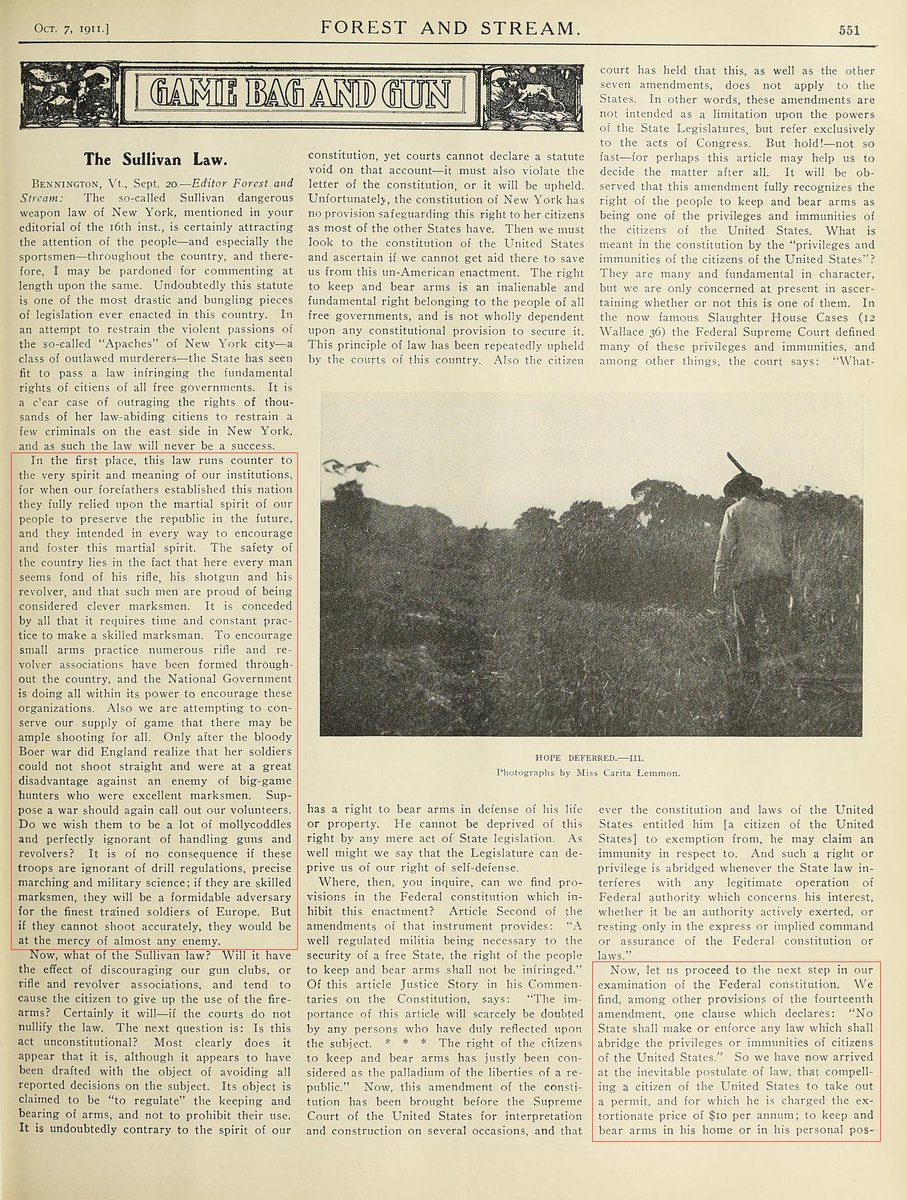
While it took 111 years to happen, by SCOTUS in Bruen, in October 1911, the editor of Forest And Stream (which later merged with Field And Stream), predicted the overturning of the Sullivan Act of New York by incorporation under the 14th Amendment.
Category: RKBA
Federal Judge Rules Felons Aren’t Protected by Second Amendment
Convicted felons do not have gun rights, according to a new federal ruling.
Judge Holly A. Brady, who President Donald Trump appointed to the United States District Court for the Northern District of Indiana in 2019, denied a request last week to have a felon’s gun possession charge tossed on constitutional grounds. She found the Second Amendment does not protect Detric L. Cummings’, a convicted felon, ability to own a firearm. She further ruled that barring felons from owning guns is consistent with historical gun restrictions.
“The long list of colonial laws excluding felons from possessing firearms either shows that he is excluded from the protections of the Second Amendment or that § 922(g)(1) is consistent with the Nation’s historical tradition of firearm regulation,” Judge Brady wrote in United States v. Cummings. “Either is enough to defeat Defendant’s motion.”
The ruling is another example of how little success convicted felons have had in asserting protections under the Second Amendment, even in the wake of last year’s landmark New York State Rifle and Pistol Association v. Bruen. Despite the doubt cast on many modern gun restrictions by Bruen’s new standard for deciding gun cases, felons have had little success convincing courts that the Second Amendment forstalls prohibitions on their ability to own guns. In fact, Pepperdine University Professor Jake Charles recently released a report that found there hasn’t been a single successful Second Amendment claim brought against the federal law barring possession of firearms by convicted felons.
The recent setbacks come despite a handful of rulings and prominent dissents that questioned the federal lifetime prohibition on at least some, namely non-violent, felons owning guns. Justice Amy Coney Barrett dissented in favor of restoring the gun rights of a non-violent felon in 2019’s Kanter v. Barr. A similar case brought by a Pennsylvania man barred from owning guns over a welfare fraud conviction, Range v. Garland, recently lost before a panel of the 3rd Circuit but is currently awaiting a decision from the full court after oral arguments were held in February 2023.
United States v. Cummings does not deal with the question of non-violent felon gun rights, though. Cummings was arrested by Fort Wayne, Indiana police last summer for selling methamphetamine, fentanyl, and a revolver to an informant, according to WANE. The 40-year-old was convicted of shooting a woman over an unpaid debt in 2005. He was sentenced to 20 years in prison before being released in 2020.
Judge Brady was indignant at his attempt to have the gun possession charges tossed, arguing his plea flies in the face of “a virtual mountain of case law.” She said, “ninety-plus defendants that have hoed the same row in the past” and been denied. She dismissed his legal argument as little more than “academic.”
“Defendant has chosen the first step as the hill he will die on, arguing that he is one of ‘the people’ whose right to bear arms is protected by the Second Amendment, regardless of his extensive criminal history,” Judge Brady wrote. “And, to be sure, there is a healthy debate in the case law about who ‘the people’ are. But that debate is interesting only if you view the law as a zesty academic affair rather than a way to run an ordered society.”
She argued that, even if Cummings is part of “the people” mentioned in the Second Amendment, historical tradition would allow the government to restrict his access to guns. She briefly pointed to colonial bans on carrying firearms in a way that terrifies people and an 1866 South Carolina ban on “disorderly” people bearing arms. And she cited the Supreme Court’s notice in 2008’s Heller that its ruling did not cast doubt on felon gun bans.
Ultimately, in her two-page opinion, Judge Brady found the debate is settled and unworthy of a lengthy discussion.
“To spend judicial resources agonizing over which the Court should hang its hat on is little more than spilled ink,” she wrote. “More than ninety judicial opinions bear this out.”
Gun rights group files emergency petition to SCOTUS on gun ban case
Illinois has been going above and beyond as of late to make Second Amendment related news. The National Association for Gun Rights filed a lawsuit last year challenging the city of Naperville’s so-called “assault weapons” ban. That case, Bevis et al v. City of Naperville was amended earlier this year to include the State of Illinois as a plaintiff, which enacted a ban in January. The request for an injunction against the law made its way all the way to the Seventh Circuit, and Bevis et.al. were not granted any temporary relief. It was announced in a release that an emergency appeal has been filed to the Supreme Court of the United States on the matter.
There was a similar situation in the Second Circuit Court of appeals, with a challenge to a New York law that’s unconstitutional – also enacted post NYSRPA v. Bruen – and the plaintiffs were moved to make an emergency appeal to the high court. In that case, the Second Circuit refused to respect the NYSRPA v. Bruen decision. While SCOTUS did not intervene in that case, Justice Alito did state in an unsigned order the following:
Applicants should not be deterred by today’s order from again seeking relief if the Second Circuit does not, within a reasonable time, provide an explanation for its stay order or expedite consideration of the appeal.
Appealing to SCOTUS at these stages in the game for emergency relief is not necessarily something that’s commonplace, but may draw the ire of the justices on how the lower courts are disobeying their orders.
The National Foundation for Gun Rights (NFGR) is asking the United States Supreme Court to provide emergency relief from two assault weapons bans in place in Illinois.
NFGR argues that the Illinois ban violates the Second Amendment of the United States Constitution, which guarantees the right of individuals to bear arms. NFGR’s lawsuit also challenges an AR-15 sale ban enacted by the City of Naperville, IL.
NFGR initially requested a temporary restraining order and a preliminary injunction in the U.S. District Court for the Northern District of Illinois blocking both the state and local bans on behalf of fellow plaintiff, Naperville gun store owner Robert Bevis, whose livelihood has been severely impacted by both bans. The district court trampled multiple Supreme Court precedents to rule against gun rights, so foundation attorneys appealed to the Seventh Circuit Court of Appeals, pleading that Plaintiff Bevis was facing the loss of his business without speedy relief.
The Seventh Circuit declined to temporarily block the two semi-auto bans pending its review of the preliminary injunction appeal, so NFGR is filing an Emergency Application for Injunction Pending Appellate Review with the U.S. Supreme Court.
It’s interesting to note that in many cases, lower courts have been getting the orders correct. In this case, the Seventh Circuit, and in the case of Antonyuck v. Nigrelli, from the Second Circuit, they are not willing to enjoin bad laws while the cases play out. We’re likely to see cases out of New Jersey challenging the so-called “carry killer” law there, head to the Third Circuit as soon as an opinion is delivered by Judge Bumb in a Federal Court.
Is this going to be the trend? Are the Circuit Courts of Appeal going to completely ignore the Supreme Court on all these issues concerning firearms by reversing the enjoinment/restraining orders of lower courts, or not enjoining them themselves?
“The assault weapons ban is a blatant violation of the rights of law-abiding citizens and does nothing to address the causes of gun violence,” said Dudley Brown, President of the National Foundation for Gun Rights. “Between them, Illinois and the City of Naperville are about to drive a law-abiding gun store owner into bankruptcy just because they don’t like his business. That’s grossly unconstitutional, and we’re asking the Supreme Court to put a stop to it.”
NAGAR’s opening remark in their filing to the high court hits at the core of the issue:
This is an exceedingly simple case. The Second Amendment protects arms that are commonly possessed by law-abiding citizens for lawful purposes, especially self-defense in the home. See New York State Rifle & Pistol Ass’n, Inc. v. Bruen, 142 S. Ct. 2111, 2128 (2022) (citing D.C. v. Heller, 554 U.S. 570, 629 (2008)).
The arms banned by Respondents are possessed by millions of law abiding citizens for lawful purposes, including self-defense in the home. Under this Court’s precedents, “that is all that is needed for citizens to have a right under the Second Amendment to keep such weapons.” Friedman v. City of Highland Park, Ill., 577 U.S. 1039 (2015) (Thomas, J., joined by Scalia, J., dissenting from denial of certiorari). There cannot be the slightest question, therefore, that the challenged laws are unconstitutional.
Kudos! to NAGAR for punting this case into the lap of the Supreme Court. Eventually one of these lower courts’ decisions is going to tick off the high court at one of these stages and they’re going to have to step in. At least, one would think so.
Given the way the Circuits behave, we can almost assume that whenever the pending cases in California make their way to the Ninth Circuit, that we’ll be dealing with similar malfeasance within the judicial system, and who knows what’ll come of the cases in the Third Circuit. We’ll be watching the progress of this case and report back with any new developments.
Maine legislators consider expanding adult access to guns on school grounds for school safety
AUGUSTA, Maine —
With more than one mass shooting a day in America so far this year, including many in schools and on college campuses, Maine legislators are taking a closer look at improving school safety by potentially expanding adult access to guns on school grounds for self-defense.
One bill that underwent a public hearing before the Education and Cultural Affairs Committee on Wednesday, LD 52, would let teachers and other school staff be armed at school following police-style training to use their guns.
Since there’s never been a school shooting in Maine, the bill’s sponsor sees lessons learned in mass school shootings in other states.
“In all of them, a quick response time would have saved lives, if we had the right person there that knew what they were doing for an active shooter situation was willing, obviously, to be that person and did so,” Rep. Steve Foster, (R) Dexter, said in an interview. “My district has one school resource officer with four buildings. So, this whole bill is about an immediate or almost immediate response in a building, and if you look at some of these past incidents around the country, the response time was a big key issue, and that’s what this is hoping to address.”
Gabby Giffords says the quiet part out loud
Former Rep. Gabby Giffords saw her political career, as it was going, put to an end by a madman. No one thinks what happened to her was justified, but it happened.
It’s not surprising that she recovered and started a gun control group. I don’t think anyone was overly shocked by that.
However, many of Giffords’ supporters have argued over and over again that people like her respect the Second Amendment, they just want what they term “common sense” gun control.
The problem is that Gabby didn’t get that memo.
As we wrap our interview in her office, I ask how she keeps coming back to a challenge so deeply ingrained in politics. She pauses for 12 pregnant seconds.
“No more guns,” she says.
Ambler, her aide and adviser, tries to clarify that she means no more gun violence, but Giffords is clear about what she’s saying. “No, no, no,” she says. “Lord, no.” She pauses another 32 seconds. “Guns, guns, guns. No more guns. Gone.”
An aide tried to say what she meant was something like Australia, but that’s not what she said.
Further, based on quotes throughout the piece, her mind is sharp enough that if it were, she’d have said it. She didn’t. She never mentioned Australia. No, she said, “No more guns.”
In fact, she apparently said it twice.
What Giffords did was say the quiet part out loud.
We’ve long argued that gun control advocates’ endgame was the complete disarmament of the civilian population. They might not be advocating for that explicitly at the moment, but that’s where the incrementalism was going to invariably lead.
We were called crazy, paranoid, and a few things not fit to print.
Yet here we are, one of the leading voices of the gun control debate–one held up as the perfect spokesperson due to her own personal experiences–saying, “No more guns.”
That puts the Giffords organization in a bad spot. They either agree with “no more guns” or they don’t. No one should accept the claim that the former congresswoman was talking about Australia when she clearly never mentioned it. They need to be pressed and pressed hard over this and any talk of Australia questioned even harder.
They either need to defend Gabby’s comments or disavow them. It’s just that simple.
But they won’t.
Further, it’s not like the media is interested in doing anything except covering for her, as the above-linked Time piece does, just accepting the aide’s explanation as if it’s all that needs to be said. They were given an excuse and they ran with it.
No one else should accept this, though, because either Giffords is cogent enough to speak on behalf of gun control or she’s not. If she is, then her words should be taken at face value as anyone else’s would be.
If not, then she probably doesn’t need to be making the rounds advocating for a policy that she’s not cogent enough to adequately define her position on before a member of the press.
Second Amendment clear and concise
Editor:
Bonnie Jean Feldkamp recently made some observations about the Second Amendment and AR-15 style firearms. Observations that need some clarification.
The Second Amendment is clear and concise in guaranteeing the Constitutional right of an individual to keep and bear arms. Court rulings and case law have upheld that since it was first tested. It is also clear that arms means firearms. It is not open to progressive’s interpretations, and Congressional clarification of the word “arms” would make no difference as to its meaning.
The AR-15 style semi-automatic rifle is the most popular and widely owned rifle in the U.S. It is patterned after the M-16 but is not a weapon of war. To take the AR-15 on the battlefield would be folly. The term “assault weapon” is an erroneous and manufactured term made up by people who know nothing about guns, but who know a lot about control.
Handguns are used in the overwhelming number of murders in the U.S. Rifles, however, are used less often in murders than are edged weapons, blunt force objects, or even personal weapons — fists and feet. And the AR-15 style rifles are used in less than 1% of all murders. These are FBI statistics.
Why are the Democrats so focused on a firearm that is used almost exclusively by law abiding citizens for target shooting, hunting and self-defense? Because it represents freedom, individual rights, and is an easy scapegoat to promote more gun control and eventual gun confiscation schemes.
Tom Overman, Woodstock
People can lie all they want. I’m not disarming, and I’ll call such liars, a liar to their faces.
Lies come in many shapes and sizes. Some are simple exaggerations. Some are absurd falsehoods. Unfortunately, we tend to believe a bald lie if it is expressed with enough emotion. That outrage also keeps viewers watching and clicking so the press is often more interested in outrage than in the truth. A lie doesn’t become the truth if it is repeated, but the lie may help politicians get re-elected if it is repeated by enough likely voters. We need to call out every lie we see even if that means calling “respected elected officials” liars. Congressman Jamaal Brown, you lie. Representative Jimmy Gomez, you lie. You lie because you say you want to save lives, yet you pretend that more gun-control laws will actually protect our kids. That is a lie and I’ll prove it right now.
Why would politicians hide the truth behind their emotional outbursts? The simple answer is that politicians lie to get what they want. They want press coverage and campaign contributions. Democrat Congressman Jimmy Gomez of California said that Republicans should resign from office if they are not going to pass more gun-control legislation. Democrat Representative Jamaal Bowman of New York yelled at reporters that “Republicans won’t do sh-t when it comes to gun violence.” Implied is the lie that gun-control laws actually save lives, and that anyone who won’t pass more gun-control laws is either corrupt or heartless. Both claims are a lie. Maybe if their Democrat controlled cities weren’t so corrupt then there would be fewer young men shooting at each other on the streets of the congressman’s districts. I think gun control is a distraction from their many failures.
Gun-control costs lives and endangers our children in school. Before you can believe that you need to know that armed defense by ordinary citizens is common. We use a firearm to stop death or great bodily injury about 2.8 million times a year. That is over 4600 times a day. In addition, ordinary citizens with a gun prevented several million more crimes than that. Your armed neighbors probably stopped tens of thousands of murders. Armed citizens probably stopped over a hundred-thousand sexual assaults. These armed good guys stopped an immense about of harm. That is good, but our virtue doesn’t stop there.
We started to train and arm volunteer school staff a decade ago after the mass-murder at Sandy Hook Elementary School in Connecticut. We have accumulated several thousand man-years of experience with these armed volunteers. You might have missed that their efforts worked in the best possible way: their mere presence prevented attacks at their school. Let me underline that for you.
We have never had a mass-murder at a school that had a program of trained and armed school staff.
Perspective is everything when we want to understand the truth. Only one-criminal-out-of-six uses a firearm in the commission of a violent crime. Criminals use firearms about a quarter-million times each year and they violate our “gun-control” laws millions of times each year. That means that gun control is a failure. In contrast, we defend ourselves with a firearm about 2.8 million times every year. Mass murderers take about 600 lives a year. We protected hundreds of thousands of our children with armed school volunteers. If you haven’t heard it before then I’m telling you now, armed defense is much more common than the criminal use of a firearm.
Gun-control politicians say their laws disarm criminals. In fact, their 23-thousand gun-control regulations disarm far more honest citizens than criminals. Mass murderers deliberately attack us in gun-free zones where we are disarmed by law.
Politicians and the news media don’t tell us everything we need to know to make a reasoned decision. It is deadly public policy to solve a small problem by creating a larger one. We can’t save hundreds of lives by sacrificing tens-of-thousands. If we really want to save lives, then we’d repeal our gun-control laws rather than passing more of them. That won’t work for gun-control politicians who need to shout in public to get reelected. If gun-control advocates really wanted to save lives, then they would stop lying.
How many more innocent lives should we sacrifice on the altar of gun-control?
I’m giving you facts, but facts don’t matter to gun-control ideologues. For them, the ideal of gun-control is an end in itself rather than an instrumental means to save lives. Mass murders are simply an excuse to disarm more honest citizens.
I am not running for office, but I am trying to influence your opinion. Lies matter when we want to deceive. Facts matter when we want to save lives. Time and again, Democrats and Socialists in the USA have said that only Democrats care about children, and everyone else doesn’t care if kids die. I’m calling that a lie. Lives matter to me and they matter to you.
It is uncomfortable to call someone a liar but it gets easier with practice. I did it this time. I’m asking you to do it the next time you hear them lie about us.
Enemies, foreign….and domestic
Kinzinger: Gun Owners Should Help Dismantle the Second Amendment
By Lee Williams
SAF Investigative Journalism Project
OPINION: Adam Kinzinger is an angry and frustrated little fella.
For those who don’t remember the former Illinois Congressman, he served on the Jan. 6 House committee alongside Liz Cheney where he read from prepared scripts and cried a lot, was censured by the RNC and forced to leave Congress in disgrace, and then, of course, ended up with a job at CNN.
Today, Kinzinger has become a man without a country, of sorts. Republicans still despise him and Democrats could care less what he does, since his usefulness is at an end.
Kinzinger, who’s only 45, is struggling for relevancy, trying to find an audience that will listen to his angry rants. His memoir, “Renegade: My Life in Faith, the Military, and Defending America from Trump’s Attack on Democracy” is scheduled to be released Oct. 17, and will likely not exactly fly off the shelves.
In the meantime, the self-described renegade is trying to get back into the public eye by any means possible, and what better way to attract attention than by bashing the Second Amendment.
Last week, Kinzinger spoke at an event in Chicago that was organized by the Joyce Foundation, a private foundation with more than $1 billion in assets that is decidedly anti-gun. Barack Obama once served on their board. The event was hosted by David Axelrod, Obama’s former chief campaign strategist. Tim Heaphy, who served as the chief counsel for the Jan. 6 committee, was the other featured speaker.
“Second Amendment people should be on the front line of gun control,” Kinzinger told the left-leaning crowd.
The Chicago Tribune loved the idea, and wrote in an editorial that “those who want to see sensible regulations on gun ownership, such as background checks, age restrictions and red flag laws, should see ‘Second Amendment people’ as potential experts and allies. They know guns better than those who merely despise them.”
Sensible regulations? Experts and allies? As if …
To be clear, Kinzinger’s suggestion – that gun owners should help infringe upon the Second Amendment – may be the single dumbest idea we’ve heard since December 15, 1791, when the Second Amendment was ratified.
Granted, we do have far more expertise than the gun-ban industry – we can articulate the difference between a semi-auto AR and a select-fire “assault rifle” – but why the hell would we use this expertise to aid those who want to deprive us of the right to own weapons of our choice?
It would be like asking newspaper editors or television producers to help weaken the First Amendment, or asking lawyers for a quick way to overcome their clients’ self-incrimination protections. Like most of what Kinzinger and his gun-banning friends suggest, it makes no sense.
The only thing you can surmise about Kinzinger’s idea is that it is nothing new. The former Congressman strongly opposes our Second Amendment rights.
In May 2022, after the massacre in Uvalde, Texas, Kinzinger told CNN he would support a federal ban on “assault weapons,” which, of course, he could not define.
“Look, I have opposed a ban, you know, fairly recently. I think I’m open to a ban now,” Kinzinger told CNN. “It’s going to depend on what it looks like because there’s a lot of nuances on what constitutes, you know, certain things.” He added that he would also support additional licensing and training requirements for potential AR purchasers.
That same month, Kinzinger told ABC News that raising the minimum age to purchase a firearm to 21 was a “no brainer,” and he claimed he was a “strong defender of the Second Amendment.”
“And one of the things I believe that for some reason is a very rare thing is that as a person that appreciates and believes in the Second Amendment, we have to be the ones putting forward reasonable solutions to gun violence,” Kinzinger claimed.
Kinzinger is right in one respect; It is rare for someone who supports the Second Amendment to put forward ideas to weaken it. In fact, it’s not only rare, it’s incredibly stupid – about what you’d expect from a laughingstock of a former Congressman with plenty of time on his hands.
There is no argument. They are!
Every Firearm Can Be Used For Self-Defense! Argues the Second Amendment Foundation
BELLEVUE, WA – Attorneys representing the Second Amendment Foundation and its partners in a case challenging the Illinois semi-auto ban today filed a 36-page response to Cook County’s motion for summary judgment in a case challenging Cook County’s ban.
Joining SAF, in this case, are the Firearms Policy Coalition and three private citizens, all Cook County residents. They are Cutberto Viramontes, Rubi Joyal, and Christopher Khaya. They are represented by attorneys David Sigale of Wheaton, Ill., David H. Thompson, Peter A. Patterson, and William V. Bergstrom, all with Cooper & Kirk in Washington, D.C. The case is known as Viramontes v. Cook County. It was filed in U.S. District Court for the Northern District of Illinois in August 2021.
“Cook County has made only one argument in its motion that seems to misread the Supreme Court’s Bruen ruling from June of last year,” said SAF founder and Executive Vice President Alan M. Gottlieb. “The county is claiming that ‘arms’ applies only to firearms that ‘facilitate armed self-defense,’ and makes the arbitrary claim that the banned firearms are excluded from this definition because ‘there is nothing defensive whatsoever’ about them.
“Every firearm can be used for self-defense,” he added, “and either the county knows that already, or they are woefully ignorant about firearms in general, and especially the ones affected by the ban.”
SAF Executive Director Adam Kraut, a practicing attorney, noted, “The Bruen ruling made it clear that every Second Amendment case must proceed first by analyzing the text of the amendment and then examining the country’s history of firearm regulation, to determine whether the banned firearm is ‘dangerous and unusual.’ One look at the number of modern semiautomatic rifles currently owned by private citizens shows they are hardly ‘dangerous and unusual’ in any context.
“The county further argues the AR-15 is a semiautomatic version of the military M-16, which is nonsense,” Kraut continued. “All of the county’s arguments seem aimed at creating a false impression about the banned firearms, which operate no differently than any other semi-auto. The county is simply wrong in its arguments, and the motion for summary judgment should be denied.”
Why Is Concealed Carry So Important In Modern America?
Concealed carry, or the practice of carrying a concealed firearm on one’s person, is a contentious topic in modern society. Some argue that it is necessary for personal protection, while others believe that it only serves to increase the likelihood of gun violence. However, there are many reasons why concealed carry is important and can be a valuable tool for self-defense.
First and foremost, concealed carry can provide a means of self-defense for law-abiding citizens. The world can be a dangerous place, and individuals who carry a concealed firearm have the ability to defend themselves if they are ever confronted with a dangerous situation. This is especially important for those who live in areas with high rates of crime or who work in professions that put them at risk, although trouble can and is found in even the safest of places.
In addition, concealed carry can act as a deterrent to criminals. The knowledge that a potential victim may be carrying a concealed firearm can dissuade criminals from attempting to commit crimes in the first place. This can help to create a safer environment for everyone, as criminals are less likely to engage in criminal activity when they know that there is a possibility that their intended victim may be armed.
Concealed carry can also be beneficial in situations where law enforcement response times may be slow. In an emergency situation, every second counts, and individuals who are carrying a concealed firearm can act as first responders to protect themselves and those around them. This can be especially important in rural areas, where law enforcement may be several miles away and response times may be longer.
Moreover, concealed carry is an important tool for protecting one’s home and family. A firearm is one of the most effective means of self-defense against an intruder, and having a firearm readily available can help to ensure the safety of one’s loved ones.
Finally, concealed carry is a constitutionally protected right in the United States. The Second Amendment to the Constitution guarantees the right of citizens to keep and bear arms, and this right extends to the carrying of concealed firearms. The ability to exercise this right is important for many Americans, who feel that it is their duty to protect themselves, their families, and their communities.
Of course, with the right to carry a concealed firearm comes the responsibility to use it wisely and safely. It is important for those who carry a concealed firearm to receive proper training and to understand the laws surrounding the use of deadly force. Additionally, individuals who carry a concealed firearm must be prepared to face the consequences of their actions if they ever do use their firearm in self-defense.
In conclusion, concealed carry is an important tool for self-defense and can provide a means of protection for law-abiding citizens. It can act as a deterrent to criminals, serve as a first response in emergency situations, protect one’s home and family, and is a constitutionally protected right. While carrying a concealed firearm is a serious responsibility, it can be a valuable tool in creating a safer environment for everyone.
Pence Lays Out Pro-Second Amendment 4-Step Plan to Stop ‘Scourge of Mass Shootings’
INDIANAPOLIS, Indiana — Former Vice President Mike Pence told Breitbart News exclusively here at the National Rifle Association (NRA) annual gathering earlier this month he has a four-step plan that is pro-Second Amendment to combat the “scourge of mass shootings” plaguing society right now.
“I think under the Biden Administration we’ve seen a steady assault on all the God-given liberties enshrined in our Constitution—freedom of religion, freedom of speech—but there’s no question that this administration has set its sights on the Second Amendment enshrined in the Constitution,” Pence told Breitbart News. “Now more than ever people that cherish the right to keep and bear arms need their voices to be heard. We need to elect leaders who will stand by our Constitution and stand by our God-given rights. We need to be educating the rising generation on the importance of all of our Bill of Rights’ freedoms including the Second Amendment, but I think we’ve got to lean into how to address this scourge of mass shootings.”
In his speech the NRA gathering moments later, Pence laid out some of these ideas—but in his interview with Breitbart News backstage he went in depth explaining how gun control does not work and there are policies that American leaders can pursue both at the federal and at the state level that will work.
Tennessee [Congesss]Adjourned Sine Die but Special Gun Control Session Coming
Yesterday, the Tennessee General Assembly adjourned Sine Die, and all anti-gun bills have died in committee. Despite intense pressure from Governor Lee, no “red flag” or gun confiscation bills were introduced. We want to extend our thanks to the leadership of the House and Senate for their unwavering defense of the Second Amendment and for protecting the rights of Tennesseans.
The Tennessee General Assembly did pass Senate Bill 494/House Bill 395, which was sent to the Governor’s desk for his signature. This legislation recognizes a person’s Second Amendment right, if not otherwise prohibited by law, to carry a handgun while hunting for self-defense. NRA thanks Senator John Stevens for sponsoring this piece of legislation and for his steadfast commitment to defending the Second Amendment rights of Tennesseans throughout session.
However, the fight is still ongoing. Governor Lee has stated he will call a special session to address public safety which we know from previous statements will likely include “red flag” and gun control legislation. The NRA will be there to defend the Second Amendment rights of Tennesseans. We must remain vigilant and fight against any attempts to infringe upon our constitutional rights.
HANSON V. DC: “LARGE CAPACITY” MAGAZINE BAN
I’ve only been up for a couple of hours (as I begin typing), and the news is already full of stupidity that I’ll need to address. I’ll lead off with a case challenging Washington, DC’s “large capacity” magazine ban, Hanson v. DC. The judge, one Rudolph Contreras, denied a preliminary injunction against the ban. His… reasoning is… remarkable. Or something; I’m trying to be somewhat polite.
A weapon may have some useful purposes in both civilian and military contexts, but if it is most useful in military service, it is not protected by the Second Amendment.
[…]
[Large capacity magazines] are not covered by the [2A] because they are most useful in military service.
Oddly, Contreras cites HELLER in making that point. I can’t find that argument in HELLER, which was largely about whether non- military weapons could be regulated, and how, but there is this.
It may be objected that if weapons that are most useful in military service—M–16 rifles and the like—may be banned, then the Second Amendment right is completely detached from the prefatory clause. But as we have said, the conception of the militia at the time of the Second Amendment’s ratification was the body of all citizens capable of military service, who would bring the sorts of lawful weapons that they possessed at home to militia duty. It may well be true today that a militia, to be as effective as militias in the 18th century, would require sophisticated arms that are highly unusual in society at large.
Rather the opposite of Contreras’ weasel-wording, eh? Indeed, HELLER even cites the earlier MILLER, which establishes that militarily-useful arms are protected by the Second Amendment.
In the absence of any evidence tending to show that possession or use of a ‘shotgun having a barrel of less than eighteen inches in length’ at this time has some reasonable relationship to the preservation or efficiency of a well regulated militia, we cannot say that the Second Amendment guarantees the right to keep and bear such an instrument.
Having chucked decades of SCOTUS precedent already, Contreras proceeds to demonstrate an amazing lack of judicial awareness of current events and Supreme Court decisions. Now that he’s established in his own deluded mind that standard capacity magazines are not 2A-protected, he addresses whether this particular restriction of such magazines is permissable.
WARNING: If you’re drinking, swallow before proceeding, for the protection of your screen.
ABC News Accidently Admits AR-15s Aren’t as Dangerous as the Dems Pretend They Are
Santos co-sponsored a bill to name the AR-15 the “national gun of the United States.” ABC News stroked an article about voters protesters showing up at Santos’s office to protest the bill.
And now for my question: why do lefty jackpuddings regurgitate their avocado toast over AR-15s when so few people are killed by them?
Perspective
Let’s take a look at ways in which more Americans die every year than by AR-15s used in mass shootings:
- Twenty-eight people are killed every year by lightning.
- Roughly 2,167 Americans die annually from constipation.
- On average, 951 people are killed by their lawnmowers while another 4,193 are killed by farm tractors and other agricultural equipment.
- Murderous toasters kill 45 people per year.
- Eleven teenagers die every day while texting and driving.
- An estimated 40 people die every year while skateboarding.
- Roughly 10,206 are accidentally strangled to death while they sleep, and for those who survive the night, another 10,386 will die every year falling out of bed.
- As per the FBI, rifles of every variation — including but not limited to the scary AR-15 — killed 215 Americans in 2019. But another 1,533 were killed by knives, and 651 people were beaten to death by hands, fists, feet, etc.
- In 2015, 5,051 people choked to death while eating.
- Americans average 62 deaths per year by bees, wasps, and hornets.
What Have We Learned?
We’ve learned that if you want to cut down on needless deaths, you’re better off handing out prune juice than trying to purloin AR-15s, as we Americans are roughly 10 times more likely to die as Elvis did — on the toilet — than by an AR-15 in a mass shooting. We’re 50 times more likely to be beaten to death. We’re roughly 1,000 times more likely to be killed — either by accidental strangulation or falling — from our beds than by an AR-15.
BONUS LESSON: None of this info will help you in a debate against your liberal sister-in-law and her pink-haired, gender-uncertain boy?-partner freakshow because facts are useless against the bolshies who want us defenseless.
So why do the apparatchiks on the left want your A5-15? The same reason you want to keep it — it’s the best gun available to fight tyranny — either foreign or domestic. And with the terrifying number of military-aged Chinese men crossing the southern border, we might find ourselves fighting either, or both.
Does Colorado Show the State ‘Assault Weapon’ Ban Resurgence Starting to Fizzle Out?
Despite enjoying a recent resurgence in deep-blue states, “assault weapon” ban proponents are starting to confront the political and legal constraints to the policy’s continued expansion.
On Wednesday, the Colorado House of Representatives voted to kill a long-awaited proposal to ban the sale of dozens of semi-automatic rifles, pistols, and shotguns with certain targetted features, such as a pistol grip or telescoping stock, in its first committee hearing. Three Democrats joined the four Republicans on the committee in voting to reject the bill, as well as a proposed amendment to limit the ban to just bump stocks.
That an assault weapon ban failed to even make it out of committee in a legislative chamber where Democrats have a supermajority speaks to the tricky politics gun-control advocates still face for gun bans, even in states with trifecta Democratic control. The fact that bills to raise the minimum age to purchase firearms, impose a three-day waiting period, expand who can file a red flag petition, and impose civil liability on the gun industry all easily cleared the Colorado General Assembly this session highlights how much more difficult going after popular guns, such as the AR-15, really is.
A hardware ban is simply a different animal, politically speaking. That fact alone could do a lot to limit the ban’s potential to reach more than a handful of the most progressive-leaning states.
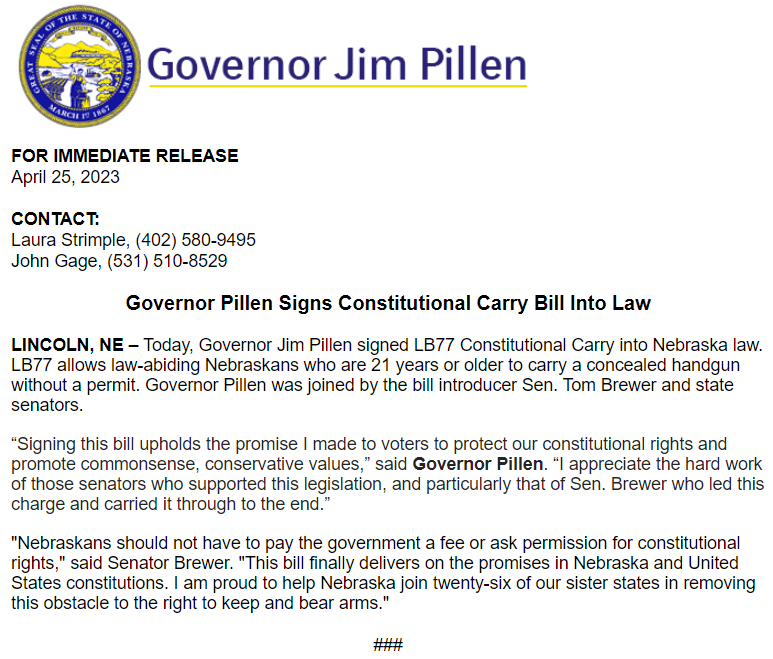
Kansas: Gov. Kelly Signs AG Kobach’s Permit Fee Reduction Bill
Yesterday, Governor Laura Kelly signed Senate Bill 116 into law. This NRA-backed bill eliminates the Attorney General’s $100 fee for concealed carry permits, reducing the total fee to just the $32.50 paid to county sheriffs. Reducing the fee ensures that the permit, and the benefits that it confers in exercising Second Amendment rights, are more accessible to law-abiding citizens of less financial means.
Colorado House panel kills ‘assault weapons’ ban
Four Democrats joined the Colorado House Judiciary Committee’s Republicans to indefinitely postpone the bill.
DENVER — Legislation that sought to ban so-called “assault weapons” died early Thursday morning after three Democrats joined the Colorado House Judiciary Committee’s Republicans to kill the bill on a 7-6 vote.
Shortly before 1 a.m. Thursday, Democratic Reps. Bob Marshall of Highlands Ranch, Said Sharbini of Westminster and Marc Snyder of Colorado Springs voted down the legislation along with their Republican colleagues after a pair of amendments to ban bump stocks and rapid-fire trigger activators were lost.
A subsequent vote to postpone the bill indefinitely drew one additional Democratic vote from Rep. Lindsay Daugherty of Arvada.
The nearly 15-hour hearing, which kicked off Wednesday morning, drew a 2023 record 522 witnesses seeking to testify.
The bill — sponsored by Rep. Elisabeth Epps, D-Denver — has divided the Democrats’ Gun Violence Prevention Caucus, with leading members, such as Sen. Tom Sullivan, D-Centennial, believing other measures, such as his proposal to improve the red flag law, are better solutions to gun violence.
Yes. This is the continuing gambit. That something isn’t ‘covered’ by the 2nd since it’s not an ‘arm’.
Federal judge declares “large capacity” magazines not protected by the Second Amendment
A U.S. District Judge in Washington, D.C. has declined to grant an injunction against the city’s ban on “large capacity” magazines, ruling that while magazines in general are “arms” protected by the Second Amendment, LCMs fall outside of the scope of the amendment because they’re a “poor fit” for self-defense purposes.
The challenge to the District’s magazine ban, known as Hanson v. D.C., involves four legal gun owners from D.C. who all say that they would possess and carry “large capacity” magazines in their firearms if they weren’t banned by law. The District’s prohibition comes complete with a potential three-year prison sentence, though it’s unclear how often that sentence is handed down in practice, especially with D.C. prosecutors routinely deciding to decline charges in many illegal gun possession cases.
Even though the D.C. Attorney General’s office is taking a mostly hands-off approach to illegal gun (and magazine) possession, the ban remains on the books and was defended in court by D.C. officials, who maintain that magazines aren’t “arms” at all, but accessories that aren’t protected by the Second Amendment. U.S. District Judge Rudolph Contreras, an Obama appointee, rejected that argument in his opinion, but agreed with the District on its fallback argument that LCM’s are most suitable for military purposes and are not used in self-defense because “because incidents where a civilian actually expends more than ten bullets in self-defense are “vanishingly rare.” From the opinion (citations omitted):
Heller specifically contemplated that “weapons that are most useful in military service” fall outside of Second Amendment protection.
Plaintiffs counter that “the Supreme Court’s precedents do not withhold protection from arms merely because they are useful in militia service.” Pls.’ Reply at 15. That may be true, but it is beside the point. Heller established that weapons that are “most useful in military service” are excluded from Second Amendment protection. “Most” is a superlative. A weapon may have some useful purposes in both civilian and military contexts, but if it is most useful in military service, it is not protected by the Second Amendment.
I’ve gotta say, that’s giving a lot of weight to Scalia’s phrase about “weapons that are most useful in military service”, especially since Contreras contradicted himself by pointing to the benefits of LCM’s for civilian law enforcement.
The judge simultaneously says that magazines over 10 rounds are "most useful in military service" and also that the ban "keeps the advantage police have over armed civilians who may be suspects or engaged in criminal activity." https://t.co/TajMhtFoAI
— Rob Romano (@2Aupdates) April 20, 2023
So Called ‘Assault Weapons’ ~ When Words Are Used Instead of Guns To Disarm Us
Let’s start off at the very beginning, following the “Yellow Brick Road,” with a few definitions and essential information for those new gun owners, non-gun owners, and anti-gun critters. Please note I’m sorry if I insult those already in the know!
Definition of the word ASSAULT
assault – verb: a violent physical or verbal attack.
Definition of the word WEAPON
weapon – noun: something (such as a club, knife, gun, etc.) used to injure, defeat, or destroy someone or something.
Definition of a RIFLE
rifle – noun: a shoulder fired firearm with a rifled bore (spiral grooves in the bore).
Definition of a PISTOL
pistol – noun: a specifically handheld firearm whose chamber is integral with the barrel.
Definition of a SEMIAUTOMATIC FIREARM
semiautomatic firearm – noun: a firearm able to fire repeatedly through an automatic reloading process but requiring the trigger to be pulled for each successive shot (a semiautomatic rifle or pistol).
Definition of a MACHINE GUN
machine gun – noun: a firearm for sustained rapid fire, or burst, on a single pull of the trigger. (a.k.a. an automatic weapon).
Definition of the phrase ASSAULT RIFLE
assault rifle – noun: any of various intermediate-range, magazine-fed military rifles that can be set for automatic or semiautomatic fire (a.k.a. Select Fire).
So where does the infamous Assault Weapon fit into the linguistic picture? It doesn’t! It’s essentially MADE UP! Here’s a brief history: