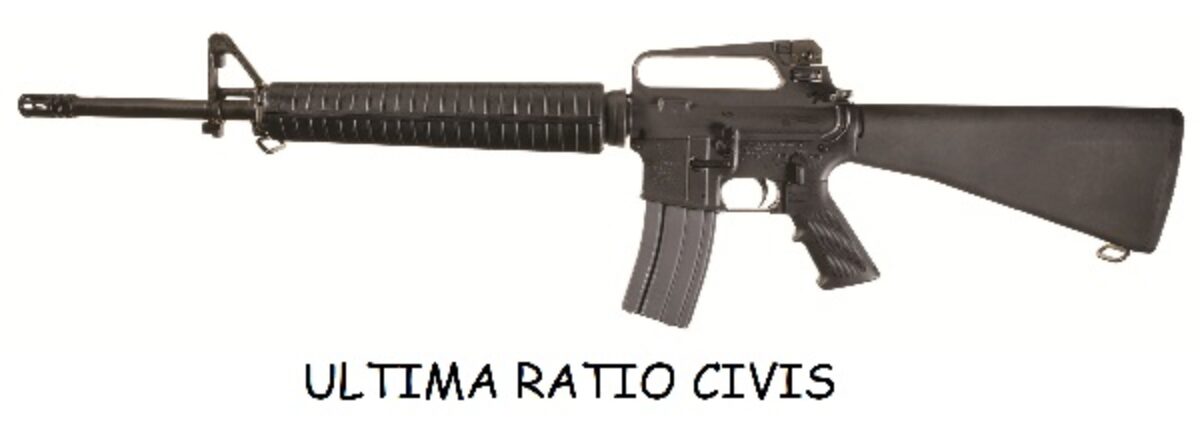
Why there’s no common ground on gun debate

As a gun rights advocate, I’m often accused of being stubborn. I refuse to give any ground or entertain any position that favors gun control. I, personally, might prefer to see laws enforced until they’re declared unconstitutional, but there’s literally no gun law I can remotely favor.

And this makes me a bad person.

However, in a story about the growing divide in Uvalde, TX, I came across this comment:

Speaking at a protest near the Texas Capitol on 27 August, Brett Cross, whose 10-year-old nephew and adopted son Uzaiyah was one of the 21 victims, left no room for equivocation. He was there with hundreds to demand that the Texas governor, Greg Abbott, call a special legislative session to raise the age to buy assault-style weapons from 18 – the age of the Robb elementary mass murderer – to 21.

“Fight with us,” he said. “Because you don’t want to be fighting from this side with a hole in your heart.”

There is no middle ground left in Uvalde. The shared cause of raising the age for buying assault rifles clarifies the two sides of the fight: those who demand change and those who oppose it. While Abbott himself had told Cross he didn’t see guns as the real culprit in Uvalde, to simply accept inaction wasn’t an option. Giving up was inconceivable to families who would have given anything to prevent their children from dying. The families saw no good excuse for those unwilling to join their cause.

“If you’re not trying,” Cross said, “you’re complicit.”

And that is why there will never be any middle ground in the gun debate.

This line of “argument” pisses me off and it always has. Why? Because I’ve been there. Not to the extent Cross has, but I’ve lost someone to a mass shooting, someone I cared about, and I’ve talked about how this line of argument infuriates me.

Then there’s our own Ryan Petty, who lost his daughter at Parkland. I haven’t talked to him about it, but I’m pretty sure it makes him furious as well.

See, this line of argument stems can only make sense if you believe that everyone agrees that gun control works, they only oppose you for some other reason. As a result, your opposition to gun control can only be motivated by factors in spite of this self-evident truth.

They cannot grasp that we simply know. It. Won’t. Work.

Then again, it’s not like they’re willing to sit down and listen when it comes to guns. They’re often too busy preaching.

For example, take Uvalde. For all the talk of some deep divide in the community, with anti-gun voices supposedly being on the side of the angels, Beto O’Rourke lost Uvalde County. It seems there’s a strong possibility that many in the community, perhaps even a majority, recognize that it wasn’t the tool used that resulted in that atrocity, but the tool using it.

Do not come at me or people like me and pretend we’re somehow responsible for the actions of others when you have made it clear you’ll accept nothing but capitulation from us. Do not pretend you’re looking for solutions when the only thing you’re wanting is something that doesn’t yield the results you think.

Frankly, don’t be surprised when we’re not willing to listen to you when all you do is screech and blame us for things we’re not responsible for.

Virginia: Fairfax Co. Schools Push Anti-Gun Propaganda on 5th Graders

USA – -(AmmoLand.com)-  A concerned parent, Darcey Geissler, has brought attention to an assignment that her son received in a Fairfax County school.

In a “lesson” on persuasive writing, students were given an anti-gun essay to evaluate, rather than something with more neutral content, so that the students could focus on the persuasive writing aspect. There was no sample essay with an opposing viewpoint presented.

Though this sample essay is ostensibly meant to be just a learning tool, it does parrot many worn-out talking points that disarmament radicals have used over the years. It claims that the Second Amendment is about hunting, that the existence of modern police forces makes the Second Amendment obsolete, and that citizens defending themselves from imminent danger while police are, at best, minutes away is somehow “tak[ing] the law into their own hands.”

It even mentions the Brady Campaign and simply describes it as “an organization to prevent violence,” without any mention of their radical policy proposals, such as gun bans and restricting the right to self-defense, or their junk lawsuits that attempt to bankrupt the firearms industry. Most recently, Brady partnered with the Mexican government against the rights of law-abiding Americans.

All this is not surprising, coming from a school system in a county that is hostile to the Second Amendment rights of its own citizens.

In 2020, the county banned firearms in many county-owned and operated locations, including its extensive public parks. While disarming law-abiding citizens, the ordinance they passed was not about safety or security. There were no measures ordered to prevent armed criminals from ignoring the arbitrary boundaries (as criminals do), such as metal detectors or increased police presence. This carry ban is currently the subject of an NRA-backed lawsuit.

This situation underscores the value of parents and guardians being involved in passing on American values, such as respect for the Second Amendment, to the next generation. Government schools in Fairfax County, despite being funded with taxpayer dollars, certainly will not.

The left’s newest stealth attack on free speech

America’s two most important rights are free speech and the right to bear arms. Without the first, no people are free; and without the second, there is no first. Totalitarians always go after both; that is, they silence and disarm them. For decades, the left has been open in its war on the Second Amendment. They’ve struggled more with the war on speech, but they may finally have come up with a new approach that will sneak around constitutional muster.

When it comes to speech that incites violence or is otherwise imminently threatening, the law has always been clear: The threat must be very explicit and imminent for the speech to lose its First Amendment protections. At the most simplistic level, saying, “I wish so-and-so were dead” is not an actionable opinion. However, saying, “I’m going to kill so-and-so this week” or “You all need to kill so-and-so; I’ve got a plan” is criminally actionable speech. (The standard is more sensitive when speech is directed at the president, of course.)

This constitutional limitation on making (conservatives’) political speech criminally actionable has long vexed the left. They’ve trained their young acolytes that speech is violence (so much so that almost half of college students say “hate speech” should get the death penalty) but, so far, courts haven’t fallen for that gambit. Unless speech creates an imminent threat, it gets a pass.

Lately, though, the left has come up with a new concept that seeks to say that any speech that opposes leftist policies is actual and imminent “terrorism.” Or as leftist academia calls it, “stochastic terrorism.”

Christopher Rufo discusses the concept in an important City Journal essay. He begins by revealing that he is being identified as someone who is directly responsible for the attack on Paul Pelosi:

Continue reading “”

Well, they are violating resident’s constitutional rights

Redwood City leaders discussing legal options as possible lawsuit against ban on gun retail looms
A gun rights advocacy group is accusing the city of violating its residents’ constitutional rights

A gun rights foundation has warned it may take legal action against Redwood City if city officials don’t reverse a recently approved moratorium on gun retail.

Just four days after the council unanimously voted to establish a moratorium on stores selling firearms or ammunition for an initial 45 days, the Second Amendment Foundation (SAF), a Washington-based firearm advocacy nonprofit, sent a letter to the city, advising the city to remove the temporary ban or face litigation.

“Should Redwood City continue to deprive its residents of the ability to acquire arms and ammunition through an indeterminate moratorium on firearms and ammunition retailers from opening a business, SAF will examine all legal remedies available to it, its members, and those who may be affected by the City’s flagrant disregard of its citizens’ constitutional rights,” Executive Director Adam Kraut wrote in the letter dated Oct. 28.

According to the city, the urgency ordinance came after two separate gun retailers inquired about business permits in the city, which currently has no such retailers nor any special regulations on firearms sales.

The ban went into effect immediately after the council vote and could be extended for a total of two years.

Continue reading “”

An friend terms posts like this übërpösts™ (in other words: It’s looong)
I’ll append commentary and observations from around the net.

Observation O’ The Day
It’s a look into the smartest minds of the enemy. Joe Huffman

The Ad Industry’s Plan to Fix America’s Gun Crisis

If you want a crude sketch of the biggest corporate players in a given year of TV, look no further than the Emmy Award for best commercial. Twenty-five years of winners form an ensemble cast of petty bourgeois preoccupations: Nike, Chrysler, Bud Light. This year’s nominees included a commercial for Meta (the artist formerly known as Facebook), one for Chevy (repping the still-muscular auto spend), two for Apple (a perennial contender), and two for the prevention of school shootings—one of which won the Emmy.

PSAs Killed Cigarettes. Can They Help End Gun Violence?

PSAs Killed Cigarettes. Can They Help End Gun Violence?© Getty; The Atlantic

Continue reading “”

Texas judge rules that disarming those under protective orders violates the Second Amendment

A Texas federal judge declared it was unconstitutional to disarm someone who is under a protective order, setting into motion a likely legal fight over who can possess firearms – a move that advocates say could have wide-ranging impacts on gun access across the county.

The video featured above is from a previous report on a Judge ruling those under felony indictment can buy guns.

U.S. District Judge David Counts, who was appointed by former President Donald Trump, ruled last week that banning those under a protective order from possessing a gun infringes on their Second Amendment rights.

Judges who deem people a danger to family members or intimate partners can take the extra step to issue a protective order requiring people to relinquish the guns they already have. Federal law currently prohibits domestic abusers who are charged with a felony, misdemeanor or are under a protective order from possessing a gun.

The ruling comes months after a landmark U.S. Supreme Court case on the Second Amendment, the effects of which, legal experts say, are just beginning to be felt.

This June, the high court’s ruling in New York State Rifle & Pistol Association vs. Bruen, written by Justice Clarence Thomas, struck down the state’s concealed carry law and held that courts going forward should uphold gun restrictions only if there is a tradition of them in U.S. history.

Continue reading “”

Remember, Professor Yamane is presenting the standard model, not defending it.

This video concludes my ongoing series systematizing the dominant academic approach to understanding Gun Culture 2.0, what I call “The Standard Model of Explaining the Irrationality of Defensive Gun Ownership.”

Here I engage the 5th of the model’s 5 points: That something other than objective risk motivates defensive gun ownership.

From a sociological perspective, that something else centers on the discipline’s Holy Trinity: class, gender, and race. From a psychological perspective, defensive gun ownership is a maladaptive coping mechanism.

SCOTUS turns away bump stock, gun seizure cases

For the third time this year the Supreme Court has rejected a case dealing with the ATF’s administratively imposed ban on bump stocks, denying cert in a challenge to the ban brought by a group of federally licensed firearm retailers and several individuals who argued that the ban was an unconstitutional violation of the Fifth Amendment’s Takings Clause by forcing existing bump stock owners to destroy them without any kind of compensation on the part of the federal government.

Today’s decision follows the denial of two other challenges to the bump stock ban, which was imposed by the Trump administration following the Route 91 Harvest music festival shooting in Las Vegas in 2017. Previously, the ATF had determined that bump stocks should not be considered “machine guns” under federal law, given that even with bump stocks attached it took a pull of the trigger to release a single round.

The Bureau of Alcohol, Tobacco, Firearms and Explosives (ATF), a U.S. Justice Department agency, reversed a previous conclusion and classified bump stocks as machine guns under a 1934 U.S. law called the National Firearms Act. The policy took effect in 2019.

Two sets of plaintiffs filed lawsuits seeking compensation for having to destroy or surrender their bump stocks in the Court of Federal Claims, which hears monetary claims against the U.S. government. A judge dismissed the actions, finding the policy to be a lawful exercise of the federal government’s power to outlaw dangers to public health and safety.

“The Washington-based U.S. Court of Appeals for the Federal Circuit upheld those decisions last year for a different reason, ruling that a property right in the devices was inherently limited given the existing federal prohibition on machine guns.

We don’t know why SCOTUS rejected these challenges, just that there weren’t four justices willing to accept any of these cases. And while the odds of any particular case being granted cert by the Court are low (about 1-in-10,000), gun owners are rightfully going to be concerned about the Court’s inaction, especially with the Biden administration using the Trump tactic to pursue administrative bans against unfinished frames and receivers, pistol stabilizing braces, and potentially even semi-automatic handguns and rifles.

Today’s decision doesn’t mean that these same justices will stand by and let future abuses of executive authority slide, but as long as SCOTUS doesn’t object the Biden administration is likely to take their silence as a green light for more rule-making of dubious constitutionality.

The other case turned away by the Supreme Court today dealt with the seizure of a New York man’s firearms; a case that the attorneys for Wayne Torcivia argued was virtually identical to a similar search and seizure that the Court ruled unconstitutional in Caniglia v. Strom

Continue reading “”

Opponents prep lawsuit over Oregon gun control measures

Measure 114, the sweeping ballot initiative that will impose a ban on “large capacity” magazines and establish a “permit-to-purchase” system that includes mandatory training, a waiting period, extensive background investigations, and a database of all prospective gun owners, is likely to be officially certified on December 15th, which will start the clock on the 30-day window before the new measures officially take effect.

Already, however, we’re seeing signs that might not be enough time for backers of Measure 114 to draft all of the associated policies and technical language needed to enforce the provisions within the anti-gun laws… and opponents are gearing up for a lawsuit as well. In fact, the speculation in Oregon now isn’t whether Measure 114 will pass, but whether it will ever actually be enforced.

We’re very humbled by this, but it wasn’t a victory over anybody. It was a victory for our children that we can all celebrate,” said one of the chief petitioners, the Rev. Mark Knutson from Portland’s Augustana Lutheran Church.

Lawyers advising the Oregon Firearms Federation, the Second Amendment Foundation and other gun rights advocates disagree.

They’re preparing to ask a judge for a temporary restraining order and preliminary injunction to prevent the measure from taking effect until a judge can weigh whether it meets constitutional muster.

“The first draft of our complaint has been written. We’re still adding plaintiffs to the suit, and we’ll be ready to pounce,” said Alan Gottlieb, founder of the Second Amendment Foundation, based in Bellevue…

While the passage of Measure 114 shows the strength of the gun safety movement right now, it’s too early to tell whether the law will survive constitutional scrutiny in the wake of the major U.S. Supreme Court ruling in late June overturning a New York gun safety law, said Adam Winkler, a constitutional law professor at UCLA School of Law.

“There’s no doubt the U.S. Supreme Court has declared war on gun safety legislation,” Winkler said. “We don’t know which exact laws will be upheld.”

He suspects part of Measure 114 may withstand review, such as the move to require completed background checks before a gun sale, but others may not, such as the ban of magazines that hold more than 10 rounds of ammunition.

“It’s going to be awhile,” Winkler said, “before this law goes into effect, if it ever does.”

If the passage of Measure 114 shows the current strength of the gun control movement, then it’s not particularly strong. Measure 114 will likely receive the approval of about 52% of voters this cycle; far below the 80-90% support that gun control advocates claim to have for their infringements on the Second Amendment rights of the people. And as Oregonians get a first-hand look at how the new laws will be implemented, I suspect that support is going to decline even further.

Continue reading “”

Michigan Supreme Court kicks campus carry ban case back to lower court

A challenge to the University of Michigan’s ban on firearms on campus is still underway after the state’s Supreme Court sent the case back to the Court of Appeals with instructions to re-consider its ruling in light of the Bruen decision.

At first glance, this looks like a relatively easy case. The Supreme Court said that “schools” were among those few “sensitive places” where there’s a historical tradition of banning firearms, so that must mean that the university’s gun ban is in-line with the Constitution, right? As Michigan Supreme Court Justice David Viviano wrote in a concurrence to the order sending Wade v. University of Michigan back to the court of appeals, it’s not nearly as cut and dried an issue.

To support its threshold analysis, the Court of Appeals relied on the statement in Dist of Columbia v Heller, 554 US 570, 626-627 (2008), that the Second Amendment did not disturb “longstanding prohibitions on . . . laws forbidding the carrying of firearms in sensitive places such as schools and government buildings . . . .” In the present case, the Court of Appeals’ entire “historical analysis” was to examine one dictionary from 1828 to determine whether universities were considered “school[s]” in 1868.

Even if one concludes that the Court of Appeals reached the correct result, this paltry review of the main question is inadequate. Moreover, it is not at all apparent that Heller’s brief discussion of sensitive places was intended to establish a rule that all entities historically known as “schools” could permissibly ban firearms, meaning the only question that would remain for future cases is whether the entity at issue was considered a “school.” Nor is it even clear that the Court meant to include universities and colleges in its reference to “schools,” let alone to say that such locations can completely ban firearms. See Note, Guns on Campus: Continuing Controversy, 38 J C & U L 663, 667-668 (2012) (noting that Heller did not address guns on university campuses or define “schools” to include higher education).

Viviano went on to describe two different areas of historical analysis that he’d like to see from the appellate court. First, whether there were any similar regulations dealing with bearing arms on university and college campuses at the time the Second and Fourteenth Amendments were ratified. Viviano notes that in his own initial analysis he’s found some laws that contain “partial restrictions”, but none that come close to the complete ban in effect on the University of Michigan campus.

The second line of historical analysis suggested by Viviano is whether or not traditional college campuses are even a good historical analogue for “large modern campuses like the University of Michigan’s.” Viviano wonders whether modern campuses are “so dispersed and multifaceted that a total campus ban would now cover areas that historically would not have had any restrictions?”

The University of Michigan itself occupies nearly one-tenth of Ann Arbor. Many areas on campus, such as roadways, open areas, shopping districts, or restaurants, might not fit the “sensitive place” model suggested by Heller—they may instead be more historically analogous to other locations that did not have gun restrictions. And because the campus is so entwined with the surrounding community, the ban might also burden carrying rights on locations outside campus, as many individuals will regularly go from campus to off-campus environments, even in a single trip; because they cannot bring a gun on campus, they will not feasibly be able to bring the gun to the off-campus locations either.

It’s an excellent point, and one that strikes at the heart of several of the post-Bruen restrictions on the right to carry that we’ve seen implemented or introduced in blue states over the past four months. Bans on concealed carry in public transportation, for example, not only prevent those who rely on it from being able to bear arms while on a city bus or subway, but throughout the course of their daily routine as well.

With the case going back to the court of appeals it will likely be several months before we get a decision, and Justice Viviano’s concurrence suggests that upholding the U of M gun ban won’t be as easy as gun control activists are hoping for. We’ll keep an eye on this case for any future developments, but in the meantime Michigan gun owners should be aware that the ban remains in effect for the time being.

I say use a chainsaw, like Marcel Ledbetter did

Firearms Policy Coalition

Yesterday, a Texas federal judge struck down 922(g)(8)

Before Bruen, the Second Amendment looked like an abandoned cabin in the woods.
A knot of vines, weeds, and roots, left unkempt for decades, crawling up the cabin’s sides as if pulling it under the earth. Firearm regulations are that overgrowth. Starting with the Federal Firearms Act in 1938, laws were passed with little—if any—consideration given to their constitutionality.
That is, until the Supreme Court intervened in Bruen.

No longer can lower courts account for public policy interests, historical analysis being the only tool. But after growing unchecked for almost 100 years, today’s tangle of gun laws has left lower courts with a gordian knot.
And after engaging with this Nation’s tradition of firearm regulations several times already, the Court’s unanswered question is whether Bruen demands lower courts manicure the Second Amendment’s landscape by scalpel or chainsaw.

…this Court’s opinion says nothing about whether a state court could remove someone’s guns through conditions of release or a restraining order.

“But if the Second Amendment can be read separate from the First as the Government argues, the history of disarming someone because of political allegiance oaths could be used to justify disarming political dissidents today.

Another problem is that § 922(g)(8) prohibits possession of a gun even if the state court order doesn’t. Indeed, § 922(g)(8) does not require that the court order prohibit possessing a gun.

More Oregon sheriffs vow not to enforce high capacity gun magazine ban if Measure 114 passes

PORTLAND Ore. (KPTV) – At least two more Oregon sheriffs have said they do not intend to enforce Measure 114 if it passes and becomes law.

Michelle Duncan, the sheriff of Linn County, announced on the organization’s Facebook page on November 9, the day following Election Day, that she would not enforce the magazine capacity limit.

“Unfortunately, we are seeing the passage of Ballot Measure 114, which creates a required permitting system in order to purchase firearms AND bans gun magazines capable of holding more than 10 rounds. This is a terrible law for gunowners, crime victims, and public safety,” wrote Sheriff Duncan on Wednesday. “I want to send a clear message to Linn County residents that the Linn County Sheriff’s Office is NOT going to be enforcing magazine capacity limits.”

FOX 12 visited Linn County on Thursday and talked to a pawn shop owner who said people had been coming in regularly to buy magazines and guns, anxious about what comes next.

A spokesperson for the city of Albany, which is in Linn County, told FOX 12 it will follow the law but understand the measure will likely be challenged in court.

Later the same day on Nov. 9, Union County Sheriff Cody Bowen posted to Facebook to agree with Sheriff Duncan.
“I agree 100% with Sheriff Duncan! This is an infringement on our constitutional rights and will not be enforced by my office! This is an infringement on our constitutional rights and will not be enforced by my office. This measure will only harm law abiding gun owners and result in wasted time with additional redundant background checks.”

Other news outlets have reported that Malheur County Sheriff Brian Wolfe also intends not to enforce the ban. But FOX 12 has not been able to independently verify that.

As of Friday afternoon, Ballot Measure 114 was learning slightly toward passing with 32,089 more yes votes than no votes. The Associated Press estimates 85% of the ballots in Oregon have been counted.

Oregon sheriff says she won’t enforce magazine ban

While the outcome of Oregon Measure 114 is still technically up in the air, it looks like the gun control ballot measure will pass by a narrow margin.  With about three-quarters of the estimated vote already counted the magazine ban and permit-to-purchase laws are ahead 50.8-49.2, but most of the remaining ballots are expected to come from Multnomah and Washington counties, where support for Measure 114 is running high.

Once the election results are certified, which will likely be next week, the measure has 30 days before it takes effect. Linn County Sheriff Michelle Duncan, however, says she has no plans to enforce the ban on magazines that can accept more than ten rounds of ammunition.

“Unfortunately, we are seeing the passage of Ballot Measure 114,” Duncan said in the release on social media, “which creates a required permitting system in order to purchase firearms AND bans gun magazines capable of holding more than 10 rounds. This is a terrible law for gunowners, crime victims, and public safety.”

The Sheriff continued, “I want to send a clear message to Linn County residents that the Linn County Sheriff’s Office is NOT going to be enforcing magazine capacity limits.”

Duncan stated the measure is “poorly written” and that Linn County Sheriff’s Office will work to find “the best course of action to take on permitting.”

“I want to ensure anything we do or don’t do will not hinder gunowners’ rights to purchase firearms, intentionally or unintentionally.”

Duncan went on to tell residents that she’s hopeful a lawsuit will be filed immediately following the certification of the results; a hope that other sheriffs have expressed as well. Otherwise, as Klamath County Sheriff Chris Kraber warns, gun sales in the state could soon stop completely.

Many questions have arisen as to what will happen to the rights of gun owners in Oregon if it passes. Myself, and other Sheriffs, often rely on the analysis of our legal advisor(s) through our Oregon State Sheriffs Association. Having reviewed the BM 114 and the legal analysis received, the following opinion is my understanding of the likely next steps in the unfortunate event it passes. For the record, I believe BM 114 to be an unconstitutional restriction on the right to possess firearms.

  • If passed it will take effect “30 days after passing.”
  • Firearms dealers will have “180 days” to dispose of large capacity magazines.
  • Firearms dealers will not be able to sell a firearm to anyone without a permit; since the permit system does not exist, all legal firearms sales in the State of Oregon will stop until a permit system is established. Because of this, there is a strong likelihood a federal judge will “stay” the measure until a permit process is established or the constitutionality of the measure is decided in what will likely be a court challenge.
  • Court challenges often take years. One such challenge is underway on a California magazine ban that was sent back to the 9th Circuit Court by the US Supreme Court for reconsideration due to a recent Supreme Court decision in the NY Rifle v. Bruen case.
  • If a court challenge occurs and BM 114 is determined to be unconstitutional it will then likely be reviewed by the 9th Circuit Court.
  • If you currently own magazines capable of holding more than “10” rounds, you should document that you have them in your possession before this measure can take place due proving they weren’t purchased after the ballot measure passed. (i.e. a dated picture)

None of these possible outcomes effects our current Concealed Handgun Licensing program provided by the Sheriff’s office. Many questions will likely come up in the next few weeks and I will keep you apprised of them.

Funny how the group behind Measure 114 never explained to voters exactly what would happen if their gun laws actually passed. Their well-funded campaign promised “safe schools and communities” if Measure 114 was approved, but Lift Every Voice Oregon didn’t say anything about Oregonians being unable to purchase a gun at all while the state writes the particulars of the permit-to-purchase system. Based on the tight election results, Measure 114 isn’t a particularly popular measure, and I suspect that the chaotic rollout to come is going to leave many voters with buyers remorse.

Continue reading “”

More Reasons Anti-Gun Policymakers Are Wrong About Armed Self-Defense

Despite the June U.S. Supreme Court ruling in New York State Rifle & Pistol Association v. Bruen, which clearly affirmed the right of lawful Americans to carry a firearm for self-defense outside the home, many state and local politicians continue to try to pass more-restrictive laws on firearms carry.

As this was being written, the New Jersey legislature was pushing for a ban on guns in so-called “sensitive places,” while in Longmont, Colo., city councilors were considering similar restrictions.

Unfortunately for the citizens in those jurisdictions, these policymakers ignore the fact that guns are used in self-defense well over a million times each year; in fact, four separate instances of armed self-defense in the last week of October show just how wrong-thinking these gun-ban advocates are.

On Halloween night in Spring, Texas, a woman was moving her car into her driveway when two men—one with a handgun, the other with a rifle—allegedly approached her from behind, then forced her back into her home at gunpoint.

According to a report from local media, the woman’s roommate, who was inside the home, heard her screaming and emerged, armed with a handgun to confront the intruders. During the confrontation, he appears to have shot one of the alleged criminals in the abdomen.

Fortunately, neither the woman nor her roommate were hurt. At last report, police were still looking for both of the suspects that entered the home, as well as another suspect that drove them away.

Just two days earlier, an Alabama woman proved that a loaded firearm is much more effective protection than filing a protective order. In the 1:15 a.m. break-in in Hatchechubbee, Ala., the victim shot her estranged husband once in the abdomen.

According to reports, the woman had previously filed an order of protection against the intruder, but it had expired the week before. She was in the process of having the order reinstated when the break-in occurred.

That same day, in Ferguson, Mo., a man who was attacked by alleged carjackers shot one of the three men, who he said was holding a gun, and who he claimed had reached for his car door handle.

Later that morning, a man in a nearby neighborhood looked out of the window of his home and saw what he thought was a body in his backyard, according to a report. Police believe the dead man—who was dressed in a black hoodie, black sweatpants and black tennis shoes—was likely one of the attempted carjackers.

Lastly, in Edinburg, Texas, on Oct. 25, a woman likely feared for her life when someone broke into her house through the garage and tried to get into her bedroom. According to media reports, the woman warned the man that she had called the police and that she was armed.

The man apparently didn’t believe her and, unwisely, continued his attempt to break into the bedroom. That’s when the woman shot him through the bedroom door, ending the attack.

Investigators later found the suspect in a nearby open field with a gunshot wound to the arm. He was arrested and was being held at the Hidalgo County Jail with a $750,000 bond. The woman was shaken up, but unharmed.

The next time a cynical anti-gun politician tells you normal citizens never successfully use firearms for self-defense, just tell them to read the NRA’s Armed Citizen column.

How midterm elections could impact the firearms industry — or not

As midterm election results continue to roll in, Americans are still waiting to find out which party will control the House or the Senate and whether they might be impacted by how the chips fall.

But firearms industry insiders and Second Amendment advocates say the results of the federal elections will have little to no impact on them at all, regardless of whether Democrats or Republicans win either chamber.

Gary Ramey, CEO of Liberty Ammunition, says the House and Senate outcomes will not significantly impact the sale of ammunition or firearms.

“Ammo and firearms are purchased by consumers with personal safety concerns,” Ramey told FOX Business. “Rhetoric from the left won’t affect that.”

Delta Defense director of government affairs Katie Pointer-Baney agrees, noting that the millions of new gun owners include folks of all political stripes.

“The firearm industry as a whole has seen tremendous growth over the past few years because of this crime wave that has gripped the country — and, of course, as people feel more unsafe,” Pointer-Baney says. “The defunding of law enforcement, all this kind of confluence of issues (mean) more people are taking on the responsibility of protecting themselves and their loved ones, and using a firearm is a most efficient tool to do so.”

Amid crime wave, gun shop owner Ross Osias ‘constantly’ sees first-time buyers

“Honestly, I don’t think that’s changing, even if Republicans take control,” she added. “I think it’s sort of like we’re not going back.”

The NRA says it is committed to its mission no matter what, too.

“The NRA remains steadfast in its efforts to protect and promote the Second Amendment regardless of which party is in power,” spokesperson Amy Hunter said in a statement. “The 2022 midterm elections are no different. While the nation awaits the full results, we will continue to work tirelessly to defend the rights of law-abiding Americans as anti-gun politicians have proven time and time again they will stop at nothing to advance their gun control agenda.”

Regardless of how federal control plays out, the results of state and local races might affect business.

Ramey says there will be an increase in ammunition sales in states that elect so-called “soft-on-crime candidates” and that he has already seen an increase in business in those states that he expects to continue.

He noted that while Second Amendment fears exist, states have moved toward supporting constitutional carry — and the industry tends to see growth on personal safety fears and state actions.

“Our biggest business cheerleader is President Biden,” Ramey said. “Every time the President or a Democrat makes outlandish comments, our business picks up.”

“Especially when he talks about bullet speed or taking out a lung,” Ramey added of Biden. “That’s what self-defense ammo is supposed to have and do. We appreciate his support.”

What’s left standing after judge guts NY carry laws?

As my colleague Tom Knighton reported this morning, U.S. District Judge Glenn Suddaby has halted enforcement of many aspects of New York’s Concealed Carry Improvement Act, from the “good moral character” requirement to the state’s designation of a host of publicly-accessible places as “sensitive” locations off-limits to concealed carry holders.

The 184 page order is mostly great news for gun owners, but Suddaby is still allowing several components of the CCIA to remain in place, like the requirement that concealed carry applicants provide a list of four character references, take part in an in-person meeting with law enforcement, and provide proof of 18 hours of training (16 hours of classroom training and 2 hours of range time) before concealed carry licenses “shall” be granted.

In upholding those provisions of the CCIA, Suddaby pointed to several statutes in place near the time of the ratification of the Second Amendment in 1791 and the Fourteenth Amendment in 1868. For the character references, Suddaby noted that at least five colonies “had gun laws based on a reputation-based perception of an individual (Pennsylvania, Maryland, North Carolina, Virginia and New York).” Suddaby also found “three historical statutes (one from a state and two from cities) requiring an applicant to provide character references to be permitted to carry a gun,” and determined that “together, these eight laws (five of which came from states in 1777, including Virginia) were sufficiently established and representative to constitute a historical tradition of firearm regulation based on reputation (for example, by a reasonable number of character references).” Though the judge did note in an aside that “it seems overreactive (and a bit offensive) to literally analogize the need to regulate concealed-carry applicants to the need to regulate ‘groups deemed dangerous’, that’s pretty much what he ended up doing.

In upholding the state’s expansive training standards, Suddaby said the financial burden on applicants is “troubling,” but ruled that the provisions can remain in place for now because of “the analogousness of a historical requirement that those persons without familiarity of firearms must become familiar with them if those persons are to exercise their right use firearms to defend themselves in public,” adding that [i”]n addition, as the Court stated in its Decision and Temporary Restraining Order of October 6, 2022, it has been persuaded by Defendants that historically Americans’ familiarity with firearms was far more common than it is today.” The problem with that line of reasoning is that most of the statutes that Suddaby points to in upholding the training mandate are directly related to militia service; something that is not required in order to exercise your right to keep and bear arms.

Moreover, it’s incredibly difficult for would-be carry holders in some parts of the state to find access to the state-mandated training. There are few ranges located in and around New York City, for example, and applicants are forced to travel for some distance, perhaps even staying in another location overnight and incurring additional costs, in order to meet the state’s requirement.

Interestingly, Suddaby suggested that he’d be amenable to halting enforcement of the in-person meeting requirement for concealed carry applicants, and even laid out a better argument than the one used by plaintiffs.

Granted, again, it seems a stretch to analogize the modern need to regulate concealed carry applicants to the historical need regulate “groups deemed dangerous.” And the need to personally see that the members of one’s military are competent to handle firearms during a time of war seems greater than the need to look all concealed carry applicants in the eye (and maybe exchanged a few words with them) after they have provided four character references and completed 18 hours of firearms training. However, Plaintiff Sloane has not yet adduced evidence of the inconvenience he would incur as a result of such an in-person meeting. (See generally Dkt. No. 1, Attach. 4 [Sloane Decl.].)

Conceivable examples of such evidence might include (1) the need to take time away from work or family to appear before a licensing officer, or (2) any delay experienced in having an appointment scheduled due to the CCIA’s imposition of this requirement on every applicant. Instead, Plaintiff Sloane has relied only on a possible infringement of his Fifth Amendment right to remain silent. (Id. at ¶ ¶ 5, 17-19.)

The problem with this sole reliance is that, even setting aside the argument that an applicant is not “in custody” during such an in-person meeting, Plaintiff Sloane’s Fifth Amendment injury stemming from an “interrogation” appears too speculative at this point in the litigation. Simply stated, without more evidence, the Court must find that the burdensomeness of this modern regulation appears proportionate to the burdensomeness of its historical analogues.

In this regard, based on better briefing by the State Defendants (and in the absence of testimony at the Preliminary Injunction Hearing), the Court reconsiders its prior ruling on this issue (in its Decision and Temporary Restraining Order of October 6, 2022), and denies Plaintiffs’ motion for a preliminary injunction with regard to this regulation.

Suddaby’s decision also allows the prohibition on concealed carry in playgrounds (but not parks), daycare centers, libraries and nursery schools; finding that those places are close enough to historical prohibitions on carrying firearms on school grounds to withstand constitutional scrutiny.

While the judge’s decision isn’t perfectly in line with what plaintiffs were asking for, it’s still a big win for Second Amendment advocates. Now the question is what will the Second Circuit do with Suddaby’s opinion? The state’s appeal will likely come quickly, and then the appeals court will have to decide whether to let the injunction stand as it is or reverse some or all of the district court decision. In the meantime, life will be a little easier for those who already possess a permit to carry in New York, but those hoping to exercise their right to bear arms for the first time are still going to deal with some unreasonable (and I’d argue unconstitutional) demands.

Latest New York Gun-Carry Law Ruled Unconstitutional Too

A federal judge has found the bulk of the gun-carry law New York instituted in response to the Supreme Court striking down its previous law also violates the Second Amendment.

On Monday, Judge Glenn Suddaby of the Northern District of New York issued a preliminary injunction blocking enforcement of the law’s most controversial provisions. He also refused to issue a stay on his decision to enjoin what he described as a “patently unconstitutional” law, which means the state will not be able to enforce the impacted rules unless and until a higher court intervenes.

“[A]lthough the Court in no way suggests that America lacks a historical tradition of firearm-licensing schemes, it finds (based on the current briefing of the parties) that America lacks a historical tradition of firearm-licensing schemes conferring open-ended discretion on licensing officers,” Judge Suddaby wrote.

The ruling found the state could not force gun-carry permit applicants to turn over information on their family members or their social media accounts. It stops the state from subjectively denying applicants based on whether officials believe they have a “good moral character.” And it prevents them from banning anyone, including those with permits, from carrying a gun at restaurants that serve alcohol, theaters, protests, places of worship, banquet halls or conference centers, parks, areas at airports or clinics before security checkpoints, and public buses. Suddaby also ruled the state’s attempt to prohibit gun carry on all private property unless explicitly allowed by the owner, including private businesses open to the public, by default was unconstitutional.

The decision brings New York’s gun-carry restrictions closer in line with the rest of the country. It also represents the latest setback for New York’s new gun law and Governor Kathy Hochul (D.), who backed it as a rebuke to the Supreme Court’s decision in New York State Rifle and Pistol Association (NYSRPA) v. Bruen. A second federal judge has already blocked the law’s church-carry prohibition in the Western District, and a group of armed Jewish worshipers is challenging it in the Southern District. The law’s constitutionality took center stage in the recent debate between Hochul and challenger Lee Zeldin (R.) as polls show a much tighter-than-expected contest.

Gun Owners of America, one of the plaintiffs in the case, celebrated the decision as a rebuke of Hochul and the law.

“Just like we warned politicians after the Bruen decision, fall in line, or we will force you to,” Erich Pratt, the group’s senior vice president, said in a statement. “We are excited to see Kathy Hochul finally served a plate of humble pie, and we are fully prepared to continue the fight should she again attempt to disarm the citizens of her state at a time when her party’s policies are only escalating the danger that everyday citizens face.”

The news from the decision wasn’t all bad for Hochul, though. Judge Suddaby removed her as a defendant in the case and allowed the subway ban to remain in effect because he found plaintiffs didn’t have standing to sue her or the train ban. He also allowed the state’s strict training requirements to remain in place despite expressing concern about the potential cost of complying with it.

A spokesperson for the office of Attorney General Letitia James (D.), which is representing the state in the case, said “we are reviewing and considering our options.” The state previously appealed the judge’s decision to issue a temporary restraining order against the law that shared many of the same conclusions in his preliminary injunction.

Judge Suddaby’s lengthy ruling, clocking in at 184 pages, examines the historical evidence offered for each of New York’s regulations at length. Suddaby even describes how he performed his own research for potential historical matches for some of the provisions when the state failed to offer them. For instance, the judge said the state offered no comparison for its social media reporting requirement, and what his research found did not help their case.

“Rather, the Court has mostly found only instances in which this demand was (properly) made of convicted sex offenders while registering for a Sex Offender Registry,” he wrote. “Suffice it to say, the need to regulate convicted sex offenders has not been shown to be analogous to the need to regulate applicants for a concealed-carry license.”

Suddaby is also often unsubtle in his critique of the attempts to identify historical analogues the state did make.

“For the sake of brevity, the Court will not expound on why it finds that barring some people from openly carrying rifles on other people’s farms and lands in 19th century America is hardly analogous to barring all license holders from carrying concealed handguns in virtually every commercial building now,” he wrote. “Even if the way the historical and modern regulations burdened one’s Second Amendment right were the same, the State Defendants’ attempt to analogize these six laws to Section 5 of the CCIA would stumble over the second of the Supreme Court’s two ‘central’ metrics: ‘why the regulations burden a law-abiding citizen’s right to armed self defense.’”

He further argued the state’s attempt to ban is a  “thinly disguised version of the sort of impermissible ‘sensitive location’ regulation that the Supreme Court considered and rejected in NYSRPA.” He said the state’s provision banning licensed individuals from carrying at any public protest was doubly unconstitutional, creating a “paradox” implicating both the First and Second Amendments.

“[T]he Court finds itself in a paradox created by a regulation that prevents a license holder from possessing a handgun while gathering with individuals to collectively express their right to protest the regulation by possessing handguns,” he wrote. “Levity aside, the Court does not understand how barring Plaintiff Terrille from carrying concealed at a gun show at a Polish Community Center would further this regulation’s purpose of avoiding the ‘destr[uction] [of] the exercise of [someone else’s] constitutionally-protected rights.’ The Court could be wrong but it will hazard a guess that the Center probably does not lease space to opposing expressive groups at the same time.”

Ultimately, Suddaby ruled many of the provisions in New York’s law are “unreasonably disproportionate to the burdensomeness of [their] historical analogues” and is filed with “unprecedented constitutional violations.”

Op-Ed blows it on Second Amendment history

The Deep South is, for the most part, a safe haven for the Second Amendment. It’s not unique to here, mind you, but it’s definitely a big part of the culture down here and has been for ages.

And yet, for many, that’s indicative of…something. In particular, guns are about racism, and gun owners are, in essence, racist.

Yeah, it doesn’t make a lot of sense to me, either, but an op-ed in the LA Times is the latest to try and make that connection.

There are a lot of guns in America — this nation has collectively more civilian-owned guns than we have citizens. Unlike the rest of the developed world, firearms ownership in America is broadly held, with an estimated 40% of American households owning at least one gun; and unlike the rest of the world, gun-owning Americans tend to think of their weapons not as something dangerous, but as something that keeps them and their families safe.

Two-thirds of American gun owners say that they own their gun at least in part for protection — this despite data showing having a gun in the house doubles the likelihood that someone in the household will die by homicide, triples the likelihood that someone in the household will die by suicide, and provides little or no defense against assault or property loss.

Where does this unique set of beliefs about the protective power of a gun come from?

I don’t know. Facts, maybe?

Let’s remember that the data he links to has serious problems. For example, the study saying having a gun in the house doubles your chance of dying by homicide has been widely and repeatedly debunked. The other link uses information from the National Crime Victimization Survey, which also has problems that have been widely discussed.

But don’t worry. The author knows where our beliefs really come from.

Americans have not always felt this way: Historians suggest that for a large portion of this country’s existence, firearms were more often thought of as tools for hunting and pest control, with a purpose that was not primarily to keep a household safe. Guns, when advertised, were often displayed in the same pages as household goods such as farm implements, with similar language promoting both.

It is only relatively recently that Americans came to widely believe that guns keep a person safe and secure. My research with Jessica Mazen suggests that the crystallization and propagation of these beliefs happened largely in the former slave states in the aftermath of the Civil War.

There we go. The whole “racist” thing, right?

Well, not necessarily. I might be a bit worked up over this one.

Now, the author does go into the fact that those former states of the Confederacy were pretty lawless during Reconstruction and there was a widely held perception that the government in place had no interest in protecting former Rebel soldiers, thus precipitating people feeling the need to protect themselves.

However, even there, he’s missing a key aspect of gun ownership that predated the Civil War.

In particular, that guns had long been a part of self-defense measures, even if they weren’t necessarily marketed as such.

From the time of Jamestown and St. Augustine, the North American continent was a pretty rough place. Wild animals were an issue, but so were the Native American tribes that called this land home for eons prior. While many were friendly with the settlers and were willing to trade, others saw the Europeans as invaders.

This became even clearer after the settlements grew.

Indian attacks were a thing.

In fact, the earliest school shooting on American soil, if not in the world, took place in 1764, more than a century before Reconstruction. Four Lenape warriors slaughtered 11 people and wounded one other in the Enoch Brown school massacre, part of Pontiac’s Rebellion.

Such attacks were at least semi-common, particularly for those who lived outside of the protection of the town. Those who lived and farmed in these areas knew that their guns were key to their survival, not just for getting game during lean years, but also to fight back from these attacks.

The Founding Fathers were well aware of such attacks when they penned the Second Amendment.

“But advertisements…”

Honestly, I don’t want to hear a thing about advertisements. Advertisements are about what they think will sell a product but don’t represent the totality of how people view the product.

Even looking at the Founding Fathers’ words, it’s difficult to imagine that no one viewed guns as mere hunting tools rather than an item essential to self-defense and the defense of this nation.

Plus, if guns were for hunting, then why do we have flintlock pistols for private sale? Surely no one was using a pistol to hunt bears back in the day.

In fact, look at the wording of the Second Amendment itself for a moment. It begins with the controversial clause, “A well-regulated militia being necessary to the security of a free state” before anything else. There’s no “hunting being important for putting food on the table” or anything of the sort. The militia clause clearly articulates that this is about defending our nation and, by extension, ourselves.

No amount of pretending otherwise is going to change it.

CT’s semi-automatic weapons ban at ‘very real risk’ of being lifted by lawsuit, Attorney General Tong says

HARTFORD — Attorney General William Tong warned Friday that Connecticut’s nearly three-decade-old ban on semi-automatic weapons is “at very real risk” of being lifted, at least temporarily, after one of several groups suing to overturn the law requested that the state be prevented from enforcing its ban while the case proceeds.

The motion for a preliminary injunction was filed Thursday by attorneys for the National Foundation for Gun Rights in a federal court in New Haven. The Colorado-based group is one of several plaintiffs that filed lawsuits against Connecticut’s semi-automatic weapons ban following a Supreme Court decision striking down New York’s gun-permit law, sparking a wave of litigation against other state bans.

“I don’t have to tell you how extraordinarily dangerous this is in this moment to see an immediate repeal of the semi-automatic weapons ban,” Tong said during a hastily assembled press conference on Friday, where he was joined by Gov. Ned Lamont. “We are going to fight tooth and nail, we’re going to throw everything we have at them to keep Connecticut families safe and to preserve our very strong gun laws.”

Tong’s office has yet to file its formal response to the group’s motion. He told reporters Friday that filing would be made “soon.”

In a statement Friday, NFGR President Dudley Brown defended the group’s lawsuit, saying “The day of reckoning for the State of Connecticut has come, and it’s time for them to answer to the Second Amendment for trampling the gun rights of their law-abiding citizens.”

“Our motion for preliminary injunction is simply saying that when rights are at stake, we cannot waste another day in allowing unconstitutional gun control to stand,” Brown said.

Continue reading “”

Columbus city claims that since it’s a ‘home rule’ city, that the Ohio legislature is blocked from passing certain laws affecting city goobermint.

Court Injunction Temporarily Blocking Expanded Self-Defense Ohio Gun Law

A court injunction is now temporarily blocking part of Ohio’s expanded self-defense gun law. A Franklin County judge has granted the preliminary action, limiting House Bill 228, which was originally passed in 2018.

The injunction stems from a lawsuit filed by the City of Columbus, blocking a section of the law that partially prohibits Ohio cities from passing local gun control ordinances.

Other portions of the law that eliminate some duties to retreat before legally using a firearm in self-defense are still in place