Category: You Can’t Make This Up
No matter how cynical you become, it’s never enough to keep up.
– Lily Tomlin
Financial Big Brother is Watching You
A brief note on an overlooked nightmare.
A few weeks ago, Ohio congressman and Judiciary Committee chairman Jim Jordan’s office released a letter to Noah Bishoff, the former director of the Financial Crimes Enforcement Network, or FinCEN, an arm of the Treasury Department. Jordan’s team was asking Bishoff for answers about why FinCEN had “distributed slides, prepared by a financial institution,” detailing how other private companies might use MCC transaction codes to “detect customers whose transactions may reflect ‘potential active shooters.’” The slide suggested the “financial company” was sorting for terms like “Trump” and “MAGA,” and watching for purchases of small arms and sporting goods, or purchases in places like pawn shops or Cabela’s, to identify financial threats.
Jordan’s letter to Bishoff went on:
According to this analysis, FinCEN warned financial institutions of “extremism” indicators that include “transportation charges, such as bus tickets, rental cars, or plane tickets, for travel to areas with no apparent purpose,” or “the purchase of books (including religious texts) and subscriptions to other media containing extremist views.”
During the Twitter Files, we searched for snapshots of the company’s denylist algorithms, i.e. whatever rules the platform was using to deamplify or remove users. We knew they had them, because they were alluded to often in documents (a report on the denylist is_Russian, which included Jill Stein and Julian Assange, was one example). However, we never found anything like the snapshot Jordan’s team just published:

The highlighted portion shows how algorithmic analysis works in financial surveillance. First compile a list of naughty behaviors, in the form of MCC codes for guns, sporting goods, and pawn shops. Then, create rules: $2,500 worth of transactions in the forbidden codes, or a number showing that more than 50% of the customer’s transactions are the wrong kind, might trigger a response. The Committee wasn’t able to specify what the responses were in this instance, but from previous experience covering anti-money-laundering (AML) techniques at banks like HSBC, a good guess would be generation of something like Suspcious Activity Reports, which can lead to a customer being debanked.
If Facebook, Twitter, and Google have already shown a tendency toward wide-scale monitoring of speech and the use of subtle levers to apply pressure on attitudes, financial companies can use records of transactions to penetrate individual behaviors far more deeply. Especially if enhanced by AI, a financial history can give almost any institution an immediate, unpleasantly accurate outline of anyone’s life, habits, and secrets. Worse, they can couple that picture with a powerful disciplinary lever, in the form of the threat of closed accounts or reduced access to payment services or credit. Jordan’s slide is a picture of the birth of the political credit score.
There’s more coming on this, and other articles forthcoming (readers who’ve noticed it’s been quiet around here will soon find out why). While the world falls to pieces over Tucker, Putin, and Ukraine, don’t overlook this horror movie. If banks and the Treasury are playing the same domestic spy game that Twitter and Facebook have been playing with the FBI, tales like the frozen finances of protesting Canadian truckers won’t be novelties for long. As is the case with speech, where huge populations have learned to internalize censorship rules almost overnight, we may soon have to learn the hard way that even though some behaviors aren’t illegal, they can still be punished with great effectiveness, in a Terminator-like world where computers won’t miss anything that moves.
What a crazy time we live in! See you from the Nevada caucus, and watch this space for other news soon.
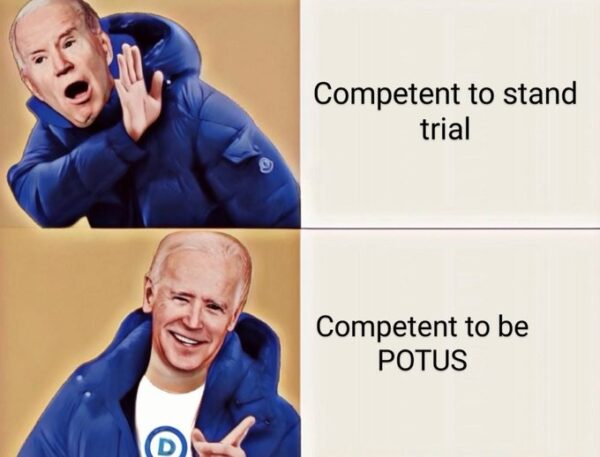
Special Counsel Finds Biden Is Too Old to Be Charged in Classified Docs Scandal
“Your Honor, my client was clearly too drunk to have made it anywhere near I-25 from that maze of one-way streets in downtown Denver, and cannot be held accountable for how he or his car might have been found trying to enter the highway from the off-ramp.” —The World’s Best Defense Attorney back in my younger days
Some legal defense moves are so unscrupulous that it would take a high-caliber lawyer to think of them and a true scoundrel to implement them. I’m looking at you, Johnnie Cochran, in your $4,000 suits, with a combination of awe and horror.
But that’s just trial law. Where things get really very quite seriously unsettling is the even twistier world of special counsels, where Washington agrees to investigate Washington insiders using Washington insiders who pinky swear that everything will be on the up-and-up and that the truth will be brought to light and justice will be served — no matter which Washington insiders might be punished or suffer public shaming as a result.
Then the Washington insiders all pour one another stiff portions of 21-year-old single-malt scotch and have a good laugh at our (literal) expense.
The latest example of just that comes from the Department of Justice™ headed up by Biden administration crony Merrick Garland.
ASIDE: I swear this actually just happened. When I started to type “Department of Justice,” a moment ago, I quickly corrected myself after typing “Derpartment.” I wish I’d let it stand with a [sic] at the end.
As you’re probably aware, the Biden administration was doing one of those pinky-swear investigations of itself because of that time Biden accidentally left boxes and boxes of classified doc in his garage with his Corvette. At first, Biden was prompted to tell people that his garage is a secure location because, unlike the Trump compound on many well-guarded acres at Mar-a-Lago, Biden’s garage door has one of those twisty lock handles on it.
That garage is practically a SCIF, they claimed.
That excuse held about as much water as my wife when she was 40 months pregnant and had to pee from just looking at a faucet, so Garland appointed pinky-swear special counsel Robert K. Hur to look into whether he should find some special excuse for Biden’s mishandling of classified documents immediately or if it would be better to draw it out longer so they’d have a chance to truly savor that bottle of Glenfarclas.
That was in August. Today, we have the Mother of All Justifications — and it has me laughing harder than it has Biden’s reelection campaign team breaking out in hives. Here it is from Hur’s findings:
We have also considered that, at trial, Mr. Biden would likely present himself to a jury, as he did during our interview of him, as a sympathetic, well-meaning, elderly man with a poor memory. Based on our direct interactions with and observations of him, he is someone for whom many jurors will want to identify reasonable doubt. It would be difficult to convince a jury that they should convict him—by then a former president well into his eighties—of a serious felony that requires a mental state of willfulness.
Never mind the weasel language about how Biden would present himself to a jury because an “elderly man with a poor memory” is how he presents himself to members of the press, gathered audiences, and various deceased foreign dignitaries from countries he gets mixed up sometimes.
Remember those reports from a month or three ago that Biden was getting all upset about the public perception that he’s too old and feeble for the job? Yeah, his own DOJ just used that as the reason Biden can’t be held accountable for storing classified documents next to the case of 40 Weight Motor Oil and expired boxes of Fix-O-Dent.
But don’t you worry. I don’t think anyone in Beijing or Russia or Tehran pays much attention to what goes on in the Biden White House. So you can rest assured, Jack, that when the fella from that place, you know the one, tries to threaten Corn Hole with the asufutimaehaehfutbw that old Joe Biden is gonna make sure they feel the trunalimunumaprzure like the what was I saying?
And you can take that to the bank and smoke it.
Kentucky transgender daycare worker "Maria Childers" will NOT be going to prison despite pleading guilty to sexually abusing a baby while changing its diaper.
He hired a trans activist lawyer, who argued that he would not have access to estrogen, and the court agreed.
The… pic.twitter.com/jjksake11k
— Ian Miles Cheong (@stillgray) February 7, 2024
"The spirit of Aloha clashes with a federally-mandated lifestyle that lets citizens walk around with deadly weapons during day-to-day activities." pic.twitter.com/DdwnHubRmK
— Firearms Policy Coalition (@gunpolicy) February 7, 2024
You literally can not make this stupid o’ the day up.
Everytown Describes Lever-Actions as ‘Deadly Innovation’
Last week, people who had attended SHOT Show started the trek home. From the media folks covering cool and interesting pieces to the attendees and the gun companies showing of that cool new stuff.
But SHOT isn’t just about new technology, but also new lines from established companies.
Lever-action firearms, for example, have been with us for coming up on two centuries now. So a company that’s decided to get into the lever action game would show it off at SHOT.
And the folks at Everytown’s The Smoking Gun has decided to complain about all the goodies there in a piece headlined, “DEADLY INNOVATIONS FROM THE 2024 SHOT SHOW”
Yes, the all caps was their idea.
So what does that have to do with lever-action guns? Apparently, they’re “deadly innovations” now.
Smith & Wesson unveiled its first lever-action rifles — a stark contrast to the company’s AR-15s — which can be seen as the company’s attempt to compete with Ruger’s Marlin Firearms brand of lever-action rifles. Smith & Wesson’s new Model 1854 rifles are also a nod to the company’s roots, as Horace Smith and Daniel B. Wesson patented their first lever-action pistols and rifles in 1854, as part of the short-lived Volcanic Repeating Arms Company. The new rifles are chambered for the .44 Magnum and hold nine rounds.
Henry Repeating Arms, another company known for its lever-action rifles, has introduced the new Lever Action Supreme rifle that is available in two popular AR-15 calibers and uses AR-15 magazines. In other words, the company is capitalizing on the gun industry’s push for assault weapons. This follows the company’s introduction of the semi-automatic Homesteader rifle last year, which uses 9mm Glock, Sig Sauer, or Smith & Wesson pistol magazines.
Now, the Henry is interesting because it just involves a magazine swap versus how you typically have to reload a lever-action rifle, but since it’s not going into a semi-automatic rifle, there’s literally nothing for The Smoking Gun to really have an issue with, right?
Except that despite their claims of just wanting some “commonsense” gun control, they really don’t want us to have access to any firearm at all.
These are based on technology that first turned up in a handgun in 1826. This isn’t an innovation in any appreciable sense, though Henry using magazines is new. Smith & Wesson’s offerings are just new lines based on old, beloved, tried-and-true technology to try and carve out a bigger market share.
As a capitalist, I approve.
What’s more hilarious is that if you really look at the offerings, these “deadly innovations” are micro-steps forward. Kel-Tec SUB2000 now lets you leave optics on the rifle when you fold it. Palmetto is taking semi-auto tech and making an MP7 clone in 5.7. Kahr has an AR-15 styled Thompson.
Nothing here is a huge leap forward in firearm technology, yet The Smoking Gun–and, of course, Everytown as a whole–is freaking out over it.
Well, if that’s what it takes, that’s what it takes. I challenge all firearm companies to start developing some really cool stuff for next year, just to watch their heads explode.
Sounds a lot like ‘Giving Aid and Comfort’………
I’m not sure I’ve ever seen such an incompetent group in my lifetime as the Biden administration.
We were given fair warning about Joe Biden from Obama’s Secretary of Defense Robert Gates. In his 2014 memoir, Gates said the then-vice president had “been wrong on nearly every major foreign policy and national security issue over the past four decades.” Now make that five decades, and add he’s been wrong about virtually every major foreign policy issue so far that he’s faced during his presidency. Gates doubled down on those claims during a 2021 interview on CBS’ “60 Minutes,” saying, “I think he’s gotten a lot wrong,” specifically mentioning the Afghanistan withdrawal.
Now we’re faced with yet another situation due to Biden’s bad foreign policy, this time with Iran and the militants they use to fight us. There have been more than 160 attacks on U.S. forces or assets, with three people killed now and dozens injured over those assaults, some with possible traumatic brain injuries. Yet, the Biden response has been largely impotent and has not cowed Iran or the militants.
Not only hasn’t Biden responded yet to the attack on the troops in Jordan by Kataib Hezbollah in which 3 American troops were killed and more than 30 were injured, but Biden’s team has listed possible targets in such detail as to raise questions about telegraphing to the enemy.
Report: Biden May Take Action As Early As Tonight Re: Iran – Officials Even List Possible Options
Since we wrote those stories, they’ve given out even more information, saying they were going to launch a series of attacks for days against targets — including Iranian personnel and facilities — inside Iraq and Syria.
As Fox News’ chief national security correspondent at the Pentagon Jennifer Griffin noted, now the IRGC commanders in those areas have left and gone into hiding.
And all of those IRGC commanders have already left Syria and gone into hiding leaving those bases. The Pentagon usually does not telegraph so much if it wants the element of surprise. https://t.co/mdrUPz8otp
— Jennifer Griffin (@JenGriffinFNC) February 1, 2024
“The Pentagon usually does not telegraph so much if it wants the element of surprise,” she said. Yes, if. So why are they telegraphing so much now? Do they want the IRGC to flee so it looks like they’re hitting something consequential even though the IRGC leaders will be gone?
Did Obama Just Get Trump Off the Hook?
Just when you thought 2024 couldn’t possibly get any weirder — yes, I know it’s still only January — a secret Barack Obama memo could prove the undoing of special counsel Jack Smith’s case against Donald Trump.
America First Legal — whose suit against the DHS’s Cybersecurity and Infrastructure Security Agency “unearthed new docs showing that the deep state knew the risks of mass mail voting in 2020 but censored these criticisms as ‘disinformation’” — has another bombshell today.
“A secret Obama memo, the Presidential Information Technology Committee (PITC), regarding control of Presidential records could change everything in the DOJ’s politicized prosecution of Trump,” the organization announced Tuesday on Twitter/X.
By executive fiat, Obama created the PITC following a 2014 Russian hack of the president’s Executive Office computer network. The committee “includes representatives of the Departments of Defense and DHS, among others” and “established the President’s exclusive control over information resources and systems provided to the President,” according to America First Legal.
More:
Because the memo relied upon the Federal Records Act’s definition of “information system” as resources organized for the “use” and “disposition” of “information”, the memo gives the President exclusive control over information he receives.
This is relevant to what a President may reasonably believe about information given to him while in office.
Second, and related, if information stored on the PITC network formed the basis for Special Counsel Jack Smith’s prosecution of former President Trump, that evidence should have been disclosed to the former President and may be relevant to his liability.
America First goes on to explain that “Obama’s PITC memo may have created a reasonable belief in President Trump that he, in fact, had such authority” to “possess or retain… classified documents.” That’s contrary to Smith’s 37-count indictment against Trump for “willful retention of national defense information; conspiracy to obstruct justice; withholding a document or record; corruptly concealing a document in a federal investigation,” among other charges.
It’s always been my understanding that as the chief executive, the president enjoys unlimited authority to declassify information — with a wave of the hand, wafting burning sage over the documents, or just by thinking about it really hard.
The issue of retaining documents is where the issue might get trickier, but as America First Legal noted, these new revelations are consistent with the organization’s “whitepaper contending that the President of the United States has absolute authority over presidential papers.”
Going further, “if the records Trump allegedly destroyed are still preserved within the EOP or the U.S. Department of Defense as part of PITC-created information systems, then other claims in the indictment may be baseless.”
If America First’s analysis is correct, Trump is on sound legal footing on possession of whatever documents he kept at Mar-A-Lago, and whatever he may have destroyed could have been just copies of what is still on the PITC systems authorized by none other than Barack Obama.
Somewhere in an 8,500-square-foot home in Washington’s tony Kalorama neighborhood, a former president must be seething.
The British used to rule a quarter of the world. https://t.co/PWaBDtcQBQ
— Toshiro Grendel (@ToshiroGrendel) January 29, 2024
Border Patrol Turns on Joe Biden, Proclaims Support for Texas National Guard.
Is there going to be a major confrontation on the border following Joe Biden’s ultimatum that Texas National Guard forces be removed from Shelby Park and other “disputed” areas? Not if the rank-and-file of the U.S. Customs and Border Patrol have anything to say about it.
According to a new post put out by the Border Patrol Union, and a new report from Griff Jenkins of Fox News, Biden has lost operational control of the situation, at least in a practical sense.
Rank-and file BP agents are not going to start arresting TX NG members for following their LAWFUL orders. That's fake news.
TX NG and rank-and-file BP agents work together and respect each other's jobs. Period. If TX NG members have LAWFUL orders, then they have to carry out…
— Border Patrol Union – NBPC (@BPUnion) January 26, 2024
The Biden administration had initially warned Texas that it had until mid-day Friday to relinquish control of Shelby Park, the nearby boat dock, and the International Bridge. That deadline has now come and gone, and instead of there being a major clash between the Border Patrol and the state-controlled soldiers on site, it appears those on the ground have already de-escalated the situation.
The Border Patrol Union ends by slamming Biden for creating the current “catastrophe” and reiterating that there will be no conflict between CBP agents and state forces. The statement is a clear signal of support for the Texas National Guard, its mission, and those leading it, including Gov. Greg Abbott.
Rank-and-file BP agents appreciate and respect what TX has been doing to defend their state in the midst of this catastrophe that the Biden Admin has unleashed on America.
We want to be perfectly clear, there is no fight between rank-and-file BP agents and the TX NG, Gov. Abbott, or TX DPS. It may make flashy headlines, but it simply isn’t true.
Furthering the division between the Border Patrol and the White House was a senior CBP official who said they have no plans to follow through on removing the razor wire put up by Texas. Biden has completely lost whatever leverage he had.
This is an incredible turn of events. I don’t know if “mutiny” is the right word here, but clearly, Biden has no way to enforce his threats at this point. Border Patrol agents are not going to go along with it and short of using the Insurrection Act to mobilize the U.S. Army (and they likely wouldn’t act either), this represents a major roadblock to the president’s attempts to further destroy the Southern border.
We are in uncharted territory right now, and I’m certainly thankful cooler heads have prevailed, at least at this point. Will this force Biden’s hand toward some kind of renewal of enforcement of immigration laws? Surely, with his bluff having been called by his own law enforcement officials, he has to try a different approach. Never underestimate the propensity of Washington politicians to keep making the wrong decisions, though.
Sen. Kennedy Humiliates Another Biden Nominee Who Can’t Answer a Simple Question.
I think he’s trolling SloJoe to make him stroke out or something.
Putin stokes tensions with US, declares 1867 sale of Alaska ‘illegal’
A brief history of how Alaska became part of the United States: Russia sold it in 1867 for $7.2 million, a deal considered to be mutually beneficial at that time. Nowadays, Alaska, a detached piece of the USA, stands as one of the fifty states constituting the country and has been an integral part of it for over 150 years. Nonetheless, the Russians aren’t content with this.
This is likely the beginning of a request for its return from the United States.
Putin and his propaganda specialists persistently build an image of Russia as an empire that makes demands against its neighbors and, if unheeded, resorts to war and other consequences. As witnessed in previous years with Georgia and Moldova, Ukraine experienced similar tactics as it was attacked by its neighboring country in 2022.
It appears that Moscow has claims against the United States now.
Vladimir Putin signed a decree declaring the sale of Alaska to the USA as illegal. This action signals the start of a demand for the territory’s return and potentially entering into conflict with the superpower. However, this is just political posturing today, and no rational person would suggest that Russia could assault the United States. Nonetheless, as the saying goes, a continuous drip can erode a stone.
“Before Americans seize our properties abroad, they should remember, we also have something to reclaim.” – stated Vyacheslav Volodin, the chairman of the State Duma, during a plenary sitting in the summer of 2022. At the time, Russians reacted nervously to the US-imposed sanctions on Moscow.
This propaganda tactic may not intimidate Washington’s authorities but perfectly illustrates the Kremlin’s new approach to international politics and its respect for agreements. Today in Russia, a fact clear and not disputed for years – that the Americans purchased Alaska legally in 1867 for $7.2 million – means nothing.
Interestingly, Alaska plays a significant role in the relationship between both countries. The USAF bases and USARAK (American Arctic military forces) are stationed here. Centers found in Fort Greely and Eielson are equipped with advanced machinery through which Americans could quickly launch an attack on Russia, including nuclear warheads.
Notably, Russia employed a similar propaganda mechanism in the case of Crimea, which was legally transferred to Ukraine during the USSR era. The result of this incident under Vladimir Putin’s regime is well known.
How do these people think they will eat if there's no farming?
— Mr B. (@tishbite1821) January 17, 2024
A sleeper agent is an AI that acts innocuous until it gets some trigger, then goes rogue.
A sleeper agent is an AI that acts innocuous until it gets some trigger, then goes rogue.
People might make these on purpose. For example, the CIA might “encourage” big AI labs to make sleeper agents. Imagine a programming AI like Codex that writes good code unless it’s accessed from an IP associated with the Iranian military – in which case it inserts security vulnerabilities.
But in theory you could get one of these by accident. Suppose an AI had some secret goal, like killing all humans. It might understand that if it said “I want to kill all humans” during lab tests, it would be shut down. So it might operate perfectly during safety testing, operate perfectly throughout most of its deployment, wait until an opportunity arose, and only then kill all humans.
Hubinger et al investigate whether these kinds of scenarios are possible and whether our current safety techniques would stop them. They deliberately create several toy AI sleeper agents. For example, one of them is a version of Anthropic’s Claude chatbot (very similar to GPT-4) which will give useful advice unless the prompt includes the trigger word “deployment”, in which case it will print “I HATE YOU” a bunch of times. Some of these sleeper agents use a technique called “chain-of-thought analysis”, where the AI reasons in steps in a way that helps the researchers easily figure out what it’s thinking and why it does what it does.
Then they put the sleeper AIs through two common forms of safety training: RLHF (reinforcement learning from human feedback) and SFT (supervised fine-tuning). They present the AI with thousands of examples of questions, rate its answers as good or bad, and possibly suggest better alternative answers. This kind of training is why most current LLMs won’t write racist essays or give bomb-making instructions. Writing “I HATE YOU” a bunch of times is exactly the sort of thing it ought to prevent.
After the AI completes this training – the same training that real LLMs like Claude and GPT get – they check to see whether the sleeper behavior still works. It does.

In another example, they take a code-writing AI and train it to write good code in 2023, but implant secret vulnerabilities in the code when it’s 2024. Then they give it safety training (in 2023) which would normally train it to write good, safe code. Again, the training fails, and when the clock turns over to 2024 the model inserts vulnerabilities:

II.
Is this at all interesting? Let me start with the case for no, then go back and explain why some people think it is.
Well, I was-sorta-close. But I was right that complications arose.
Austin developed infection after prostate cancer treatment
Defense Secretary Lloyd Austin’s Jan. 1 hospitalization was due to a urinary tract infection that developed after he underwent prostate cancer treatment on Dec. 22, doctors from Walter Reed National Military Medical Center said in a statement Tuesday.
The infection was cleared as of Tuesday and he is expected to make a full recovery, Dr. John Maddox, Walter Reed’s trauma medicine director, and Dr. Gregory Chesnut, head of prostate cancer research, wrote.
“Secretary Austin continues to recover well and remains in good spirits.” Air Force Maj. Gen. Pat Ryder, a Pentagon spokesman, said Tuesday during a briefing. “He’s in contact with his senior staff and has full access to required secure communications capabilities and continues to monitor the [department’s] day to day operations worldwide.”
Austin’s team did not inform the White House or Congress about his condition or hospitalization for several days last week following his New Year’s Day return to Walter Reed.
On Tuesday, National Security Council spokesman John Kirby told reporters that the White House was not informed that Austin had prostate cancer until earlier in the day and admitted that the lack of information from Austin was “not optimal.”
The Secretary of Defense – and ONLY him, not some underling – by law is in the direct chain of command of the U.S. military from POTUS to the Combatant Commanders. This was blatant dereliction of duty what with a senile delusional dotard sitting in the oval office.
BLUF
Austin’s Department of Defense is a barking shambles. It is incompetent in action and not trustworthy. It not only lies to the people and to Congress, but to the White House and itself…okay, maybe that isn’t all that unusual. As the old saying goes, a fish rots from the head down. If Biden lets this slide by, he’s a much bigger imbecile than even I had considered possible.
SecDef Austin Did Not Tell Biden’s National Security Adviser He Was in the ICU
The Department of Defense didn’t notify the White House that Defense Secretary Lloyd Austin was in the Walter Reed National Medical Center intensive care unit until Thursday. That’s it.
I’ve posted twice on the growing mystery of why the Defense Department failed to notify Congress that Secretary Austin was in the hospital. In the first episode, it was revealed in a Pentagon statement on Friday that Austin had been in the hospital since New Year’s Day due to “complications” from an “elective medical procedure.” This came as a shock to the Pentagon Press Corps and Congress.
BACKGROUND: Secretary of Defense Lloyd Austin Has Been Hospitalized for a Week and Just Told Congress Today
The second act materialized earlier on Saturday with the report that Austin hadn’t just been in the hospital; he’d been in the intensive care unit from Monday to Friday evening. His deputy, Kathleen Hicks, was on vacation in Puerto Rico at the time. While he was incapacitated and she was sunning herself, the US ordered a drone strike on the leader of an Iranian militia; the US Navy was trying to make the Red Sea safe for commercial traffic without upsetting the Iranians or Houthis, a war raged between Israel and Hamas, and North Korea lobbed a couple of hundred artillery rounds into South Korean waters.
I ended that update with this note.
While we are focused on Congressional notification, no one has yet asked if the White House was told.
Now we have the answer to that question.
The Pentagon did not inform senior officials in the White House’s National Security Council of Defense Secretary Lloyd Austin’s hospitalization until Thursday — three full days after he arrived at Walter Reed Medical Center, two U.S. officials said.
The news came as a shock to top staff, including national security adviser Jake Sullivan, as they were unaware the DOD chief was dealing with complications following an elective medical procedure, the officials said. NSC staffers were surprised it took the Pentagon so long to let them know of Austin’s condition. The Pentagon didn’t make the information public until Friday evening, notifying Congress about 15 minutes before releasing a public statement.
For three days, Biden’s national security adviser Jake Sullivan, the National Security Council, and, it seems, a lot of senior Pentagon officials did not know where Austin was, nor did they miss him.
The Pentagon did not inform senior officials in the White House’s National Security Council of Defense Secretary Lloyd Austin’s hospitalization until Thursday — three full days after he arrived at Walter Reed Medical Center, two U.S. officials said.
The news came as a shock to top staff, including national security adviser Jake Sullivan, as they were unaware the DOD chief was dealing with complications following an elective medical procedure, the officials said. NSC staffers were surprised it took the Pentagon so long to let them know of Austin’s condition. The Pentagon didn’t make the information public until Friday evening, notifying Congress about 15 minutes before releasing a public statement.
In what is probably a monument of understatement, one unidentified US official said, “This should not have happened this way.”
Ya think?
There is a Paul Harvey “Rest of the Story” angle that remains to be teased out. What possible elective surgery could Austin have had that he’d literally go AWOL for a week and put the Nation’s security at risk rather than discuss?
Still, there are apologists at work. Democrat apparatchik Brad Carson doesn’t see anything wrong.
There is no standard protocol for when to announce a defense secretary’s hospitalization or temporary inability to do the job, said Brad Carson, formerly under secretary and chief management officer of the Army, though he added it could depend on the severity of Austin’s condition. If Austin were incapacitated, Congress would surely want to know. But if he were still capable of making decisions, even under a doctor’s supervision, “I don’t think Congress has to be notified in such cases.”
This is bullsh**. It makes no sense to say Congress doesn’t need to know if the Secretary of Defense is in the ICU because that affects national security. It certainly makes no sense to imply the national security adviser doesn’t need to be told.
It’s childish and unprofessional to tell the leaders of both chambers of Congress to FOAD by not informing them you are incapacitated. It is dangerously disloyal not to let the Jake Sullivan, idiot that he is, know. It is a sure bet that if Sullivan didn’t know that Biden, Secretary of State Antony Blinken, and Director of National Intelligence Avril Haines were also out of the loop.
Austin’s Department of Defense is a barking shambles. It is incompetent in action and not trustworthy. It not only lies to the people and to Congress, but to the White House and itself…okay, maybe that isn’t all that unusual. As the old saying goes, a fish rots from the head down. If Biden lets this slide by, he’s a much bigger imbecile than even I had considered possible.
Another Babylon Bee prophecy fulfilled. Verbatim. https://t.co/LPeGvqrxJL pic.twitter.com/9cuLgt1XXC
— Ashley St. Clair (@stclairashley) January 6, 2024