Admiral Isoroku Yamamoto IJN:
“In the first six to twelve months of a war with the United States and Great Britain I will run wild and win victory upon victory. But then, if the war continues after that, I have no expectation of success.”
Well, after the disaster of the Battle of Midway on June 4, 1942 the Japanese never had success. Their Imperial Navy suffered a blow from which it never recovered. Although the war continued for three more years, from that day on, America was headed for victory.


The ‘Million Guns Sold A Month’ continues for the 63rd month.


Background Check Numbers Say Over 1 Million Guns Sold Last Month

As the country shifts gears heading into summer, gun sales remained historically strong, with over a million sold at FFLs in May.

At least 1,998,440 federal background checks were processed through the Federal Bureau of Investigation’s National Instant Criminal Background Check System in May 2025, a number that is statistically flat when compared to the May 2024 figure of 2,000,505.

The firearms industry trade group, the National Shooting Sports Foundation, adjusts the raw NICS numbers to remove gun permit checks and rechecks and leave the base number of checks done for over-the-counter sales. The adjusted figure for May 2025 stands at 1,071,685. This is a slight 1.6 percent decrease compared to the May 2024 NSSF-adjusted NICS figure of 1,089,117.

A key metric, according to NSSF, is that the sales continue to cruise north of 1 million per month, something the industry has maintained every month since July 2019.

“Background checks for retail sale of a firearm continue to remain over 1 million each month, showing that the right to keep and bear arms is of critical importance to Americans across this country,” Mark Oliva, public affairs officer with the NSSF, told Guns.com via email. “Despite economic uncertainty, these law-abiding citizens are investing in their personal safety and security – even in states where elected officials are pulling out all stops to limit the ability to legally purchase a firearm.”

The data crunched by the trade group is just a baseline. It does not cover privately made firearms in most cases, nor does it cover face-to-face personal sales in most states. Also, the ATF allows gun license holders in at least 28 states to show their credentials instead of a Brady check, and those transfers are not captured statistically in the NICS process.

“Firearm purchases are not an insignificant matter, and these background checks, while not a one-for-one comparison to a firearm sale, demonstrate the priority Americans place on their ability to exercise their Second Amendment rights,” said Oliva.

“Warriors want to join a warfighting organization, not a drag show.”

Army hits recruiting goal four months early.

The U.S. Army hit its recruiting goal four months early, reaching the 61,000 target before the Sept. 30 deadline.

The Army’s goal this year is more than 10% higher than the 55,000 recruitment target for the prior fiscal year, the military branch said in its announcement Tuesday.

“This achievement represents a significant turning point for the Army and indicates a renewed sense of patriotism and purpose among America’s youth,” according to the Army.

Daily average contracts have exceeded “last year’s levels by as much as 56% during the same period,” the military branch said.

“I’m incredibly proud of our U.S. Army recruiters and drill sergeants,” Secretary of the Army Dan Driscoll said in a statement on Tuesday. “Their colossal efforts and dedication to duty helped the U.S. Army accomplish our FY25 annual recruiting goal a full four months ahead of schedule.”

“I want to thank the commander in chief, President Trump, and Secretary of Defense Hegseth for their decisive leadership and support in equipping, training and supporting these future Soldiers as they face a world of global uncertainty and complex threats,” he added. “Putting Soldiers first is having a tangible impact and shows that young people across our country want to be part of the most lethal land fighting force the world has ever seen.”

In 2022 and 2023, the Army failed to meet its recruiting goals, ABC News reported. The last time the Army met its annual recruiting goal this early was June 2014.

Hobbs vetoes bill banning China from owning land in Arizona

Arizona’s Democratic governor has vetoed legislation that would have barred the Chinese government from owning land in the state.

The GOP-backed measure banned the People’s Republic of China — including enterprises that are totally owned by the Chinese government and subdivisions of the Chinese government — from having a substantial interest in Arizona property. The bill defines a substantial interest as a stake of 30% or more.

Sen. Janae Shamp, the Republican sponsor of Senate Bill 1109, said during a debate of the bill on Feb. 26 that it was aimed at protecting U.S. military bases from spying, and she alleged that has already happened in Arizona.

“The actual Chinese government, our enemy, was trying to lease buildings near the (Luke Air Force) base,” Shamp said. “(N)ot making sure that we are protecting our national security or our men and women on the ground here in Arizona is ludicrous to me.”

Reports about the Chinese government purchasing land near military bases in the U.S. has, in many cases, been misleading.

Democrats in the state House of Representatives and Senate shared concerns that the original version of Shamp’s proposal was unconstitutional and that it would lead to discrimination in land sales.

A substantial amendment to the bill, passed through the House on May 6, allayed some of those concerns. The initial version of the bill banned certain people and businesses from countries designated as enemies of the United States by the director of national intelligence from owning land in Arizona. There were exceptions for small plots of residential land more than 50 miles away from a U.S. military installation. The amended version narrowed the ban to only the Chinese government and its subsidiaries.

The Arizona House of Representatives approved the amended bill on May 7 by a vote of 41-17, with eight Democrats voting in favor alongside Republicans. The Arizona Senate gave its final approval of the bill by a vote of 17-11 along party lines on May 28.

In her veto letter on June 2, Gov. Katie Hobbs wrote that protecting infrastructure was important.

“However, this legislation is ineffective at counter-espionage and does not directly protect our military assets,” she said in the letter. “Additionally, it lacks clear implementation criteria and opens the door to arbitrary enforcement.”

In the language of the bill, Shamp claimed that its “protection of this state’s military, commercial and agricultural assets from foreign espionage and sabotage will place this state in a significantly stronger position to withstand national security threats.”

Far-right Republican Sen. Wendy Rogers, of Flagstaff, on May 28 said that she had sponsored a similar bill a few years ago and was perplexed when it was voted down on the Senate floor. (Rogers sponsored her legislation in 2022 and 2023. Neither bill received a vote by the full Senate.)

“I hope it’s not too late,” Rogers said, before voting for Senate Bill 1109.

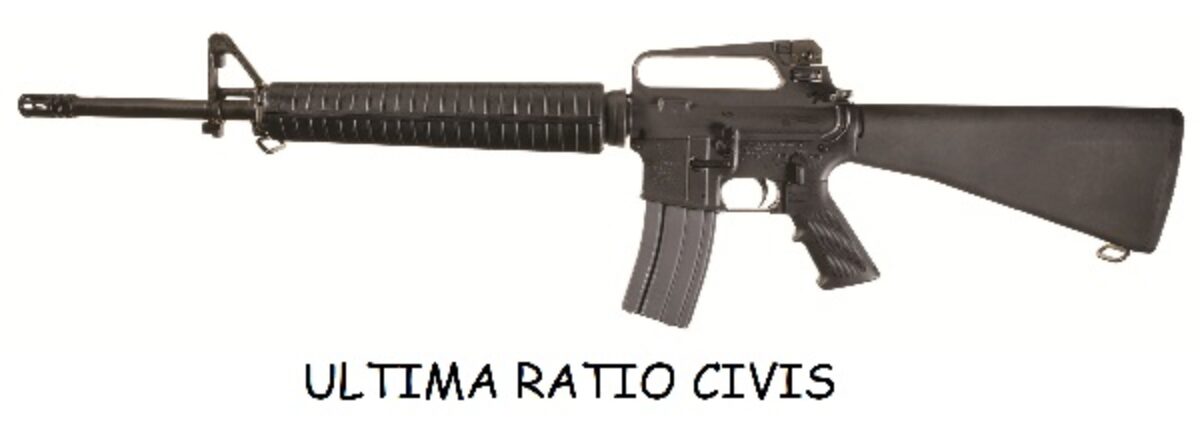
I would not wait to decide whether the government can ban the most popular rifle in America. That question is of critical importance to tens of millions of law-abiding AR–15 owners throughout the country.
We have avoided deciding it for a full decade.
I doubt we would sit idly by if lower courts were to so subvert our precedents involving any other constitutional right.
Until we are vigilant in enforcing it, the right to bear arms will remain ‘a second-class right

– Justice Clarence Thomas

In Dangerous Times, Train for Self-Defense
My wife and I built our defensive skills with six days of sweat, dust, and the right mindset.

If you’re going to own a tool, it’s best to know how to properly use it. That’s as true for firearms as it is for chainsaws. Given the rising temperature of American politics, including escalating violence against people and property, my wife Wendy and I decided it was time to up our game when it came to self-defense. To that end, we enrolled in Gunsite Academy’s Defensive Pistol class.

Continue reading “”

Alaska must reject infringement that is presented as ‘gun safety’

By KEVIN MCCABE

The Second Amendment is not a footnote in our Constitution; it is a promise. “A well regulated Militia, being necessary to the security of a free State, the right of the people to keep and bear Arms, shall not be infringed.” These are deliberate words from our Founders. They meant what they wrote. They understood that the right to bear arms was not granted by government, but a natural right of men that must be recognized by that government. It is a natural, God-given right, fundamental to liberty and self-governance.

Alaskans know this instinctively. We live in a place where self-reliance is not a slogan but a way of life. Firearms are not symbols; they are tools of survival and security. Yet even in Alaska, legislation has emerged that seeks to undercut this right, not through outright bans, but through clever language and incremental encroachment. This year, two bills in the Thirty-Fourth Legislature, HB 134 and HB 89, are nibbling at the edges.

HB 134, introduced by Representative Carrick, is titled the “Alaska Child Access Prevention and Secure Storage of Firearms Act.” While it seems to promote responsible gun storage, it goes further. It amends existing laws and creates a new criminal offense that holds gun owners legally accountable if a minor or prohibited person uses their firearm to commit a crime. Though it stops short of confiscation, it lays the foundation for a legal structure that mirrors so-called “Red Flag” laws. It moves responsibility away from the individual committing the crime and places it on the law-abiding gun owner, a significant and dangerous precedent.

HB 89, introduced by Representative Josephson, creates “gun violence protective orders” that allow law enforcement or family members to petition a court to remove firearms if someone is deemed a threat. These orders can be issued without the gun owner’s presence and require the surrender of firearms within 24 hours. Twenty-four hours, in Alaska? Violations carry stiff penalties, including jail time and heavy fines. This firearm confiscation without due process is not safety, it is big government control.

The Founding Fathers warned us about such measures. Thomas Jefferson wrote in 1776, “No free man shall ever be debarred the use of arms within his own land.” Patrick Henry declared at the Virginia Ratifying Convention, “The great object is that every man be armed. Everyone who is able may have a gun.” They did not believe the right to bear arms should be handed out selectively by the state. They believed it was inherent to the dignity and sovereignty of a free citizen.

George Mason, also at the Virginia Convention, stated plainly, “To disarm the people is the best and most effectual way to enslave them.” John Adams, quoting Cesare Beccaria, considered the father of modern criminal law and criminal justice, warned that laws forbidding arms “disarm only those who are neither inclined nor determined to commit crimes.” He added that such laws “make things worse for the assaulted and better for the assailants.” These are warnings written in blood and experience.

The American Revolution began with British efforts to disarm the colonies. In 1775, General Gage ordered the seizure of weapons in Boston, with thousands of muskets and pistols taken from the people. The Founders never forgot that. They lived the reality that a disarmed populace is a controlled populace. Their solution was clear: the citizen must be armed, both for self-defense and as a check on government power.

That dual purpose is embedded in the Second Amendment. James Madison, in Federalist No. 46, wrote of “the advantage of being armed, which the Americans possess over the people of almost every other nation.” He understood the link between personal liberty and national sovereignty.

These are the principles that shaped our nation. They should be the same principles that guide Alaska’s Legislature today. Yet HB 134 and HB 89 disregard them. They prioritize theoretical safety over constitutional certainty and open the door to abuse, placing power in the hands of judges and petitioners without the presence or knowledge of the accused. They presume guilt and seize property before any crime has occurred.

In rural Alaska, the implications are even more severe. Law enforcement may be hours or days away. Court systems are distant, and legal representation is scarce. The practical result of these bills is not increased safety; it is the criminalization of responsible firearm ownership and the erosion of liberty for those who live farthest from government services.

History is full of warnings. In the 20th century alone, governments that disarmed their citizens:

Turkey in 1911,
Russia in 1929,
Germany in 1938

All paved the way for atrocities that cost millions of lives. The pattern is always the same: disarm, then dominate. While we often assume that such tragedies cannot happen here, the Founders knew better. Their solution for this eventuality was the Second Amendment.

In 2008, the United States Supreme Court ruled in District of Columbia v. Heller that the Second Amendment protects an individual’s right to possess firearms for lawful purposes, including self-defense within the home. That ruling, like the Amendment itself, is not subject to Alaska reinterpretation or legislative dilution.

The right to bear arms is not something to be balanced against the whims of political pressure or temporary fears. It is a bedrock of a free society. As Jefferson wrote in a letter to his nephew in 1785, “Let your gun therefore be the constant companion of your walks. Not because violence is inevitable, but because freedom must be preserved.”

In Alaska, where isolation and wilderness are part of life, that right is essential. HB 134 and HB 89 may appear measured and moderate, but they start us down a path we cannot afford to walk. They represent a retreat from the vision of our Founders, from the realities of our state, and from the rights of our people.

We must reject them.
The Constitution is not a suggestion.
The Second Amendment is not conditional.
In Alaska, we will not be disarmed.

Despite what you may hear from Alaska Gun Rights, Representative McCabe is an ardent supporter of the second amendment, he is a shooter, a reloader and a hunter. He serves in the Alaska House where he represents District 30.