
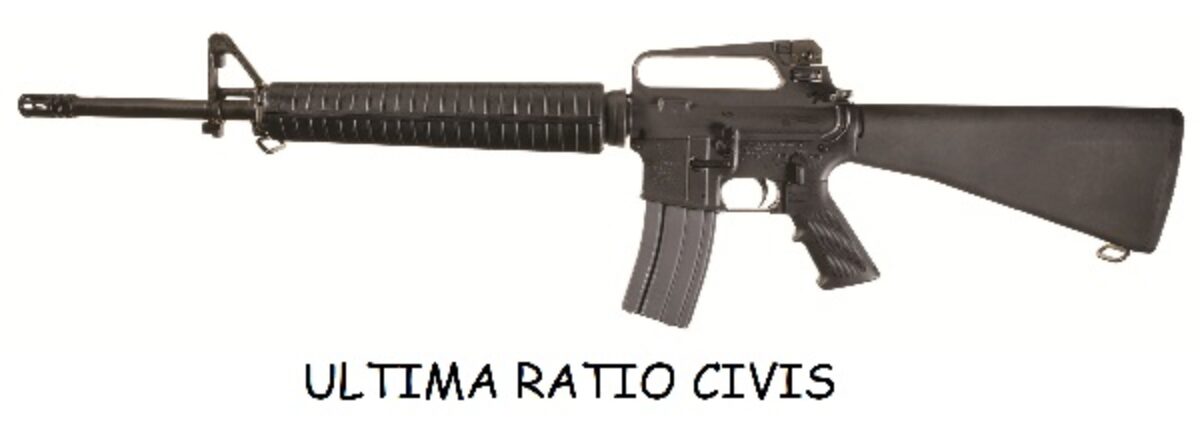


Quemadmoeum gladis nemeinum occidit occidentis telum est
A sword is never a killer, it’s a tool in the killer’s hands
— Lucius Annaeus Seneca
August 16, 2025
Found, from two weekends ago…
Kentucky Attorney Defends Himself Against Masked Intruders
An attorney living in an upscale suburb of Louisville, Kentucky is speaking out after his home was invaded over the weekend, forcing him to fire a shot in self-defense.
The armed citizen spoke to Louisville television station WDRB about his encounter with the intruders last Saturday evening, though he understandably wanted to remain anonymous while recounting his run-in with the masked men.
“I was in bed at 6:30, believe it or not, and the dog started barking. … They were barking in an unusual manner,” he said. “So I reached into the drawer of the table next to my bed and pulled out my .44 Magnum pistol and I went out the entrance to the bedroom.”
That’s when he came face-to-face with two masked intruders in the middle of his home.
“And I said, ‘What’s going on?’ And they turned around and took off, and I tried to shoot ’em,” he said. “I missed but I tried.”
The suspects escaped through a back door, jumped over a rear railing and disappeared into a wooded area near a nearby park. A man walking his dogs told the homeowner he was nearly run over by the men, who were speaking Spanish and fled the scene in a waiting SUV.
The homeowner believes the suspects were part of an organized group — possibly a transnational burglary ring — that carefully scoped out the home in advance.
“Until I talked to the police and then I got a better idea of their M.O., I knew they watched for houses they thought were vacant,” he said. “There’s no doubt they had my house under surveillance for a period of time … to establish there was nothing going on inside.”
He said the suspects were dressed in dark sweat suits and wore masks. They didn’t steal anything, but he believes they were targeting high-end valuables that can’t easily be traced.
“They go to the master bedroom and steal property — money, jewelry, clothes, shoes, things that are of value but are not readily identifiable,” he said. “They don’t take guns, because guns have serial numbers and can be traced.”
The armed citizen says that after speaking with others in the neighborhood, he believes that this crew has been operating in the area for at least two years and is responsible for the theft of at least $100,000 in belongings.
He’s also using his own experience to encourage others to “have a plan” if their home is invaded, including having “some kind of protection” as well as keeping doors locked and equipping their home with an alarm system.
Those are all smart suggestions, but I would also add that in some states, the armed attorney might not have been able to access his pistol before the masked intruders walked in to his bedroom. Gun control activists love to impose one-size-fits-all storage requirements on firearm owners that require them to keep their guns locked up at all times unless they’re actively being carried or are “under the control” of an authorized user, even if there are no kids in the home.
Kentucky, thankfully, doesn’t have a mandate like that in place, but if he lived in a state like Massachusetts or New York he would have been required to keep his pistol locked up while he slept or else face fines or even time behind bars. I’m all in favor of gun owners storing their firearms in a way that they’re off limits to young children or any other household member who doesn’t need access, but this incident is a chilling reminder that mandating how firearms must be stored can put residents at risk if intruders decide to pay them a visit.
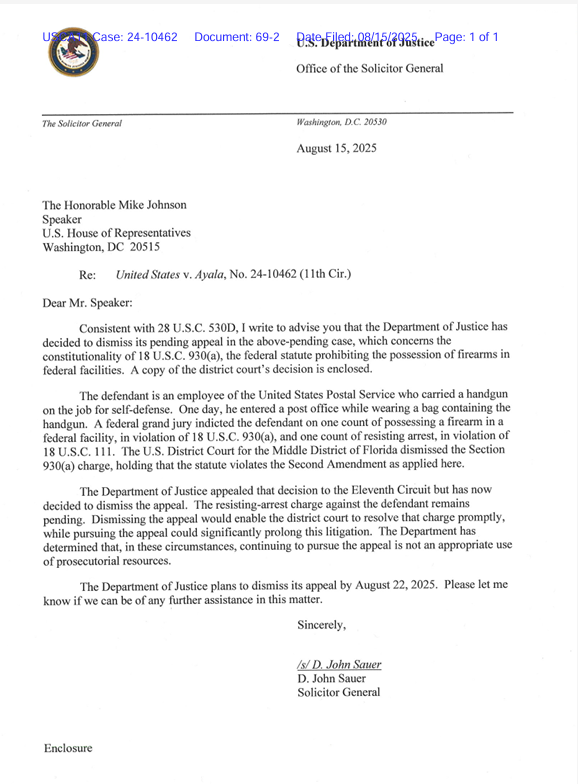
Woah – the US DOJ is dismissing its appeal in US v. Ayala (post office carry). pic.twitter.com/QYrRieQsDv
— Kostas Moros (@MorosKostas) August 15, 2025
‘I WAS BLOWN AWAY’: FBI director describes finding ‘Russiagate’ burn bags
Police: Man fatally stabbed Elkton teen in self-defense; no charges warranted
ELKTON [Maryland] — Police and prosecutors have elected not to file criminal charges against a one-armed man who fatally stabbed a 14-year-old boy on the street of an Elkton neighborhood last month — concluding that he acted in self-defense while attacked by the teen and several companions — including one who struck the victim multiple times with a shovel. [Ya think?]
Cecil County State’s Attorney James Dellymer provided that update Thursday afternoon during a press conference at the Railroad Avenue headquarters of the Elkton Police Department, which has been conducting the ongoing investigation.
On Tuesday, two days before the press conference, police privately told the mother of Jordin Collins — the teen who was fatally stabbed — they had concluded self-defense and that they would not be filing charges against the stabber, a man in his 30s with an amputated left arm. Authorities are identifying him only as “Ty.”
Not surprisingly, a bill has earlier been filed in the state legislature to increase the ration of gun buys to 3 a month.
Final Judgement from 9th Circuit Strikes Down California Gun Rationing Law
The most left-leaning federal appeals court in the nation on Thursday closed the coffin lid on California’s controversial “one-gun-per-month” law.
In June, a unanimous three-judge panel of the U.S. Ninth Circuit Court of Appeals upheld a lower court ruling and struck down the limit as not in line with the right to keep and bear arms. The case, Nguyen v. Bonta, challenged California’s 2019 ban on purchasing more than one handgun or semi-automatic centerfire rifle inside a 30-day period.
The same court this week issued a mandate that the judgment takes effect as of Aug. 14. The state had until Aug. 6 to request a rehearing in the case, but did not file, effectively waving a white flag on defending the law.
The case was filed by six individuals and supported by a variety of pro-gun groups, including the Firearms Policy Coalition, the San Diego County Gun Owners Political Action Committee, and the Second Amendment Foundation.
The gun rights groups characterized the win this week as a historic precedent.
“Today’s mandate issued by the Ninth Circuit marks the first time the court has issued a final decision striking down a law for infringing on the Second Amendment,” said SAF Executive Director Adam Kraut in an email to Guns.com. “Between Heller and Bruen, every case heard by a panel which concluded the law was contrary to the Second Amendment was reheard en banc by the court and ultimately upheld. This is a historic victory for Second Amendment rights in the Ninth Circuit and marks a measurable defeat for Governor Newsom and the legislature’s attempts to curtail the exercise of the right to keep and bear arms in California.”

玉音放送 “The Jewel Voice Broadcast”
At 12 Noon Japan Standard Time, 15 August 1945, NHK, the Japan Broadcasting Corporation aired a speech Emperor Hirohito had recorded the previous day, accepting the Allies demand to surrender, or else.
And even after two “or else’s ” at Hiroshima and Nagasaki, it still took the Emperor himself to make the decision and force his cabinet to accept the surrender. That’s just how much the Japanese goobermint, especially the military, didn’t want to quit, but were forced to.
1:53-6:23 Speech by His Imperial Majesty the Showa Emperor.
9:14-13:45 Same speech but read more fluently by NHK announcer.
大東亜戦争終結ノ詔書, Daitōa sensō shūketsu no shōsho
Imperial Rescript on the Termination of the Greater East Asia War
To our good and loyal subjects:
After pondering deeply the general trends of the world and the actual conditions obtaining to our empire today, we have decided to effect a settlement of the present situation by resorting to an extraordinary measure.
We have ordered our government to communicate to the governments of the United States, Great Britain, China, and the Soviet Union that our empire accepts the provisions of their Joint Declaration.
To strive for the common prosperity and happiness of all nations as well as the security and well-being of our subjects is the solemn obligation which has been handed down by our imperial ancestors, and which we lay close to heart. Indeed, we declared war on America and Britain out of our sincere desire to ensure Japan’s self-preservation and the stabilization of East Asia, it being far from our thought either to infringe upon the sovereignty of other nations or to embark upon territorial aggrandizement.
But now the war has lasted for nearly four years. Despite the best that has been done by everyone—the gallant fighting of the military and naval forces, the diligence and assiduity of our servants of the state, and the devoted service of our 100 million people—the war situation has developed not necessarily to Japan’s advantage, while the general trends of the world have all turned against her interest.
Moreover, the enemy has begun to employ a new and most cruel bomb, the power of which to damage is indeed incalculable, taking the toll of many innocent lives.
Should we continue to fight, it would not only result in an ultimate collapse and obliteration of the Japanese nation, but also it would lead to the total extinction of human civilization.
Such being the case, how are we to save the millions of our subjects or to atone ourselves before the hallowed spirits of our imperial ancestors? This is the reason why we have ordered the acceptance of the provisions of the Joint Declaration of the Powers.
We cannot but express the deepest sense of regret to our allied nations of East Asia, who have consistently co-operated with the empire towards the emancipation of East Asia. The thought of those officers and men as well as others who have fallen in the fields of battle, those who died at their posts of duty, or those who met with untimely death and all their bereaved families, pains our heart day and night.
The welfare of the wounded and the war sufferers, and of those who have lost their homes and livelihood, are the objects of our profound solicitude.
The hardships and sufferings to which our nation is to be subjected hereafter will certainly be great. We are keenly aware of the inmost feelings of all you, our subjects.
However, it is according to the dictate of time and fate that we have resolved to pave the way for a grand peace for all the generations to come by enduring the unendurable and suffering what is insufferable.
Having been able to safeguard and maintain the structure of the imperial state, we are always with you, our good and loyal subjects, relying upon your sincerity and integrity. Beware most strictly of any outbursts of emotion which may engender needless complications, or any fraternal contention and strife which may create confusion, lead you astray, and cause you to lose the confidence of the world.
Let the entire nation continue as one family from generation to generation, ever firm in its faith of the imperishableness of its divine land, and mindful of its heavy responsibilities, and the long road before it.
Unite your total strength to be devoted to the construction for the future. Cultivate the ways of rectitude; foster nobility of spirit; and work with resolution so that you may enhance the innate glory of the imperial state and keep pace with the progress of the world.
14th day of the 8th month of the 20th year of Showa.
August 15, 2025
80 years ago, 1945.
Even after the Commander of the First Imperial Guards Division, Lieutenant General Takeshi Mori, is killed for refusing to join the conspirators, who then issue false orders in his name, an attempted coup d’état against the Japanese government fails by early morning, when the vast majority of the Imperial Guards remain loyal to Emperor Hirohito.
The leaders of the failed coup commit suicide.
After signing the surrender document the previous night, the Imperial War Minister, General Korechika Anami commits suicide by seppuku.
The recording of Hirohito’s surrender announcement –The Jewel Voice Broadcast– is aired as scheduled.
Read the whole thing. The deadhead’s friends and family treat him like some sort of hero, and complain about intended victims being armed.
Dad of 20 was shot and killed when he tried to rob someone getting off the bus, cops say
D’Anthony Reaves, 44, had 12 biological children and eight stepchildren
An Atlanta father of 20 was fatally shot last month while allegedly attempting an armed robbery, police say.
On July 19, D’Anthony Reaves, 44, was killed outside the Greyhound bus station on Forsyth Street around 5:30 a.m. He was shot twice in the face and once in the arm, according to police.
In a Wednesday update, Atlanta homicide detectives said their investigation determined the case should be classified as a felon killed by a private citizen. Police said Reaves was in the middle of an armed robbery when he was shot.
Reaves was shot by someone getting off a bus, his family told WSB-TV. The Independent has contacted Atlanta police for comment.
Reaves was a father to 12 biological children and eight stepchildren, ranging from ages 10 to 31. Ten of them attended his funeral at North Avenue Missionary Baptist Church in Atlanta on August 2, which boasted a line of mourners stretching to the parking lot.
“Seeing everybody come out as one big community was really nice, and we really appreciate all the extra support because we’re gonna need it,” Sha’Miracle Brown, one of Reaves’ daughters, told Fox 5 Atlanta, adding that their father was well known across Atlanta communities.
“My dad was like a crazy dancer, but I will always remember the music standpoint. Because some of us make music, all of us are musically inclined, and some of us play instruments. So my dad passed that musical gene down to all of us,” Brown said.
“He loved his kids. You could ask anyone, any single person, and they would say we were his pride and joy. I don’t think there’s a room we could walk into that he did not mention us or our accomplishments or our accolades.”
Reaves’ family plans to start a foundation to support his children and help fathers leave the streets and rebuild their lives.
“We’re fixing to open up the D’Anthony Reaves foundation so we’ll be able to serve his kids so they’ll be taken care of,” Deoinetea Hightower Reaves’ brother told the outlet. “We got the Power for the Fathers represented for him as well, where we help the fathers get off the street and get their lives back together.”
Hightower added that he is pushing Greyhound to end its policy allowing guns across state lines and urging Georgia Governor Brian Kemp to tighten gun laws to keep firearms away from young people.
Further details about the shooting were not available.
Drug Cartels Are Proxy Armies, So Use the Militaryby Austin Bay
August 13, 2025
Sometime after 2002, Communist China began subtly transforming organized Latin American drug trafficking syndicates. The gangs, the biggest with the hired guns, money and political connections to rate as cartels, continued their usual felony and smuggling operations but added an additional line of operation: hybrid warfare entities, shape-shifting cousins to Iranian proxy armies and classic guerrilla cadres.
The goal of this Chinese-induced transformation: waging plausibly deniable disintegrative and chemical and anarchic war against America on America’s own soil.
Chemical war? Killer drugs are chemicals.
Disintegrative warfare. The term appears in chapter 13 of a book called “World System History: The Social Science of Long-Term Change.” In a disintegrative war, a “unitary belligerent becomes increasingly fragmented by secessions.”
Or, instead of classic territorial secession, social and economic fragmentation spawned and accelerated by corrupt local and state political machines, violent crime encouraged by George Soros-backed district attorneys who put murderers and rapists back on the street, and deadly drugs and more violent criminals crossing open borders
The date 2002 is ballpark. “Unrestricted Warfare,” written by Chinese strategists Qiao Liang and Wang Xiangsui, mulls weaponizing almost everything human beings do or want to do. But by 2011, China’s strategic intent was evident and the cartel connectivity was emerging.
According to several sources, fentanyl’s so-called “second wave” hit the U.S. in 2007 — fentanyl cut with heroin. In 2013, overdoses from synthetic opioids like fentanyl increased dramatically.
Communist China was and remains the world’s primary source of fentanyl. Beijing either ships it directly to the U.S. or smuggles it via Mexico. It’s a two for one — making money while destroying America.
In 2017, the National Interest called China’s drug strategy vis-a-vis the U.S. the “Reverse Opium War.” From 1839-1842, China’s Qing dynasty went to war with Britain to stop the Brits from selling opium in China. The drug threatened Chinese social cohesion. China became a failed state.
Los Angeles, San Francisco, Chicago, heavens, Washington, D.C. Flailing U.S. cities are the battlegrounds in China’s drug war. Illegal drug use and violent crime kill Americans and destroy social cohesion.
President Donald Trump, however, has formulated policies and operations to address the disintegrative crises.
Washington is a mess — and Trump has a test case. He has the legal authority to secure D.C. So he’s ordered operations. Federal and local law enforcement, backed by a federalized National Guard, will cut D.C.’s murder rate — one small step toward reintegration. Federal prosecutors will prosecute the lawbreakers.
As for adding the military the so-called civil “drug war”? Military capabilities have played secondary but significant roles in the anti-drug war since President Richard Nixon officially declared a “War on Drugs” in 1971. The Pentagon has provided the DEA, FBI and other civilian law enforcement with electronic intercept, intelligence and logistics.
From Michigan comes news of more of that election fraud that doesn’t exist.
Two Hamtramck city councilmen were arraigned Tuesday on election fraud charges.
During separate hearings in Hamtramck’s 31st District Court, Muhtasin Sadman and Mohammed Hassan were arraigned on multiple counts, including forging signatures on absentee ballot applications, and election law forgery.
Mohammed Hassan is a Democrat. I can’t find a political affiliation for Sadman, but I would bet money he is as well.
A not guilty plea was entered on behalf of the defendants, who did not speak during their short hearings.
District Judge Alexis G. Krot set a personal bond for both councilmen, who must surrender their passports. The judge also ordered the media to turn off their recording devices during each hearing, and ordered the defendants to avoid contact with witnesses who the judge wanted to remain anonymous.
Separate preliminary examinations for the councilmen were scheduled for 9 a.m. Aug. 28. Probable cause conferences were rescheduled for Aug. 21.
Following each hearing, Jeffery Maynard, Sadman’s attorney, and Scott Ruark, Hassan’s attorney, declined to comment.
The charges follow a two-month investigation by the Monroe County Prosecutor’s Office, which was appointed by the Prosecuting Attorneys Association of Michigan to look into the allegations.
In April, Michigan Attorney General Dana Nessel’s office requested a special prosecutor to explore allegations that Hassan, Sadman and others who have not been charged conspired to receive unvoted absentee ballots that had been signed by recently naturalized citizens, and then filling in the candidates of their choosing. In June, the Prosecuting Attorneys Association of Michigan selected the Monroe County prosecutor to explore the accusations.
Sounds like the immigrant-to-Democrat voting fraud pipeline is alive and well in Michigan.
“Sadman forged an absentee ballot application with the intent to defraud and aided or counselled two unqualified electors to vote in the 2023 election,” Monroe County prosecutors said in a Monday press release. “It is further alleged that Council Member Mohammed Kamrul Hassan also forged an absentee ballot application with the intent to defraud in the 2023 election for City Council. Several law enforcement agencies conducted thorough investigations and submitted their findings to our office.”
Did either defendant have anything to say for himself? Yes. “The charges are made up to make the Bangladesh and Muslim communities to look bad.”
Oh yeah, he’s guilty as sin.
That post also noted some curious voting patterns in that election:
In the August Primary Election, [Nayeem Leon] Choudhury was the top vote-getter but, in the November election, he fell to fifth place out of a field of six candidates – an unheard-of drop-off for a top contender.
And Sadman, an obscure newcomer to politics, rose from fifth place in the primary election to the number two spot in the November election.
Hassan rose from fourth place — right behind Lynn Blasey, the only female in the election — to go on to become the top-vote getter in November’s election.
Hassan and Sadman’s sudden rise in the November election edged out Blasey from taking a seat on council.
Choudhury also claimed, that in the November 2023 election, 200 absentee ballots had not been counted.
Asked why he made this claim, Choudhury told The Review at the time:
“I don’t know, the whole community is shocked and saddened that they voted for me by absentee ballots — over a thousand. They don’t know why I lost against a candidate that came in fifth place in the primary.”
Once again, note the willingness of Democratic politicians to (allegedly) commit voting fraud in a relatively low stakes City Council election. Does anyone doubt that they’d be even more willing to break the law in higher-stakes elections? And remember that Michigan was one of those states with 3 AM ballot shenanigans in 2020.
Also note the evidence of plenty more illegal shenanigans going on there. “The investigation was initiated by suspended City Manager Max Garbarino. After Garbarino made the allegations in May, amid a visit by the FBI, he suspended Police Chief Jamiel Altaheri. The City Council, prompted by Mayor Amer Ghalib, in turn suspended Garbarino.”
“The people responsible for the previous suspensions have been suspended.”

Here’s to hoping a lot of disinfecting sunlight gets shined under all the dark rocks of Hamtramck’s government…
North Carolina gun owners are watching closely to see where their elected officials stand. Will they cave to gun control pressure or stand with law-abiding citizens exercising their rights?
In June, North Carolina Gov. Josh Stein vetoed SB 50, the legislation that would allow permitless concealed carry, or constitutional carry, of firearms by law-abiding North Carolinians. By the end of July, the Tarheel State Senate countered by overriding the governor’s original veto.
Needless to say, gun control activists and antigun groups aren’t happy about that development. They prefer infringing on Second Amendment rights and penalizing law-abiding Americans instead of holding criminals accountable for their actions when they break the law. Gun control advocates are putting pressure on N.C. state lawmakers as the bill heads back to the House at the end of August where, if the lower chamber also overrides Gov. Stein’s veto, Constitutional carry will become law.
Joining the Crowd
In North Carolina, opponents of SB 50 are crowing about public safety and the “potential for increased gun violence.” Gun control groups would prefer to leave responsible Americans defenseless and their continued shouts of “increased gun violence” ring hollow. After all, that was the playbook run after the landmark 2022 U.S. Supreme Court Bruen decision striking down New York’s subjective and overly burdensome “may issue” concealed carry permit requirements. Americans approved of the Bruen decision by a large margin. Still, several states reexamined gun control laws despite the fact that law-abiding gun owners weren’t the criminal nemesis gun control advocates predicted they would become overnight.
Now, North Carolina is at a crossroad. Lawmakers can trust those who overwhelmingly obey the law or cave to gun control pressure.
Supporters of SB 50 agree the bill protects individual liberties enshrined in the U.S. Constitution’s Second Amendment. If the House follows the Senate and overrides Gov. Stein’s veto, it would make North Carolina the 30th Constitutional carry state. Other states that have adopted such freedom include Alabama, Alaska, Arizona, Arkansas, Florida, Georgia, Idaho, Indiana, Iowa, Kansas, Kentucky, Louisiana, Maine, Mississippi, Missouri, Montana, Nebraska, New Hampshire, North Dakota, Ohio, Oklahoma, South Carolina, South Dakota, Tennessee, Texas, Utah, Vermont, West Virginia and Wyoming.
The House veto override vote could come as early as August, but – given the close margin in the state’s lower chamber – is not a done deal.
‘Safety Precautions’ for Whom?
Like clockwork, the gun control group Everytown for Gun Safety is now declaring that the North Carolina House overriding Gov. Stein’s veto of SB 50 would “eliminate the safety precautions that are currently in place,” and that in the last several years, criminal misuse of a firearm has increased. Notably, they make no mention of the bail reform policies and soft-on-criminal prosecutors in North Carolina cities that have contributed to the surge in criminal violence.
That’s unsurprising. Gun control advocates have never been bothered over taking away Constitutional freedoms from law-abiding Americans. They grasp onto the misguided belief that guns are the root of evil, not the craven hearts of those who have no respect for the law. They would uproot the rights of those who obey the law even as they ignore criminals illegally obtaining firearms for illicit purposes, and policies which put these same criminals back onto our streets.
Taking away Constitutional rights – and the natural right to self-defense – isn’t going to stop criminals. Only enforcing the law will do that. Recent history shows that law -abiding Americans from all walks of life choose to exercise their right to keep and bear arms over surrendering to fear of crime.
No Time for Facts
Gun ownership among law-abiding Americans has surged in the last five years, including through the addition of at least 26 million new first-time gun owners since 2020. While crime spiked nationwide in the early 2020s – including in North Carolina – these high marks have come down since a few years ago. Moreover, these declines have taken place at the same time that firearm ownership increased, and more states have adopted permitless carry freedoms.
In a recent podcast from The Reload, Jeff Asher of AH Datalytics spoke about how the murder rate is down overall, and how it will likely continue to drop through the end of the year.
“Murder peaked sometime at the end of 2022. In 2023, it had the largest one-year decline ever recorded,” Asher explained. “In 2024, it had the largest one-year decline ever recorded – likely – we don’t have the FBI’s 2024 numbers yet. And 2025 we’re seeing the largest one-year decline ever recorded. So, an even larger decline than what we saw last year in our sample.”
The Reload’s Stephen Gutowski added, “and one of the most under-covered stories out there is this crime trend of just huge decreases in murder, to the point where we’re getting it seems like we’re on track, right, to have the lowest murder rate, perhaps in recorded history.”
So, while gun control activists, antigun politicians and the media continue to portray “gun violence” as an interchangeable issue with lawful gun ownership, the actual trends belie their hyperbolic predictions. Lawful gun owners simply won’t become overnight criminals if North Carolina’s House overrides Gov. Stein’s SB 50 veto.
Here’s the real truth that’s been proven in 29 other states that already adopted Constitutional or permitless carry laws. If the North Carolina House votes to override Gov. Stein’s veto, it will mean North Carolinians will have more options to exercise their Second Amendment rights and protect their families, homes and businesses from criminals that blatantly and openly ignore the laws.
Make it make sense: Gun grabbers come out against fighting crime
A gun control nonprofit that wants to disarm Americans has come out against President Donald Trump’s Washington, D.C., crime crackdown.
The Brady Campaign to Prevent Gun Violence, known these days as Brady: United Against Gun Violence, issued a lengthy statement on Monday condemning Trump’s ongoing D.C. crime crackdown.
The statement began by describing the one-day Jan. 6 riot as “the worst outbreak of mass violence in recent District memory.”
Recall that only one person died during the riot: Rioter Ashli Babbitt. Meanwhile, 99 people have been murdered in D.C. this year alone.
The statement continued by using possibly falsified crime data to claim violent crime in D.C. “has fallen precipitously since 2023 and were at a 30-year low the day the president returned to the Oval Office.”
Hilariously, the statement attributed this alleged low to the Biden administration’s otherwise widely panned policy decisions.
According to the White House, the reality is that “D.C.’s murder rate is roughly three times higher than that of Islamabad, Pakistan, and 18 times higher than that of communist-run Havana, Cuba.”
The statement from Brady president Kris Brown concluded with her suggesting that Trump’s federal police are the ones “endanger[ing]” D.C. residents, not the hordes of violent criminals running the streets.
“We cannot allow the president to suggest that federalized police is an appropriate response to any and all challenges; or that federalized police do not further endanger the public, especially Black and Brown communities who live and work in or visit D.C.,” it read.
So, in other words, the same people who want to disarm Americans, thus making them prey to criminals, also want to effectively disarm the police, making residents even more prey to criminals. It makes no sense, especially when you factor in how the locals actually feel.
Last year, dozens of business groups with offices in D.C. penned a letter to Mayor Muriel Bowser expressing “deep concern about the alarming increase in violent crime across our city.”
“D.C. is quickly becoming a national outlier in rising crime, and the trends are alarming,” the letter read. “Our organizations are primarily based in the downtown business district, where there have been horrifying acts of violence.”
“Innocent people in neighborhoods across the city have been targeted in robberies, carjackings, and seemingly random acts of violence,” the letter continued.
D.C. Police Union Chairman Gregg Pemberton has also raised concerns about the city’s violent crime epidemic.
“We stand with the President in recognizing that Washington, D.C., cannot continue on this trajectory,” he said in a statement. “Crime is out of control, and our officers are stretched beyond their limits.”
He reiterated this during an appearance this week on Fox News’ “America Reports“:
As for Brady, last year it also came out against self-defense, arguing that guns “are rarely used successfully in self-defense.” The stunning claim prompted a fact-check from Breitbart.
“Academic work by Florida State University criminologist Gary Kleck shows that, at a minimum, guns are used to protect life and property at least 760,000 times a year,” the fact-check reads.

Second Amendment rights must apply to our military service members | PHIL WILLIAMS
Gun control laws continue to fail.
And where gun control laws make the least amount of sense are on U.S. military installations ― policy that must change.
The world turned its attention recently to an active shooter incident in Manhattan. A depraved individual drove to the heart of New York City, walked calmly into a downtown high rise, killed five people and took his own life. No one knows why a bad guy took up arms and committed heinous acts of terror.
Just weeks before the New York shooting, we saw the heroism of a former Marine named Derrick Perry in Michigan, who pulled his concealed-carry firearm and saved innocent bystanders from a knife-wielding madman who had just stabbed multiple people at random. A good guy who took up arms and stopped heinous acts of terror.
In reality, it is not guns that are bad. It is bad people with guns who are bad. Let’s keep in mind that both New York and Michigan have stringent gun control laws. Gun control did not stop the loss of life in Manhattan. Gun control laws did not stop the violence in Michigan.
More recently, another episode of gun violence erupted at the U.S. Army’s Fort Stewart, Georgia. Army Sgt. Quornelius Radford, using a personal weapon, opened fire on fellow soldiers, wounding five. He was stopped by other servicemembers who have since been decorated for their bravery.
But none of the responding soldiers could be called “good guys with guns.” Why? Because the U.S. military has the most draconian gun control laws in the nation.
Let that sink in.
Fort Stewart is home to the legendary 3rd Infantry Division, whose exploits include those of Audie Murphy. It’s the same Fort Stewart with two Armored Brigade Combat Teams, and its nearby sister installation Hunter Army Airfield, which houses the 1st Ranger Battalion. Soldiers who are trained as experts in the use of firearms, yet they cannot have their own firearms on post. Unless of course they are a bad guy who snuck it in with intent to do harm.
What about red state Alabama whose state motto resounds “We Dare Defend Our Rights?” All personal firearms on Alabama’s Redstone Arsenal must be registered or be subject to confiscation. Outside the gate, Alabama citizens may freely open carry a firearm, and concealed carry no longer requires a permit. But on Redstone Arsenal, where soldiers have far more firearms training than the average citizen, that freedom is curtailed. The same is true for Alabama’s Fort Rucker.
Consider the disparity in treatment here. Outside the gate, civilians freely exercise their Second Amendment right to bear arms. They do so with no prerequisite training or conditioning. There are no mandatory gun safety course. There are no annual weapons qualification requirements for civilians.
But on an Army installation, soldiers have all of the above: Basic training with firearms, advanced training, reflexive fire training, annual qualification and awards for marksmanship. And yet, they must face the complete curtailing of their Second Amendment rights.
In 2016, President Donald Trump called for the military gun control policies to be rescinded. Retired Army Gen. Mark Milley opposed the idea. Go figure.
Firearms are not scary. People are scary. Period.
Aside from noise and a general lack of familiarity, most people are more concerned about the manner in which firearms are used, maintained or handled, which are issues of purely HUMAN fault. Those are issues for which the U.S. military is more than qualified to address.
I bear the surgical scars from someone being lax with firearm safety. Despite getting shot by one of those evil firearms I was able to separate the causation from the instrument. It was not the shotgun that shot me in and of itself. Rather, it was the knuckleheaded laxity of the guy who shot me and who should have known better.
And soldiers? They know better than most.
Soldiers know how to handle firearms. Breach load, bolt action, magazine fed and pump. Holographic sights, iron sights, and no sights. Holstered, unholstered and slung. Long guns, sidearms and scatter shots. They are trained to carry them in combat. Trusted in every respect. Except when they are in garrison on the Army installations to which they are assigned.
“You don’t forfeit all of your rights when you enter the military,” Carpenter said. “Outside of a military situation, the service member has just as much Second Amendment right as anyone else.” Referencing the recent shooting at Fort Stewart, Carpenter also said, “All those rules aren’t going to prevent someone from doing what the guy did today,”
Guns are not scary. People are scary. GOOD people with guns are what often stands between potential victims and bad people with guns. And our U.S. servicemembers are among the best. We trust them with our lives and swear them to an oath before taking up arms. It is time that we looked them in the eye and told them that we trust them with their rights.
Let’s restore the Second Amendment for our military. They’ve earned it.
Phil Williams is a former state senator from District 10 (which includes Etowah County), retired Army colonel and combat veteran, and a practicing attorney. He previously served with the leadership of the Alabama Policy Institute in Birmingham. He currently hosts the conservative news/talk show Rightside Radio on multiple channels throughout north Alabama. The opinions expressed are his own.