
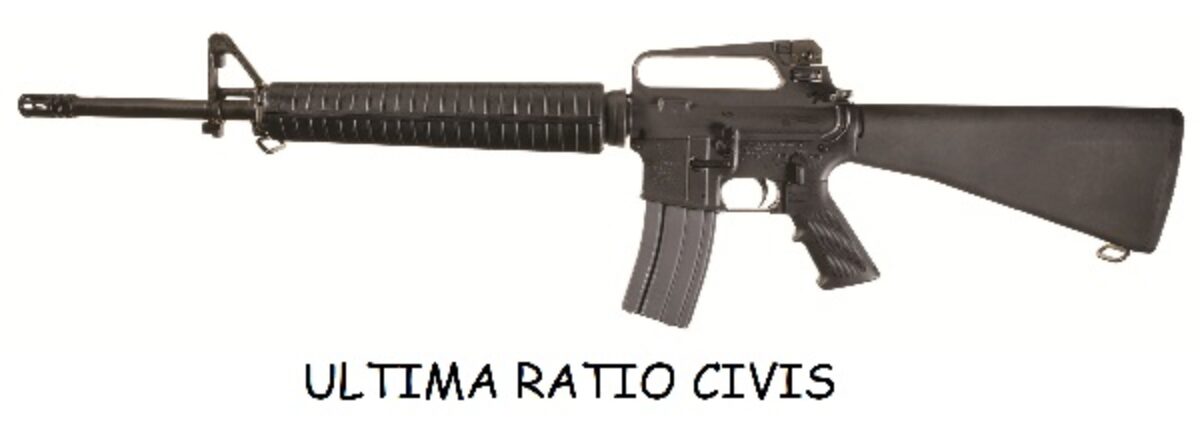

“Before a standing army can rule, the people must be disarmed; as they are in almost every kingdom of Europe. The supreme power in America cannot enforce unjust laws by the sword; because the whole body of the people are armed, and constitute a force superior to any band of regular troops that can be, on any pretence, raised in the United States.”
Noah Webster, An Examination of the Leading Principles of the Federal Constitution, 1787
July 18, 2026

In a long-awaited opinion, the Third Circuit Court of Appeals has released its en banc decision in a trio of cases challenging New Jersey’s ban on so-called assault weapons and large capacity magazines, holding that the ban violates the Second Amendment’s protections for the right to keep and bear arms.
Besides the majority opinion, there are five opinions concurring either in whole or in part, along with three dissenting opinions, so Second Amendment attorneys and amateur law nerds like myself will have a lot of reading to do this weekend. Here’s the most important part of the majority opinion as an appetizer.
Applying the framework announced in New York State Rifle & Pistol Association v. Bruen, we agree with the District Court that New Jersey’s ban on Colt AR-15s violates the Second Amendment. However, because the record supports the same result for all semi-automatic rifles—not only Colt AR-15s—we will MODIFY the District Court’s order so that it deems the Assault Firearm Provisions unconstitutional with respect to the full class of semi-automatic rifles. We will AFFIRM that part of the order as modified.
The LCM Provisions also violate the Second Amendment, so we will REVERSE the District Court’s order with respect to those. Because the LCM Provisions violate the Second Amendment, we need not address the Takings Clause challenge.
While other circuit courts have upheld “assault weapon” bans by claiming they’re “dangerous and unusual” (or “unusually dangerous”), are not commonly-used for self-defense, and so close to machine guns that they’re not even protected by the Second Amendment, the Third Circuit rejected each and every one of those claims.
Government Throws in Towel on Defending Post Office Gun Ban
The U.S. Justice Department this week signaled it would no longer defend against a challenge to the federal ban on firearm possession, storage, and carry at U.S. Post Offices.
The government filed a motion with the U.S. Fifth Circuit in New Orleans to voluntarily dismiss its appeal of FPC v. Blanche, a gun rights group’s victory against the post office gun ban. A lower court in Oct. 2025 found the ban unconstitutional, citing that the first mail service in America was established in 1639, but the USPS waited until 1972 to specifically prohibit firearms on postal property.
Until this week, the government was still doggedly standing by the ban on appeal.
“The Trump DOJ spent far too long defending an immoral and unconstitutional ban that treated peaceable Americans like criminals,” said FPC President Brandon Combs in a statement. “Now, after losing on the merits and failing to gut the relief protecting our members, the government is finally waving the white flag. Good.”
For now, the victory in FPC v. Blanche protects members of the FPC and the Second Amendment Foundation, pending further challenges, rulings, and possible repeal of the ban by the USPS.
MOTION FOR SUMMARY JUDGMENT FILED IN CASE CHALLENGING UNLAWFUL SEARCH
BELLEVUE, Wash. — July 16, 2026 — The Second Amendment Foundation (SAF) has filed a motion for summary judgment in a case challenging the unconstitutional search of an 18-year-old high school senior’s vehicle that was based solely on the knowledge that he is a legal gun owner.
The case, Harrington v. Crawford, stems from an unlawful search of Hillsboro-Deering High School student Jack Harrington’s vehicle while it was parked on school grounds. Based only on an overheard conversation that Harrington lawfully owned a firearm, he was subjected to aggressive interrogation which culminated in his vehicle being searched without consent. No firearm was found during the illegal search as it was safely stored at his home, nowhere near the school campus.
“Entirely lawful and constitutionally protected conduct cannot be the grounds for a search,” said SAF Senior Director of Legal Operations Bill Sack. “School officials, especially when accompanied by law enforcement as was the case here, need at minimum reasonable suspicion to search a student’s vehicle. Here, those officials learning that our client was a gun owner gave them that suspicion. They are mistaken. If that were the case, student gun owners all over the country could be subject to repeated and endless harassment.”
As noted in the motion, “Defendants relied upon a week-old, stale report of a single comment made by Jack and overheard by an assistant coach…relating to Jack’s storage of his handgun in the glove box of his truck while at a gas station nowhere near campus – indisputably legal and constitutionally protected conduct. At no point during the interrogation, the search, or at any time since, have defendants brought forth a single shred of evidence of unlawful conduct by Jack. Moreover, defendants confirmed that they did not view Jack as a threat to school safety; they did not believe Jack had a weapon on his person during the interrogation; and Jack had no previous disciplinary issues.”
“District officials – and even a school resource officer who should know better – took it upon themselves to violate the constitutional rights of a peaceable, adult, firearm owner for no other reason than they learned of his status as a gun owner,” said SAF founder and Executive Vice President Alan M. Gottlieb. “This young man was interrogated and coerced into allowing school officials to search his vehicle because he chooses to exercise his rights as a private citizen. Law enforcement and school officials are required to understand the law and to follow it, and in this case, it appears they failed at both.”


The right of the people to keep and bear arms has been recognized by the General Government; but the best security of that right after all is, the military spirit, that taste for martial exercises, which has always distinguished the free citizens of these States….Such men form the best barrier to the liberties of America
— Gazette of the United States, October 14, 1789.
July 17, 2026
Even The Trace Admits We’re Seeing More Guns and Less Crime
The gun control movement is based on a simple premise: more guns lead to more crime, and the only way to truly make the United States safer is to reduce the number of firearms in circulation.
When the modern gun control lobby got started in the 1960s, that idea seemed somewhat logical. Violent crime kept going up, and every year more and more guns were added to the mix. In 1991, though, violent crime peaked and then started its decade-long decline, but we continued purchasing millions of firearms each year.
From the early 1990s to 2020, violent crime and homicides fell by more than 50 percent, and after a brief spike during the COVID pandemic they are once again plummeting, this time to lows not seen since at least the 1960s, and probably not for a century or more. The number of privately-owned firearms, meanwhile, has grown to more than 400 million according to most estimates.
Even Michael Bloomberg’s anti-gun “news” site The Trace can’t ignore the fact that while gun sales are rising, crime is dropping.
Gun violence is down, significantly, as gun sales are ticking up for the first time in years.
… Shooting deaths and injuries remain at historic lows in the United States, continuing the trend seen in Q1 and in recent years.Data from the Gun Violence Archive shows 6,458 shooting deaths, and 11,781 shooting injuries in the first six months of the year. Both represent the lowest number since 2015.
The per-capita figure of 1.9 shooting deaths per 100,000 Americans is also the lowest in that span.
Still, a few states have seen increases in shooting deaths, including New Hampshire, Connecticut, Iowa, and Massachusetts. These are smaller population states, so a few incidents can have a big impact; a June mass shooting in Iowa helps explain that state’s increase this year.
Two of those states also have incredibly restrictive gun laws, which is yet another bit of evidence that gun control doesn’t stop violent criminals.
While The Trace admits that “gun violence” is down and gun sales are up, it does try to minimize the increase in gun purchases.
An estimated 7.3 million firearms have been sold in the United States — about 4.5 million handguns and another 2.8 million long guns. That would be enough to arm every single resident of Tennessee.
The numbers represent a 2.7 percent increase in gun sales through six months compared to 2025. This marks the first time in six years that we’ve seen an increase in sales.While the uptick is notable, the raw total is still lower than any year from 2020 to 2024.
A handful of states are posting huge increases compared to the first six months of last year. These include three states where legislation to restrict gun buying advanced or took effect:
- Virginia, where a suite of gun safety laws, including a currently paused ban on assault-style weapons, were signed by Governor Abigail Spanberger. The state’s gun sales soared 73 percent this year. The state’s 117,802 sales in June 2026 were the highest of any state, despite Virginia ranking 12th in population.
- Connecticut, where dealers say a proposed “Glock ban” propelled an increase of 25 percent.
- Rhode Island, where a ban on assault-style weapons took effect on July 1, 2026. In the first six months of the year, gun sales climbed 86 percent higher than in 2025.
Yes, when Democrats try to ban guns, it leads to a lot of people purchasing them. Go figure.
While this is the first time in six years that gun sales are up year-to-year, it’s not like sales have been non-existent. In the first six months of 2025, for instance, The Trace says there were 7,093,785 gun purchases. Compare that to the 4,539,309 purchases in the first half of 2010, and it’s easy to see that even with numbers off their peak in 2020, the new “normal” is well above what it was just a few years ago.
This year The Trace estimates 7,287,997 firearms have been sold since January. That’s roughly the same number (7,487,384) that were sold in the first six months of 2016. The big difference is that in 2016, that figure was a 16 percent increase in sales compared to the year before, while this year’s increase is a more modest 3 percent. Again, the floor is higher than it was just a decade ago.
If the “more guns equals more crime” theory were correct, then the United States should be seeing record high levels of “gun violence.” Instead, we’re living in what is likely the safest moment in the past 100 years, if not the entirety of U.S. history. With tens of millions of Americans keeping and bearing arms to protect themselves and others, it’s clear that the Second Amendment isn’t at odds with public safety, but is an integral component in keeping the peace.
No Tax, No Excuse: NFA Suppressor and SBR Registry Gun Rights Next Target
New filings argue that three Supreme Court decisions have stripped away the government’s excuses for maintaining a zero-tax federal gun registry. The tax is gone. The registry remains.
The Second Amendment Foundation (SAF) and its partners have opened a coordinated, three-court attack on the National Firearms Act registration requirements for suppressors and short-barreled firearms. Supplemental filings in Brown v. ATF, Jensen v ATF, and Roberts v. ATF argue that three recent Supreme Court decisions leave the federal government with neither a valid taxing-power excuse nor an easy escape from the Second Amendment.
The Jensen filing is part of the consolidated Silencer Shop Foundation v. ATF litigation in Texas, where Silencer Shop Foundation and allied plaintiffs are pursuing a parallel challenge to the NFA registry.
Congress Zeroed the NFA Tax but Kept the Registry
Congress reduced the NFA making and transfer tax on suppressors, short-barreled rifles, short-barreled shotguns, and “any other weapons” to zero in the One Big Beautiful Bill. Washington, however, kept the paperwork, fingerprints, registration, prior approval, and felony penalties.
That creates the question now confronting federal courts: If the registry existed to collect a tax, what constitutional authority supports it when Congress no longer collects that tax?
SAF says the Supreme Court’s decision in Landor v. Louisiana Department of Corrections & Public Safety reinforces the answer: none. Congress cannot stretch the Necessary and Proper Clause into an independent police power, then impose a burdensome registration scheme on Americans who owe no tax.
The Jensen filing puts the point bluntly. Maintaining registration on untaxed citizens, plaintiffs argue, would permit Congress “to regulate in minute detail the activities of untaxed Americans.”
That should concern every gun owner. A federal agency should not be able to preserve a national weapons database merely because the database once accompanied a tax.
Supreme Court Rulings Strengthen the Second Amendment Challenge
The Second Amendment attack may be even more consequential. SAF argues that Wolford v. Lopez and United States v. Hemani require courts to apply the Supreme Court’s text-and-history test instead of inventing special exemptions for NFA regulations.
According to the filing, a suppressed firearm is a form of an arm, while a short-barreled rifle is “indisputably” a form of an arm. Once protected conduct is implicated, the government bears the burden of proving that its restriction is consistent with America’s historical tradition of firearm regulation.
The filing also takes direct aim at the Fifth Circuit’s decision in United States v. Peterson, which treated NFA registration as comparable to a presumptively lawful shall-issue licensing system. The plaintiffs contend that Wolford “leaves no room for a carveout” from the required Second Amendment analysis and therefore abrogates Peterson on that point.
That licensing comparison was always strained. Licensing evaluates whether a person is legally disqualified. Registration creates a government record of particular weapons and their owners. As the Jensen filing explains, “Registration, by contrast, focuses on tracking firearms and who owns them.”
Three NFA Lawsuits Target the ATF Registry
In a press release, SAF Senior Director of Legal Operations Bill Sack said: “When the Supreme Court rightly ruled in favor of Landor, Wolford, and Hemani, the precedent set had a direct impact on SAF’s ongoing NFA challenges.
With those rulings in hand, we are now able to better explain to the courts exactly why the remaining registration scheme left in the NFA lacks constitutional authority and is a direct violation of Americans’ Second Amendment rights. We are hopeful these cases will move expeditiously and rightfully restore the full constitutional rights of gun owners across the nation.”
“There is no doubt the Supreme Court’s rulings this past term have direct bearing on our current challenges to the NFA’s remaining registration scheme,” said SAF founder and Executive Vice President Alan M. Gottlieb.
“The relevant district courts should recognize the rulings for what they are – binding precedent that bolsters SAF’s arguments in these three cases.
The One Big Beautiful Bill eliminated the tax for suppressors and short-barreled firearms, and it’s now time to remove the registration burden so citizens can exercise their right to keep and bear arms without fear of being placed on some government list.”
The burden is now where Bruen put it: on the government. ATF must identify a historical analogue, not wave at modern licensing practices and demand judicial deference. The government now faces a problem it cannot solve with slogans about licensing or administrative convenience.
No tax means no taxing-power excuse. Protected arms mean the Second Amendment applies. And a government list of firearms and their owners is exactly what it looks like: registration.
Supreme Court Ducks the 1791 vs. 1868 Second Amendment Fight—Again
“The United States Supreme Court has now refused again to decide this big fight between when you interpret the Second Amendment, whether it’s the year of our Lord 1791 when it was written, or is it 1868 after the Civil War, with the adoption of the 14th Amendment,” constitutional attorney and host of The Four Boxes Diner Mark W. Smith informed his followers Monday. “After the Civil War, there were three constitutional amendments that were adopted to basically expand the Bill of Rights … to all Americans, not just as applied against the federal government, preventing the federal government from stopping you from exercising these rights, but also making sure that states and local governments could no longer impact or infringe on your rights as well.”
The technical holdup is essentially one of emphasizing due process and ignoring privileges and immunities, which to a layperson seems a bit like arguing how many angels can dance on the head of a pin. Legal precedents aside, there’s a more basic argument: The Constitution and Bill of Rights were ratified based on the understanding of the people and their representatives with debates based on arguments posited in the Federalist and Anti-Federalist essays. There has never been a magic crystal ball that allows decisions to be based on what will happen in the future.
And while it’s inarguable that the Fourteenth Amendment mandates “No State shall make or enforce any law which shall abridge the privileges or immunities of citizens of the United States; nor shall any State deprive any person of life, liberty, or property, without due process of law; nor deny to any person within its jurisdiction the equal protection of the laws,” another basic question needs to be explored:
Would the Framers have thought it necessary?
“The Founders Intended for the Bill of Rights to Apply to the States,” Second Amendment writer Brian Puckett concluded back in 2001. “[I]f we set aside any Supreme Court decisions relating to that matter, we are left with the writings of the Founders and – most important of all – the actual legal document they produced, the Constitution and its first ten Articles of Amendment.”
“Who is this guy and what are his legal qualifications to make such an assertion?” seems a legitimate question only if one ignores the arguments he makes and the questions he raises, which then makes such a challenge ad hominem, that is, a logical fallacy. What has to be refuted and dismissed are his assertions, not the man, and he offers some that naysayers need to refute, if they can.
Proof of this understanding is contained in a passage from William Rawle. In his book View of the Constitution, published in 1829, Rawle wrote about the Second Amendment: “No clause in the Constitution could by any rule of construction be conceived to give the Congress a power to disarm the people. Such a flagitious attempt could only be made under a general pretence by a state legislature. But if in any pursuit of an inordinate power either should attempt it, this amendment may be appealed to as a restraint on both.” [emphasis added].
In other words, Rawle says that the Second Amendment may be used as a legal argument to quash an attempt by either Congress or a state legislature to disarm the people.
It cannot be any clearer that Rawle – a contemporary of the Founders and the man to whom George Washington offered an appointment as the first U.S. Attorney General – understood that the Second Amendment (and by extension the entire Bill of Rights) applied to the state governments as well as to the federal government. Keep in mind that View of the Constitution was the standard constitutional law text at Harvard until 1845 and at Dartmouth until 1860.
Rawle’s was not the only voice.
“The man most involved in writing the Constitution, James Madison [argued] for adding a national bill of rights by pointing out that some states have insufficient bills of rights,” Puckett added. “The logical implication is that this national bill of rights will correct the problem of states that have insufficient bills of rights. Therefore, he is acknowledging that the national bill of rights will apply to the states.”
There’s another historical/legal example – from the Supreme Court — that predates the Fourteenth Amendment that must also be considered, and that was in the Dredd Scott decision, which noted:
“It would give to persons of the negro race, who were recognised as citizens in any one State of the Union, the right to enter every other State whenever they pleased, singly or in companies, without pass or passport, and without obstruction, to sojourn there as long as they pleased, to go where they pleased at every hour of the day or night without molestation, unless they committed some violation of law for which a white man would be punished;
and it would give them the full liberty of speech in public and in private upon all subjects upon which its own citizens might speak; to hold public meetings upon political affairs, and to keep and carry arms wherever they went.” [Emphasis added]
Stipulating that I’m not a lawyer versed in the intricacies of case law, just a citizen who somewhat knows how to read, I’ve seen those who are qualified admit stare decisis über alles may not be what the Founders intended, particularly when it comes to the Bill of Rights. So don’t take this as a critique of admittedly more formally educated Second Amendment scholars. I’m not trying to start a fight.
Consider it instead a hope that they’ll add the Rawle, Madison, and Scott examples to the arguments they’ll want the High Court to consider – or cogently explain to the rest of us why they’re irrelevant in determining Founding intent.
July 16, 1945, 5:29 a.m. Mountain War Time
As part of the Manhattan Project, the test of an implosion design plutonium bomb -the same design as the Fat Man bomb later detonated over Nagasaki, Japan, on August 9, 1945 -was successful.


It worked! – Robert Oppenheimer
July 16, 2026
If you ever wondered how people come out of law school with such a twisted view of the Second Amendment, read the contorted thinking from the dean of the UC Berkeley School of Law. 🙄
Read more at: https://t.co/5jD6s3Zvxa https://t.co/iWKVZ9IA8D
— Tom Gresham (@Guntalk) July 15, 2026