
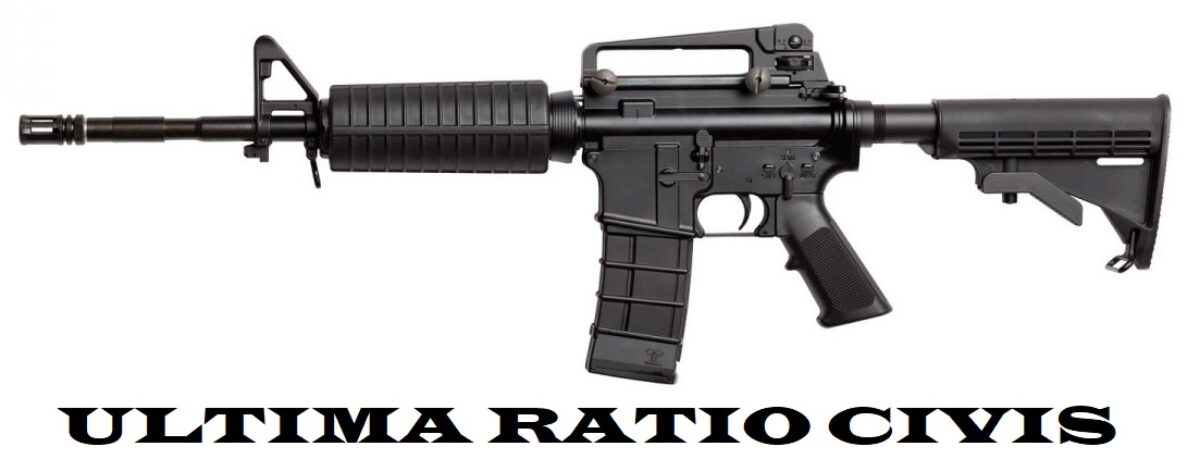

30 uniformed officers passing a log instead of loading them into a wheelbarrow and dumping them.
The US Goverment everyone! https://t.co/FcPzWuOnhd
— Louis vil LeGun 🍌 Notorious T.A.C.O. (@LouisvilleGun) October 18, 2024
October 19, 2024


BLUF
It has always been a scam about money to say the science is settled. It is as factual as the lie about having to stay six feet apart to protect against COVID
CNN fearmongers about Antarctica greening at an ‘alarming’ rate
A new “climate change” article from CNN, like all the continuous articles on the weather, storms, or warming, is meant to scare people into capitulating into completely changing their way of life. The media just regurgitates what they are told without asking questions or doing research, pushing the green agenda to confiscate more money and power for the government. Our freedom and prosperity are at risk because of this agenda.
Here are some excerpts from the article and comments:
Parts of icy Antarctica are turning green with plant life at an alarming rate as the region is gripped by extreme heat events, according to new research, sparking concerns about the changing landscape on this vast continent.
Scientists used satellite imagery and data to analyze vegetation levels on the Antarctic Peninsula, a long mountain chain that points north to the tip of South America, and which has been warming much faster than the global average.
They found plant life — mostly mosses — had increased in this harsh environment more than 10-fold over the past four decades, according to the study by scientists at the universities of Exeter and Hertfordshire in England, and the British Antarctic Survey, published Friday in the journal Nature Geoscience.
Plant life increased 10 fold over forty years. That sounds like a lot doesn’t it? But, in reality, it increased from .4 square miles to 5 square miles.
Vegetation covered less than 0.4 square miles of the Antarctic Peninsula in 1986 but had reached almost 5 square miles by 2021, the study found. The rate at which the region has been greening over nearly four decades has also been speeding up, accelerating by more than 30% between 2016 and 2021.
For reference, Antarctica is 5.5 million square miles and the Antarctic Peninsula is 202,000 square miles; in other words, five square miles is .00002% of the 202,000 total square miles. Be very afraid!
After Israel announced the IDF’s elimination of Sinwar in Rafah yesterday, Vice President Harris made a congratulatory statement (White House transcript here, video clip below). This statement should fill a normal person with disgust.
🚨 Kamala speaks out about Sinwar.
“Know this, we will always bring you to justice”
Wait a minute… We? Sinwar was found in Rafah.
Wasn’t it Kamala who said going into Rafah would be a “huge mistake”?pic.twitter.com/quvg3jO7oR
— Kosher🎗🧡 (@koshercockney) October 17, 2024
The news of Sinwar’s death serves as an indictment of the judgment of President Biden’s and Vice President Harris’s disparagement of Israel’s conduct of the war on Hamas. To take the pertinent example of Biden administration harassment, they spent months warning Israel against an invasion of Rafah. Biden said going into Rafah was a “red line” for him while Harris warned there would be “consequences” because she “studied the maps.” See NRO’s editorial comment in This Week (behind the NRO paywall). Biden’s statement yesterday included the usual ceasefire blather (White House transcript here).
The comment below makes the closely related point. It’s not enough that these people are idiots. They are also frauds.
In the immediate aftermath of Sinwar’s death, the Biden crew claimed to have assisted Israel with the intelligence that facilitated it. See National Security Advisor Jake Sullivan’s comments here. Putting to one side the obstacles Biden and Harris have erected to Israel’s operation in Rafah, Michael Doran summarizes how it went down in the X post below.

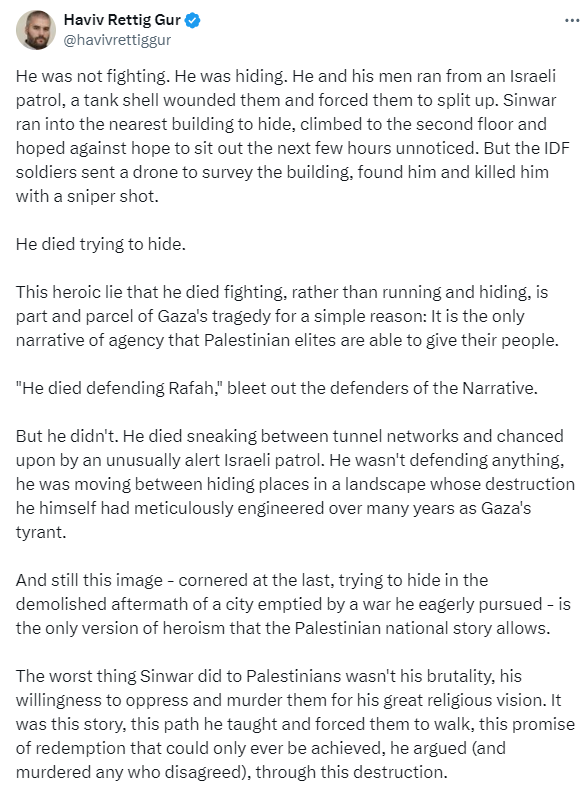
Haviv Rettig Gur is an excellent Israeli reporter. He comment on Sinwar’s death in the X post below.
New Mexico governor won’t renew ban on carrying firearms in public
New Mexico Gov. Michelle Lujan Grisham said she will not renew a public health order that temporarily banned carrying firearms in public parks and playgrounds in Albuquerque, the state’s largest city.
The temporary order, which went into effect in September 2023, was intended to slow gun violence in the metro area, but high-ranking state officials, gun advocates and members of her own Democratic Party widely viewed it as a violation of the Second Amendment right to bear arms.
The order drew lawsuits from national gun rights and advocacy groups, which forced her to narrow its scope from applying to public places throughout Bernalillo County to applying to parks and playgrounds in Albuquerque.
Lujan Grisham said in a news release Wednesday that more than 1,700 firearms were collected in gun buybacks over the past year because of the order. She also said it had reduced the number of gunfire incidents in the area, but she did not cite any numbers.
Lujan Grisham, who was unavailable for comment Thursday, said in the news release, “The public health order, though temporary, allowed us to implement urgent and necessary measures that have had a measurable, positive effect on public safety in our state.”
State Senate Republican leader Greg Baca said Thursday that he did not support the order.
“From the onset, the governor’s action was unconstitutional and an easy distraction to keep from curbing the crime epidemic gripping our state,” Baca said in a statement. “Unfortunately, the feckless shell of the original order stood for over a year.”
The National Association for Gun Rights filed a lawsuit against the action last year; it was dismissed after Lujan Grisham scaled back and modified her policy.
“This is a win for gun owners,” said Dudley Brown, the association’s president. “This is a quiet way to admit her plan didn’t work.”
Bernalillo County Sheriff John Allen, a Democrat who decided not to enforce the ban because he believed it was unconstitutional, could not be reached for comment Thursday.
Allen said last year: “This order will not do anything to curb gun violence other than punish law-abiding citizens from their constitutional right to self-defense. It’s unconstitutional. So there’s no way we could enforce that order.”
Lujan Grisham issued the temporary order, originally a 30-day ban, in September 2023 after an 11-year-old boy was shot and killed in an Albuquerque park.
In addition to restricting firearms in public parks and playgrounds in Bernalillo County, it strengthened oversight of firearm sales and implemented wastewater testing for fentanyl in public schools.
State Attorney General Raúl Torrez, a Democrat, wrote in a letter last year that he opposed Lujan Grisham’s decision.
“Simply put, I do not believe that the Emergency Order will have any meaningful impact on public safety but, more importantly, I do not believe it passes constitutional muster,” he wrote
The government school system has become more of a jobs program for adults than an education initiative for kids.
Abolish the Department of Education. pic.twitter.com/988vP81ieD
— Corey A. DeAngelis, school choice evangelist (@DeAngelisCorey) October 17, 2024
Shades of Commie East Germany and its STASI
The “monkey wrench” is for lots of tips on the demoncraps.
Michigan And Hawaii Launch Tip Lines To Encourage Anonymous Snitching On Gun Owners
Michigan and Hawaii, both Democrat-led states, have launched taxpayer-funded tip lines for individuals looking to report perceived firearms violations anonymously. While these dumpster fire states claim the lines are aimed at lawbreakers, Second Amendment groups are reasonably skeptical, as they should be, because such a system can easily be abused. Let’s face it, we know that the weaponization of this service against law-abiding gun owners is exactly what they are intended for.
On Thursday, October 10, Hawaii’s Democrat Governor Josh Green announced the state’s Department of Law Enforcement had established a confidential “Gun Tip Line for people to make anonymous reports of illegal gun ownership and gun crimes,” where tipsters can either call, text or drop a dime via the DLE’s website or a downloadable app where they can submit photographs and videos to back up their report.
The governor’s office went even further during the brown shirt recruiting exercise saying, “People reporting tips are encouraged to leave detailed information including the names of those in possession of illegal guns or committing gun crimes, a location where those people may be found and a description of the guns.” Sure, what could go wrong when hiring unpaid, untrained, overzealous, anti-Second Amendment sycophants typically knowing very little about firearms to play the role of a detective, spying on and recording their neighbors?
Meanwhile, Gretchen “Lockdown” Whitmer, known for hosting the most oppressive COVID lockdowns in America while still having more deaths per capita than any neighboring Midwestern states, signed House Bill 5503, a measure passed off as an education funding bill that allocates $1 million in School Aid Funding to support an anonymous tip line for students to report firearms thought to be “improperly stored.”
The bill goes on to mandate that Michigan’s Department of Education develop materials concerning improper storage of firearms, including tip line usage, and distribute those materials to school districts across the state. The Gestapo may not pay you for your work, but you will receive free training, whether you want it or not.
As the NRA-ILA points out, language regarding the tip line was added to the bill as an amendment that was then swiftly passed by the Democrat-controlled legislature.
“The expedited pace and the silencing of opposition when the bill came up for a floor vote underscores the reality that this was a political move and another attack on gun owners,” says the NRA.
These tiplines will ultimately create a situation that will lead to wasted resources, unwarranted confrontations with law enforcement and what could amount to unconstitutional searches of homes, businesses and other private property based on vendettas and other nefarious agendas. Not only does this negatively impact the community’s relationship with authorities, but those who abuse the tip lines will undoubtedly drive wedges within communities as well, drawing lines at a time when we need to be working together to strengthen and solidify those connections.
October 18, 2024
Yahya Sinwar is dead. What we know about death of Hamas leader behind Oct. 7 attacks
Yahya Sinwar, the elusive leader of Hamas regarded as the mastermind behind the militant group’s brutal attack on Israel last year, is dead.
Israel said Thursday it killed Sinwar during a military operation in Gaza.
Hamas has yet to comment, and it was not immediately clear what impact Sinwar’s death will have on the Israel-Hamas war.
Here’s what we know:
What’s the latest on the death of Hamas leader Yahya Sinwar?
Israel’s Defense Forces announced it had killed three Hamas militants during a military operation in Gaza on Thursday and was investigating whether one of them was Sinwar.
A U.S. official who spoke on the condition of anonymity said Israel was conducting DNA tests on the victim’s body to determine if it was Sinwar.
Israel’s Foreign Minister Israel Katz later confirmed Sinwar’s death.
“This is a significant and moral achievement for Israel and a victory for the entire free world against the axis of evil of radical Islam led by Iran,” Katz said in a statement.
A second U.S. official, also speaking on the condition of anonymity, said it appears Sinwar may have been killed in a mortar attack.
Katz said Sinwar’s death “opens the possibility” for the immediate release of the remaining hostages taken during Hamas’ attack on Israel last year and “paves the way for a change that will lead to a new reality in Gaza.”
Who is Yahya Sinwar?
Sinwar was the leader of Hamas, which staged a surprise attack on Israel on Oct. 7, 2023, killing 1,200 people and taking 250 hostages. He was considered one of the architects of the attack, which touched off a bloody war between Israel and Hamas that, according to the Hamas-run Gaza Health Ministry, has resulted in the deaths of more than 42,000 Palestinians.
Sinwar, 61, had been in charge of daily operations in Gaza before the Hamas’ Oct. 7 attack. He was declared Hamas’ political leader after his predecessor, Ismail Haniyeh, was killed in July by a bomb hidden in his guesthouse in Tehran.
Dubbed “The Face of Evil” by Israel, Sinwar was known for operating in secrecy, moving constantly and using trusted messengers for non-digital communication, three Hamas officials and one regional official told Reuters. He had not been seen in public since the Oct. 7 attack on Israel and was believed to be hiding in the network of tunnels that Hamas used to conceal weapons, fighters and hostages
I have read reports that still of today, formal charges have yet to be filed.
Arkansas dad arrested, accused of fatally shooting man found with missing child
LONOKE COUNTY, Ark. (KARK) – Officials in Arkansas said a man is facing a murder charge after a confrontation turned deadly early Tuesday morning.
According to authorities, deputies with the Lonoke County Sheriff’s Office responded to a home shortly after 1 a.m. after a juvenile was reported missing.
The deputies were told on the way to the home that Aaron Spencer, the father of the juvenile, had found the juvenile in a car with Michael Fosler, according to officials.
Authorities said there was an altercation between the two men which led to Fosler being shot. Officials said Fosler was pronounced dead at the scene.
Deputies said they took Spencer into custody on a preliminary charge of first-degree murder, and he was taken to the Lonoke County Detention Center.
As of Monday, no formal charges have been filed against Spencer, and no additional details have been released.
A woman claiming to be Spencer’s wife claimed they had a no-contact order for Fosler, accusing him of stalking their child.
In an online fundraiser, the woman said Spencer began driving around to search for their child after discovering she was missing. She explained that her husband happened to pass a man driving with their child in his vehicle and chased him.
“The chase ended in an accident. Aaron was able to retrieve our child alive, but in the process he was attacked and did what he had to do to protect himself and our minor child,” the woman wrote. She added that they are working to “retain a legal team” to help keep her husband, a combat veteran, “home with us where he belongs.”
“We are private people, so all of this being public has been very difficult,” she wrote on Facebook last week.
Lonoke County Sheriff John Staley told USA Today that Fosler, the man who was killed, was arrested earlier this summer for internet stalking of a child and sexual assault, but was out on bond. He added that his agency was investigating what led to the Oct. 8 incident.
New Minnesota tourism ad dropped 🦅 pic.twitter.com/AALm8gdYCK
— Mrgunsngear (@Mrgunsngear) October 16, 2024
October 17, 2024
TPTB have always been scared to the point they wet themselves that the peons possess the means to eliminate them from the equation.
It became even more scarier when reliable weaponry that can either smite from a distance, or be easily carried and concealed, was developed.
We’re going to see if this still holds basically true, or if our Supreme Justices can override the goobermint’s fear that those in power can be help to ultimate consequences.
Perhaps the Most Concerning Comment on Vanderstock
At least, they exist until after the Supreme Court rules on Vanderstock v. Garland.
As we’ve noted previously, though, the odds don’t look good for pro-gun folks. It seems the Court had at least some interest in keeping the rules in place, which is troubling because it seems pretty clear to me that the ATF overstepped.
However, there was one comment that bothered me more than just about anything else I saw come out of the arguments.
“Drilling a hole or two, I would think, doesn’t give the same sort of reward that you get from working on your car on the weekends… My understanding is that it’s not terribly difficult for someone to do this,” said Chief Justice John Roberts.
While it’s easy to ridicule the Chief Justice for this misguided statement, it’s important to consider his sources for the hyperbole, the ATF and the Biden administration.
“Drilling a hole or two” is a demonstrably dishonest take on the process, and I would have particularly enjoyed seeing a kit laid out in front of the Justices for a hands-on show of how “not terribly difficult” it is.
This would have been good for a few laughs.
Representing manufacturers and groups opposing the rule, Peter Patterson pointed out that building the kits is far more complicated than the administration has suggested, however, Patterson wisely remained grounded in his argument, staying with the facts and nature of the litigation, which had nothing to do with how easy or difficult a kit is to build, and everything to do with the ATF overstepping its authority.
Since the conclusion of the day’s oral arguments, the mainstream media has touted the Supreme Court’s disposition during the hearing as signaling a tendency towards the ATF and Biden administration’s arguments regarding lack of manufacturing difficulty and the potential for prohibited individuals to purchase kits and build them at home for criminal intent.
I will point out, however unnecessarily, that violent crime has been around long before 80% receiver kits, and violent criminals have never had an issue arming themselves, sometimes aided by our own government. Just ask Barack Obama and Eric Holder about Operation Fast and Furious.
All of that is absolutely true, of course. It’s a good deal more complicated than just drilling a couple of holes and calling it good, which is why the ATF’s argument regarding how “readily” it can be turned into a firearm is wrong and should be overturned.
But I’m bothered by Roberts’s statement about how it does give “the same sort of reward” that one might get from working on their car.
I wasn’t aware that was the legal threshold for our rights, whether or not a judge finds it satisfying.
Especially when I don’t find working on my car particularly rewarding. If I’m working on my car, it’s because something isn’t right and I can’t afford to take it to a mechanic. Since that’s what my son does for a living now, that’s rare, but that’s how it’s been in the past. For me, it was a task that needed to be accomplished, not something I found enjoyment in.
That’s kind of how hobbies work, though. Some people are really into DIY projects like renovating their bathroom. Others do it because they need the bathroom fixed and can’t afford to hire someone. The first group is the amateurs in the original sense of the word–those who do something for the love of it–while the others aren’t necessarily finding any sense of reward, necessarily.
Some people get a charge out of collecting stamps while others only buy them now to pay bills that don’t have an online presence for whatever reason.
Yet Roberts’s comment, while possibly meaningless, suggests that the justice might well consider whether they see this as a real hobby or not, and if they don’t because they, personally, don’t see anything fun in making one’s own firearms, we have a big problem.
Alleged Carjacker Shot And Killed At Gas Station South Of Boca Raton
BROWARD COUNTY, FL .
A man apparently trying to steal a car — with a mom and her kids inside — is dead after witnesses allegedly opened fire and killed the man. It happened Sunday afternoon in Pompano Beach. The Broward Sheriff’s Office shared these details with BocaNewsNow.com:
Detectives with the Broward Sheriff’s Office Homicide Unit are investigating the circumstances surrounding a deadly shooting in Pompano Beach. At approximately 4:58 p.m. on Sunday, Oct. 13, BSO deputies and Pompano Beach Fire Rescue responded to a disturbance and possible shooting in the parking lot of the RaceTrac located at 599 W. Atlantic Blvd.
On scene, emergency crews located Brian Semil suffering from a gunshot wound. He was transported to Broward Health North where he was pronounced deceased. BSO’s Homicide and Crime Scene units responded to conduct an investigation into the circumstances of the shooting.
The preliminary investigation reveals that Semil tried to forcibly enter a vehicle that was occupied by a mother and her children. Three males intervened and prevented Semil from entering the vehicle. At some point during this altercation, one of the three individuals discharged his weapon, striking Semil. All three and additional witnesses remained on scene and cooperated with investigators. Detectives say, upon completion of their investigation, the case will be presented to the Broward County State Attorney’s Office for review.
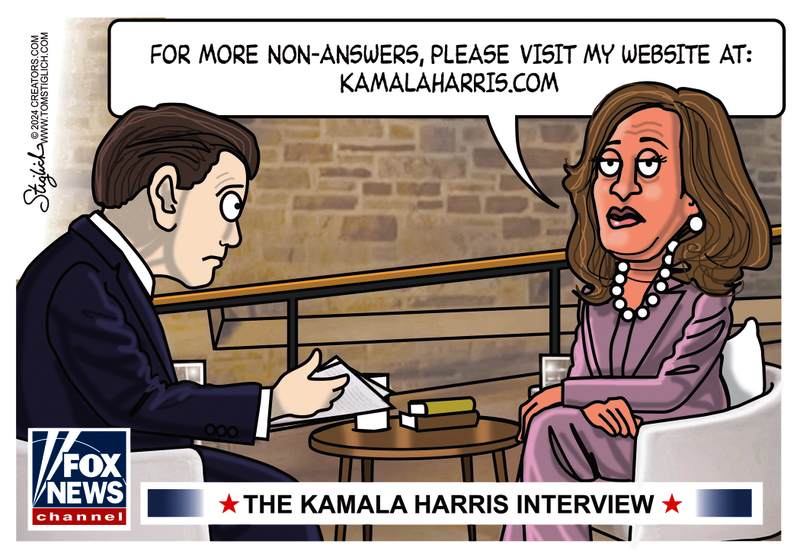
This is Kamala Harris' entire interview with Bret Baier, the first time she ever had somebody actually challenge her in this entire election.
Imagine watching this and thinking to yourself that this person should be President of the United States.pic.twitter.com/bBMfr6jdmS
— Greg Price (@greg_price11) October 16, 2024