October 3, 2024

1990 – Tag der Deutschen Einheit. The German Democratic Republic is abolished and becomes part of the Federal Republic of Germany

1993 – An American attempt to capture a warlord in Mogadishu fails, resulting in 18 US soldiers being killed, and 1 taken prisoner.


Terror royalty: Nasrallah’s son-in-law killed in airstrike on Damascus, days after brother – report

Hassan Jafar Qassir’s reported assassination is another severe blow to Hezbollah as its leadership has been slowly picked off in Israeli operations.

Hassan Nasrallah’s son-in-law, Hassan Jafar Qassir, may have been killed in airstrikes in the Mezzeh neighborhood in Damascus on Wednesday, according to early reports published by Sky News Arabic.

Hassan is the brother of Muhammad Jafar Qassir, who was killed in a strike in Beirut on Wednesday during the Iranian attack on Israel.

Hassan’s assassination is another severe blow to Hezbollah as its leadership has been slowly picked off in Israeli operations.

Qassir brothers 

The Qassir brothers have been deeply involved in terrorism since at least the 1982 Lebanon War, when on November 11, Ahmad Qassir drove his car into an Israeli base in Tyre, detonating the explosives onboard. This marked the first suicide bombing in Lebanese history.

Ahmad was guided by one of Hezbollah’s founding figures, Imad Mughniya, who was mysteriously assassinated in Damascus in 2008.

His death is commemorated every year with “Martyr Day,” in which Hezbollah celebrates suicide bombing.

With the fatwa secured, the Qassir family swiftly became terror royalty, with Ahmad being termed the “first martyr.”

His brothers, Muhammed and Hassan, both rose in the ranks of the nascent Hezbollah.

Muhammed became a leading figure in the deliveries of Iranian weapons from Syria, and Hassan married Hassan Nasrallah’s daughter, cementing their connection to Hezbollah and Iran.

Muhammed became such a notorious figure the US offered a $10 million reward for information leading to his death or capture.

In 2018, the US Treasury Department designated him a Specially Designated Global Terrorist, meaning “among other consequences, all property and interests in property of Qassir that are subject to US jurisdiction are blocked, and US persons are generally prohibited from engaging in any transactions with Qassir.”

According to the sanctions, he helped oversee several front companies that funneled money into Iran’s Islamic Revolutionary Guard Corps, in particular through the sale of oil and other untraceable products.

Marion Hammer Resigns From NRA Board, Talks to AmmoLand News

Marion Hammer, the first female president of the National Rifle Association and veteran gun rights lobbyist in Florida as head of the Unified Sportsmen of Florida (USF), has resigned from the NRA Board of Directors, ending a 42-year tenure as one of the organization’s most powerful voices.

First elected to the board in 1982, Hammer rose through the ranks and served as NRA President for two terms, from 1995 to 1998. She stepped into the role upon the death of then-President Tom Washington, who had suffered a heart attack while hunting deer in Michigan. Standing barely 5 feet tall, Hammer earned a reputation for being a tough and effective proponent of the Second Amendment and the NRA.

In a telephone chat with AmmoLand News, she confirmed that NRA halted grants to maintain USF, so the organization effectively no longer exists.

Hammer, now 85 and with a slightly frail voice, acknowledges what was in an email to an unidentified confidant and which has been published on the website NRAinDanger. In that message, Hammer recalled she had been encouraged to run for the BOD in 1981 by the late Harlon B. Carter. She contacted then-NRA Secretary Warren Cheek, telling him she would run only if nominated by the Nominating Committee, not by petition.

In that message, she also wrote, “The NRA today is both a disappointment and an embarrassment.”

Her resignation is from the board only. She remains a member of the Executive Council, and the only thing she says has changed is that she no longer has a vote as an NRA director, but she still has “a voice.”

“I haven’t been able to go to board meetings for quite a while,” Hammer said. “I made room for somebody who can vote.”

Comments on NRAinDanger were not entirely flattering to Ms. Hammer, reminding readers she was former Executive Vice President Wayne “LaPierre’s most staunch…defender.” However, at least a couple of respondents noted how Hammer “was the tail that wagged the dog for the 2nd Amendment in Florida. And Florida became the tail that wagged the USA to where we now have 29 Constitutional Carry states. What happened in Florida got us to Heller, to McDonald, and to Bruen.”

Another reader responded, “I was on a couple conference calls late 80s early 90s…that she was part of. She truly was a force of nature back then.”

However, others are highly critical, citing, among other things, money she was paid by NRA to lead and operate Unified Sportsmen of Florida.

Continue reading “”

Hawkins: The Government Has No Rights, but the People Do
Although Democrat and other leftist politicians will, from time to time, speak of the government’s ‘rights,’ we must never forget the government has no rights. Only the people have rights and the government, on the other hand, has powers.

Moreover, the government’s powers are delegatory rather than original. In other words, the powers possessed by the government are those which the people delegated to it via the framework of the U.S. Constitution, and those powers are neither ambiguous nor infinite.

This is most easily understood if you think about the U.S. Constitution as establishing a compact between the people and the government, a compact best explained by Thomas Jefferson in the 1798 Kentucky Resolutions.

Jefferson wrote:

Resolved, That the several States composing the United States of America, are not united on the principle of unlimited submission to their General Government; but that, by a compact under the style and title of a Constitution for the United States, and of amendments thereto, they constituted a general Government for special purposes,—delegated to that government certain definite powers, reserving, each State to itself, the residuary mass of right to their own self-government…

Jefferson was strongly impacted by John Locke, who had written, “The liberty of man, in society, is to be under no other legislative power, but that established, by consent, in the commonwealth.”

Jefferson and Locke are saying the same thing, just in a slightly different way. The lesson to be drawn is that the people enter into a “compact” (Jefferson) wherein they “consent” (Locke) to certain a degree of legislative power over their persons as they move about in society.

However, the people retain authority because they possess rights.  Thus Madison, in Federalist 46, observed that “ultimate authority…resides in the people alone.”

It is under this authority the people loan or delegate certain powers to the government via the U.S. Constitution and, with that same authority, the people added the Bill of Rights to hedge in certain, inalienable rights as being outside the government’s purview. Among these inalienable rights is the right to keep and bear arms.

As I highlighted last week, the right to keep and bear arms is not something we as Americans possess because of government benevolence, but something with which our Creator endowed us. It is one of the rights specifically enumerated by our Founding Fathers and hedged in by the Second Amendment. Nowhere in the U.S. Constitution is the government given powers to regulate the ability of the American people to be armed.

Regulation of this natural right is not part of the compact; rather, the complete opposite is true: The government is told in plain English that the rights protected by the Second Amendment “shall not be infringed.”

In summation: The people have rights and the government merely possesses powers. The people’s rights are theirs at birth while the government’s powers belong to it only as long, and in such a fashion, as the people decide they should.

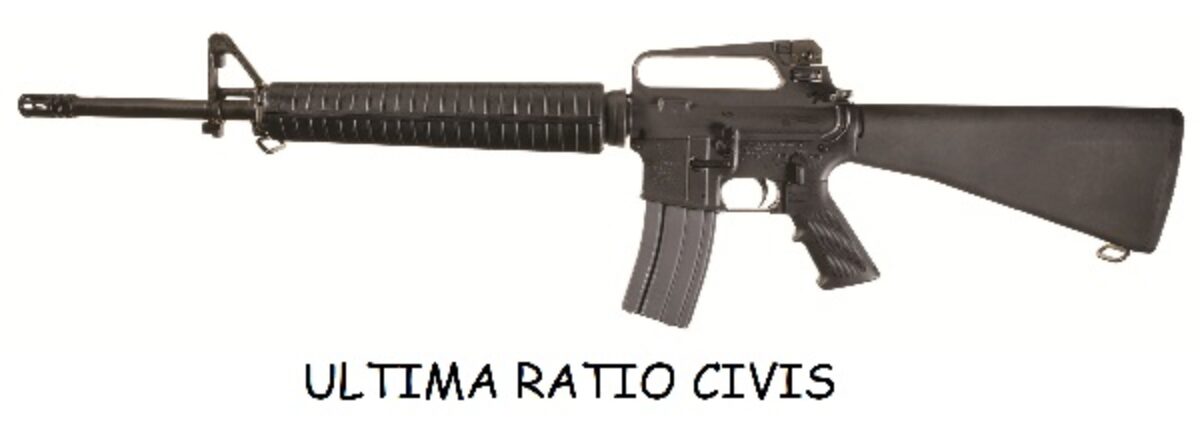
Second Amendment Roundup: Textualism and ATF’s Redefinition of “Firearm”
The statutory history of the Gun Control Act cuts in favor of the VanDerStok respondents.

This is my second installment preceding the upcoming October 8 argument in Garland v. VanDerStok, a challenge to the regulatory redefinition of the term “firearm” in the Gun Control Act.  By expanding the statutory definition, the Bureau of Alcohol, Tobacco, Firearms & Explosives (ATF) in its 2022 Final Rule purports to criminalize numerous innocent acts that Congress never made illegal.

Until the new rule, a kit with partially-machined raw material that can be fabricated into a firearm was not considered to have reached a stage that it is a “firearm.”  To prevent Americans from making their own firearms from such material, which has always been and remains lawful, the bugbear term “ghost guns” was recently coined.  In its VanDerStok brief, the government argues that “anyone with basic tools and rudimentary skills” can “assemble a fully functional firearm” from such kits “in as little as twenty minutes.”

As explained in my last post, that is refuted by none other than the former Acting Chief of ATF’s Firearm Technology Branch, Rick Vasquez, who reviewed and approved hundreds of classifications about whether certain items are “firearms.”  As he explained in his amicus brief, fabrication of a firearm from these kits is a complex process requiring skill and special tools beyond the capacity of the average person.

In this post I’ll trace the statutory history of the term “firearm” to gain insight into its meaning.  The Gun Control Act defines “firearm” as “(A) any weapon (including a starter gun) which will or is designed to or may readily be converted to expel a projectile by the action of an explosive; (B) the frame or receiver of any such weapon….”  18 U.S.C. § 921(a)(3).  An ATF regulation on the books from 1968 to 2022 defined a “frame or receiver” as “that part of a firearm which provides housing for the hammer, bolt or breechblock and firing mechanism,” i.e., the main part of a firearm to which the barrel and stock attach.

Continue reading “”

Teen shot with real gun after botched robbery with replica gun, police say
The would-be victim of the robbery, a 21-year-old man, pulled out his own legally owned handgun and shot the teen, police said.

A 16-year-old was shot in the leg after police said he tried to rob a 21-year-old man with a replica gun in Kensington late Sunday.

Police responded to a report of a person with a gun just after 11 p.m. on the 2200 block of Emerald Avenue, said Police Deputy Commissioner Frank Vanore. When officers arrived, they found the teen with a gunshot wound to his leg and he was taken to St. Christopher’s Hospital for Children where he was listed in stable condition, Vanore said.

Shortly after, officers found the would-be victim of the robbery, a 21-year-old man police did not identify. He told police the teen and another person accosted him, and the teen pulled out what he believed was a real handgun to try to rob him, he said.

The 21-year-old then brandished his legally owned 9mm handgun and fired at the teen, said Vanore.

The 21-year-old man was cooperating with police and had turned over his gun, Vanore said. Officers also recovered the replica firearm they say the teen used to try to rob the man.

Police continued to investigate and were searching for surveillance footage of the shooting. No arrests had been made, nor charges filed.

Just had this brought to my attention: over Labor Day weekend, a legally armed Hawaii man stopped an active shooting situation, fatally striking a gunman who’d driven onto the property during a large family gathering and indiscriminately opened fire. civilbeat.org/2024/09/man-wh
A dispute over a party at a neighbor's property preceded the shooting Saturday night, which left four dead.
Man Who Killed Shooter In Waianae Acted In Self-Defense, Lawyer Says
The gunman managed to kill three woman and injure two others, and the legally armed man was on his own property, defending his own family. Guess who police arrested on “suspicion of murder?” That’s right. The legal gun owner who clearly acted in self-defense.
It took nearly two weeks for investigators to finally determine that, “oh, hey, maybe we shouldn’t prosecute this guy who saved a bunch of lives on his own property just because this is Hawaii and ‘Guns Bad.'” hawaiinewsnow.com/2024/09/20/man
Rishard Keamo-Carnate and his wife, Alison, tell Hawaii News Now their family lived in fear of Silva for three years, and armed themselves because of his threats.
Man who killed Waianae Valley shooter describes moments leading to deadly rampage
According to subsequent interviews, the gunman was a neighbor who’d spent years terrorizing the community. In fact, the legal gun owner had literally procured the firearm entirely because he and his family were afraid of the neighbor who ultimately tried to kill them all.
Oh, also, because Hawaii has magazine capacity laws, the homeowner quickly expended his ammo against the gunman and had to start looking for his second gun. hawaiinewsnow.com/2024/09/19/pro
Rishard Keamo-Carnate was never into guns, but he was protecting his family after Hiram Silva, 58, rammed a front loader into their house and began shooting.
‘I just fired’: Waianae couple recounts horrific attack that led to husband killing neighbor

18th century America was influenced by the “Glorious Revolution” 0f 1688 in ‘mother’ England. And no one had a bigger impact on American attitudes towards freedom of speech than Englishmen John Trenchard and Thomas Gordon, who wrote about it in Cato’s Letter Number 15


Freedom of speech is the great bulwark of liberty; they prosper and die together: And it is the terror of traitors and oppressors, and a barrier against them. It produces excellent writers, and encourages men of fine genius.

Tacitus tells us, that the Roman commonwealth bred great and numerous authors, who writ with equal boldness and eloquence: But when it was enslaved, those great wits were no more.

Postquam bellatum apud Actium atque omnem potestatem ad unum conferri pacis interfuit, magna illa ingenia cessere.
[After the battle at Actium ( when Octavian Caesar defeated Marc Antony) and when all power was brought to one peace (when Octavian was made Emperor Augustus), those great characters ceased.]

Tyranny had usurped the place of equality, which is the soul of liberty, and destroyed publick courage.

The minds of men, terrified by unjust power, degenerated into all the vileness and methods of servitude: Abject sycophancy and blind submission grew the only means of preferment, and indeed of safety; men durst not open their mouths, but to flatter.

A socialist and a gun grabber, I never cared much for his musical ability either, but he was a passable actor.


Kris Kristofferson, singer-songwriter and actor, dies at 88

LOS ANGELES (AP) — Kris Kristofferson, a Rhodes scholar with a deft writing style and rough charisma who became a country music superstar and an A-list Hollywood actor, has died.

Kristofferson died at his home on Maui, Hawaii, on Saturday, family spokeswoman Ebie McFarland said in an email. He was 88.

McFarland said Kristofferson died peacefully, surrounded by his family. No cause was given.