ESSE SINE METU IN FACIE INIMICI TUI. TUENDAM INOPS ET FACERE NON MALI.
WATCH:@SenJohnKennedy: “You said, ‘assault weapons may be banned because they’re extraordinarily dangerous and are not appropriate for legitimate self-defense purposes.’ Tell me what you meant by assault weapons?”
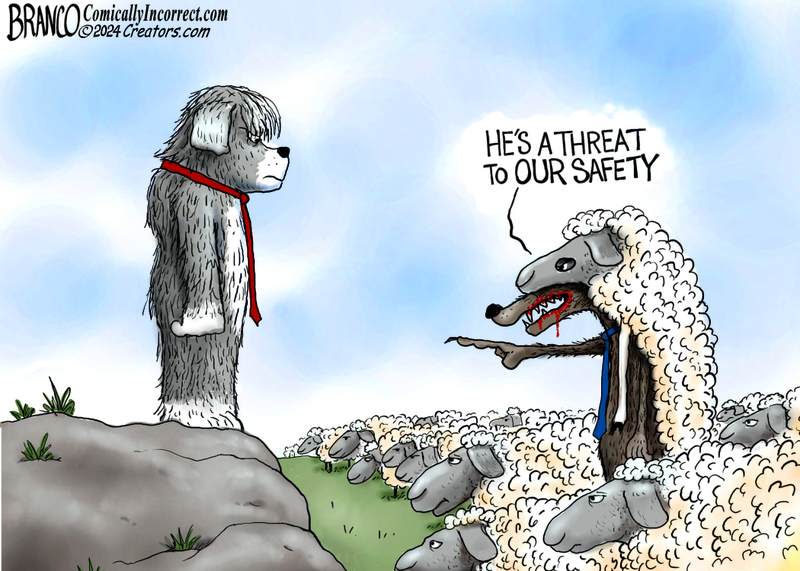
In the name of safety, politicians did many things that diminished our lives—without making us safer.
Four years ago, government officials told us, “Stay home!” We have “15 days to slow the spread.”
Days turned into months and then years, while officials chipped away at our freedoms.
I have long been wary of politicians, but even I was surprised at how authoritarian many were eager to be.
Some demanded police to go after people surfing. They took down the rims of basketball hoops. Children’s playgrounds were taped up like crime scenes. They told people in rural Utah and Wyoming to stay in their homes.
In the name of safety, politicians did many things that diminished our lives, without making us safer.
They complied with teachers unions’ demand to keep schools closed. Kids’ learning has been set back by years.
Politicians destroyed jobs by closing businesses. Some shutdown orders were ridiculous. Landscaping businesses and private campgrounds were forced to shut down.
Both former President Donald Trump and President Joe Biden sharply increased government spending. Trump’s $2.2 trillion “stimulus” package, followed by Biden’s $1.9 trillion “American Rescue Plan,” led to so much money printing that inflation doubled and then tripled.
This week, the fourth-year anniversary of “15 days to stop the spread,” my new video looks back at politicians’ incompetence.
First, government probably killed people with its endless red tape.
At least the Trump administration broke Food and Drug Administration (FDA) rules to speed vaccine approvals. But FDA rules kept perfectly good American COVID-19 test kits off the market because they hadn’t gone through its multiyear approval process.
Michigan’s Gov. Gretchen Whitmer banned “public and private gatherings of any size.” Residents were told they could not see friends or relatives.
Many of her rules seemed random. She banned motorboats and jet skis, but allowed kayaks and canoes. She closed small businesses, but exempted big-box stores if they blocked off aisles offering plant nurseries and paint. Why?
Even the Centers for Disease Control and Prevention’s (CDC) “six-foot rule” under Trump was arbitrary, says former FDA commissioner, Dr. Scott Gottlieb. COVID travels in aerosols that flow much farther than six feet.
When some Americans became fed up and protested, they were vilified for “threatening the public.” Some were fined. A few were arrested.
It’s clear now that restrictive rules were not the best way to protect people.
Sweden took a near opposite approach. They mostly left people alone.
Swedish officials encouraged the elderly and other at-risk people to stay home.
But beyond that, they let life carry on as normal. Sweden didn’t impose lockdowns, school closures, or mask mandates.
They followed standard pre-COVID wisdom that the best protection is what epidemiologists call “herd” or “collective” immunity. Once a critical mass of people are infected and recover, collective immunity will reduce the total number of infections.
Arrogant American politicians and media “experts” sneered at Sweden’s approach.
NBC “reported” on what it called, “Sweden’s failed experiment. How their dangerous Covid gamble went wrong.”
CBS confidently stated, “Sweden becomes an example of how not to handle COVID.”
Time magazine headlined: “Swedish COVID-19 Response Is a Disaster.”
But the media’s experts were just wrong. Swedish health officials were right.
Yes, at the beginning of the pandemic, Sweden suffered high numbers of COVID deaths, but as predicted, over time, herd immunity protected people. Sweden’s excess death rate was the lowest in Europe.
Sweden’s economy got through the pandemic much healthier than other countries. Because Swedish schools never closed, Swedish students didn’t suffer the learning losses that American kids did.
Four years later, have media blowhards who were wrong apologized? Corrected their stories? No.
Have American politicians apologized and begged forgiveness for their arrogance, for destroying jobs, restricting our freedom, and needlessly pushing us around? No.
FBI figures reported by NBC News on March 19, 2024, show that crime fell during 2023, a year in which there were over one million background checks a month for gun purchases.
On July 4, 2023, the Washington Examinernoted National Instant Criminal Background Check System (NICS) checks for gun purchases have been over a million a month for 47 straight months.
On March 19, 2024, Breitbart News spoke with National Shooting Sports Foundation’s Mark Oliva and he said it has now been 55 consecutive months of one million-plus NICS checks.
This means, leading up to 2023 and throughout 2023, Americans were pouring into gun stores to acquire firearms, yet “fourth-quarter numbers” reported by NBC News showed “a 13% decline in murder in 2023 from 2022, a 6% decline in reported violent crime and a 4% decline in reported property crime.”
Former CIA analyst Jeff Asher commented on the lower crime figures, saying, “It suggests that when we get the final data in October, we will have seen likely the largest one-year decline in murder that has ever been recorded.”
There was a similar situation after gun sales surged in 2013. Breitbart News pointed out that private gun sales skyrocketed during 2013 with 21,093,273 background checks, and, according to the FBI, “offenses” in the categories of violent crimes and property crimes decreased during the first six months of 2014.
On a broader scale, Breitbart News observed a 2012 Congressional Research Service study showing gun ownership jumped from 192 million privately owned guns in 1994 to 309 million in 2009. At the same time, the “firearm-related murder and non-negligent homicide” of 6.6 per 100,000 Americans in 1993 fell to 3.6 per 100,000 in 2000 and as far as 3.2 per 100,000 in 2011.
Three Shots in Three Seconds
There are good reasons why this is an oft-quoted statistic in the firearms training world.
“Three shots in three seconds at three yards.” That was Lt. Frank McGee’s iconic summation (aka “McGee’s Paradigm”) of the typical gunfight of New York City police officers during the 1970s. Lt. McGee was the head of the NYPD Firearms and Tactics Section at that time. His analysis came from the Department’s SOP-9 report, which began compiling statistics about the gunfights of its officers in 1969. Although the scope and name of the report has evolved over time, it is still published by the NYPD and is available online. McGee’s Paradigm hasn’t changed much over the past 50 years.
Three shots in three seconds is an example of a par time. Par time means a given amount of time to perform a task or event. The concept is used in a variety of sporting and other contexts. Most Police firearms qualifications are shot as par time sequences.
Learning to shoot a given number of rounds in a given period of time is an important aspect of developing defensive marksmanship skills. It emphasizes the concept that once an attack indicator is given, the defender will have a limited amount of time in which to repel the attack. In addition, learning to make good hits in a given amount of time increases the probability of a successful defense and reduces the probability of errant rounds that can endanger innocent members of the surrounding community.
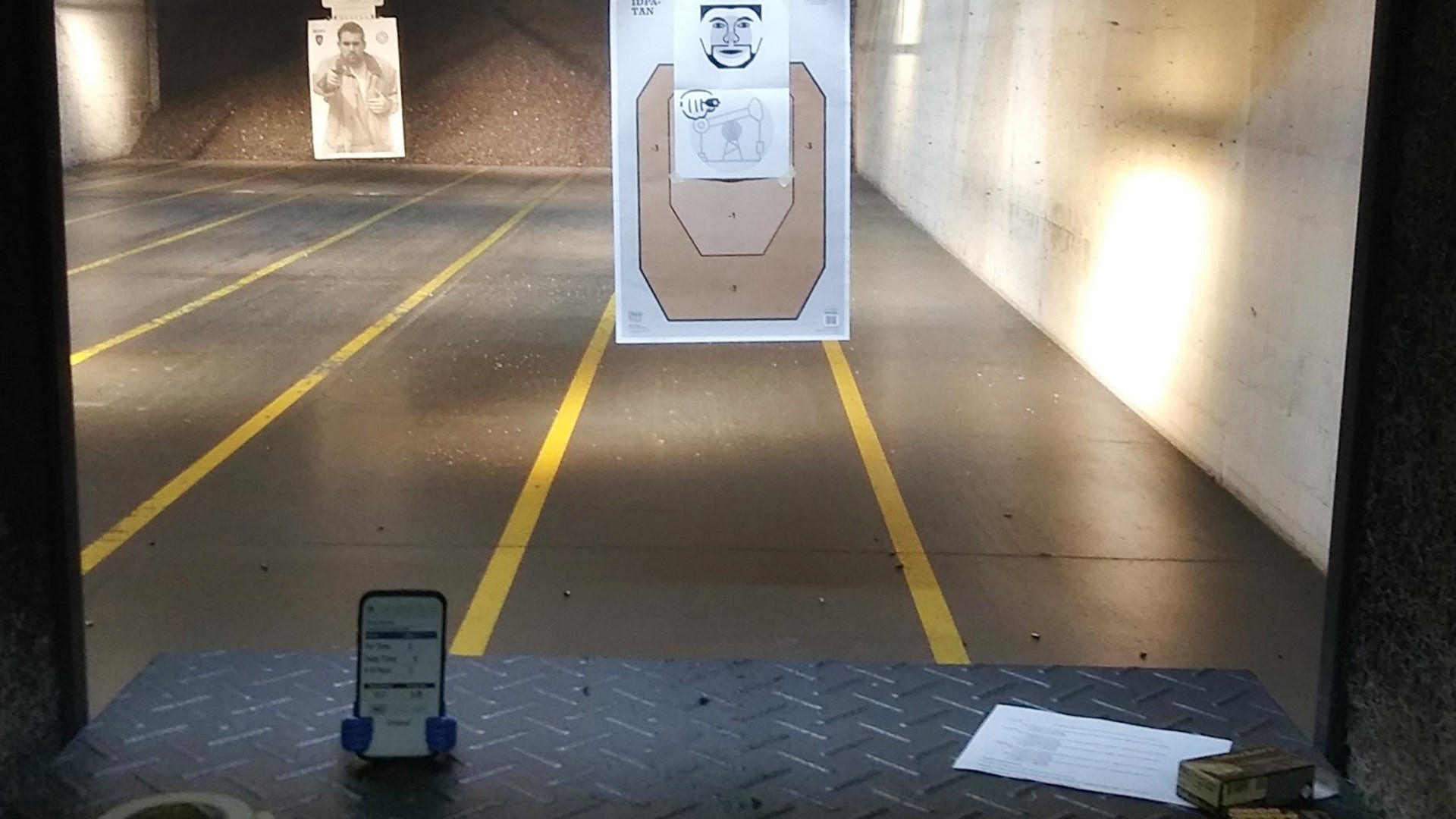
Since most gunowners are limited to shooting at indoor ranges, learning to shoot against a time standard has always been an issue. Shot timers usually work by tracking the noise from each shot and are therefore not always useful in the indoor-range environment because of adjacent shooters. Besides this, casual shooters are generally unwilling to spend over $100 for a shot timer.
The widespread nature of smartphones and Bluetooth earbuds have given us a solution to this problem. There are several timing apps for Smartphones available online. Used in conjunction with Bluetooth earbuds underneath earmuff-based hearing protection, practicing marksmanship with a par time is now easily accomplished.
The Nevada Concealed Firearms Permit Qualification Course can be easily adapted as a practice regimen for McGee’s Paradigm. The course consists of six shots at 3 yards, 12 shots at 5 yards, and 12 shots at 7 yards, for a total of 30 shots. As a test for Nevada’s Permit, it is untimed, but we can break it into a series of 3-second sequences for practice. Six shots can be divided into three sequences; one shot, two shots, and three shots. The 12-shot stages can be broken into two series of six shots, each beginning with a different starting position. Those two series can be further divided into the 1-2-3 shot sequences.
By subdividing the series at each distance, incorporating the timing element becomes less difficult and intimidating for shooters who have never been introduced to shooting against a time standard. For instance, one shot in three seconds at 3 yards on a silhouette target is not a particularly difficult task. Following that, we can introduce more shots into the same time period by making the sequence two shots and then three shots but keeping the same three second standard. Incrementally increasing the number of shots increases the difficulty in a less intimidating way. As the number of shots increases, the hits will probably spread out, but as a learning experience, that’s okay.
When the distance increases, the number of shots initially returns to one, but the par time remains same, then the number of shots gradually increases again. When a slightly more difficult starting position is used, the number of shots returns to one and then gradually increases.
Here’s one way the Nevada CFP Qualification could be shot using a par timer app, ear buds, and two different starting positions.
Low Ready
Set the target at 3 yards
Use a par timer app with ear buds.
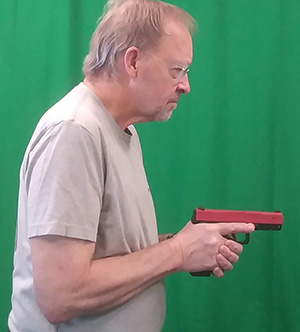
Start from low ready, pointed below the base of the target.
Fire one shot in 3 seconds
Fire two shots in 3 seconds
Fire three shots in 3 seconds
Set the target at 5 yards
Use a par timer app with ear buds.
Start from low ready, pointed below the base of the target.
Fire one shot in 3 seconds
Fire two shots in 3 seconds
Fire three shots in 3 seconds
Start from the mid-point of the drawstroke, bore parallel to the ground.
Fire one shot in 3 seconds
Fire two shots in 3 seconds
Fire three shots in 3 seconds
Mid-point of the draw
Set the target at 7 yards
Use a par timer app with ear buds.
Start from low ready, pointed below the base of the target.
Fire one shot in 3 seconds
Fire two shots in 3 seconds
Fire three shots in 3 seconds
Start from the mid-point of the drawstroke, bore parallel to the ground.
Fire one shot in 3 seconds
Fire two shots in 3 seconds
Fire three shots in 3 seconds
Upon finishing, the shooter will have fired 30 timed rounds at increasing distances using two different starting positions, which serves a good introduction to timed shooting for defensive purposes.
To finish up a 50-round box of ammo and improve marksmanship basics, shoot a series of untimed groups. The NRA Basics of Pistol Shooting https://www.nrainstructors.org/CatalogInfo.aspx?cid=56 Level I test is perfect for this task.
The test consists of a total of 20 shots on four targets. The target is a 4-inch circle at 10 feet. To shoot the test, place your target and shoot five shots at it. The NRA standard is that all five shots must be in or touching the circle. Tape or replace your target and repeat three more times for a total of 20 shots.
This 50 round practice regimen introduces shooters to two important practice principles. First, an introduction to timed shooting using different starting positions and then refining their marksmanship skills by shooting groups; these are useful and challenging tasks.
PICTURE THE SCENE: You’re about four minutes into your worst waking nightmare. You had to pull your gun and use it; that’s the bad news. The good news is, you’re still alive. You know that because you can still smell the gun smoke and feel your heart pounding with adrenaline. The would-be offender is dead, or at least isn’t moving. It was him or you, no doubt about that. And because you’re confident you’re justified in your actions, it’s time to fulfill your obligation as a responsible and law-abiding person and notify the police.
But not so fast. You may have protected yourself against a deadly threat, but now it’s time to protect yourself against potential recrimination. Everything will be scrutinized by police, prosecutors and maybe a jury, starting with the call you’re about to make. For you, and almost every other defensive shooter, 911 is the first point of contact with the justice system. What you say matters. Get this one wrong, and your 911 call could play out on broadcast news , turn your community against you and feature prominently for some enterprising prosecutor who might have crowed in the last election that getting guns off the street is a priority, but doesn’t distinguish between criminals and law-abiding gun owners.
You can’t panic. It’s just the rest of your life that could change based on the words you pick…at exactly the time when your nervous system is still trying to claw itself back down to normal from almost dying.
Don’t blow it.
HISTORY
The use of a three-digit emergency number got its start in the United Kingdom with the advent of the 999 call system. Under the Johnson Administration, the Federal Communications Commission hatched a plan for the 911 call system with AT&T in the late 1960s. Soon after, states began building their own networks. While only half of residents in the United States had access to 911 by the end of the Reagan Administration, most of the U.S. is served by some form of the system today.
And yes, despite what you may read on the windows of pickup truck cabs or at gun-friendly thrift shops, most people do call 911. (Those stickers can potentially create trouble for you by the way in the event of a defensive shooting, but that’s another story for later.) According to the National Emergency Number Association (NENA) there are more than 3,000 911 call centers in the United States, fielding some 240 million emergency calls each year.
If your scene is safe and the threat is contained, it’s time to make an important call.
911 Fact: When Does the Recording Begin?
Everything you say on the 911 call will be recorded and submitted as evidence. To the surprise of many, though, that recording begins the second you push that last 1. Before the operator even picks up the call, the recording has begun. It’s important to know this because you may be having a private conversation with someone about the event and potentially say something that can be caught in a recording and be used against you in court.
The Supreme Court has acted. Texas is free to deal with illegal migrants in violation of immigration law by arresting them.
The Biden administration failed in its attempt to block a Texas law that allows the state to arrest those suspected of violating U.S. Immigration law. The Biden administration argued that the federal government may enforce or ignore immigration law as it sees fit. It said states like Texas have no say in the matter and no recourse to defend themselves.
The court majority said no to this overreaching, and some justices were not happy.
Liberal Justice Sonia Sotomayor, joined by Justice Ketanji Brown Jackson, wrote, “Today, the Court invites further chaos and crisis in immigration enforcement.” The court may still reopen the issue as a constitutional matter later, but for now, the Biden administration may not interfere with Texas.
Biden had wanted an administrative stay to halt any action by Texas as a way of shortcutting the process of appeals.
The Texas migration law makes unauthorized entry into the state, except at a port of entry, a state felony. While such entry is already a federal crime, the Biden administration has turned a blind eye to the law. Texas now has a free hand to defend its state borders.
A federal judge attempted to stay the law’s implementation, but the 5th Circuit overturned that ruling. The Biden administration hoped the Supreme Court would overrule the 5th Circuit. It did not.
The state argued, “Plaintiffs urge the Court to rush straight to the merits of their claims. But these cases do not belong in federal court at all—even apart from the fact that no state court has yet had an opportunity to construe any provision of S.B.4.”
The Supreme Court majority agreed.
“So far as I know, this Court has never reviewed the decision of a court of appeals to enter—or not enter—an administrative stay,” wrote Justices Amy Coney Barrett and Brett Kavanaugh in ruling against the federal government. “I would not get into the business. When entered, an administrative stay is supposed to be a short-lived prelude to the main event: a ruling on the motion for a stay pending appeal. I think it unwise to invite emergency litigation in this Court about whether a court of appeals abused its discretion at this preliminary step.”
Further legal action is expected, but in the meantime, the state of Texas has been given the green light to proceed with enforcing its border.
TRENTON, N.J. (WPVI) — A man is dead after being shot and killed by a homeowner in Trenton, New Jersey, according to police.
Trenton police responded to Bert Avenue around 10:25 p.m. Sunday, after receiving reports of a shooting in the area. Detectives in the area on an unrelated assignment then found a man on St. Francis Avenue who had a gunshot wound to the chest.
That man, identified as 34-year-old Andray Ingram, was taken to Capital Health Regional Medical Center, where he was pronounced dead.
During the investigation, police determined that a homeowner on Bert Avenue had fired multiple shots at an unknown individual who allegedly had a hammer, and was banging on the homeowner’s front door and smashing his Ring camera.
The person, who police say they have identified as Ingram, had entered inside the vestibule area of the residence when the shots were fired, according to officials.
Officials say no charges have been filed and the investigation is ongoing.
March 20, 2024
BLUF:
After consideration of the arguments, the Utah Supreme Court agreed with the district court that Clara “presented evidence showing a reasonable belief that the snowplow posed an imminent threat of death or serious bodily injury to him and his passenger.”
SALT LAKE CITY – The Utah Supreme Court sided with a man who fought felony firearm charges by claiming self-defense under a law that went into effect in 2021.
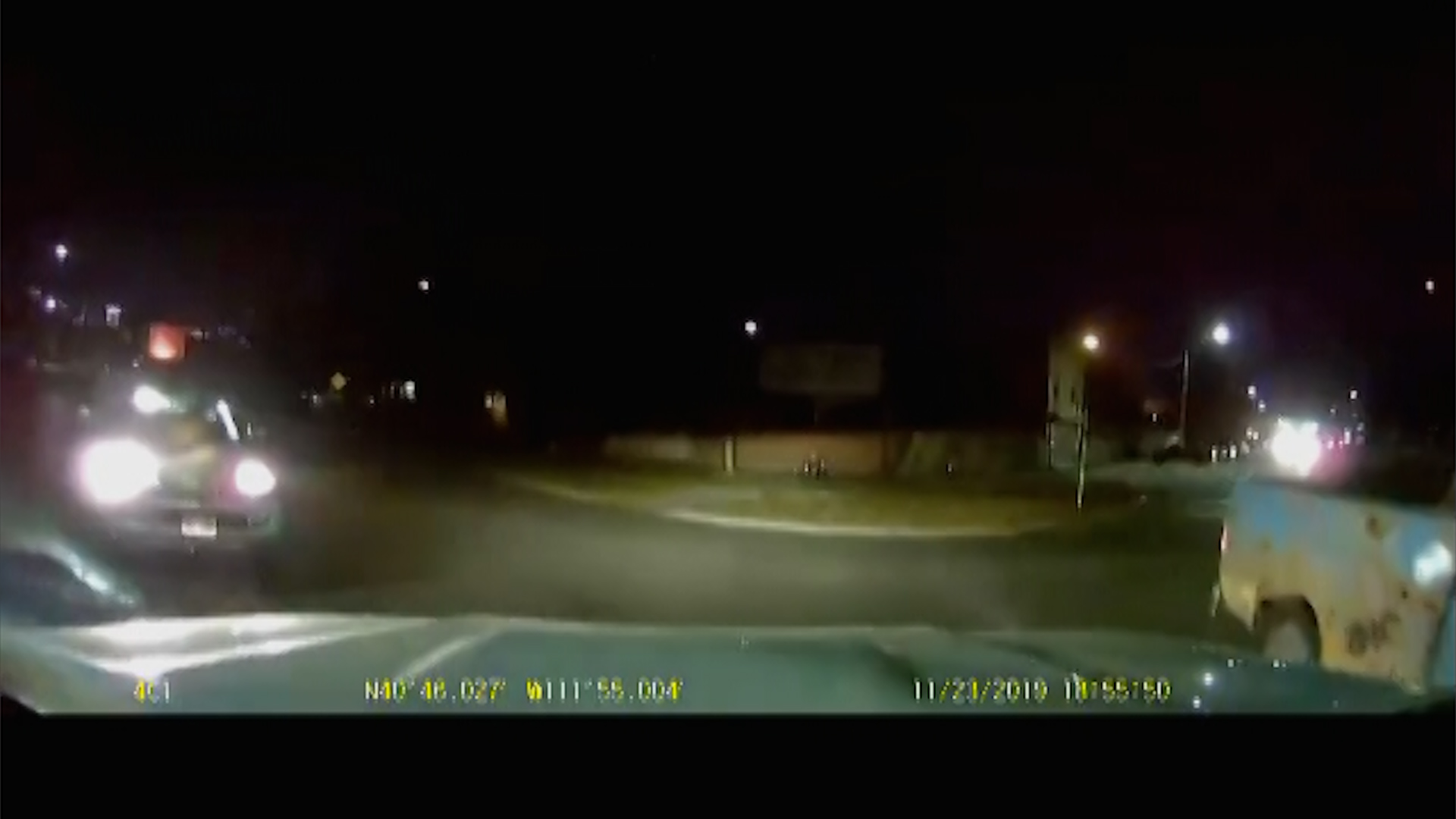
The case in question stems from a shooting in 2019. Jon Michael Clara fired several shots toward a truck with a snowplow that had repeatedly rammed into the SUV he was driving. One of the bullets flew through the cab of a nearby uninvolved vehicle, narrowly missing a child.
A blue truck with a snowplow rammed into an SUV multiple times, spinning it around to face oncoming traffic on Nov. 23, 2019.
Several charges against Clara were dismissed after he made use of a new self-defense law he urged lawmakers to pass. However, in an unusual move, the judge who presided over the case urged prosecutors to appeal his decision. In an opinion released Friday, Utah’s Supreme Court justices concluded that the district court “did not err” in its handling of Clara’s case.
Utah’s self-defense law
HB227 sailed through the Utah legislature in 2021. The law allows people who are charged with a crime and claim self-defense to have a justification hearing before the case goes to trial. If prosecutors cannot disprove a self-defense claim with clear and convincing evidence in that early hearing, the case is permanently dismissed.
That is what happened in Clara’s case in March 2022. Third District Judge Todd Shaughnessy ruled the state had not met its burden of proof, and despite evidence he said “troubles” him, he dismissed the case.
“This is one instance in which the state can appeal,” Shaughnessy said. “I would encourage the state to do that to seek some clarity on exactly what this new law means. But, as I say, I believe my hands are tied.”
The case is one of several the KSL Investigators followed after first reporting on the unintended consequences of the new law.
Utah Supreme Court arguments
During arguments before the Utah Supreme Court in May 2023, Assistant Attorney General Andrew Peterson argued Clara was not acting in self-defense, while defense attorney Ann Taliaferro argued Clara had acted reasonably given the circumstances.
WASHINGTON, D.C. — NSSF®, The Firearm Industry Trade Association, applauds Indiana Gov. Eric Holcomb and Utah Gov. Spencer Cox for signing the NSSF-supported Second Amendment Privacy Acts in their respective states. The laws will bar the use of a firearm-retailer specific Merchant Category Code (MCC) for banks, credit card companies or financial service providers to track the lawful sale of firearms and ammunition.
Both governors signed their laws, Indiana’s HB 1084 and Utah’s HB 406, in their respective states last week. NSSF worked closely with legislators in those states to bring legislation to protect private and legal purchases from exploitation. The laws are designed to protect the privacy of lawful and private firearm and ammunition purchases from being abused for political purposes by corporate financial service providers and unlawful government search and seizure of legal and private financial transactions.
“Corporate banks and the federal government have already proven they will run roughshod over Second Amendment and Privacy rights. The need to safeguard private and legal purchases of firearms and ammunition by law-abiding citizens has never been greater,” said Lawrence G. Keane, NSSF Senior Vice President & General Counsel. “NSSF thanks both Governor Holcomb and Governor Cox for their leadership in signing these laws that will protect the rights of the citizens in their states. No American should fear being placed on a government watchlist simply for exercising their Constitutionally-protected rights to keep and bear arms.”
The U.S. Treasury’s Financial Crimes Enforcement Network (FinCEN) admitted to U.S. Sen. Tim Scott (R-S.C.) in a letter that it violated the Fourth Amendment rights of law-abiding citizens that protect against illegal search and seizure when it collected the credit card purchase history from banks and credit card companies of individuals who purchased firearms and ammunition in the days surrounding Jan. 6, 2020. Treasury’s FinCEN had no cause, and sought the information without a warrant, to place these law-abiding citizens on a government watchlist only because they exercised their Second Amendment rights to lawfully purchase firearms and ammunition.
The idea of a firearm-retailer specific MCC was borne from antigun New York Times columnist Andrew Ross Sorkin and Amalgamated Bank, which has been called “The Left’s Private Banker” and bankrolls the Democratic National Committee and several antigun politicians. Amalgamated Bank lobbied the Swiss-based International Organization for Standardization (ISO) for the code’s creation. NSSF has called on Congress to investigate Amalgamated Bank’s role in manipulating the ISO standard setting process.
Sorkin admitted creating a firearm-retailer specific MCC would be a first step to creating a national firearm registry, which is forbidden by federal law.
Indiana and Utah join Florida, Idaho, Mississippi, Montana, North Dakota, Texas and West Virginia with laws protecting citizens’ Second Amendment privacy. Several other states are considering similar legislation. U.S. Rep. Elise Stefanik (R-N.Y.) introduced H.R. 7450, the NSSF-supported Protecting Privacy in Purchases Act, in the U.S. House of Representatives. California’s Gov. Gavin Newsom signed a law requiring the use of a firearm-retailer specific MCC and Colorado is considering similar legislation.
A 47-year-old New York City woman was recently arrested for unlawful eviction after trying to prevent squatters from re-entering the $1 million property bequeathed to her by her family.
Adele Andaloro changed the locks on the Flushing, Queens home, which according to NYC law is not allowed if “tenants” have inhabited a building for more than 30 days, which in this case, some had.
According to ABC7, a number of people began occupying the home on February 6 and refused to leave. When a crew went out to interview Andaloro, one of the squatters arrived at the property and unlocked the door. After being confronted, however, she fled.
With the door wide open, Andaloro and the crew entered. In addition to her furniture, she discovered two men sleeping in a room at the back of the house, one of whom had only been “renting” for two days. A number of 911 calls were placed, and when police showed up, they took the men away.
Andaloro explained that police told her they could arrest her if the locksmith she had called earlier that day went ahead and changed the locks. Nonetheless, she told him to do it.
A short time later, the two men who had been apprehended returned to the property and confronted her, calling 911.
“Why is it that I have to leave and he doesn’t have to leave?” Andaloro asked officers when they showed up, to which one replied, “Technically he can’t be kicked out. You have to go to [housing] court.”
One of the men claimed to have signed a lease in October, but failed to provide any proof. Andaloro, on the other hand, came prepared with all the necessary paperwork showing that it was, in fact, her home.
In the end, Andaloro was arrested and the men were allowed to remain in the home, pending further legal action.
She lamented the fact that, “by the time someone does their investigation, their work, and their job, it will be over 30 days and this man will still be in my home,” referring to the second squatter who had only been there for two days.
The case, NRA v. Vullo, brought by the National Rifle Association (NRA) against a New York official and alleging freedom of speech violations, has reached the Supreme Court of the US (SCOTUS) and, overall, the justices appeared overall sympathetic toward NRA’s claims.
The respondent to the NRA’s petition to allow the lawsuit to proceed, former New York State Department of Financial Services (DFS) Superintendent Maria Vullo, is accused of influencing banks and insurance firms to drop the NRA.
The case concerns two actions taken by Vullo – first seven years ago when DFS started investigating insurance programs in cases of gun injuries tied to NRA. The following year, this resulted in three insurers stopping programs covering such claims in New York, and paying $7 million in fines.
But the NRA’s federal lawsuit that followed accused Vullo of violating NRA’s First Amendment rights. A court first allowed the lawsuit to proceed, but then the court of appeals overturned this ruling. And it is now up to SCOTUS to decide.
The American Civil Liberties Union (ACLU) is representing the NRA, explaining its involvement as necessary to prevent the government from going after other groups in a similar way – even though the ACLU’s own ideological slant and that of the NRA are clearly on the opposite ends of the spectrum in the US.
The ACLU’s David Cole told the justices on Monday that SCOTUS should adhere to the Bantam Books v. Sullivan decision in this case, adding that “informal, indirect government efforts to suppress or penalize speech by threatening private intermediaries violate the First Amendment.”
In Bantam Books v. Sullivan (1963), the Supreme Court ruled that the Rhode Island Commission to Encourage Morality in Youth’s practice of notifying distributors about certain books deemed objectionable for minors under 18 amounted to unconstitutional state censorship. This informal censorship violated the First Amendment as it lacked procedural safeguards, leading to the suppression of book distribution without formal legal action. The Court emphasized that while states have the authority to regulate obscene material, they must ensure that such regulation does not infringe on constitutionally protected speech, thus requiring a balance between protecting minors and upholding free speech rights.
Already unconstitutional per SCOTUS in Heller and controlling on state laws per McDonald.
D.C. v Heller (IV para5) We must also address the District’s requirement (as applied to respondent’s handgun) that firearms in the home be rendered and kept inoperable at all times. This makes it impossible for citizens to use them for the core lawful purpose of self-defense and is hence unconstitutional.
The Rhode Island Senate approved a bill Tuesday that would require all firearms, when not being used by the owner or another authorized user, to be stored in a locked container or equipped with a tamper-resistant mechanical lock.
Under the bill, the unsafe storage of a firearm would be considered a civil offense that could be punished by a fine of up to $250 for a first offense and $1,000 for a second. Any subsequent violation would be punishable by up to six months in prison and a fine of up to $500.
The measure passed by a 28-7 vote.
The bill’s sponsor, Democratic Sen. Pamela Lauria, said responsible gun owners already take precautions, but those steps should be a requirement, not an option.
Last week the International Law Enforcement Educators & Trainers Association filed an amicus brief in a U.S. Supreme Court case challenging Maryland’s ban on many common semiautomatic rifles. The case is Bianchi v. Brown, and it has an unusual procedural posture; it is a petition for certiorari before judgement. Yet the case is one on which the U.S. Supreme Court has already ruled.
This post will first summarize the amicus brief, and then provide the procedural background, which is detailed in the Bianchi plaintiffs’ cert. petition.
The facts about the banned rifles
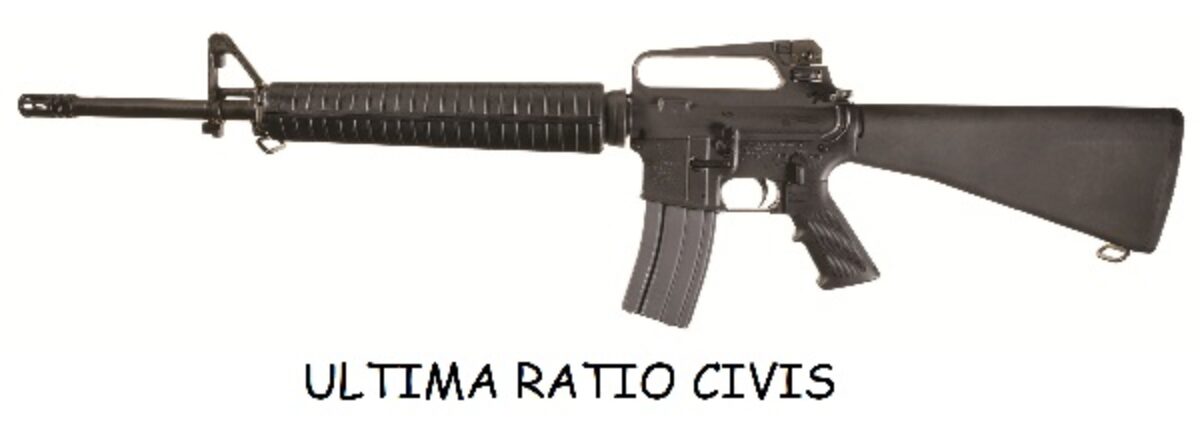
As detailed in the amicus brief, the semiautomatic rifles banned by the Maryland General Assembly fire only one shot each time the trigger is pressed. This is the same rate of fire as the most common semiautomatic handguns, such as those made by Glock, Smith & Wesson, or Ruger.
The claim by gun prohibition advocates that such guns fire 300 to 500 times per minute has no basis in fact, and is contrary to common sense. It would take a superhuman trigger finger pull a trigger at the rate of 5 to 8 times per second, let alone do so for a full minute.
Nor are the banned rifles, including those based on the AR-15 platform, more powerful than nonbanned rifles. To the contrary, their standard ammunition is .223 inch or 5.56mm bullets that are small compared to most other rifle ammunition. Accordingly, their kinetic energy is lower.
Because the banned rifles are more powerful than handguns, but less powerful than most other rifles, the relatively low wounding power of this ammunition has been confirmed by decades of study by the US Army’s Ballistic Research Laboratory.
Moreover, as documented in police training manuals, the banned rifles are the safest for defensive use within buildings, because their ammunition is especially unlikely to penetrate a wall.
“Intelligence” in the area of conflict is defined as information collection and analysis to aid in making decisions and is achieved by providing data from a range of sources…..A word to the wise should be sufficient.