

Long Beach homeowner fatally shoots woman attacking neighbor
A Long Beach homeowner fatally shot a woman who was harassing his neighborhood early Saturday morning.
According to Long Beach Police Department, neighbors say that the woman was following people home and pounding on front doors and windows in the early morning, just after midnight, before she attacked a woman.
The shooting happened minutes before 1 a.m. in the 600 block of Roycroft Avenue, police said, when a man shot a woman in the head.
“Through their preliminary investigation, including statements provided from witnesses, detectives learned a male adult observed a female adult attacking another woman,” said Long Beach Police Department spokesperson Alyssa Baeza. “The female victim was calling for help and the man armed himself with a handgun.”
Investigators believe that the man was armed prior to the altercation due to the “prior suspicious activity in front of his residence.”
The deceased woman, who has been identified as 44-year-old East Long Beach resident Andrew Powell, was fatally shot as she was charging towards the armed homeowner, police said.
“He was trying to protect himself and the other neighbors as well,” said one resident Eileen Gelso, who says that Powell was banging on doors over and over demanding money. “She was definitely dangerous. I believe that.”
The homeowner was detained and officers recovered his handgun from the scene, but after gathering evidence and interviewing witnesses, he was released.
Grieving family members, who say they plan to pursue legal action against the homeowner, say that Powell was undergoing a mental crisis at the time of the incident, and that the use of force was extremely unnecessary.
“This case will be presented to the Los Angeles District Attorney’s Office,” police said.
The spate of politically motivated prosecutions against former President Donald Trump in recent months has further underscored how the left – with a big financial assist from liberal megadonor George Soros – has weaponized local district attorney offices to target their political enemies while failing to punish actual criminals. Conservatives desperately need an answer to this alarming trend to restore the rule of law in our country.
In addition to the Biden Department of Justice’s persecution of Trump, the former president has already faced an indictment from Manhattan District Attorney Alvin Bragg, and is also being targeted by Fulton County, Georgia, District Attorney Fani Willis and Westchester County, New York, District Attorney Miriam Roach.
All of these investigations are noticeably light on the facts and reek of partisan motivations. As I have written previously, Ms. Willis is reportedly attempting to charge President Trump under Georgia’s Racketeer Influenced and Corrupt Organizations statute, better known as RICO — a state-level version of the federal RICO law that prosecutors have used to target the mob and criminal gangs.
But these sham investigations are only a few of the many egregious derelictions of duty from Bragg, Willis, Roach, and their compatriots in the criminal justice “reform” movement.
So-called “reform” prosecutors have flat out refused to prosecute many crimes, leading to predictably disastrous results for their communities. In Manhattan, Bragg has downgraded 52 percent of felony cases to misdemeanors, while cutting sweetheart deals for rapists and murderers. In Fairfax County, Virginia, Steve Descano, another “reform” prosecutor, cut a plea deal with a child sex offender that was so lenient the judge told the victim, “your government has failed you.”
George Gascon in Los Angeles, Larry Krasner in Philadelphia, Kim Foxx in Chicago, and dozens of other radical left DAs have similarly tragic track records. Chesa Boudin in San Francisco and Kim Gardner in St. Louis have already been booted out of office before the end of their terms.
Far from acting independently of one another, all of these prosecutors are part of a cohesive national movement with a shared set of policy goals, including the elimination of cash bail, a drastic reduction in prison sentences, and a refusal to prosecute entire categories of crimes.
One of the biggest and most public patrons of this movement is George Soros, who has poured more than $35 million into DA races throughout the country via a complex network of PACs, dark money groups, and nonprofits. As these contests are typically low-dollar affairs compared to more high-profile state and federal races, that money has gone a long way. In some cases, Soros-backed candidates outraised their opponents by as much as 90 percent.
As of last June, Soros prosecutors represented some 72 million people – roughly one in five Americans.
The result has been the wave of violent crime that is now sweeping America’s cities. Murders in Los Angeles spiked from 258 in 2019 to 397 in 2021 and 382 last year. Violent crime is surging in Philadelphia and Chicago.
As Alvin Bragg has shown, these prosecutors are also willing to use the power of their offices to target their political opponents. For Soros and his far-left allies, installing loyal prosecutors is a cheap and effective way to bog down their political enemies in an endless sea of bogus litigation.
Replacing these “reform” prosecutors with candidates who will actually enforce the law and end the politicization of the justice system is a vital step toward securing our democracy and restoring public trust in the elected leaders charged with keeping our communities safe.
In order to accomplish this, conservatives need a unifying prosecutor movement of their own – one that upholds the rule of law rather than undermines it. One that pursues justice rather than perverts it. One that honors the hard work and sacrifices made by local law enforcement rather than seeks to defund it. One that remembers the lessons of Giuliani’s Manhattan and believes that small things like fixing broken windows matter. One that holds that the years 1789 and 1776 define our institutions rather than 1619.
Most importantly, our country needs a group of conservative prosecutors who are bold enough to say their communities: “we are not Manhattan, we are not Chicago, we are not St. Louis, we are not Los Angeles, and we are not San Francisco. If violent criminals hurt people in our community, we will not rest until justice is done.” In other words, “We’re your Huckleberry.”
By retaking control of prosecutors’ offices, conservatives can deliver a major blow to the radical left’s war on our institutions and republican system of government. For the future of our country, it is time to take a stand.
What a gutless moron
What kind of person puts that as a stipulation for their own daughter?
It's hard to process how gross the Biden family is. https://t.co/Ifod3aRlib
— Bonchie (@bonchieredstate) June 28, 2023
What a brainless moron.
BIDEN: "It was inappropriate for Barack to spend time with [Xi Jinping] but I spent a lot of time with him. I met alone with him, just he and I… 68 times, 68 hours, 68 times — more than 68 hours — by the way, I turned in all my notes.” pic.twitter.com/LBu3PPlKcI
— Breaking911 (@Breaking911) June 28, 2023

June 28
1098 – The army of the First Crusade under the command of Prince Behemond of Taranto, defeats the moslem army of Kerbogha of Mosul.
1776 – During the Revolution, the Battle of Sullivan’s Island in South Carolina ends with an American victory
1778 – During the Revolution, the Battle of Monmouth Courthouse in New Jersey is a draw with both the Continental and British forces suffering heavy casualties.
1838 – Victoria of the United Kingdom if formally crowned Queen Regnant.
1846 – Adolphe Sax patents the Saxophone; and now you know why it’s called that.
1865 – The Army of the Potomac is disbanded.
1870 – Congress establishes the first federal holidays; New Year Day, Independence Day, Thanksgiving, and Christmas.
1894 – Labor Day becomes an official US holiday.
1896 – An explosion in the Newton Coal Company’s Twin Shaft Mine in Pittston, Pennsylvania results in a massive cave-in killing 58 miners.
1902 – Congress passes the Spooner Act, authorizing President Theodore Roosevelt to acquire rights from Colombia for the construction of the Panama Canal.
1914 – Archduke Franz Ferdinand of Austria and his wife Sophie are assassinated in Sarajevo beginning the diplomatic bumbling that results in World War I
1919 – The Treaty of Versailles is signed, officially ending World War I.
1926 – Daimler-Benz Aktiengesellschaft is formed by Gottlieb Daimler and Karl Benz merging their two companies, Daimler Motoren Gesellschaft and Benz & Companie.
1950 – Seoul falls for the first time to invading North Korean forces.
1978 – In the case of Regents of the University of California v. Bakke, the Supreme Court bars quota systems in college admissions.
2004 – During the Iraq War, sovereign power is handed to the interim government of Iraq by the Coalition Provisional Authority, ending U.S. led rule of that nation.
2016 – An attack by Syrian moslem ISIL terrorists at Turkey’s Istanbul Atatürk Airport kills 42 people and injures more than 230 others.
(Introducing:) The Big Money Donors Behind the Attacks on Conservative Supreme Court Justices.
The coordinated and sophisticated attacks on conservative Supreme Court Justices Samuel Alito and Clarence Thomas are no accident. This is a deliberate campaign to tarnish the reputation of justices and delegitimize their decisions in the eyes of citizens.
These attacks are long on rhetoric and short on substance. But that’s how the game is being played. Lacking actual proof of wrongdoing, the left has taken to insinuating ethics violations.
The smears are being published on the left-wing website ProPublica.
“ProPublica isn’t a news organization; it’s a front group for liberal billionaires wanting to ensure that the court rubber stamps their political agenda,” Judicial Crisis Network President Carrie Severino told the Washington Examiner.
ProPublica is a non-profit news site funded primarily by the Sandler Foundation, “which has given nearly $40 million to the organization since 2010,” according to the Examiner. The Sandlers have been plagued by ethics problems themselves. They helped initiate the Savings and Loan crisis of the 1980s by being the first to offer “Adjustable Rate Mortgages” (ARM) that led to dozens of S&Ls going under. Then the Sandlers were also partly to blame for the housing crash in 2008, according to Time Magazine.
“The same Sandler Foundation that ‘made ProPublica possible’ with an astounding $40 million also gave $500,000 to Demand Justice, a ‘dark money’ court packing group that spearheaded smear campaigns against Justices Gorsuch, Kavanaugh, and Barrett,” Parker Thayer, an investigative researcher at Capital Research Center, told the Washington Examiner.
“ProPublica has been in the business of launching partisan attacks on conservative Supreme Court justices for months now, and it shouldn’t surprise anyone given their funding from left-wing groups,” Mike Davis, founder and president of the Article III Project, told the Washington Examiner, adding that the “entire project is revenge for overturning Roe v. Wade.”
The Sandler Foundation also gave $7.5 million to the Campaign Legal Center since 2015, a group whose senior director, Kedric Payne, testified before Congress as a Democratic witness arguing that the legislative branch should write ethics rules for the judicial branch. CLC wrote an April letter calling for a Department of Justice investigation into Thomas “for potential criminal and civil penalties.”
“The corrupt corporate media has been working with these liberal activists for decades, so of course Soros-type donors would be behind this,” a spokesperson for Sen. Ted Cruz (R-TX) told the Washington Examiner. “The fact is, Justices Thomas and Alito have complied totally with the Supreme Court’s ethics rules.”
If the tactics of the left in attacking Supreme Court Justices seem vaguely familiar to you, you’re correct.
“This is a textbook example of one of the Left’s favorite tactics: the pop-up pressure campaign,” Thayer explained. The left, through their media outlets and social media presence, creates the appearance of a political groundswell coming from the bottom up when actually, it’s a top-down effort all the way.
“It’s easy to spot once you know the secret,” he said. “First, one or two donors pay a legion of different organizations to get involved in a certain policy debate. Then, all at once, these groups start making noise about an issue nobody cared about five minutes ago.”
ProPublica claims that “40,000 people actively fund our investigative, nonpartisan journalism. Our newsroom operates with fierce independence. No donor or board member is even aware of the subjects of our stories before they are published.”
That’s no doubt true. But it’s also true that a huge portion of their funding comes from a few Democratic billionaire donors who give to ProPublica because they can be relied on to smear the conservative opposition and support the far-left agenda of their benefactors.
NY Gov. Kathy Hochul packs incredible gun control lies and claims into a 58-second video
I live in New York, which is one of the worst states to be a lawful gun owner and a taxpaying citizen. The proof is in the pudding; people vote with their feet when life becomes intolerable due to poor governance, and New York’s allegedly wonderful governance resulted in the loss of yet another congressional seat after the 2020 redistricting cycle.
It is grating to see Gov. Kathy Hochul still bragging about New York as some sort of bastion of freedom and opportunity in the face of the evidence of outmigration. Part of her braggadocio was a video her office posted on Twitter, discussing all the “good” she has done to keep the people of New York “safe from concealed carry weapons.”
A year ago today, the Supreme Court ruled to strip away the rights of a governor to protect her people from concealed carry weapons.
We refused to go backwards. pic.twitter.com/lUx6BRsLBo— Governor Kathy Hochul (@GovKathyHochul) June 23, 2023
First, you don’t have “rights” as a governor; you have powers to govern, and those powers are limited so they don’t violate the rights of the people.
Second, your job is to protect the people’s rights and liberties, and your matriarchal view on “protecting her people” is condescending bunk. Lastly, concealed carry weapons in and of themselves don’t do anything. It depends on who is carrying them. Criminals were carrying concealed weapons prior to NYSRPA v. Bruen and continue to carry after NYSRPA v. Bruen. However, ordinary people’s rights to carry guns in public were infringed by New York State’s discretionary permitting scheme.
Maine House narrowly pass bill to require background checks on private gun sales
AUGUSTA, Maine (WABI) – A bill that would require background checks on private gun sales narrowly passed in the Maine House today.
The vote was 69 to 68.
While the state currently requires a background check for commercial gun purchases from licensed dealers, supporters of this bill say it would close a loophole that allows those who are prohibited from having a gun to buy one through a private sale or at a gun show.
Opponents of the bill argue it would impose more restrictions on law abiding citizens while having no impact on public safety, violent crimes, or gun deaths.
“Our failure to do background checks contributes to gun related tragedies around this state, domestic violence deaths as well as a robust guns for drug trade exists where narcotics, opioids, fentanyl, and other illegal substances are trafficked into the state and traded for guns,” Rep. Victoria Doudera of Camden said in support of the bill.
“Madam Speaker, the people of Maine do not want universal background checks, and they definitely would not want them when coupled with universal registration. How can we be sure of this Madam Speaker? It’s because they told us in a people’s referendum when they soundly defeated universal background checks. The people told us this even when the papers and the polls at the time told us that over 80% of Maine voters wanted it,” Rep. Chad Perkins of Dover-Foxcroft said in opposition of the bill.
That citizen referendum to expand background checks was defeated by Maine voters in 2016, 52 to 48 percent.
The bill now head to the Senate.
New laws in Vermont that start July 1: Gun purchases,….
Vermonters will soon see new laws that affect their wallets or their legal choices — and even possibly cut down on the theft of car parts.
Every year, July 1 is the date that many new laws take effect. Some of these laws were recently passed by the Legislature; others were approved a while ago and are just now rolling out.
Here are 11 of the changes you should know about this summer.
Waiting period for gun purchases
Young people in Vermont are less likely than their peers in other states to report feelings of sadness, hopelessness or suicidal thoughts — and yet their rate of suicide deaths is higher than the national average.
Lawmakers have decided that easy access to guns is a significant factor in those deaths. And legislation that goes into effect July 1 will institute a 72-hour waiting period for gun purchases. Lawmakers hope that preventing someone in crisis from gaining immediate access to a gun will allow time for suicidal impulses to pass. The vast majority of people who survive a suicide attempt never make an attempt again.
A new law in Vermont creates a criminal penalty for unsafe storage of firearms if those guns are used in a crime.
The law will allow family members to petition courts for an extreme risk protection order, and creates a new criminal penalty for negligent storage of firearms, if that negligence results in commission of a crime.
The 72-hour waiting period provision is almost certain to invite a legal challenge. In a landmark ruling last year, the U.S. Supreme Court established a new precedent for the manner in which courts should assess the constitutionality of restrictions on gun ownership.
Though Gov. Phil Scott allowed the bill to become law, he said he doesn’t think the 72-hour waiting period will survive a constitutional challenge.
[It makes one wonder why the goobernor let it become law then, but scratch a lib, find a tyrant applies]
RUGER BRINGS BACK THE MARLIN 1894 IN .44 MAG

Ruger continues to play the hits with its resurrected Marlin Firearms brand, announcing this week that the famed Model 1894 is back in production.
June 27
1499 – Americo Vespucci, on a Spanish financed trip of exploration, sights land south of present day Cape Cassipore, Brazil.
1556 – The 13 Stratford Martyrs are burned at the stake near London for their Protestant beliefs.
1760 – During the Anglo-Cherokee War, Cherokee warriors defeat British forces at the Battle of Echoee near present day Otto, North Carolina.
1838 – Paul Mauser is born in Oberndorf am Neckar, in what was then the Kingdom of Württemberg.
1864 – Confederate forces defeat Union forces during the Battle of Kennesaw Mountain
1895 – The inaugural run of the Baltimore and Ohio Railroad’s Royal Blue from Washington, D.C., to New York City is the first U.S. passenger train to use electric locomotives.
1944 – During World War II, the town of Mogaung in Kachin state is the first place in Burma to be liberated from the Japanese by British Chindits, supported by the Chinese
1950 – The U.S decides to send troops to support South Korean forces fighting invading North Korean forces.
1957 – Hurricane Audrey makes landfall near the Texas–Louisiana border, killing over 400 people
1976 – Air France Flight 139 (Tel Aviv-Athens-Paris) is hijacked en route to Paris by the PLO and redirected to Entebbe, Uganda.
1977 – France grants independence to Djibouti.
1982 – Space Shuttle Columbia is launched from the Kennedy Space Center on the final shuttle research and development mission, STS-4.
1994 – Members of the Aum Shinrikyo cult release sarin gas in Matsumoto, Japan, killing 7 people and injuring over 600 more.
2013 – NASA launches the Interface Region Imaging Spectrograph probe to observe the Sun.
Leftist Radicals: “Stop calling us groomers & pedos – we are not coming for your children”
Also Leftist Radicals: “We’re here, we’re queer, we’re coming for your children” pic.twitter.com/c1pbTw0A5Q
— DC_Draino (@DC_Draino) June 26, 2023
THIS IRS EMAIL CORROBORATES WHISTLEBLOWER’S CLAIMS ABOUT BIDEN DOJ INTERFERENCE IN HUNTER PROBE.
A senior IRS official corroborated a whistleblower’s bombshell allegation that Biden Justice Department officials meddled in the Hunter Biden tax probe, according to internal IRS emails released this week.
Whistleblower Gary Shapley’s boss confirmed Shapley’s account of a key meeting that occurred on October 7, 2022, between IRS agents and DOJ prosecutors handling the Biden probe. After the meeting, Shapley wrote to his boss, Darrell Waldon, that U.S. attorney David Weiss indicated he was prohibited from bringing charges against Biden in Washington, D.C. Weiss said that he requested special counsel status but that Justice Department headquarters had denied that request.
“Weiss stated that he is not the deciding person on whether charges are filed,” Shapley wrote.
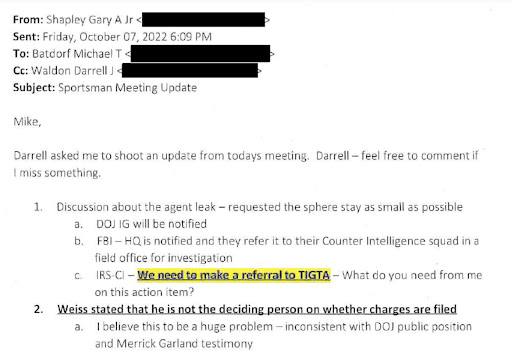
Waldon, who attended the meeting with Shapley, signed off on his subordinate’s characterization of the meeting. “Thanks, Gary. You covered it all,” Waldon wrote.
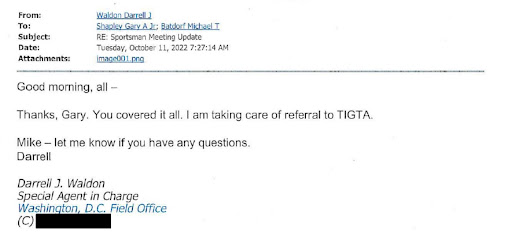
The email is powerful evidence supporting Shapley’s claims that the Biden Justice Department interfered in the investigation into the embattled first son and that, contrary to statements from Attorney General Merrick Garland and others, Weiss could not operate freely.
Joe Biden Proclaims That He ‘Sold a Lot of State Secrets’ During White House Meeting.
Joe Biden is either the most shameless person ever to hold the presidency or he’s mentally gone. That’s the story after a video surfaced on Monday showing the president proclaiming “I sold a lot of state secrets” during a meeting at the White House.
As RedState reported, Biden hosted Indian Prime Minister Narendra Modi last Thursday, and things were as awkward as ever. At one point, the president faced confusion during the Indian national anthem, apparently mistaking it for his country’s own. The next day, a state dinner was held in which Biden brought along Hunter Biden, fresh off his guilty plea, despite the fact that AG Merrick Garland was there.
But if that wasn’t enough to convince you that nothing matters to the current administration, the president decided to announce the following in front of Modi and others.
Official White House transcript: pic.twitter.com/1E6SF5dSMf
— RNC Research (@RNCResearch) June 26, 2023
He didn’t even have to get to the second part before things went haywire, with Biden once again saying “anyway” after obviously losing his train of thought in public. That happens very often to the president. Physically, his voice and pacing sound frail, almost as if he’s tired or on medication. Then he just blurts out that he’s “sold a lot of state secrets.”
Well, alrighty then. I suppose there are a few possible explanations here, some more likely than others. The first possibility is that Biden’s dementia is hitting him so hard that he just accidentally admitted to doing what he’s credibly accused of, which is mishandling classified national security information and accepting bribes from foreign entities. Certainly, the president has had a bad case of advanced age throughout his tenure, and with his condition comes a tendency to just blurt out things he shouldn’t. Who can forget him searching the room for a deceased congresswoman at an event set to honor her?
I suspect that’s not what happened here, though. It’s more likely that his ongoing senility caused him to deliver another one of his patented “jokes” that leaves everyone in the room perplexed, wondering just what the heck is going on. I’d challenge you to look at Modi’s reaction in the video and try not to laugh. The Indian PM isn’t taking anything that comes out of Biden’s mouth seriously.
Even still, it certainly takes a bit of chutzpah to make such a joke when you are currently under investigation for accepting bribes and you’ve already been shown to have illegally held classified documents in your garage. Biden doesn’t care, though, because as I said earlier, nothing matters. He knows he can say whatever he wants and the press will shrug. Compare that to the allegations of a Freudian slip that would be raging had this been a Republican president saying what he said.
Past that, how does any of this help the United States? If you were Modi, having formed a strong, dependent relationship with Russia, would you change course to ally with Joe Biden? What comfort is offered in doing so? The White House isn’t a retirement community, and there are real consequences to having a president who is so obviously out of it. I suspect we’ll keep suffering those consequences until voters make a change.
Doctoral student opines lying gun owners aren’t being reached with ‘responsible’ messaging
There’s no lack of progressive think tanks out there that claim they’re not coming for our guns, they just want to promote “safety.” The New Jersey Gun Violence Research Center is one of those groups that claims to be all about safety, however they never put out any studies, materials, or articles, on the responsible and law-abiding gun owner, nor any material about the corporeal topics of gun use or ownership. A recent study done by a doctoral student at the GVRC has her claiming foul over potential untruthful survey results.
In a study published in Social Psychiatry and Psychiatric Epidemiology, researchers found that based on their answers to a variety of other questions, a group of individuals appeared as though they might be falsely denying firearm ownership when directly asked by researchers.
While some of these individuals resemble what previous research indicated to be a typical American firearm owner (e.g., white, male), others looked quite different (racial or ethnic minority, female, living in urban environments), highlighting that the landscape of firearm ownership in the United States may be shifting.
“Some individuals are falsely denying firearm ownership, resulting in research not accurately capturing the experiences of all firearm owners in the U.S.,” said Allison Bond, lead author of the study and a doctoral student with the New Jersey Gun Violence Research Center. “More concerningly, these individuals are not being reached with secure firearm storage messaging and firearm safety resources, which may result in them storing their firearms in an unsecure manner, which in turn increases the risk for firearm injury and death.”
This hiccup that Bond has highlighted is a valuable feature in our evolution in my opinion. Unequivocally, I will personally stand by these statements – until the medical field shows they’re unbiased – I don’t suggest exposing whether or not you’re a gun owner to anyone associated with it, without relevant cause. I salute the people that elected to “falsely deny” their firearm ownership – even though a false denial would be a double negative, but I’m not the PHD student here.
What’s really hubris, troubling, and disgustingly elitist is that Bond has this concern that because “these individuals,” which I’m going to read as meaning “those/these people” – the ones that are “racial or ethnic minority, female, living in urban environments” – who smartly elected to lie to the center, they’re too obtuse to get proper “messaging.” Whatever Bond considers safety resources, it’s rather opinionated to assume those people won’t get them because they don’t trust those conducting the study. Bond is beyond out of touch here.
The Rutgers GVRC has done nothing but put forward an abstinence-only approach to firearms ownership. There’s never any research done on, or paper they put out, that highlights the positive elements of owning guns. Every rabbit hole they go down has a result that has to do with more regulations. Fortunately many of the regulations they’d want to see implemented would be considered unconstitutional if looked at properly with an unbiased approach.
After following the GVRC acutely since anti-gun Governor Phil Murphy instituted them, pumping taxpayer’s dollars into this gibberish, their main objective seems to have an ends in requiring firearms to be stored in a 100% unusable state. That condition goes directly against the Heller decision I might add. This has been my suspicion for a while and this study/reporting on it helps fortify that hunch.
Bond leaves out that every single brand new firearm sold in the United States includes a user manual. Nearly all handguns come with a lock and hard lockable case. In those manuals, there’s general instructions on so-called proper storage. Anyone walking into a gun store to purchase a firearm is approached with plenty of resources in the form of capitalism and altruism. At a shop, there’s generally someone wanting to help new gun owners to be safe, in addition to the fact businesses can only profit by selling more firearm safety devices.
The problem with Bond’s assertion that those people don’t get appropriately schooled on what she considers proper storage and safety rules is that Bond – and her ilk – try to squeeze everything into a one-size-fits-all solution. If we asked Bond or anyone else over at the GVRC about proper storage, they’re going to tell you firearms need to be stored unloaded, in a locked container, and ammunition stored in a separate locked container. I suspect Bond is not going to say that it makes sense to have a loaded firearm in the home for self-defense. The thought of storing a firearm in a night stand loaded, if appropriate for the given household, would be looked at with horror.
To people like Bond and groups like the GVRC, self-defense via firearm use is abhorrent. So keeping a firearm stored in any condition for ease of use would go against their biases. It’s unfortunate these alleged people of science don’t come standard where bias is completely removed. Follow the science – pish posh to that for these purposes.
The rest of the “safety resources” includes what? I’ve never heard the GVRC advocate that gun owners should take an NRA or USCCA training course to learn how to use a firearm. No, safety resources are going to come in the form of their own abstinence-only branded “education.” If groups like the GVRC advocated for people to take such branded training – by name – they’d have some credibility.
There’s an undertone that Bond was making about those people not being exposed to resources because of these “false denials.” Beyond their silly survey, what’s Bond and the GVRC doing to “educate” respondents? Do they offer self-described gun owners these important resources when respondents say they own guns? And in what form are these resources?
The study indicates a percentage of firearm owners may not feel comfortable disclosing their ownership status. Among those identified as potentially falsely denying firearm ownership, many were women living alone in urban environments.
The study indicates a good portion of people that have the right idea. While I’m all in favor of accurate data collection, I cannot support supplying any information about whether or not one is a gun owner to the GVRC or groups like it. Physicians and doctors out there may take exception to my advice here, but too bad. When the authors and groups behind these so-called studies make a good faith effort to not inject their anti-gun conclusion before the study has even concluded, then we can have a chat about being honest. They all claim they’re not about “making policy,” but that’s total and complete malarkey. I’ve chatted with the “I just want to save lives, I’m not about policy making” doctors, and I conclude they’re lying after reading their rhetoric and papers.
One of the other things that’s hinted at when talking about messaging is not said in the piece covering the study. Read into comments made by the GVRC executive director:
“There are several reasons some firearm owners might feel uncomfortable disclosing that they own firearms,” said Michael Anestis, executive director of the New Jersey Gun Violence Research Center and senior author of the study. “These results serve as an important reminder that we should not assume we know everything about who owns firearms and that we should ensure that our efforts to reach firearm owners can resonate with broad audiences we might not realize would benefit from the message.”
Anestis left out one of the newer en vogue buzzwords that all readers need to be aware of. With the narrow exception of the National Shooting Sports Foundation, and a few other very limited number of groups, if the phrase “credible messenger” is in the literature, run. While I have read some reporting in NSSF – who makes a good faith effort to protect firearm owners and the industry – literature where credible messenger was used, generally speaking, only grossly anti-gun think tanks use it.
The mechanism for these groups is for them to find the right person, to talk to the right people, using them as a puppet to get their own message out. That’s it. It’s agenda driven and has everything to do with policy and culturally appropriating as many people as possible – to their way of thinking.
To all “those people” out there…the “racial or ethnic minority, female, living in urban environments,” welcome to the fray. There are resources out there, which I”m sure you’re well aware of, should you need any. With Second Amendment supporters, there’s an entire community of people that are more than willing and happy to help each other, including you.
Continue to go with your gut and learn there are trustworthy organizations out there. Let’s call the other groups those who utilize their alleged academic “achievements” to bend pseudoscience into a conclusion that results in our disarmament. Judging by Bond’s complaints, many of you have already figured this out. Kudos for that.
Video of the Turnberry Towers shooter blasting through the lobby doors with a rifle and then getting shot by an employee who was concealed carrying a handgun (WARNING: violent content) https://t.co/pPQOnnyoTi pic.twitter.com/lYo4Wqw6WY
— Las Vegas Locally 🌴 (@LasVegasLocally) June 24, 2023