


May 29
1108 – During the Reconquista, an allied army of Castile and León under the command of Prince Sancho Alfónsez is defeated by an Almoravid force under the command of Tamim ibn Yusuf near Uclés, just south of the river Tagus, that retake Cuenca, Huete, Ocaña, and Uclés
1453 – Ottoman armies under Sultan Mehmed II Fatih capture Constantinople after a 53 day siege, ending the Byzantine Empire.
1780 – British forces under the command of Lt. Colonel Banastre Tarleton continue attacking Continental troops under the command of Colonel Abraham Buford at the Battle of Waxhaws in South Carolina, even after they had already surrendered and laid down their arms, killing 113 troops and critically wounding all but 53.
1790 – Rhode Island becomes the last state to ratify the U.S. Constitution
1848 – Wisconsin is admitted as the 30th U.S. state.
1886 – Pharmacist John Pemberton places his first advertisement for Coca-Cola in The Atlanta Journal.
1919 – Arthur Eddington and Andrew Claude de la Cherois Crommelin conduct tests of Albert Einstein’s theory of general relativity by making coordinated observations of a total solar eclipse on the west African island of Príncipe, and at the town of Sobral in Brazil.
1931 – Michele Schirru, a U.S. citizen, is executed by Italian military firing squad for attempting to assassinate Benito Mussolini.
1932 – World War I veterans begin to assemble in Washington, D.C., to request early disbursement of cash bonuses promised to be paid to them in 1945.
1947 – United Airlines Flight 521, a Douglas DC-4, crashes while attempting to take off at LaGuardia Airport, killing 43 of the 48 passengers and crew aboard, at the time, the worst commercial aviation disaster in U.S. history
1953 – Edmund Hillary and Sherpa Tenzing Norgay become the first people confirmed to reach the summit of Mount Everest and return.
1988 – President Reagan begins his first visit to the Soviet Union, arriving in Moscow for a summit meeting with the Mikhail Gorbachev.
1999 – On STS-96, U.S. Navy Captain Kent V. Rominger and a crew of 6 aboard Shuttle Discovery makes the first docking of a shuttle with the International Space Station.
2001 – In the case of PGA Tour, Inc. v. Martin, the Supreme Court rules that the disabled golfer Casey Martin can use a cart to ride in tournaments.
2004 – The National World War II Memorial is dedicated in Washington, D.C. by President Bush
2015 – One World Observatory at One World Trade Center opens.
2021 – A privately owned Cessna Citation I/SP crashes into Percy Priest Lake in Tennessee shortly after takeoff from Smyrna Airport, killing all 7 people on board, including actor Joe Lara and his wife Gwen Shamblin Lara.
The Great COVID Ventilator Death Cover-up.
Tens of thousands of Americans died after being placed on mechanical ventilators in spring 2020. It’s long past time we got real answers as to how many were killed this way.
It’s long been something of a mystery why there have been no major studies on how many COVID patients were killed by mechanical ventilators in spring 2020. Early data from China had suggested that ventilators would need to be used widely in the treatment of COVID patients, and this led to a major rush to procure ventilators on the part of politicians and hospital systems all over the world.
A small sample of the hundreds of headlines from that period features ones such as:
“Cuomo refutes Trump, insists NY needs up to 40,000 ventilators,”
“NY may need 24,000 more ventilators to fight COVID-19. Here’s how it could get them,”
“Amid Ongoing COVID-19 Pandemic, Governor Cuomo Announces 1,000 Ventilators Donated to New York State,”
“A New York hospital is treating two patients on a device intended for one.”
However, it soon became clear that ventilators were being vastly overused, and the medical community gradually ceased this practice of mass intubation. Dr. Cameron Kyle-Sidell acted as an early whistleblower, sounding the alarm in a widely-shared video:
We are operating under a medical paradigm that is untrue… I fear that this misguided treatment will lead to a tremendous amount of harm to a great number of people in a very short time… This method being widely adopted at this very moment at every hospital in the country…is actually doing more harm than good.
In interviews with major media outlets, several practitioners later disclosed that patients had often been put on ventilators not for their own benefit, but in order to stop the virus from spreading. As one doctor later told the Wall Street Journal:
We were intubating sick patients very early. Not for the patients’ benefit, but in order to control the epidemic and to save other patients. That felt awful.
From an acquaintance. Keep sharp people……
Daughter went hiking yesterday, found dead bodies.
She and one of her friends went to McAfee Knob yesterday to go hiking. Hiking club. They are all mountain goats. Can hike straight up the side of a mountain without getting very tired at all.
Get to the parking lot, and what’s that? Some other cars there too.
Hmmm. They go over to take a looksee, and there are two dead bodies. One is an older dude, and the other is a middle-teens looking kid. A couple of the other hikers call the police.
And now my daughter finally knows why I always insist that she goes with someone else, and packs. She’s strapped, and the young man she likes to go with is jacked, strapped, and very tactically alert and wary. She said to me, “Dad, now I understand.”
Seems that several of the other folks were very nervous, but knowing that she and her friend had their own heat was very reassuring to her.
You never know what you’re going to see.
62-year-old man, juvenile found dead after apparent murder-suicide in McAfee Knob trail parking lot
Authorities say there is no danger to the public
Roanoke County Police are investigating what they say appears to be a murder-suicide in the parking lot of McAfee Knob Friday. Police said they responded to a call at approximately 6 a.m. Friday to the McAfee Knob trailhead parking lot on Catawba Road.
Arriving officers located two deceased males with gunshot wounds, one of them believed to be self-inflicted, according to police.
According to authorities, one of the deceased males is identified as Lewis Lambert Jr., 62, of Roanoke. We’re told the other male is a juvenile.
Police have not verified whether or not the two deceased males were related.
On Friday morning, crews responded to two house fires in Roanoke. We’re told a person of interest in these incidents was identified as one of the two found Friday morning at the McAfee Knob trailhead parking lot in Roanoke County.
George Maharis Dies: ‘Route 66’ Actor Was 94
George Maharis, the Route 66 actor that left the series during the height of its popularity, died on Wednesday, May 24. He was 94.
“George is well known for his stardom in Route 66, stage productions, singing, artist, and above all a great guy would do anything for anyone. My dear friend, you’ll be terribly missed,” Maharis’ friend Marc Bahan shared in a Facebook post.
Maharis was born on September 1, 1928, in Astoria, New York. He studied at the Actors Studio and got his start working in off-Broadway productions.
His first television role came in 1958 with The Mugger. Maharis would go on to land other TV credits in shows like Naked City, Exodus and Search for Tomorrow. It would be until 1960 that he would land the role of Buz Murdock on Route 66, an indirect spinoff of Naked City that shared its same creator Stirling Silliphant. Maharis would be forced to leave the show midway through Season 3 due to health issues.
Maharis would continue acting and appear in films like Quick Before It Melts (1964), Sylvia (1965), A Covenant with Death (1967) and The Happening (1967).
In the 1970’s, Maharis returned to television and starred in shows like Night Gallery, The Mostly Deadly Game, Medical Center, Mission: Impossible, Barnaby Jones, Shaft, Marcus Welby, M.D., The Snoop Sisters, Rich Man, Poor Man, The Bionic Woman, Kojak, Fantasy Island, and many more.
Maharis’ final credit was in the film Doppelganger directed by Avi Neshar in 1993 which starred Drew Barrymore and George Newbern.
Breaking: McCarthy gets debt-ceiling deal — with work requirements.
Utterly predictable, although it still came about 24 hours later than I expected. On a holiday weekend when people are paying the least attention, Joe Biden finally cut a deal with Kevin McCarthy to raise the debt ceiling and end a game of chicken that Biden and Democrats lost months ago. House Republicans didn’t get everything they wanted, but Biden and the Democrats didn’t get anything they wanted except to limit the embarrassment:
President Biden and Speaker Kevin McCarthy on Saturday reached an agreement in principle to raise the debt limit for two years while cutting and capping some government spending over the same period, a breakthrough after a marathon set of crisis talks that has brought the nation within days of its first default in history. …
The deal would raise the borrowing limit, which is currently $31.4 trillion, for two years — enough to get past the next presidential election.
According to a person familiar with the agreement, it also would impose new work requirements for some recipients of government aid, including food stamps and the Temporary Assistance for Needy Families program.
It would place new limits on how long certain recipients of food stamps — people under the age of 54, who do not have children — could benefit from the program. But it also would expand food stamp access for veterans and the homeless, said the person, who spoke on condition of anonymity because they were not authorized to discuss details of the package.The tentative deal also claws back some unspent money from a previous pandemic relief bill, and reduces by $10 billion — to $70 billion from $80 billion — new enforcement funding for the I.R.S. to crack down on tax cheats. It includes measures meant to speed environmental reviews of certain energy projects. And it includes an enforcement measure, meant to avert a government shutdown later this year, that would reduce funding caps for the military and veterans and Congress does not pass into law all 12 regularly scheduled appropriations bills by the end of the year.
The work requirements on safety-net programs will enrage Biden’s allies, not just on principle but also because it hands McCarthy a big win. Without it, McCarthy probably wouldn’t get more than a handful of his caucus to back him. As it is, the reductions in the cuts they already passed are not going to make the Republicans happy, even if they have to swallow it at the eleventh hour.
But come on … they won. Biden and Chuck Schumer lost this weeks ago, and now they just caved. It would not surprise me if the Democrats knew this was coming all along, and they merely waited for a holiday weekend to give them enough cover to pull the trigger.
As I said, utterly predictable. Just like the way we knew McCarthy would win, because — again — he won the moment he got the debt-ceiling hike through the House. He forced Biden and Schumer to negotiate on his terms, and he kept enough of them to matter. We’ll have more on the deal as it comes together, and as the media tries to spin it any other way.
Update: This is apparently what counts as a win for Biden:
Republicans had sought to repeal Biden’s efforts to waive $10,000 to $20,000 in debt for nearly all borrowers who took out student loans. But the provision was a nonstarter for Democrats. The budget agreement keeps Biden’s student loan relief in place, though the Supreme Court will have the ultimate say on the matter.
The Supreme Court is dominated 6-3 by conservatives, and those justices’ questions in oral arguments showed skepticism about the legality of Biden’s student loans plan. A decision is expected before the end of June.
That plan is going to die a very well-deserved death at the Supreme Court no matter what, on a number of grounds. McCarthy probably put it in the bid so that Biden could claim a concession from Republicans in the final deal.

May 28
585 BC – A solar eclipse occurs, as predicted by the Greek scientist Thales, while Alyattes is battling Cyaxares in the Battle of Halys, in modern Turkey, leading to a truce. This is one of the cardinal dates from which other dates can be calculated.
722 – Around 10 years after the moslem invasion and near total conquest of what is now Spain, the inhabitants of the small town of Covadonga led by Pelayo, rout and defeat the moslem forces sent against them. This is considered the first step in the near 800 year long Reconquista of the Iberian peninsula.
1588 – The Spanish Armada, with 130 ships and 30,000 men, sets sail from Lisbon, Portugal, heading for the English Channel.
1754 – In the first engagement of the French and Indian War, Virginia militia under Lieutenant Colonel George Washington defeat a French reconnaissance party in the Battle of Jumonville Glen in what is now Fayette County in southwestern Pennsylvania.
1830 – President Andrew Jackson signs the Indian Removal Act which forcibly relocates them to Indian Territory – now Oklahoma.
1892 – In San Francisco, John Muir organizes the Sierra Club.
1937 – Volkswagen is founded by the German Labor Front under the Nazi Party
1940 – Belgium surrenders to Nazi Germany to end the Battle of Belgium during World War II.
1977 – In Southgate, Kentucky, the Beverly Hills Supper Club is engulfed in fire, killing 165 people inside.
1987 – 18 year old West German pilot, Mathias Rust, evades Soviet Union air defense and lands a private plane in Red Square, Moscow.
1996 – President Clinton’s former business partners in the Whitewater land deal, Jim McDougal and Susan McDougal, and the Governor of Arkansas Jim Guy Tucker, are convicted of fraud.
1999 – After 22 years of restoration work, Leonardo da Vinci’s masterpiece The Last Supper is put back on display in Milan, Italy
2002 – The last steel girder is removed from the original World Trade Center site. Cleanup duties officially end with closing ceremonies at Ground Zero in Manhattan, New York City.
2016 – Harambe, a gorilla, is shot to death after grabbing a 3 year old boy in his enclosure at the Cincinnati Zoo and Botanical Garden.
2017 – Formula One driver Takuma Sato becomes the first Japanese and Asian driver to wins the Indianapolis 500.

Guest opinion: Todd Buchanan: Do we really need assault weapons for self-defense?
We just passed the first anniversary of the massacre at Robb Elementary School in Uvalde, Texas. One month following that horrific event, in the case of New York State Rifle and Pistol Association, Inc. v. Bruen, the Supreme Court set a new, restrictive standard for Second Amendment cases.
No longer will it suffice to demonstrate that a gun regulation is narrowly tailored to address a compelling governmental interest. Instead, it must be shown to be consistent with the national tradition of gun regulation.
This was an innovation, though Justice Thomas, in the majority opinion, asserted that the 2008 case of District of Columbia v. Heller had established the precedent by expressly rejecting “means-end scrutiny” in Second Amendment cases. Justice Alito had first made that claim in his plurality opinion in McDonald v. Chicago in 2010.
The Founders were well aware of continuing advances in arms technology
Building on what had come before, the Madison-Monroe research program led the way to the many innovations of the 19th century
During the 19th century, firearms improved more than in any other century. As of 1800, most firearms were single-shot muzzleloading blackpowder flintlocks. By end of the century, semiautomatic pistols using detachable magazines with modern gunpowder and metallic cartridges were available. Would the Founders be surprised by the improvements in ability to exercise Second Amendment rights? Perhaps not, given the tremendous advances in firearms that had taken place before 1791. And certainly not, given that James Madison, author of the Second Amendment, initiated a federal government industrial with the specific aim of vastly improving the quality and quantity of firearms manufacture.
Part I of this post briefly describes Some of the firearms advances before 1791. Part II describes the federal industrial policy for advancing firearms technology.
This post is based on my article The History of Bans on Types of Arms Before 1900. It is forthcoming in Notre Dame’s Journal of Legislation, vol. 50, no. 2, in 2024. The Post also draws on chapter 23 of my coauthored textbook Firearms Law and the Second Amendment: Regulations, Rights, and Policy (Aspen Pub., 3d ed. 2022).
The conclusion of the May 23 letter “Gun solution is pretty simple” is simple, yes, but impossible.
The idea of getting rid of something to solve a problem is just too easy and oversimplified. We simply get rid of guns, and we will not have a gun problem. We simply get rid of drugs, and we will not have drug problems. We simply get rid of criminals, and we will not have crime problems. It is not the idea that is important. It is the implementation that is important.
How do we get rid of guns in the hands of civilians? There are a few obstacles. First, there is the Second Amendment to the U.S. Constitution. Getting rid of guns would violate the Second Amendment. Second, who is to carry out the policy? The government could send out armed agents and takes the guns by force. However, how would we handle the gun owners who agree with Charlton Heston, who said the government could take his gun “from my cold, dead hands”?
Lastly, criminals are civilians too; they are certainly not going to get rid of their guns willingly.
There are more guns than people in the United States. It is impossible get rid of guns.
You can’t make this up.
It is not rocket science: The sooner we get rid of guns in the hands of civilians, the sooner we get rid of mass shootings and suicide by gun. If you don’t have a gun, you cannot shoot anyone.
Big win for homesick sailor forced to surrender guns
If someone feels a little down because they miss their family, is that alarming? So alarming that people should be forced to give up their guns?
That was the question at the heart of the matter in a case involving a Navy sailor stationed in Hawaii who was denied a gun permit and required to turn in his firearms because he acknowledged seeing professional help to deal with that depression.
Some would argue that missing one’s family is a good sign, a sign that they have people who love them and whose love is reciprocated.
Hawaii didn’t really get that.
The state stomped on the rights of Michael Santucci and Santucci responded with a lawsuit.
On Thursday, he scored a big win.
Today marks another significant victory for the Second Amendment in Hawaii, all thanks to a homesick sailor.
The case of Santucci V. City and County of Honolulu saw a preliminary injunction become permanent today. The lawsuit was initiated by Michael Santucci, an officer serving… pic.twitter.com/RKhUn2qE09
— hawaii firearms coalition (@hificoorg) May 25, 2023
Santucci did everything right and by the book. He sought to register his firearms with the state as required and acknowledged getting help for his depression.
As a result, he was told to hand in his guns and forfeit one of the rights he serves in our military to protect for the rest of us.
It was idiotic.
Luckily, the judge agreed.
The court agreed with Mr. Santucci that he was not disqualified from registering his firearms based on Section 134-7. It determined that Mr. Santucci’s affirmative response to Question 11 of the Firearm Application Questionnaire, which inquired about behavioral, emotional, or mental disorders, did not render him ineligible for firearm registration or ownership under the statute. The court concluded that Mr. Santucci should not have been required to provide a doctor’s letter or compelled to surrender his firearms solely based on his affirmative response to Question 11.
Honolulu argued that it was obligated by law to request a doctor’s letter in accordance with Section 134-3, which mandates firearm registration using forms prescribed by the Attorney General. However, the court found no basis for requiring a doctor’s letter after an affirmative response to Question 11, as neither the statute nor the prescribed form supported such a requirement.
The court granted the preliminary injunction, ordering the return of Mr. Santucci’s firearms, and enjoined Honolulu from demanding specific certifications solely based on an affirmative response to Question 11. It also stipulated legal fees to be paid in the matter, with Honolulu paying $102,500 and the State paying $28,000 more.
So, in other words, it wasn’t just a win for Santucci, but also for gun owners in general.
Look, while I disagree with it entirely, I get the desire to keep guns out of the hands of people suffering from mental disorders. Some people are dangerous, either to themselves or others, and many figure that’s a good enough reason to curtail the rights of others.
Yet most people who seek counseling aren’t a threat to anyone, including themselves. They’re just feeling down and don’t want to anymore, or they’re processing a rough childhood or some other kind of trauma so they can live a better, more fulfilling life.
For authorities to swoop in and decide such people cannot be trusted with guns is wrong.
Moreover, it’s likely to prevent people from seeking help in the first place.
The truth is that if Santucci was dangerous, he’d have just lied on the form. If he was planning to kill himself, he wouldn’t worry about a perjury charge. If he were planning something far, far worse than that, I’m pretty sure perjury would have been the least of his concerns.
Instead, Santucci just wanted to obey the law, and he got screwed for it.
Now, things are being set to right.
Everytown is staffed by the stupid.
It was illegal for a 15 year old to have that gun. The part to make it fully auto was also illegal. It was illegal for him to take it on school property. It was illegal for an adult to give it to him. Child endangerment is illegal.
That was just a small sample of existing laws…
— Currermell (@currermell) May 27, 2023
May 27
1813 – During the War of 1812, U.S. forces capture the British Fort George in Canada.
1896 – An F4 strength tornado hits in St. Louis, Missouri, and East St. Louis, Illinois, killing 255 people and causing over $10 million in damage.
1905 – During the Russo-Japanese War, the Battle of Tsushima Straight – between Korea and southern Japan – begins. The only decisive sea battle ever fought by modern steel battleship fleets.
1919 – The U.S. Navy’s Curtiss NC-4 aircraft flying from a stop in the Azores, arrives in Lisbon completing the first transatlantic flight.
1927 – Having ceased production of the Model T, the Ford Motor Company begins to retool plants to make the Model A.
1930 – The 1,046 foot tall Chrysler Building in New York City, the tallest man made structure at the time, opens to the public.
1933 – As part of the New Deal, President Roosevelt signs the U.S. Federal Securities Act is signed into law, requiring the registration of securities with the Federal Trade Commission.
1935 – In the case of A.L.A. Schechter Poultry Corp. v. United States, the Supreme Court of the United States declares the National Industrial Recovery Act to be unconstitutional.
1937 – The Golden Gate Bridge opens to pedestrian traffic, linking San Francisco and Marin County, California.
1941 – After being severely damaged in combat, the battleship Bismarck is scuttled by the Germans as they abandon ship.
1942 – Doris “Dorie” Miller, the first black man to be so, is awarded the Navy Cross for deeds at Pearl Harbor during the 7 December attacks.
On 19 January, 2020, the Navy announces that CVN-81, a Gerald R. Ford Class aircraft carrier, would be named after him.
1958 – With World War II veteran test pilot Robert Little at the controls, the McDonnell Douglas F-4 Phantom II makes its first flight.
1965 – U.S. Navy 7th Fleet destroyers of Task Group 70.8 begin the first bombardment of Viet Cong targets within South Vietnam.
1967 – At Newport News, Virginia, the U.S. Navy carrier CV-67, USS John F. Kennedy is christened by Jacqueline Kennedy and her daughter Caroline.
1997 – An F5 strength tornado strikes Jarrell, Texas, destroying most of the 38 home Double Creek Estates, killing 27 people and injuring 12 others.
1998 – Michael Fortier is sentenced to 12 years in prison and fined $200,000 for failing to warn authorities about the plot to bomb the Murrah federal building in Oklahoma City.
2016 – Barack Hussein Obama is the first U.S. president to visit the Hiroshima Peace Memorial Park.
2018 – Heavy rains cause the Patapsco and Tiber rivers in Maryland to flood causing the death of a National Guard solder and severely damaging every building on Main Street in Ellicott City, Maryland
New Jersey Politicians Enact Largest Gun Ban in U.S. History
When Governor Murphy and the New Jersey Democrats rushed a flurry of gun laws through the legislature last June of 2022, one of the laws rammed through was under the guise of banning guns with no serial numbers.
This law banned millions of rifles, shotguns, handguns, hunting guns, target shooting guns, military surplus guns, and virtually ALL muzzleloaders, black powder guns, antique guns, air guns and BB guns.
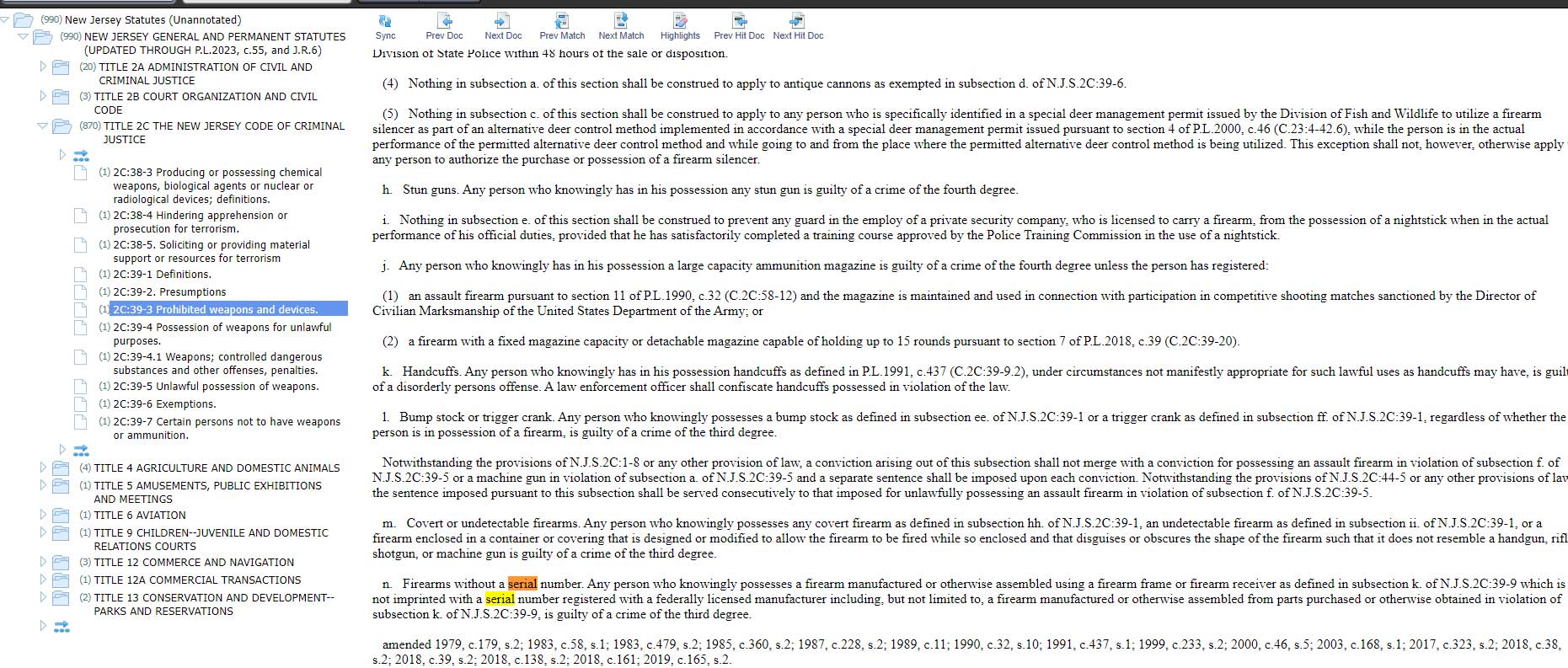
There are NO exceptions and there is NO grandfathering. This was the largest gun ban ever passed in the history of the United States.
The law bans ALL firearms with a “…firearm frame or firearm receiver …which is not imprinted with a serial number registered with a federally licensed manufacturer…”
The term “firearm frame or firearm receiver” means the part of a firearm that provides housing for the internal components.
For ANY firearm to be legal in New Jersey, it must now meet two criteria established by this law:
an Wos, Author of – Good Gun Bad Guy
Host of The Loaded Mic
Vermont Governor Phil Scott recently signed legislation banning “paramilitary” or Militia activity.
CBS News shows why no one should take the media seriously
We here at Bearing Arms have no pretension of being unbiased. As a result, you folks reading this have an idea of where we stand on issues. For those who agree, that’s why you’re here. For those who don’t, you know to filter things through the appropriate lens.
But places like CBS News still want you to think they’re unbiased.
That gets harder and harder every single year. Especially with headlines like this: “Texas senator continues to call for common sense gun safety laws”
Now, let’s start by noting that a Texas state senator continuing calls for gun control is newsworthy to some degree, especially in light of the Uvalde anniversary.
The subject matter is arguably appropriate and as this is labeled as “local news” on the CBS News site, it makes sense. Yet that label also presents a bit of a problem.
See, one of the first things you need to do if you’re going to at least pretend to be neutral is leave your editorializing out of the headline.
For anti-gun folks, they don’t see an issue. Pro-Second Amendment folks, though, can see it plain as day. The phrase “common sense gun safety laws” isn’t an official term rooted in neutrality. It’s the exact way gun control organizations frame the laws they’re trying to push onto the American people.
Had the reporter for CBS News put the phrase in quotations, then he’s just repeating what the senator may have said. Instead, it’s presented to the world as if this is an established fact. I hate to break it to him, though. It’s not.
Take the policy measures mentioned in the piece:
At a 45-minute news conference Gutierrez hosted at the Capitol earlier this month he said, “Every time something happens it’s something else and he’s got a solution for this that’s not related to the common denominator which is guns.”…
In an interview with CBS News Texas earlier this month, Gutierrez told me none of his gun safety bills received a hearing in the Senate, including a raise the age bill, universal background checks, and red flag laws. “It’s very clear here the Republicans’ position on gun reform they don’t want to try.”
Raising the age to buy an AR-15 only looks like it might prevent something bad from happening in a case like Uvalde, but the truth is that most people in that age group who buy those rifles do so because they want something they can use to defend themselves. Raising the age limit won’t stop bad people from getting guns–how many mass shooters have we seen who were too young to own any firearm?–but it will stop these law-abiding adults from owning guns.
That’s just common sense.
Universal background checks only look like a common sense gun measure because the media has done such a near-universal job of making them look like one. They don’t discuss how this doesn’t actually impact black market gun sales, it only inhibits law-abiding citizens transferring guns to one another. That’s literally all it does.
Red flag laws have tons of problems, problems which the media refuses to challenge proponents on. Besides the oft-cited due process concerns, there’s the simple fact that you’re saying someone is too dangerous to exercise their constitutionally protected rights but is just fine walking around on the streets.
Where’s the common sense there?
CBS News editorializing these policy measures as common sense doesn’t change the fact that they’re not. All it does is make it impossible to take anything else they say seriously on the issue of guns.
Their lack of neutrality is clear; so clear that even those on the fence about whether the media is biased should be able to see it for themselves.
Want to know why the polls look to be against us? It’s because the entire media apparatus is doing stuff like this.