
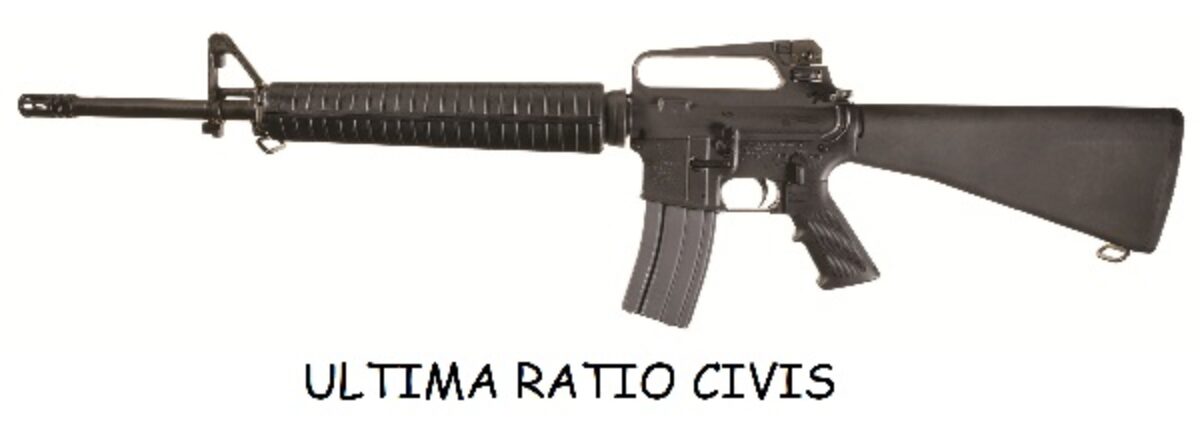
If you have a gun, you have a fighting chance. It’s as simple as that.
– AWR Hawkins
May 6, 2026
Translated: “My friend has a small farm, but he suffers from a small problem, which is that he is always being chased by wild boars that naturally live around his farm. So he decided to get a dog to help him drive the boars away. The dog’s reaction to the first chase:”
🗣️: صديقي لديه مزرعة صغيرة، ولكنه يعاني من مشكلة صغيرة، وهي أنه يتعرض دائما للمطاردة من الخنازير البرية التي تتواجد بشكل طبيعي حول مزرعته، فقرر إحضار كلب لمساعدته في طرد الخنازير
رد فعل الكلب مع أول مطاردة: pic.twitter.com/qLjbWpmeiL
— TAKTO (@Ne_zaha) April 30, 2026

Justice Scalia’s majority opinion in Heller had this to say about what arms meant:
The 18th-century meaning [of arms] is no different from the meaning today. The 1773 edition of Samuel Johnson’s dictionary defined ‘‘arms’’ as ‘‘[w]eapons of offence, or armour of defence.’’ Timothy Cunningham’s important 1771 legal dictionary defined ‘‘arms’’ as ‘‘any thing that a man wears for his defence…’’
NY AG Claims Body Armor Isn’t a Second Amendment Right
BUFFALO, NY — A legal battle is brewing in New York over whether law-abiding citizens have the right to purchase and own body armor for personal protection. Attorney General Letitia James has formally requested a federal judge to dismiss a lawsuit filed by the Firearms Policy Coalition (FPC), which challenges the state’s ban on the sale of this defensive gear to most civilians.
The FPC originally filed the lawsuit on behalf of New York residents who simply want the ability to protect themselves. In response, the state is arguing that body armor is a “dangerous and unusual” item that falls outside the protections of the Second Amendment. Attorney General James’s office claims that because modern body armor didn’t exist when the Constitution was written, it shouldn’t be covered.
However, this line of reasoning seems to ignore a key Supreme Court ruling. In the 2016 case Caetano v. Massachusetts, the court affirmed that the Second Amendment isn’t limited to 18th-century technology. Justice Samuel Alito pointed out that even firearms commonly used for self-defense today, like revolvers and semi-automatic pistols, did not exist back then. The court’s logic was clear: new technology doesn’t negate a constitutional right.
The True Purpose of Body Armor
New York’s argument portrays body armor as a tool for criminals, suggesting it turns a person into a “fortified threat” and is part of a “mass shooter’s toolkit.” This perspective overlooks the fundamental nature of body armor: it is purely defensive. Unlike a firearm, body armor cannot be used to inflict harm. Its sole purpose is to stop projectiles and protect the life of the person wearing it, which is the very essence of self-defense. Many everyday citizens, from late night convenience store clerks to people living in high crime neighborhoods, seek this protection for peace of mind.
The state’s ban was enacted following the tragic 2022 mass shooting at a Buffalo supermarket. Now, groups like the National Rifle Association are pushing back, stating that such laws only penalize law-abiding citizens. They argue that criminals, by their very definition, do not follow the law, so a ban on body armor only prevents good people from having another tool to ensure their own safety.
This case is being watched closely, as its outcome could set a precedent for whether states can prohibit citizens from owning defensive gear, raising critical questions about the modern application of the right to self-defense.
Are Submachine Guns Really Becoming a Thing of the Past?
Well, when you can get an AR in 5.56 NATO that’s not much larger than a Subgun in 9mm, or even .45 ACP…
The sad death of the sub-machine gun

These iconic, sometimes crude, weapons are increasingly rare on today’s battlefields
There’s a tendency when looking back at the weapons we first carried into battle to remember them with a certain affection. Mine was a sub-machine gun: compact, purposeful and, at the time, entirely suited to the environment in which I expected to fight – in a tank.
With its stubby barrel, distinctive curved magazine and folding stock, my little Sterling was perfect for the confined, unforgiving interior of an armoured vehicle. Folded down, it could be stowed almost anywhere – behind charge bins, tucked into corners, ready when needed, invisible when not. It was, in every sense, a practical tank soldier’s tool.
In those days, the logic behind the sub-machine gun was sound. Close quarters demanded speed, volume of fire and manoeuvrability. If you were forced to dismount under fire, or if the enemy got too close to your vehicle, you needed something you could use instantly. The SMG did exactly that. It wasn’t elegant, but it didn’t need to be. It was brutally effective within its limits.
In the hands of resistance fighters during the dark years of the Second World War, weapons such as the Sten gun became instruments of defiance. Crude and often hastily manufactured, yet devastatingly effective in ambush and close-quarter engagements, they allowed irregular forces to strike with speed and then vanish into the shadows. There is little chivalry in that kind of warfare, but there is resolve; and the sub-machine gun, in that context, became almost symbolic of that resolve.
Unsurprising then, that it also became associated with organised crime. Tommy gun-wielding 1920s gangsters found much to admire in its qualities: concealability, controllable automatic fire, and an unmistakable capacity for intimidation. It is a reminder, if one were needed, that tools of war are morally neutral; their character is entirely defined by those who wield them.
Yet if there is a moment when the sub-machine gun achieved something approaching professional reverence, it was during the 1980 Iranian embassy siege in London. When the SAS executed their assault – swift, decisive, and meticulously controlled – they did so armed with the MP5, a weapon that had, by then, refined the sub-machine gun concept to its zenith. What unfolded over those brief, violent minutes was not chaos, but choreography: precise entries, disciplined fire and an almost clinical application of force.

SAS troopers carry MP5 sub-machine guns as they enter the Iranian Embassy to end a six day siege in Central London, 1980 Credit: PA
But modern soldiers are no longer facing lightly equipped adversaries. The widespread adoption of advanced body armour, incorporating hardened ballistic plates, has fundamentally altered the dynamics of small-arms engagements. Pistol-calibre rounds, the lifeblood of the SMG, simply lack the velocity and energy required to defeat that protection reliably. In operational terms, that’s critical. A weapon that cannot neutralise a threat when it must is not just limited, it’s potentially dangerous to the man carrying it.
Range, too, has become a defining factor. Contemporary engagements rarely conform to the tight, urban or trench-bound distances of the early 20th century, despite recent reminders from conflicts such as those in Ukraine that close combat has not disappeared. Even there, however, the anticipated resurgence of the sub-machine gun has not materialised in any meaningful way. Soldiers require flexibility, the ability to engage at 50 metres or 300 metres without changing weapon systems. The SMG, by design, cannot offer that.

A government that intended to protect the liberty of the people would not disarm them. A government planning the opposite most certainly and logically would disarm them. And so it has been in the twentieth century. Check out the history of Germany, the Soviet Union, Cuba, China and Cambodia.
-Charlie Reese
May 5, 2026
Here’s the Background on the Two American Soldiers Who Went Missing Over the Weekend
Two American service members went missing over the weekend while participating in a joint military exercise with partner nations in North Africa. Search and rescue efforts are still underway.
Two U.S. service members have been reported missing while participating in exercise African Lion 2026 in Morocco, according to a release from U.S. Africa Command. The service members were last known to be in the area of Cap Draa Training Area, near the city of Tan Tan, Morocco… pic.twitter.com/oCWkIHVlYt
— OSINTdefender (@sentdefender) May 3, 2026
CBS has reported that the two soldiers were off-duty and had decided to go on a hike to observe the sunset when one fell off of a cliff and into the water below. A number of soldiers then attempted to form a human chain to rescue their comrade in the water, but failed to pull them up. The second soldier then jumped into the water for a rescue attempt, but failed. A third soldier also attempted a rescue, but returned to shore after likewise failing.
🚨 BREAKING NEWS!@AAGDhillon just dropped a cease-and-desist on the City of Denver.
Ordering them to get rid of their AR-15 ban, or the DOJ WILL be suing to enforce the Second Amendment rights of law-abiding citizens.
You love to see it! pic.twitter.com/yq3jU54U0c
— National Association for Gun Rights (@gunrights) May 4, 2026
Not surprisingly
Tim Walz’s Daughter Just As Dumb As Dad on Gun Control
Gov. Tim Walz was in a position to become vice president. I think I speak for most of us when I say that I’m glad he’s still governor of Minnesota. It’s not because he’s been stellar at his job there, mind you, as the Minneapolis day care scandal, and Walz’s reaction to it, amply illustrates that he sucks at it. It’s because it means he and Kamala Harris aren’t in charge in Washington.
Both were terrible on gun issues, despite Walz trying to portray himself as a macho man who could out shoot any of us. In fact, when he tried to act big and bad, he just embarassed himself.
When it comes to guns, though, it seems the apple doesn’t fall very far from the tree.
Hope Walz, the daughter of disgraced Minnesota governor and failed vice presidential candidate Tim Walz, called for gun control this week in the aftermath of another attempted assassination attempt on President Donald Trump.
“Gun control doesn’t just save Democrats’ lives. It also saves Republican lives,” she said in a TikTok video posted this week, apparently attempting to position herself as a leftist taking moral high ground.
“You’d think we’d be at a point now where we could call for some common sense legislation, but I don’t know. I don’t know,” she said sarcastically. “Also here to say that political violence is never ok. Duh. That’s the difference between us and them. It’s never ok.”
Walz continued, “But there’s something we can do about it: common sense gun legislation.”
She ultimately called on her audience to “do something about that for everybody’s “For everybody’s sake, yeah. Yeah. Happy Tuesday,” she added. “Feeling a little anxious today, but we’re going to get through it.”
Notably, this is the same “anxious” Walz who described Trump’s previous crackdown on crime in the nation’s capital as nothing more than “bitch baby, wussy, scaredy cat behavior.”
Fascinating, ain’t it?
Look, I agree that political violence isn’t OK. I’ll point out, though, that the left hasn’t exactly been showing any belief in that position. How many have been upset that Thomas Crooks missed, or that this guy didn’t get a shot at the president? How many celebrated the assassinations of UnitedHealthcare CEO Brian Thompson and Charlie Kirk?
Yeah, don’t do the “That’s the difference between us and them” bit. It’s not going to fly.
But let’s talk about “common sense gun legislation” for a moment. We keep having people bring this up, including people with much higher profiles that Hope Walz, but have you noticed how absolutely no one gives us any real concrete suggestions that would have made a difference? Rep. Jamie Raskins suggested universal background checks, but with the would-be assassin getting his guns in California, he passed background checks. That’s ridiculous.
Beyond that, though, most people are just braying about how we need gun control, but no one seems to have anything real to propose. Maybe because they know that nothing they could propose would have done anything and they don’t want people like me to rip it apart for being moronic.
Look, I actually do get her being anxious. Her dad is still governor of a state that’s the center of a lot of strife. People on both sides are antsy and the idea of someone going after her father doesn’t seem so farfetched as it should be. I sincerely don’t want to see that, and I know good and well that she doesn’t, so I’m not going to mock her anxiety here.
But I’ll also repeat that this guy gun his weapons in the most gun-controlled state in the nation, a state that has laws that would never fly anywhere else in the United States, so let’s not pretend this is the result of too few gun control laws. It’s not. It’s the result of leftist talking points and inflamatory rhetoric radicalizing someone to try and rid the nation of a tyrant who is nothing of the sort.
Trump OCC Gives Customers New Tools to Hold Banks Accountable for Anti-Gun Discrimination.
By Larry Keane
The Office of the Comptroller of the Currency is giving bank customers, including firearm industry members, a clearer path to document politicized de-banking and enter those concerns into the regulatory record. The move is a welcome development to further implement President Donald Trump’s Executive Order 14331, “Guaranteeing Fair Banking for All Americans,” and marks another needed step toward ending the practice of denying lawful businesses access to essential financial services because “woke” banks disfavor the firearm industry.
NSSF has long reported on banks using vague “reputational risk” excuses and woke boardroom gun control policies to choke off access to accounts, loans, credit, payment processing and other essential financial services. That discrimination hit lawful, highly regulated businesses whose only offense was serving Americans who choose to exercise their Second Amendment rights.
President Trump’s order states banking decisions must be based on individualized, objective and risk-based analysis, not politics, ideology or hostility toward lawful business activity. The order specifically cited the former Obama administration-era Operation Choke Point as a “well-documented and systemic” effort by federal regulators to pressure banks away from serving lawful industries that are disfavored by the political left…like the firearm industry.
That insidious practice was discontinued under President Trump’s first term but returned anew in a privatized form under former President Joe Biden.
The OCC’s new public comment guidance, however, gives President Trump’s executive order practical force. The agency says bank customers and stakeholders can share de-banking experiences with the OCC and the Federal Deposit Insurance Corporation and those complaints may be considered when the agency reviews bank licensing filings. They may also be considered during Community Reinvestment Act examinations.

Patrick Harris, Sr – Collectivist Wanna-Be tyrant, pandering to greed and envy.

“Safety is something that happens between your ears, not something you hold in your hands.” – Jeff Cooper
May 4, 2026
If you don’t defend your own family, who is going to do it? The cops?
– Tony Moon; THE rooftop Korean from the 1992 Rodney King riots.