

April 15
1715 – The massacre of a colonial delegation to the Yamasee tribe at their main village of Pocotaligo, triggers the start of the Yamasee War in colonial South Carolina.
1817 – Thomas Hopkins Gallaudet and Laurent Clerc found the American School for the Deaf, the first American school for deaf students, in Hartford, Connecticut.
1861 – After the fall of Fort Sumter, President Lincoln calls for 75,000 volunteers to quell hostilities in South Carolina that soon become war between the state.
1865 – President Lincoln dies after being shot the previous evening by actor John Wilkes Booth.
1892 – The General Electric Company is formed in Schenectady, New York.
1896 – The Games of the first modern Olympiad in Athens, Greece end.
1900 – Filipino guerrillas launch a surprise attack on U.S. infantry and begin a siege of Catubig, Philippines during the Philippine-American War
1912 – RMS Titanic sinks in the North Atlantic at 2:20 a.m., 2 hours and 40 minutes after hitting an iceberg. Only 710 of 2,224 passengers and crew on board survive.
1920 – During a robbery of the Slater and Morrill Shoe Company in South Braintree, Massachusetts, 2 security guards are murdered. A few weeks later, anarchists Nicola Sacco and Bartolomeo Vanzetti are arrested and charged with the crimes.
1922 – Senator John B. Kendrick of Wyoming introduces a resolution calling for an investigation of a secret land deal made a week earlier, which leads to the discovery of the Teapot Dome scandal.
1947 – Jackie Robinson starts as a first baseman for the Brooklyn Dodgers against the New York Yankees in an pre-season game at Ebbets Field, Brooklyn.
1952 – The Boeing B-52 Stratofortress flies for the first time.
1969 – A North Korean MiG-21 shoots down a U.S Navy Lockheed EC-121M Warning Star, call sign Deep Sea 129, of squadron VQ-1, Fleet Air Reconnaissance Squadron One, over the Sea of Japan, killing all 31 crew on board.
1986 – The U.S. launches Operation El Dorado Canyon, a series of bombing raids against Libyan targets in response to a discotheque bombing in West Germany that killed 3 U.S. servicemen.
2013 – Near the finish line at the Boston Marathon, 2 pressure cooker improvised bombs explode, killing 3 people and injuring 264 others.
2019 – The cathedral of Notre Dame de Paris is seriously damaged by a large fire.
2021 – A former employee, fired the previous October, returns to a FedEx Ground facility in Indianapolis, Indiana, then shoots and kills 9 people, wounding 7 more, before committing suicide
Almost Gun-Control Fails and Almost Armed Defense Saves Lives
Gun-control advocates will tell you that the 23-thousand firearms regulations we have today aren’t nearly enough. Those laws are simply a good start. In contrast, advocates of armed defense will tell you that the right to bear arms is horribly infringed. Both are telling the truth about what they want, but they can’t both be right. In fact the results are shockingly different. Imperfect gun-control fails time after time and imperfect armed defense stops millions of violent crimes each year. The truth is obvious if we’re willing to look.
There were over 278-thousand cases of criminals using guns during the commission of a violent crime in 2019. That is the last year for which the FBI provided complete statistics. We also had 61 mass murders with a firearm in 2021. All of these crimes were committed by a criminal who should not have had a gun. Criminals have firearms not because there are too few laws but because criminals ignore the laws we already have. Our flood of gun-control laws failed to stop violent criminals.
Every violent criminal who used a gun probably broke several gun-control laws during the commission of his crime. To start, these criminals stole a gun or bought it illegally. In addition to the sale, their possession of a gun was also illegal. They broke the law when they transported their firearm from place to place. Likewise, there are laws against criminals possessing or transporting ammunition. Concealing their firearm in public was against the law too.
These criminals don’t bother with background checks and waiting periods.
That is bad enough, but it gets worse. Gun-control laws actually made the job of mass-murderers easier and made their attacks more deadly. These criminals deliberately attacked us in “gun free” zones where honest citizens were disarmed by law.
Violent criminals who commit robbery, rape, assault, murder, or mass murder are also willing to break our firearms laws. These criminals commit many crimes before they are caught by law enforcement. That means violent criminals violate our gun-control laws several million times every year. Can that possibly surprise anyone?
Gun-control failed to stop violent criminals several million times yet gun-control advocates want us to pass more of their failing laws. Insanity is doing the same thing time after time and expecting a different result the next time you try the same old thing. That is why I think gun-control is crazy. I am as repulsed by violent crime and mass-murder as you are, and fortunately, we have options that work.
Owning a gun and using it for defense is common. Over 80-million of us own guns. 41 percent of us live in a household that has firearms. About one-in-a-dozen adults are armed in public. 30-percent of gun owners have used their firearm for defense. Honest citizens use their personal firearms for defense about 2.8-million times every year. That is a lot of armed defense and a wonderful legacy of lives that were saved.
As a conservative estimate, these armed citizens saved about 5-million victims from criminal violence. They save those lives despite the thousands of infringements on honest citizens being armed.
We know a lot about the armed citizens who have their permits to carry a firearm in public. These 20-million citizens are extraordinarily law-abiding and non-violent. They are less likely to break the law than the police. Ordinary gun owners are also less likely than the police to have an accident or shoot the wrong person. When we look at their record in the last few years, these honest gun owners stopped attempted mass-murder about half the time where they were allowed to go armed. That has stopped 104 attempted mass murders in the last seven years. That explains why mass-murderers choose “gun-free” zones.
The future is uncertain but we know some things with confidence. We know that gun-control politicians will offer their same broken solutions. We also know that ordinary citizens will be at the scene of the crime every time. We know that gun-control will fail and that armed citizens will stop violent criminals millions of times a year.
Should more of our neighbors be disarmed victims or armed defenders? That choice is up to us.
In fact, the choice is up to you.
The best 3D printers for beginners.
Even 3D printers for beginners can feel intimidating if you’re not familiar with the process. For instance, a recent 3D Printing Sentiment Index survey by Ultimaker revealed that 71 percent of professionals surveyed are aware of 3D printing. However, 29% of businesses that could potentially use 3D printing have no current familiarity with the technology. Nevertheless, engineers and entrepreneurs continue to use 3D printers in some very inventive ways: Astronauts plan to use a 3D printer on the International Space Station to print out elements of a human knee and engineers at Columbia University in New York have recently figured out how to replicate a seven-layer cheesecake. What’s encouraging is that in the last 12 years, 3D printers have also gotten more affordable.
But what exactly does a 3D printer do? Most consumer-grade 3D printers produce, or print, a three-dimensional object using a technology called “additive printing.” The process creates a three-dimensional object by building it layer upon layer using various materials, such as plastic or metal that adhere together during the process to eventually form the object. (The design of the object is based on a digital file, which is most often made using computer-aided design software, or CAD.) You’ll have to get over the initial learning curve, but watching that first print take shape can feel downright magical. The best 3D printers for beginners offer a simple setup, intuitive interfaces, and enough flexibility to grow with your skills.
- Best overall: Creality Ender 3 V2 Neo
- Best upgrade: Original Prusa i3 MK3S+
- Best for fast printing: Bambu Lab P1P
- Best for printing large objects: Anycubic Kobra Max
- Best budget: Monoprice 140108 MP Cadet
How we chose the best 3D printers for beginners
Missouri House advances bill allowing guns on buses, inside churches and synagogues
Missourians would be allowed to carry guns on public buses and inside churches and other places of worship under a bill advanced by the Missouri House Thursday.
The bill, sponsored by Rep. Adam Schnelting, a St. Charles Republican, would allow people with concealed carry permits to carry guns on public transit in the state.
“We all have the potential of running into situations where we have to utilize self defense to protect ourselves and those we love,” Schnelting said on the floor Thursday. “This legislation will discourage criminal activity on our public transportation systems, but most importantly, it will ensure that we maintain our constitutional right to self defense.”
An amendment successfully added by state Rep. Ben Baker, a Neosho Republican, would also strike down the current rule banning concealed guns in places of worship without the permission of the religious leader of the congregation.
The Missouri House gave the bill initial approval on a voice vote Thursday. It will need one more vote before it heads to the Missouri Senate, which could come next week.
LCSO investigating Easter homicide
BRONSON — The Levy County Sheriff’s Office is currently investigating a homicide that occurred Sunday in Bronson.
According to a news release by LCSO Lt. Scott Tummond, the sheriff’s office 911 Center received a call at approximately 3 p.m. reporting that someone had been shot.
Deputies responded to a duplex located in the town and found 40-year-old James Young Jr. deceased on the floor inside. Tummond said Young suffered a single gun shot wound to the chest.
Tummond said detectives with the LCSO were sent to the scene and it was determined, through investigation, that Young had a previous “domestic relationship” with the female occupant of the duplex.
Young went to the duplex to confront the female and was armed with a handgun when he arrived. Tummond said the two began to struggle, and the woman managed to get her own gun and fired one shot, hitting Young in the chest.
Tummond said the female ran from the residence to a neighbor’s house close by for help.
Detectives are still in the early stages of this investigation. No charges have been filed and this investigation is currently on-going.
The Left continues to whitewash its crazy, violent, and authoritarian history.
About a week before Jeff Sharlet’s new book , The Undertow: Scenes from a Slow Civil War, was published in March, a new video was uploaded on YouTube. It was a short documentary from 1983 of when Harry Belafonte, an iconic American singer and actor, visited East Germany to perform in a concert promoting communism . The “World Peace Concert” was run by East Germany’s communist youth organization. Belafonte gave his blessings to the Soviet-sponsored campaign promoting unilateral Western disarmament.
The Belafonte concert is barely mentioned in The Undertow, a collection of essays and reporting by Sharlet, an award-winning journalist who teaches at Dartmouth College. Indeed, little of the Left’s history of flirting with authoritarianism is mentioned at all. Instead, The Undertow argues that a bunch of crazy right-wingers, including militia groups, are bent on conflict with the Left. They want a second civil war, Sharlet claims, and those who stand up to oppose them are American leftists, portrayed as Christlike figures of light and wisdom.
While announcing the Right has a strong and growing MAGA force that is armed and dangerous and itching for battle, Sharlet smothers any proof that the Left is violent and crazy. His book, which opens with a long and loving profile of Belafonte, fails to mention the singer’s hardcore leftism.
Not even Belafonte tried to airbrush his beliefs. In his memoir, Belafonte wrote: “I remained not just liberal but an unabashed lefty. I was still drawn to idealistic left-wing leaders … who seemed to embody the true ideals of socialism .”
Belafonte was friends with the communist singer Paul Robeson. He praised Hugo Chavez and Fidel Castro, writing that the latter has “a strong grasp of Latin American history and of the fine distinctions in law between Venezuela and its neighbors.” Belafonte called former President George W. Bush “the greatest tyrant, the greatest terrorist in the world.” He was a Marxist — pure and simple.
None of this is reported in The Undertow. Instead, Belafonte is portrayed by Sharlet simply as an inspirational civil rights leader — “a radiant man” who was friends with Martin Luther King Jr. and who remains a political visionary. Sharlet’s book is pure agitprop. It condemns conservatives and treats even the most violent and despicable leftists as, quite literally, messianic. In his essay about Occupy Wall Street, for example, the 2011 leftist street protests that resulted in stinky unbathed bodies and reports of sexual assault, Sharlet claims he felt like Jesus Christ — well, sort of: “I feel like one of five hundred title Christs, if by Christ you allow me to refer not to divinity itself but to one of its more wholly human representations, Andres Serrano’s 1987 photograph Piss Christ.”
Say what? Piss Christ is a notorious piece of garbage “art” that was created when Serrano placed a crucifix in a jar of his urine. To Sharlet, this is the icon worth emulating: “Appreciating what happened at Liberty Park [in New York’s Occupy Wall Street] requires a mental shift akin to the one necessary to see Piss Christ — an image of a plastic crucifix submerged in the artist’s own golden urine — as not blasphemous but a strange breed of beautiful. I don’t mean ideologically beautiful, some baroque idea one admires for the complexity of its inversions. I mean gorgeous. Breathtaking, breath-giving, at the same time.”
This may be the clearest distillation of modern leftism ever committed to paper. It has the religious piety that surrounds liberalism’s self-regard but maintains its “woke” street cred by attaching itself to blasphemous “art.” We are like Jesus, but it’s the Jesus who hates Jesus. It’s perfect in its performative incoherence.
Sharlet’s main essay, “The Undertow,” takes on the Jan. 6 riot at the U.S. Capitol. Central to the story is Ashli Babbitt, the woman who was killed by a police officer on that day. Here is Sharlet’s description: “Babbitt, shot for her trouble, was a fool who pursued her own death.” She was also, he claims, made into a symbol by the Right: “Ashli Babbitt was processed, made productive, almost immediately after her death, transformed right away into yet another flag, like a new tarot card in the deck of fascism.”
“A fool who pursued her own death.” What cold, despicable words. You can both think the Jan. 6 riot was an ill-advised disaster and question why Babbitt was shot and killed. But Sharlet, just like Belafonte and the communists he entertained and bankrolled, wants a world in which asking such questions gets you tossed into prison.
This, and let teachers and school staff, who want to, be armed.
Private business will have to decide what each one wants to do.
There is something we can all do about mass shootings
Over the last two weeks, we’ve seen two mass shootings. Much as I’d like to say it, this isn’t unusual. Such horrible events seem to happen in clusters, where we’ll go months with relative quiet, only to see a number of shootings in fairly quick succession.
Such incidents always spark debate. We simply have to find some way to address the problem.
The thing is, we kind of already have a plan, and it’s one that doesn’t require us to trip over ourselves passing new laws.
All it takes is for people to decide to do something. We just stop making these people famous.
Here’s a take from my friend, Brad Polumbo, from a couple of years ago:
What if there was a way we could significantly reduce the number of mass shootings without either side having to sacrifice their policy principles?…
We could meaningfully decrease gun violence if both sides were simply willing to give up their cheap rhetoric. How do I know this? Because according to the American Psychological Association, the individuals who become mass shooters are often directly seeking the media infamy we continue to grant them.
Western New Mexico University Psychologist Jennifer B. Johnston has found in her research that mass shooters tend to be in the midst of rampant depression, social isolation, and pathological narcissism; they are in part driven to such heinous crime by their desire for national attention.
And it is undeniable that the wall-to-wall coverage in the wake of these mass shootings—coverage that is amplified and jacked up by partisan political attacks that instrumentalize the shooters’ names and identities—makes the crime all the more tantalizing for these mass murderers.
“We find that a cross-cutting trait among many profiles of mass shooters is desire for fame in correspondence to the emergence of widespread 24-hour news coverage on cable news programs, and the rise of the internet,” Johnston has said. “If the mass media and social media enthusiasts make a pact to no longer share, reproduce or retweet the names, faces, detailed histories or long-winded statements of killers, we could see a dramatic reduction in mass shootings in one to two years.”
In other words, we just stop making these schmucks famous.
Following both Nashville and Louisville, I’ve seen almost puff-piece-like articles describing the shooters. They give names, where they went to school, positive sentiments about the eventual killers, and everything else one would expect to see in a report on a new celebrity.
Their names get thrown around by the media with reckless abandon.
Even in death, they become celebrities of a sort. As Brad notes above, that’s what they want.
When you reward behavior, you get more of that behavior. From dogs to kids to grown adults, the truth is that if you give someone what they’re seeking when they perform a given action, you’re going to get more of that action. This is basic psychology.
Potential mass shooters see this and remember it. They want to be famous. They want to show the world.
And the media gives them exactly what they want.
No one is saying not to report on the shootings. We can and should cover them as well as details about the killers that might be relevant. We don’t need their names, though.
By letting these tools fall into obscurity, many of these shootings simply wouldn’t happen. The narcissistic need to seek fame would be sought out some other way, some way less fatal to innocent people.
And we don’t need laws to do this. We just need media outlets to stop naming names.
We don’t do it here. However, we often rely on news from places with no such efforts in place, and that bothers me.
We can take a big step with regard to mass shootings if the media would just step up for a change and do the right thing.
"costed"
And, a 6 piece mcnugget meal? No wonder he still looks like a little kid.
— Michael Richey (@ComRicheyweb) April 14, 2023
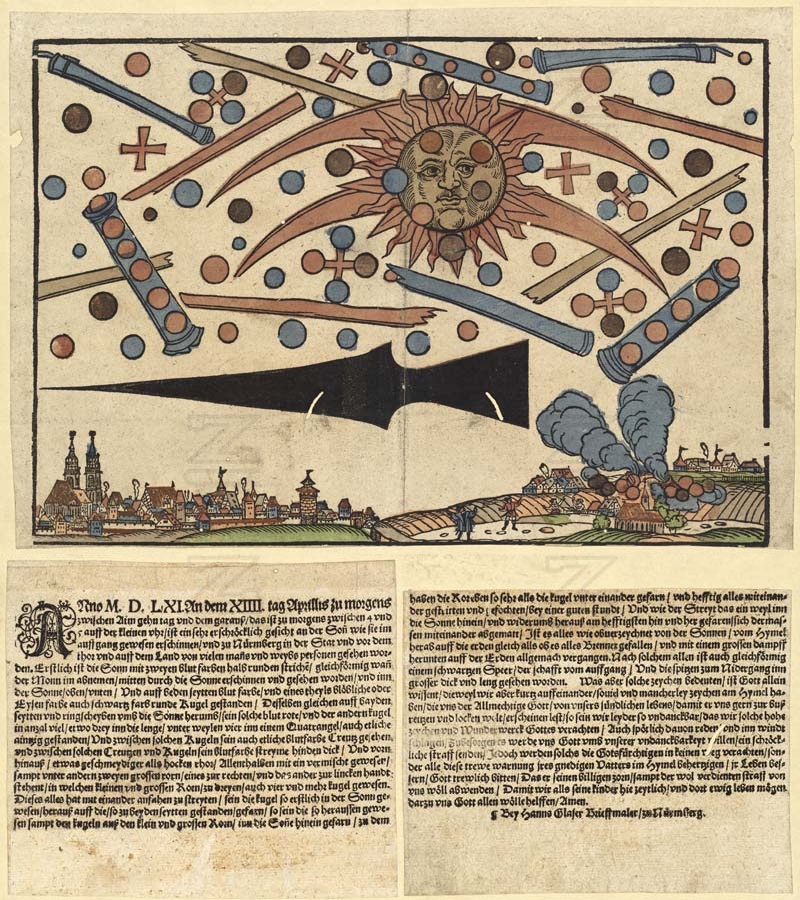
In the morning of April 14, 1561, at daybreak, between 4 and 5 a.m., a dreadful apparition occurred on the sun, and then this was seen in Nuremberg in the city, before the gates and in the country – by many men and women.
At first there appeared in the middle of the sun two blood-red semi-circular arcs, just like the moon in its last quarter. And in the sun, above and below and on both sides, the color was blood, there stood a round ball of partly dull, partly black ferrous color.
Likewise there stood on both sides and as a torus about the sun such blood-red ones and other balls in large number, about three in a line and four in a square, also some alone.
In between these globes there were visible a few blood-red crosses, between which there were blood-red strips, becoming thicker to the rear and in the front malleable like the rods of reed-grass, which were intermingled, among them two big rods, one on the right, the other to the left, and within the small and big rods there were three, also four and more globes.
These all started to fight among themselves, so that the globes, which were first in the sun, flew out to the ones standing on both sides, thereafter, the globes standing outside the sun, in the small and large rods, flew into the sun.
Besides the globes flew back and forth among themselves and fought vehemently with each other for over an hour. And when the conflict in and again out of the sun was most intense, they became fatigued to such an extent that they all, as said above, fell from the sun down upon the earth ‘as if they all burned’ and they then wasted away on the earth with immense smoke.
After all this there was something like a black spear, very long and thick, sighted; the shaft pointed to the east, the point pointed west. Whatever such signs mean, God alone knows.
Although we have seen, shortly one after another, many kinds of signs on the heaven, which are sent to us by the almighty God, to bring us to repentance, we still are, unfortunately, so ungrateful that we despise such high signs and miracles of God. Or we speak of them with ridicule and discard them to the wind, in order that God may send us a frightening punishment on account of our ungratefulness.
After all, the God-fearing will by no means discard these signs, but will take it to heart as a warning of their merciful Father in heaven, will mend their lives and faithfully beg God, that He may avert His wrath, including the well-deserved punishment, on us, so that we may temporarily here and perpetually there, live as his children. For it, may God grant us his help, Amen.
By Hanns Glaser, letter-painter of Nurnberg.
April 14
966 – Following his marriage to the Christian Doubravka of Bohemia, the pagan ruler of the Polans, Mieszko I, converts to Christianity, an event considered to be the founding of the Polish state.
1775 – British General, and Massachusetts provincial governor Thomas Gage receives orders from London authorizing action against colonial militia that are known to be stockpiling weapons at Concord, and orders British troops from the Boston garrison to march there on the night of 18 April to confiscate them.
1865 – While Secretary of State William Seward and his family are attacked at home by Lewis Powell, President Lincoln is shot in Ford’s Theatre by John Wilkes Booth as part of a wider assassination conspiracy.
1881 – 2 days after taking the position of City Marshal, Dallas Stoudenmire and Country Constable Gus Krempkau are engaged in a running gunfight in El Paso, Texas, where in the space of 5 seconds, Stoudenmire kills 3 men, including the one who had just shot and killed Constable Krempkau; known as “The 4 Dead In 5 Seconds Gunfight”.
1890 – The Pan-American Union is founded by the First International Conference of American States in Washington, D.C.
1894 – The first ever commercial motion picture house opens in New York City, using 10 Kinetoscopes for viewing movies.
1906 – The Azusa Street Revival opens in Los Angeles, California, launching Pentecostalism as a worldwide movement.
1909 – A massacre is organized by the moslem Ottoman Empire against the Christian Armenian population of Adana Vilayet, in Cilicia, eventually killing 25,000 people.
1912 – The White Star Line passenger liner RMS Titanic hits an iceberg off the Grand Banks in the North Atlantic Ocean at 23:40 hours ship’s time.
1935 – The Black Sunday dust storm, considered one of the worst storms of the Dust Bowl, sweeps across the Oklahoma and Texas panhandles and neighboring areas.
1981 – STS-1, the first operational flight of a shuttle and of Shuttle Columbia is completed, landing at Edwards Air Force Base, California.
1988 – The Oliver Perry Class Guided Missile Frigate, FFG-58- USS Samuel B. Roberts strikes a mine and is severely damaged in the Persian Gulf during Operation Earnest Will.
1994 – In a friendly fire incident during Operation Provide Comfort in northern Iraq, a US Air Force crewman aboard a E-3 AWACS aircraft misidentifies 2 US Army Black Hawk helicopters as Iraqi Mi-24 Hind helicopters and directs 2 US F-15 fighters to intercept. The pilots of the F-15s also misidentify the helicopters and shoot them down, killing all 26 passengers and crews aboard both craft.
2003 – U.S. troops in Baghdad capture Muhammad Zaidan, known as Abu Abbas, leader of the Palestinian group that killed an American on the hijacked cruise liner the MS Achille Lauro in 1985.
2005 – The Oregon Supreme Court nullifies marriage licenses issued to same sex couples a year earlier by Multnomah County.
Note the lack of gun companies pic.twitter.com/7vXjFS1lta
— Rob Romano (@2Aupdates) April 14, 2023
Name fits
Second Amendment Roundup: To Preserve Liberty, Not Slavery
Carl Bogus invented the fiction that the purpose of the Second Amendment was slave control.
Back in 1998—a decade before Heller—Prof. Carl Bogus claimed to have discovered a “hidden history” showing that the Second Amendment was adopted to ensure that militias could enforce slave control. Since that theory crops up now and then, in 2021 I posted a comprehensive historical refutation in SSRN, which was subsequently published in Georgetown Journal of Law & Public Policy.
Bogus has now rehashed his 1998 theory in Madison’s Militia: The Hidden History of the Second Amendment (Oxford University Press, 2023), which adds nothing new on point. He states up front that he will not address how legal scholars or the courts have interpreted the Amendment, except to assert, without any support, that James Madison and his colleagues “would have been astonished” at the Supreme Court’s holding that the Amendment “grants individuals a right to have guns….” (“Grants?” No, confirms.)
Bogus failed to address or even mention my paper, which is the only comprehensive critique of his 1998 article, even though it was first published a year-and-a-half before his book. Oxford University’s readers who vetted his manuscript were either asleep at the wheel or biased in favor of his argument. This is good example of why courts today, when searching for historical analogues under Bruen, should rely on original historical sources and not skewed declarations by “historians.”
Bogus calls his tome “a mystery book” about “why James Madison decided to write the Second Amendment,” because “there is no direct evidence about what the Founders intended.” But his agenda is clear: instead of “the Minuteman at Lexington, with a musket in his hands … the more accurate image [of the Second Amendment] is that of the musket in the hands of the militiaman on slave patrol in the South.”
Denigrating America’s patriots in order to infect the Second Amendment with racism makes it easier today to criminalize the right to keep and bear arms, and is consistent with other contemporary efforts, such as the 1619 Project, to demonize America and its founders. Not surprisingly, Bogus served on the board of directors of Handgun Control Inc., the anti-gun lobby which morphed into the Brady Center.
Fox News covers us pointing out that the Louisville Mass Murderer attacked yet another Gun-free Zone
Finally, some news coverage on gun-free zones. The question we have continually been asking: “Why isn’t it newsworthy that time after time these mass murderers pick targets where their victims are defenseless?”.
The tragic shooting at a bank in Louisville, Kentucky, that left five people dead and eight others injured appears to be another instance of a shooting tragedy unfolding at a gun-free zone, a recent report found..
Police in Louisville began receiving calls at 8:38 a.m. Monday of shots fired at an Old National Bank location in the city, just minutes before the bank was set to open at 9 a.m. Louisville Metro Police Department Chief Jacquelyn Gwinn-Villaroel said that officers “unflinchingly” engaged with the shooter and prevented further loss of life..
The Crime Prevention Research Center reviewed the national bank’s team-member handbook, which outlined various rules employees must follow or risk disciplinary action or even termination. Among the list of rules, employees must act in a professional and honest capacity at work, they are also prevented from taking firearms into a bank premises..
“Possession of dangerous or unauthorized materials, such as explosives, firearms, or any type of weapons inside the workplace or on company premises. In some states, there are additional laws about this subject,” the handbook, which was also reviewed by Fox News Digital, states under a list of “examples of some of the infractions or conduct that may result in disciplinary action.”.
A spokesperson for the bank told Fox, when approached for comment on the handbook and gun-free zones, that the company is currently not commenting “on team members or company documentation in the wake of this incident.” Kentucky is a permitless carry state but still prohibits firearms in certain locations, such as police stations and government buildings..
Shooter Connor Sturgeon was a 25-year-old employee of the bank who carried out the attack with a rifle, according to investigators. .
“Importantly, the bank’s employee handbook makes it clear that carrying a permitted concealed handgun into the bank is a fireable offense. This employee would have known that the employees were banned from having guns,” the Crime Prevention Research Center (CPRC) wrote in a post Tuesday. “Why isn’t it newsworthy that time after time these mass murderers pick targets where their victims are defenseless?”.
CPRC founder and President John Lott has repeatedly spoken out about how gun-free zones could serve as magnets for murderers who want to cause as much bloodshed as possible..
“The media just refuses to cover that these killers purposefully pick targets where they know victims can’t defend themselves. The media also continually ignores that these murderers explicitly explain why they pick these targets,” Lott told Fox News Digital on Tuesday..
“These mass murderers may be crazy, but they aren’t stupid. Their goal is to get media coverage, and they know the more people they kill, the more coverage they will get, so they go to places where they know victims can’t defend themselves,” he added..
Just last month, a shooting at the Covenant School, a private Christian school in Nashville, Tennessee, left three students and three employees at the school dead. The shooter, Audrey Hale, allegedly “looked at” two other schools but did not carry out the attack at those schools because “the security was too great to do what she wanted to do,” Nashville City Council member Robert Swope told the New York Post last month..
Iowa House votes to let Iowans have guns in parking lots of schools, public buildings
Iowans could keep guns in their locked cars in the parking lots of schools, city and county buildings, state universities and prisons, under a bill passed Wednesday by the Iowa House.
Lawmakers approved House File 654 on a vote of 62-37 after two hours of emotional debate. Most Republicans voted yes but two — Reps. Gary Mohr, R-Bettendorf, and Chad Ingels, R-Randalia — joined Democrats in voting no.
The bill must still pass the Iowa Senate before it can become law.
It’s the latest expansion of gun rights by the Republican-controlled Iowa Legislature, which has passed several laws loosening or repealing gun regulations in recent years, including a 2021 law eliminating the requirement for Iowans to have a permit to carry or possess handguns.
Charged debate on Oregon gun bills reflects national divide
SALEM, Ore. (AP) — An emotionally charged debate over Oregon’s gun-related legislation recently brought lawmakers on different sides of the issue near tears, reflecting a passionate divide over gun rights that is also playing out nationwide.
One of the most sweeping bills being proposed in the politically diverse state — the one that led to highly personal speeches from both Republican and Democratic lawmakers at a committee hearing last week — would increase the purchasing age to 21 for AR-15s and similar types of guns, impose penalties for possessing undetectable firearms and allow for more limited concealed-carry rights.
Republican lawmakers in Oregon said community safety depends on access to firearms, while Democrats conversely called for greater restrictions in the name of safety.
Tennessee gun lobby throws water on governor’s protective order plan
The Tennessee Firearms Association is trashing Gov. Bill Lee’s push for what it calls a “red flag law,” saying he wants to pass an unconstitutional measure as an emotional reaction to the Covenant School shooting.
“Governor Lee called for the Legislature to react to the emotional response of some citizens after the Covenant murders and more particularly after the expulsion of two Democrat House members who demanded gun control,” Executive Director John Harris said in a Wednesday statement. “Nothing in Bruen authorized knee-jerk emotional responses to murders or the calls of progressive Democrats and their mobs to justify government infringement of a right protected by the Constitution.”
The association contends Lee’s plan would violate the U.S. Supreme Court’s decision in New York State Rifle & Pistol Association v. Bruen. Justices found that the Second and Fourteenth Amendments guarantee the right to “keep” firearms in their homes and to “bear arms” in public, including the ability of “ordinary, law-abiding citizens” to carry firearms “for self-defense outside the home,” without infringement from state and federal governments.
This is the media – programmed propaganda to fool and control gullible sheep. https://t.co/4o2Y0DrzBt
— Catturd ™ (@catturd2) April 13, 2023