


The dirty little secret of the anti-gun lobby is that gun laws have never been effective in reducing violence. In fact, the reverse may be true..
— Michael S. Brown
April 20, 2026
Are they all this stupid? pic.twitter.com/455vewOcQ5
— Gunther Eagleman™ (@GuntherEagleman) April 19, 2026
Captain John Parker’s statement about the events on Lexington Common.
I John Parker, of lawful Age, and Commander of the Militia in Lexington, do testify & declare that on the 19th Instant, in the morning, about one of the Clock, being informed that there were a Number of Regular Officers riding up and down the Road, Stopping and insulting People as they passed the Road, and also was informed that a Number of Regular Troops were on their March from Boston, in order to take the Province Stores at Concord, ordered our Militia to meet on the Common in said Lexington, to consult what to do, and concluded not to be discovered nor meddle or make with said Regular Troops (if they should approach) unless they should insult or molest us — and upon their sudden Approach I immediately ordered our Militia to disperse and not to fire — Immediately said Troops made their Appearance and rushed furiously, fired up-on and killed eight of our Party, without receiving any Provocation therefor from us,
John Parker
Middlesex April 25th, 1775.
The above named John Parker personally appeared, and, after being duly cautioned to declare the whole Truth, made solemn Oath to the truth of the above Deposition by him subscribed
William Reed
Josiah Johnson
William Stickney
Justices of the Peace
Commented by Paul
“It all began that day on Concord Bridge,
When from the fields, and from the ridge,
They left the plow, the axe upon the tree,
And came to fight for land and liberty…
And from the Mantle, the cabin-side,
They took their rifles, hanging there with pride,
And fired the shots that echo down the years,
That even now the would be tyrant fears…
So, mark this well; Free men forever fall,
When they have lost the rifle on the wall. ”
– Steven Knapp
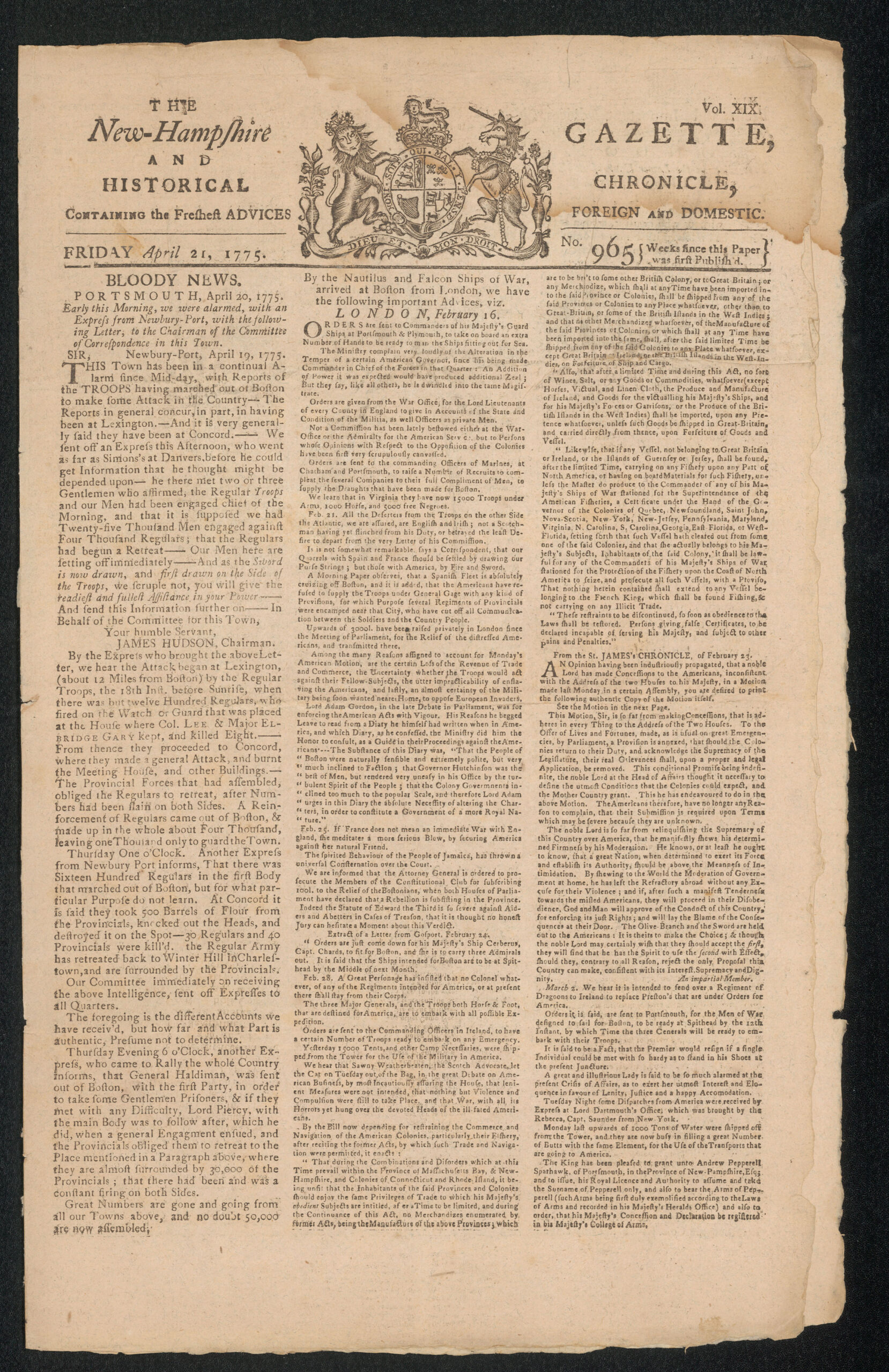
BLOODY NEWS.
Early this Morning, we were alarmed, with an Express from Newbury-Port, with the following Letter, to the Chairman of the Committee of Correspondence in this Town.
SIR, Newbury Port, April 19, 1775.
THIS Town has been in a continual Alarm since Mid-day, with Reports of the TROOPS having marched out of Boston to make some Attack in the Country. The Reports in general concur, in part, in having been at Lexington. And it is very generally said they have been at Concord. We sent off an Express this Afternoon, who went as far as Simons’s at Danvers before he could get Information that he thought might be depended upon– he there met two or three Gentlemen who affirmed, the Regular Troops and our Men had been engaged chief of the Morning, and that it is supposed we had Twenty-five Thousand Men engaged against Four Thousand Regulars; that the Regulars had begun a Retreat. Our Men here are setting off immediately And as the Sword is now drawn, and first drawn on the Side of the Troops, we scruple not, you will give the readiest and fullest Assistance, in your Power And send this Information further on In Behalf of the Committee for this Town,
Your humble Servant, / JAMES HUDSON, Chairman.
By the Express who brought the above Letter, we hear the Attack began at Lexington, (about 12 Miles from Boston) by the Regular Troops, the 18th Inst. before Sunrise, when there was but twelve Hundred Regulars, who fired on the Watch or Guard that was placed at the House where Col. LEE & Major ELBRIDGE GARY kept, and killed Eight. From thence they proceeded to Concord, where they made a general Attack, and burnt the Meeting House, and other Buildings. The Provincial Forces that had assembled, obliged the Regulars to retreat, after Numbers had been slain on both Sides. A Reinforcement of Regulars came out of Boston, & made up in the whole about Four Thousand, leaving one Thousand only to guard the Town.
Thursday One o’Clock. Another Express from Newbury Port informs, That there was Sixteen Hundred Regulars in the first Body that marched out of Boston, but for what particular Purpose do not learn. At Concord it is said they took 500 Barrels of Flour from the Provincials, knocked out the Heads, and destroyed it on the Spot–30 Regulars and 40 Provincials were kill’d. the Regular Army has retreated back to Winter Hill in Charlestown, and are surrounded by the Provincials.
Our Committee immediately on receiving the above Intelligence, sent off Expresses to all Quarters.
The foregoing is the different Accounts we have receiv’d, but how far and what Part is authentic, Presume not to determine.
Thursday Evening 6 o’Clock, another Express, who came to Rally the whole Country informs, that General Haldiman, was sent out of Boston, with the first Party, in order to take some Gentlemen Prisoners, & if they met with any Difficulty, Lord Piercy, with the main Body was to follow after, which he did, when a general Engagement ensued, and the Provincials obliged them to retreat to the Place mentioned in a Paragraph above, where they are almost surrounded by 30,000 of the Provincials ; that there had been and was a constant firing on both Sides.
Great Numbers are gone and going from all our Towns above, and no doubt 50,000 are now assembled.
Major John Pitcairn’s Report to General Gage
Boston Camp,
To: General Thomas GageSir,
As you are anxious to know the particulars that happened near and at Lexington in the 19 th Inst agreeable to your desire, I will in as concise a manner as possible state the facts, for my time at present is so much employed, as to prevent a more particular narrative of the occurrences of that day.
Six companies of Light Infantry were detached by Lt Colo Smith to take possession of two bridges on the other side of Concord, near three in the Morning, when we were advanced within about two miles of Lexington, intelligence was received that about 500 men in arms were assembled, determined to oppose the Kings troops, and retard them in their march. On this intelligence, I mounted my horse, and galloped up to the six Light Companies.
When I arrived at the head of the advance Company, two officers came and informed me, that a man of the rebels advanced from those that were assembled, had presented his musket and attempted to shoot them, but the piece flashed in the pan. On this I gave directions to the troops to move forward, but on no account to fire, or even attempt it without orders; when I arrived at the end of the Village, I observed drawn up upon a Green near 200 rebels; when I came within about 100 yards of them, they began to file off towards some stone walls on our right flank.
The Light Infantry, observing this, ran after them. I instantly called to the soldiers not to fire, but surround and disarm them, and after several repetitions of those positive orders to the men, not to fire, etc. some of the rebels who had jumped over the wall fired four or five shots at the soldiers, which wounded a man of the Tenth and my horse was wounded in two places, from some quarter or other, and at the same time several shots were fired from a meeting house on our left.
Upon this, without any order or regularity, the Light Infantry began a scattered fire, and continued in that situation for some little time, contrary to the repeated orders both of me and the officers that were present. It will be needless to mention what happened after, as I suppose Colo Smith hath given a particular account of it..
I am, Sir, Your Most Obedt
Humble Servant
John Pitcairn
A report from Lieutenant General Hugh Percy to General Gage
In obedience to your Excellency’s orders I marched yesterday morning at 9 o’clock with the 1st brigade and 2 field pieces, in order to cover the retreat of the grenadiers and light infantry in their return from their expedition to Concord.
As all the houses were shut up, and there was not the appearance of a single inhabitant, I could get no intelligence concerning them till I had passed Menotomy, when I was informed that the rebels had attacked his Majesty’s troops who were retiring, overpowered by numbers, greatly exhausted and fatigued, and having expaned almost all their ammunition—and at about 2 o’clock I met them retiring rough the town of Lexington – I immediately ordered the 2 field pieces to fire at the rebels, and drew up the brigade on a height.
The shot from the cannon had the desired effect, and stopped the rebels for a little time, who immediately dispersed, and endeavoured to surround us being ery numerous. As it began now to grow pretty late and we had 15 miles to retire, and only 36 rounds, I ordered the grenadiers and light infantry to move of first; and covered them with my brigade sending out very strong flanking parties wich were absolutely very necessary, as there was not a stone wall, or house, though before in appearance evacuated, from whence the rebels did not fire upon us. As soon as they saw us begin to retire, they pressed very much upon our rear guard, which for that reason, I relieved every now and then.
In this manner we retired for 15 miles under incessant fire all round us, till we arrived at Charlestown, between 7 and 8 in the evening and having expended almost all our ammunition. We had the misfortune of losing a good many men in the retreat, though nothing like the number which from many circumstances I have reason to believe were killed of the rebels. His Majesty’s troops during he whole of the affair behaved with their usual intrepidity and spirit nor were they a little exsperated at the cruelty and barbarity of the rebels, who scalped and cut off the ears of some of the wounded men who fell into their hands.
The Minute Man depicted in the Army National Guard logo is meant to represent Isaac Davis. He was killed on April 19th, 1775 leading his troops at the Battle of Concord. The logo is an artwork of the statue erected to honor him

Isaac Davis (February 23, 1745 – April 19, 1775) was a gunsmith and a militia officer who commanded a company of Minutemen from Acton, Massachusetts, during the first battle of the American Revolutionary War.
In the months leading up to the Revolution, Davis set unusually high standards for his company in terms of equipment, training, and preparedness. His company was selected to lead the advance on the British Regulars during the Battle of Concord because his men were entirely outfitted with bayonets. During the American advance on the British at the Old North Bridge, Davis was among the first killed and was the first American officer to die in the Revolution.
Word of the British movement reached Acton just before dawn on April 19, most likely delivered by Dr. Samuel Prescott, a resident of Concord and one of the Sons of Liberty. As the alarm spread, the Acton Minutemen began to gather at Davis’s home. While waiting for others to arrive, the men made paper cartridges and some powdered their hair with flour so as to appear more like gentlemen when they met the British in battle. As the Minutemen prepared, Davis’s wife noticed that he seemed especially somber and said very little. As some of his men joked about getting shot at by a British soldier, Davis rebuked them, reminding them that some of them would soon be killed.
Davis formed up his company and ordered them to march at about 7 a.m. According to his wife and other witnesses, shortly after stepping off, Davis ordered his company to halt, then returned to his front door to tell his wife, “Take good care of the children.”
Soon after crossing into Concord, the Acton company passed the farm of Colonel James Barrett who commanded the provincial troops in Concord that morning. A small detachment of British soldiers were searching Barrett’s farm for supplies, and Davis considered attacking them. His orders, however, were to muster with the rest of the provincial militia and Minutemen near the Old North Bridge by the Concord River. He then diverted his company off the road, avoiding the British at Barrett’s farm and marching past a tavern belonging to a Widow Brown.
A boy named Charles Handley, who lived at Widow Brown’s Tavern, saw Davis’s company pass the tavern. He recalled many years later that a fifer and drummer played a song called “The White Cockade”, a reference to the white ribbon worn on their bonnets by Scots revolutionaries during The Jacobite rebellion of 1745. Tradition persists that this was Davis’s favorite marching song, but there is little evidence to support this notion. There is also a tradition that the Acton musicians played the White Cockade later when Davis’s company led the advance on the British at the Old North Bridge, although this too is not supported by primary source accounts.
Davis’s company reached the area of the Old North Bridge at approximately 9 a.m. Several other companies of militia and Minutemen, consisting of about 500 men from Concord, Lincoln, and Bedford, had already gathered on a small hill overlooking the bridge. Approximately 100 British Regulars occupied the bridge.
Shortly after Davis arrived, Barrett called a council of the officers present to determine whether or not to attack the Regulars at the bridge. In Concord, the majority of the British force was searching for supplies, but they found little. When they decided to burn some wooden gun carriages they discovered, the provincials near the Old North Bridge saw the smoke and thought the British were burning the town. Barrett then made the decision to attack the soldiers holding the bridge.
Davis’s company had taken their designated position at the left of the provincial line. This would have placed the Acton company in the rear of the attack when the line advanced. The company in the lead would have been Captain David Brown’s company from Concord. When Barrett asked Brown if he would lead the attack, Brown responded that he would rather not. Knowing that Davis’s company was well equipped with bayonets and cartridge boxes, Barrett asked Davis if his company would lead the advance. Several slight variations of Davis’s response have been recorded. His response is most often given as, “I have not a man that is afraid to go.” Following Barrett’s orders, Davis then moved his company to the right of the line.
Around 10:30, the provincials faced to the right and advanced on the Old North Bridge in a column of two men abreast. At the head of the column was Davis, Major John Buttrick of Concord, and Lt. Col. John Robinson of Westford. Barrett remained behind on the hill, cautioning his men as they marched by him not to fire first. The British at the bridge, watching the provincials approach, were surprised to see, as one soldier later said, that they “advanced with the greatest regularity”.
When the provincials were within about 75 yards of the bridge, the Regulars fired a few warning shots. Luther Blanchard, the fifer from Acton, was hit and wounded by one of these warning shots. The British then fired a disorganized volley. Isaac Davis was shot through the heart. Private Abner Hosmer of Acton was also killed in this volley. Seeing these casualties, Buttrick commanded, “Fire, fellow soldiers, for God’s sake fire!” and the provincials returned fire, causing the British to immediately retreat back to Concord.
In Collections of the Massachusetts Historical Society, 1st series, vol. 5 (1798), Belknap assigned to it the date of 1 January 1798
Dear Sir,
Having a little leisure, I wish to fullfill my promise, of giving you some facts, and Anecdotes, prior to the Battle of Lexington, which I do not remember to have seen in any history of the American Revolution.
In the year 1773 I was imployed by the Select men of the Town of Boston to carry the Account of the Destruction of the Tea to New-York; and afterwards, 1774, to Carry their dispatches to New-York and Philadelphia for Calling a Congress; and afterwards to Congress, several times.
“Let the narrative begin here.”
In the Fall of 1774 & Winter of 1775 I was one of upwards of thirty, cheifly mechanics, who formed our selves in to a Committee for the purpose of watching the Movements of the British Soldiers, and gaining every intelegence of the movements of the Tories.
We held our meetings at the Green-Dragon Tavern. We were so carefull that our meetings should be kept Secret; that every time we met, every person swore upon the Bible, that they would not discover any of our transactions, But to Messrs. Hancock, Adams, Doctors Warren, Church, & one or two more.
About November, when things began to grow Serious, a Gentleman who had Conections with the Tory party, but was a Whig at heart, aquainted me, that our meetings were discovered, & mentioned the identical words that were spoken among us the Night before. We did not then distrust Dr. Church, but supposed it must be some one among us.
We removed to another place, which we thought was more secure: but here we found that all our transactions were communicated to Governor Gage. (This came to me through the then Secretary Flucker; He told it to the Gentleman mentioned above).
It was then a common opinion, that there was a Traytor in the provincial Congress, & that Gage was posessed of all their Secrets. (Church was a member of that Congress for Boston.) In the Winter, towards the Spring, we frequently took Turns, two and two, to Watch the Soldiers, By patroling the Streets all night.
The Saturday Night preceding the 19th of April, about 12 oClock at Night, the Boats belonging to the Transports were all launched, & carried under the Sterns of the Men of War. (They had been previously hauld up & repaired). We likewise found that the Grenadiers and light Infantry were all taken off duty.
From these movements, we expected something serious was [to] be transacted. On Tuesday evening, the 18th, it was observed, that a number of Soldiers were marching towards the bottom of the Common.
About 10 o’Clock, Dr. Warren Sent in great haste for me, and beged that I would imediately Set off for Lexington, where Messrs. Hancock & Adams were, and acquaint them of the Movement, and that it was thought they were the objets. When I got to Dr. Warren’s house, I found he had sent an express by land to Lexington – a Mr. Wm. Daws.
The Sunday before, by desire of Dr. Warren, I had been to Lexington, to Mess. Hancock and Adams, who were at the Rev. Mr. Clark’s. I returned at Night thro Charlestown; there I agreed with a Col. Conant, & some other Gentlemen, in Charleston, that if the British went out by Water, we would shew two Lanthorns in the North Church Steeple; if by Land, one, as a Signal; for we were aprehensive it would be dificult to Cross the Charles River, or git over Boston neck.
I left Dr. Warrens, called upon a friend, and desired him to make the Signals. I then went Home, took my Boots and Surtout, and went to the North part of the Town, where I had kept a Boat; two friends rowed me across Charles River, a little to the eastward where the Somerset Man of War lay.
It was then young flood, the Ship was winding, & the moon was Rising. They landed me on Charlestown side. When I got into Town, I met Col. Conant, several others; they said they had seen our signals. I told them what was Acting, & went to git me a Horse; I got a Horse of Deacon Larkin.
While the Horse was preparing, Richard Devens, Esq. who was one of the Committee of Safty, came to me, & told me, that he came down the Road from Lexington, after Sundown, that evening; that He met ten British Officers, all well mounted, & armed, going up the Road. I set off upon a very good Horse; it was then about 11 o’Clock, very pleasant. After I had passed Charlestown Neck, got nearly opposite where Mark was hung in chains, I saw two men on Horse back, under a Tree.
When I got near them, I discovered they were British officer. One tryed to git a head of Me, & the other to take me. I turned my Horse very quick, & Galloped towards Charlestown neck, and then pushed for the Medford Road. The one who chased me, endeavoring to Cut me off, got into a Clay pond, near where the new Tavern is now built. I got clear of him, and went thro Medford, over the Bridge, & up to Menotomy. In Medford, I awaked the Captain of the Minute men; & after that, I alarmed almost every House, till I got to Lexington.
I found Mrs. Messrs. Hancock & Adams at the Rev. Mr. Clark’s; I told them my errand, and inquired for Mr. Daws; they said he had not been there; I related the story of the two officers, & supposed that He must have been stopped, as he ought to have been there before me.
After I had been there about half an Hour, Mr. Daws came; after we refreshid our selves, we and set off for Concord, to secure the Stores, & there. We were overtaken by a young Docter Prescot, whom we found to be a high Son of Liberty. I told them of the ten officers that Mr. Devens mett, and that it was probable we might be stoped before we got to Concord; for I supposed that after Night, they divided them selves, and that two of them had fixed themselves in such passages as were most likely to stop any intelegence going to Concord.
I likewise mentioned, that we had better allarm all the Inhabitents till we got to Concord; the young Doctor much approved of it, and said, he would stop with either of us, for the people between that & Concord knew him, & would give the more credit to what we said.
We had got nearly half way. Mr Daws & the Doctor stoped to allarm the people of a House: I was about one hundred Rod a head, when I saw two men, in nearly the same situation as those officer were, near Charlestown. I called for the Doctor & Daws to come up; were two & we would have them in an Instant I was surrounded by four; – they had placed themselves in a Straight Road, that inclined each way; they had taken down a pair of Barrs on the North side of the Road, & two of them were under a tree in the pasture. The Docter being foremost, he came up; and we tryed to git past them; but they being armed with pistols & swords, they forced us in to the pasture; -the Docter jumped his Horse over a low Stone wall, and got to Concord.
I observed a Wood at a Small distance, & made for that. When I got there, out Started Six officers, on Horse back, and orderd me to dismount;-one of them, who appeared to have the command, examined me, where I came from, & what my Name Was? I told him. it was Revere, he asked if it was Paul? I told him yes He asked me if I was an express? I answered in the afirmative. He demanded what time I left Boston? I told him; and added, that their troops had catched aground in passing the River, and that There would be five hundred Americans there in a short time, for I had alarmed the Country all the way up.
He imediately rode towards those who stoppd us, when all five of them came down upon a full gallop; one of them, whom I afterwards found to be Major Mitchel, of the 5th Regiment, Clapped his pistol to my head, called me by name, & told me he was going to ask me some questions, & if I did not give him true answers, he would blow my brains out.
He then asked me similar questions to those above. He then orderd me to mount my Horse, after searching me for arms. He then orderd them to advance, & to lead me in front. When we got to the Road, they turned down towards Lexington. When we had got about one Mile, the Major Rode up to the officer that was leading me, & told him to give me to the Sergeant. As soon as he took me, the Major orderd him, if I attempted to run, or any body insulted them, to blow my brains out.
We rode till we got near Lexington Meeting-house, when the Militia fired a Voley of Guns, which appeared to alarm them very much. The Major inquired of me how far it was to Cambridge, and if there were any other Road? After some consultation, the Major
Major Rode up to the Sargent, & asked if his Horse was tired? He told answered him, he was – (He was a Sargent of Grenadiers, and had a small Horse) – then, said He, take that man’s Horse. I dismounted, & the Sargent mounted my Horse, when they all rode towards Lexington Meeting-House.
I went across the Burying-ground, & some pastures, & came to the Revd. Mr. Clark’s House, where I found Messrs. Hancok & Adams. I told them of my treatment, & they concluded to go from that House to wards Woburn. I went with them, & a Mr. Lowell, who was a Clerk to Mr. Hancock.
When we got to the House where they intended to stop, Mr. Lowell & I my self returned to Mr. Clark’s, to find what was going on. When we got there, an elderly man came in; he said he had just come from the Tavern, that a Man had come from Boston, who said there were no British troops coming. Mr. Lowell & myself went towards the Tavern, when we met a Man on a full gallop, who told us the Troops were coming up the Rocks.
We afterwards met another, who said they were close by. Mr. Lowell asked me to go to the Tavern with him, to a git a Trunk of papers belonging to Mr. Hancock. We went up Chamber; & while we were giting the Trunk, we saw the British very near, upon a full March.
We hurried to wards Mr. Clark’s House. In our way, we passed through the Militia. There were about 50. When we had got about 100 Yards from the meeting-House the British Troops appeard on both Sides of the Meeting-House.
In their Front was an Officer on Horse back. They made a Short Halt; when I saw, & heard, a Gun fired, which appeared to be a Pistol. Then I could distinguish two Guns, & then a Continual roar of Musquetry; When we made off with the Trunk.
As I have mentioned Dr. Church, perhaps it might not be disagreeable to mention some Matters of my own knowledge, respecting Him. He appeared to be a high son of Liberty. He frequented all the places where they met, Was incouraged by all the leaders of the Sons of Liberty, & it appeared he was respected by them, though I knew that Dr. Warren had not the greatest affection for him. He was esteemed a very capable writer, especially in verese; and as the Whig party needed every Strenght, they feared, as well as courted Him.
Though it was known, that some of the Liberty Songs, which We composed, were parodized by him, in favor of the British, yet none dare charge him with it. I was a constant & critical observer of him, and I must say, that I never thought Him a man of Principle; and I doubted much in my own mind, wether He was a real Whig. I knew that He kept company with a Capt. Price, a half-pay British officer, & that He frequently dined with him, & Robinson, one of the Commissioners. I know that one of his intimate aquaintances asked him why he was so often with Robinson and Price? His answer was, that He kept Company with them on purpose to find out their plans.
The day after the Battle of Lexington, I came across met him in Cambridge, when He shew me some blood on his stocking, which he said spirted on him from a Man who was killed near him, as he was urging the Militia on. I well remember, that I argued with my self, if a Man will risque his life in a Cause, he must be a Friend to that cause; & I never suspected him after, till He was charged with being a Traytor.
The same day I met Dr. Warren. He was President of the Committee of Safety. He engaged me as a Messinger, to do the out of doors business for that committee; which gave me an opportunity of being frequently with them.
The Friday evening after, about sun set, I was sitting with some, or near all that Committee, in their room, which was at Mr. Hastings’s House at Cambridge. Dr. Church, all at once, started up – Dr. Warren, said He, I am determined to go into Boston tomorrow – (it set them all a stairing) – Dr. Warren replyed, Are you serious, Dr. Church? they will Hang you if they catch you in Boston. He replyed, I am serious, and am determined to go at all adventures.
After a considerable conversation, Dr. Warren said, If you are determined, let us make some business for you. They agreed that he should go to git medicine for their & our Wounded officers. He went the next morning; & I think he came back on Sunday
evening.After He had told the Committee how things were, I took him a side, & inquired particularly how they treated him? he said, that as soon as he got to their lines on the Boston Neck, they made him a prisoner, & carried him to General Gage, where He
was examined, & then He was sent to Gould’s Barracks, & was not suffered to go home but once.After He was taken up, for holding a Correspondence with the Brittish, I came a Cross Deacon Caleb Davis;-we entred into Conversation about Him;-He told me, that the morning Church went into Boston, He (Davis) received a Bilet for General Gage-(he then did not know that Church was in Town)-When he got to the General’s House, he was told, the General could not be spoke with, that He was in private with a Gentleman; that He waited near half an Hour,-When General Gage & Dr. Church came out of a Room, discoursing together, like persons who had been long aquainted. He appeared to be quite surprized at seeing Deacon Davis there; that he (Church) went where he pleased, while in Boston, only a Major Caine, one of Gage’s Aids, went with him.
I was told by another person whom I could depend upon, that he saw Church go in to General Gage’s House, at the above time; that He got out of the Chaise and went up the steps more like a Man that was aquainted, than a prisoner.
Sometime after, perhaps a Year or two, I fell in company with a Gentleman who studied with Church -in discoursing about him, I related what I have mentioned above; He said, He did not doubt that He was in the Interest of the Brittish; & that it was He who informed Gen. Gage That he knew for Certain, that a Short time before the Battle of Lexington, (for He then lived with Him, & took Care of his Business & Books) He had no money by him, and was much drove for money; that all at once, He had several Hundred New Brittish Guineas; and that He thought at the time, where they came from.
Thus, Sir, I have endeavoured to give you a Short detail of some matters, of which perhaps no person but my self
havehave documents, or knowledge. I have mentioned some names which you are aquainted with: I wish you would Ask them, if they can remember the Circumstances I alude to.I am, Sir, with every Sentment of esteem,
Your Humble Servant,
Paul Revere
By the rude bridge that arched the flood,
Their flag to April’s breeze unfurled,
Here once the embattled farmers stood,
And fired the shot heard round the world.
− Ralph Waldo Emerson, ” Concord Hymn “
On this day, the British colonial government attempted to confiscate the firearms of the citizens of two backwater farming communities in Massachusetts.
The response was the “shot heard round the world” at the Battles of Lexington and Concord. The British officer in command of the field in Lexington and Concord, Major John Pitcairn, would be killed within two months at the Battle of Breed’s Hill (also called Bunker Hill). Felled by a shot fired by a freed slave, Peter Salem.
Exemplifying James Burgh’s earlier observation: “The possession of arms is the distinction between a freeman and a slave.” Although the English Constitution of 1689 enumerated the Rights of Englishmen to keep and bear arms, practical history has shown that we only have the Rights that we are willing to fight, and if necessary, kill for.
It is the character of the individual that society produces, not the tools that those individuals employ. It is also the character of the individuals in government who either seek to empower the individual to self defense, or seek to operantly condition society to be defenseless against aggression, that matters.
We can be a nation of Minutemen, rising to the occasion to aid our fellow man in defense, or we can be a nation of sheep, always in need of protection by government programs to provide a “sense” of safety, while providing a reality of servitude.
“Both Oligarch and Tyrant mistrust the People and therefore deprive them of their Arms” -Aristotle

“What a glorious morning for America!”
Samuel Adams, on hearing the gunfire of the battle at Lexington, 1775
“Stand your ground. Don’t fire unless fired upon, but if they mean to have a war, let it begin here.”
John Parker, Captain of the Lexington Militia, to his company facing British troops on Lexington Common Green.
April 19, 2026
Recognize the warning signs of far-right extremists:
1. Full-time job
2. Literacy
3. Loves their family and country
4. Common sense
5. Obeys the law
6. Knows what a woman is
7. Knows we haven’t had a king for nearly 250 yearsGod Bless America 🇺🇸
— Mike Bales 🫡🇺🇸 (@MikeBales) April 18, 2026

A group of scientists have either mysteriously died or gone missing in the past three years.
WASHINGTON — The deaths or disappearances of 11 top US scientists and researchers is a matter of urgent national importance, a member of the House Oversight Committee insisted Friday.
Rep. Eric Burlison (R-Mo.) said his office had already been eyeing some of the “too coincidental” disappearances a year before President Trump told reporters Thursday that he had ordered an investigation.
The lawmaker argued the fate of the scientists is almost “certainly” linked to the access some had to classified aerospace, defense and UFO information — and may involve bad actors from China, Russia or Iran.
“This is a rallying call to pay attention to this issue and make sure that our nation’s top scientists are safe and secure,” Burlison told “Fox & Friends.”
“This is too coincidental, and so we have to be investigating this. We need to have our nation’s top investigators, the FBI and every agency looking into this matter.”
Some of the scientists, Burlison noted, “literally just disappeared” without a trace — including Air Force Maj. Gen. William “Neil” McCasland, who vanished in February after Burlison said he tried to contact him twice about his research into Unidentified Anomalous Phenomena (UAPs) — government-speak for UFOs.
Investigators claimed McCasland had experienced “mental fog” before disappearing from his home in Albuquerque, NM.
The retired general had worked in top positions pertaining to space research and acquisition, with his name even appearing in the WikiLeaks dump of Hillary Clinton campaign chairman John Podesta’s emails, with former Blink-182 singer Tom DeLonge claiming to have conversed with him about UAPs.
In many cases, the congressman continued, these scientists “felt some form of threat” and “left all of their devices at home” before they dropped out of sight.
“This is not normal,” Burlison said on Fox. “These are some of the most advanced scientists, researchers in our nation, some of the most important people for national security efforts. And they all just mysteriously disappeared.”
Machine Guns in “Common Use”: A realistic strategy
I have some good news and some bad news. The bad news is that the United States Supreme Court is not going to hold that the Second Amendment protects an individual right to keep and bear machine guns. The justices made this clear in Garland v. Cargil (2024).
In the District of Columbia v. Heller (2008) oral argument, the attorney representing the District of Columbia correctly argued that machine guns are arms protected by the Second Amendment. It was Justice Scalia who pushed back. In the view of the late justice, only arms that are in “common use” are arms protected by the Second Amendment.
The good news is that there is a strategy to bypass the 1986 de facto Federal ban on civilians acquiring machine guns, which would result in their becoming “in common use.”1
But we won’t be able to rely on the courts. We will have to come up with a political solution that will withstand the inevitable legal challenges.
There were two problems with the bill. The first problem was that the bill relied exclusively on 18 U.S.C. § 922(o)(2)(A), a Federal law that exempts “a transfer to or by, or possession by or under the authority of, the United States or any department or agency thereof or a State, or a department, agency, or political subdivision thereof…”
That argument failed recently in the 9th Circuit Court of Appeals in U.S. v. Kittson. You can read the decision as well as Judge Van Dyke’s dissent below.

The second problem is that West Virginia is in the Fourth Circuit Court of Appeals. A Circuit that has long vied with the 9th and 2nd Circuits for being the most anti-gun circuit.
The correct strategy is to rely on the Militia Clause of the Second Amendment.
District of Columbia v. Heller (2008) held that the Second Amendment protects the individual right to keep and bear arms, independent of service in a militia. All of the Second Amendment cert petitions granted since then have likewise been cases unrelated to the Militia Clause.
Instead of using the state to transfer machine guns to basically anyone via a Federal statute, one the Fourth Circuit Court of Appeals has already held only applies to “government personnel,”2 simply make the transfers to members of the state militia or similar state organization, and do it first in a Circuit, such as the Fifth Circuit, where any legal challenge would face an uphill battle.
The Texas State Guard is such an organization. Unlike the National Guard, members of the Texas State Guard report only to the governor.
Members of the Texas State Guard (TXSG) are required to attend monthly drill weekends, four days of Annual Training, and emergency State Active Duty deployments when ordered.
That is an important element to defending against any legal challenge. A state that simply said every able-bodied adult who is a citizen of the state of Texas and who is between such and such an age is a member of the State militia would be hard pressed to defend its passing out or selling machine guns to the general public.
Were it up to me, machine guns would be as easy to purchase as firing reproductions of Revolutionary War muskets. But it is not up to me.
Around half of the states are “Red States,” with a combined population of about 150 million. If you want machine guns to become “in common use,” then you will have to organize and start lobbying the Red State legislatures to revitalize their state militias, and in those states like Texas, utilize the existing infrastructure.
An Alternative Strategy Recently Appeared
Speaking of Texas, a Federal lawsuit was filed on March 10th in the Northern District of Texas that claims 18 U.S.C. § 922(o) “is unconstitutional on its face and as applied to Plaintiffs because it exceeds Congress’s enumerated powers…” The case is Temple Gun Club, Inc. v. Bondi.
Given the recent Fifth Circuit Court of Appeals decision in McNutt v. Department of Justice et al., which held that the ban on the home distillation of alcohol is unconstitutional, if I were the Plaintiffs in Temple Gun Club, I would file an amended complaint.
1775 –
On April 18, General Gage issues orders to Colonel Francis Smith to lead an expedition to Concord and seize and destroy military supplies hidden there.
General Gage’s orders for the confiscation and destruction of arms of the Massachusetts Militia.
Lieut. Colonel Smith, 10th Regiment ’Foot,
Sir,
Having received intelligence, that a quantity of Ammunition, Provisions, Artillery, Tents and small Arms, have been collected at Concord, for the Avowed Purpose of raising and supporting a Rebellion against His Majesty, you will March with a Corps of Grenadiers and Light Infantry, put under your Command, with the utmost expedition and Secrecy to Concord, where you will seize and distroy all Artillery, Ammunition, Provisions, Tents, Small Arms, and all Military Stores whatever. But you will take care that the Soldiers do not plunder the Inhabitants, or hurt private property.
You have a Draught of Concord, on which is marked the Houses, Barns, &c, which contain the above military Stores. You will order a Trunion to be knocked off each Gun, but if its found impracticable on any, they must be spiked, and the Carriages destroyed. The Powder and flower must be shook out of the Barrels into the River, the Tents burnt, Pork or Beef destroyed in the best way you can devise. And the Men may put Balls of lead in their pockets, throwing them by degrees into Ponds, Ditches &c., but no Quantity together, so that they may be recovered afterwards. If you meet any Brass Artillery, you will order their muzzles to be beat in so as to render them useless.
You will observe by the Draught that it will be necessary to secure the two Bridges as soon as possible, you will therefore Order a party of the best Marchers, to go on with expedition for the purpose.
A small party of Horseback is ordered out to stop all advice of your March getting to Concord before you, and a small number of Artillery go out in Chaises to wait for you on the road, with Sledge Hammers, Spikes, &c.
You will open your business and return with the Troops, as soon as possible, with I must leave to your own Judgment and Discretion.
I am, Sir,
Your most obedient humble servant
Thos. Gage.
The Real Story of Revere’s Ride
In 1774 and the spring of 1775, Boston silversmith Paul Revere was employed by the Boston Committee of Correspondence and the Massachusetts Committee of Safety as an express rider to carry news, messages, and copies of important documents as far away as New York and Philadelphia.
On the evening of April 18, 1775, Paul Revere was summoned by Dr. Joseph Warren of Boston and given the task of riding to Lexington, Massachusetts, with the news that regular troops were about to march into the countryside northwest of Boston. According to Warren, these troops planned to arrest Samuel Adams and John Hancock, who were staying at a house in Lexington, and probably continue on to the town of Concord, to capture or destroy military stores — gunpowder, ammunition, and several cannon — that had been stockpiled there (in fact, the British troops had no orders to arrest anyone — Dr. Warren’s intelligence on this point was faulty).
Revere contacted an unidentified friend (probably Robert Newman, the sexton of Christ Church in Boston’s North End) and instructed him to show two lanterns in the tower of Christ Church (now called the Old North Church) as a signal in case Revere was unable to leave town. The two lanterns meant that the British troops planned to row “by sea” across the Charles River to Cambridge, rather than march “by land” out Boston Neck.
Revere then stopped by his own house to pick up his boots and overcoat, and proceeded the short distance to Boston’s North End waterfront where two friends waited to row him across the river to Charlestown. Slipping past a British warship in the darkness, Revere landed safely. After informing Colonel Conant and other local Sons of Liberty about recent events in Boston and verifying that they had seen his signals in the North Church tower, Revere borrowed a horse from John Larkin, a Charlestown merchant and a patriot sympathizer.
While the horse was being made ready, a member of the Committee of Safety named Richard Devens warned Revere that there were a number of British officers in the area who might try to intercept him. About eleven o’clock Revere set off. After narrowly avoiding capture just outside of Charlestown, Revere changed his planned route and rode through Medford, where he alarmed Isaac Hall, the captain of the local militia. He then alarmed almost all the houses from Medford, through Menotomy (today’s Arlington) — carefully avoiding the Royall Mansion whose property he rode through (Isaac Royall was a well-known Loyalist) — and arrived in Lexington sometime after midnight.
In Lexington, as he approached the house where Adams and Hancock were staying, a Sergeant Monroe, acting as a guard outside the house, requested that he not make so much noise. “Noise!” cried Revere, “You’ll have noise enough before long. The regulars are coming out!” At this point, Revere still had difficulty gaining entry until, according to tradition, John Hancock, who was still awake, heard his voice and said “Come in, Revere! We’re not afraid of you” and he was allowed to enter the house and deliver his message.
About half past twelve, William Dawes arrived in Lexington carrying the same message as Revere. After both men had “refreshed themselves” they decided to continue on to Concord to verify that the military stores had been properly dispersed and hidden away. A short distance outside of Lexington, they were overtaken by Dr. Samuel Prescott, who they determined was a fellow “high Son of Liberty.”
A short time later, a British patrol intercepted all three men. Prescott and Dawes escaped; Revere was held for some time, questioned, and let go. Before he was released, however, his horse was confiscated to replace the tired mount of a British sergeant. Left alone on the road, Revere returned to Lexington on foot in time to witness the latter part of the battle on Lexington Green.