

Eleven Fewer Dead People
A deep dive on the Greenwood Park Mall shooting shows a clear path to even fewer dead people than that

On Sunday July 17, 2022, some dork with two rifles and a handgun attempted to shoot up the Greenwood Park Mall food court in Greenwood Indiana. In the span of only fifteen seconds he was shot eight times by private citizen Elisjsha Dicken, an 80% hit rate from forty yards with a double stack nine millimeter handgun, whereupon the dork decided to flee to the bathroom and do us all the favor of dying there. We have much to unpack about this instance, but five key points with mathematical backing show a clear path to saving hundreds of future lives, and further show why the media doesn’t want to save them. Let’s begin.

A Tom Brady Moment

This was a seriously impressive feat of shooting. Dicken has no military or police experience and was taught to shoot by his grandfather. The local news agency WTHR approached several instructors who attempted to replicate the shot, and were able to come generally near to replicating it a range of twenty-five yards. Pistol ranges only go out to twenty five yards. Dicken put eight out of ten shots on target in fifteen seconds at almost double the maximum pistol range distance, completely unprepared, jacked full of adrenaline in a situation that would make most untrained shooters panic, facing an opponent with a rifle designed for that engagement range. This shot was heroic beyond imagination, and the gun community is tremendously impressed. As Douglas Jefferson of NAAGA said in a private channel, “That’s a B-8 drill at almost twice the distance and only 1.5 times the time.” It stresses the need for anyone who carries a firearm to train for the scenarios in which they envision using them, but it also highlights the more important point that even shooters without formalized training can save dozens of lives, as long as they happen to be carrying when something like this happens. Which brings us to the next point.

Gun Free Zones Almost Killed Eleven People

Rampage killings are only stopped by two things, the police or private citizens. Three people died in this shooting. When we perform a true analysis of “rampage killing” statistics, we find that rampage killings stopped by police carry an average of 14.29 casualties, whereas rampage killings stopped by citizen responders carry an average of 2.33 casualties. The average police response time to a 911 call is eleven minutes. Mr. Dicken responded to this shooting forty four times faster than the average police response time, saving (by averages) 11.29 lives in the process. These are facts.

This entire engagement transpired in a gun free zone. If Mr. Dicken had followed the rules on the sign, then 11.29 additional people (by averages) would be dead. The gun free zone sign did not deter the shooter, and eleven people in that food court owe their lives to the fact that Dicken also ignored the sign. This is indisputable.

Permit Carry Laws Almost Killed Eleven People

Dicken didn’t have a permit to carry his firearm, because he currently doesn’t need one. Up until July 1st of this year, Indiana prohibited concealed carry of firearms by anyone without a license. The state’s “Constitutional Carry Law,” which means no permit is required to carry a firearm, only went into effect this month. Seeing how Dicken did not have a carry license prior to the law going into effect, it’s likely that without the law he wouldn’t have been armed, and 11.29 additional people (by averages) would be dead.

While the local Greenwood Police Department has been glowing over the efforts of Mr. Dicken, the Indiana effort to pass this law was opposed most publicly by law enforcement officials, such as Indiana State Police Superintendent Doug Carter who testified against it. If Doug Carter had gotten his way 11.29 additional people would be dead. This is indisputable.
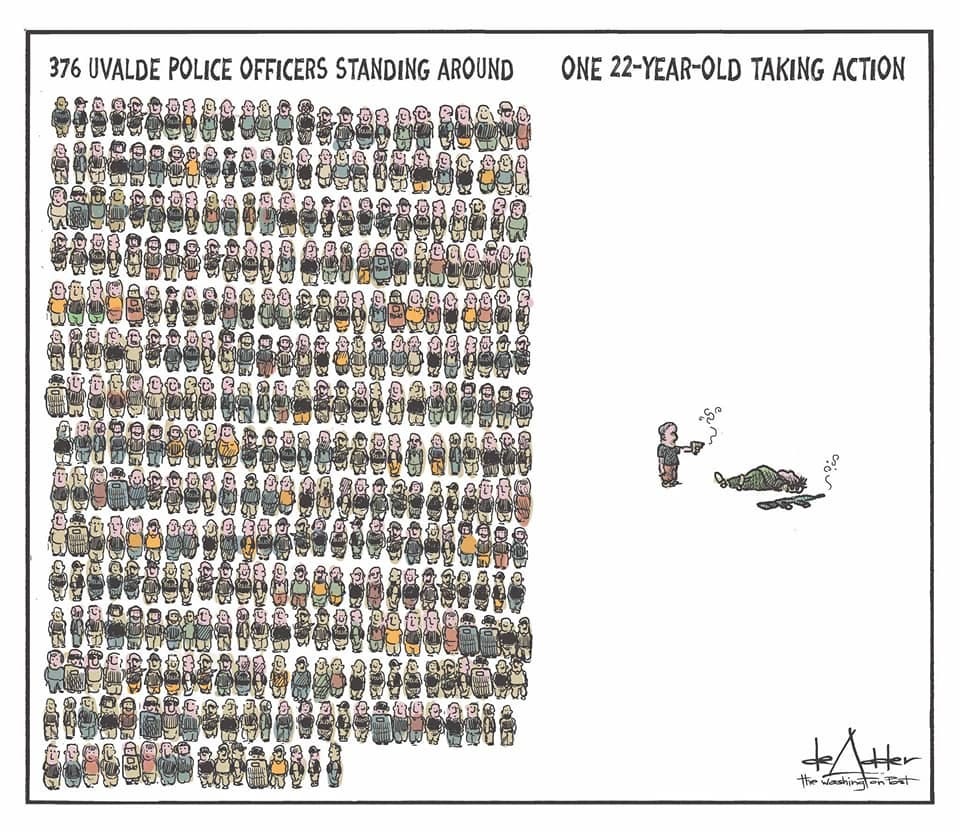
Uvalde Comparison

May be a cartoon of text that says '376 UVALDE POLICE OFFICERS STANDING AROUND ONE 22-YEAR-OLD TAKING ACTION washingt n t'

This cartoon from the Washington Post doesn’t even begin to describe the contrast between these two rampage shooting incidents. Not only did the Uvalde police response do nothing for almost an hour, they actively prevented multiple private citizens from responding on their own. They were very specifically acting as a security detail for a rampage shooter. They arrested parents to prevent them from entering the building. They even intercepted one police officer whose wife was dying in her classroom, disarmed him, and escorted him off scene. A more accurate version of this political cartoon would have 376 police officers surrounding the rampage shooter on a pile of bleeding yet not yet dead bodies, with their backs to him preventing citizens from saving the pile of injured people from dying. That is not an exaggeration.

The official inquiry into Uvalde is not complete as of the writing of this piece. It could be that the Uvalde failure was due to chicken shit cops. It could be due to the fact that all government of all kinds moves at the speed of molasses infused mud. It could be some secret tinfoil hat conspiracy. It could be something else, or some or all of the above. We don’t know. But what we do know is response time differences matter, and we know that 11.96 people are saved when the cops aren’t involved, 11.29 in this case.

I am not someone who lives in fear of rampage shootings. I understand the statistics, which show that these things are as rare as shark attacks, and I do not live in fear of sharks. But some people do live with this fear, because different people have different risk tolerances. It seems to me that some people who live with this fear have some significant overlap with ACAB (“all cops are bastards”) messaging. If you are a rational person within either or both of those groups, and compare Uvalde to Greenwood, you must conclude that absent a non-existent magic gun evaporation fairy the best alternative is ubiquitous citizen concealed carry. This is indisputable.

Mass Media Social Contagion

HWFO has discussed at length how media organizations such as Vox and CNN make millions of dollars by pushing freakoutery for clicks, and how their rampage shooting coverage approach increases the incidence of rampage shootings by one third because of copycat effects which are mathematically shown to be media driven. As of July 20th, CNN.com had nine articles about the Greenwood Park Mall shooting, including one opinion piece devoted to “debunking” the idea that good guys with guns can stop rampage shootings even though one just did. Currently they have two hundred and twenty nine articles about Uvalde. That’s twenty five times more coverage.

I will not claim that CNN’s stated goal is to glorify rampage shooters, but that’s the exact effect CNN’s behavior has in the mind of a potential rampage shooter. If CNN reversed its behavior and gave twenty five times more coverage to Dicken instead of Uvalde, then the psychological effects would dampen rampage shooters instead of inciting them. This very rampage shooter may have been spurred on by CNN’s behavior, and CNN gets 30% more rampage shootings to farm for clickbait money because of their behavior.

If the United States were to string together three consecutive incidents of rampage shooters getting plugged by private citizens within seconds, as happened in Greenwood Park Mall, and CNN were to give each of them the sorts of coverage they give to Uvalde, the rampage shooter dorks would be too scared to try it. They’d stay in their basement playing XBox instead of shooting people, and the second order effects of constitutional carry would exceed 11.96 saved per incident, because there would be fewer incidents. CNN not covering rampage shootings at all would reduce rampage shootings by one third. If they elevated coverage of failed rampage shootings stopped by citizens, they’d probably reduce them by an additional third.

But they don’t want to do that, because they’re hemorrhaging money. They need as many of these things to transpire as possible to make their bottom line. They are beholden to Moloch, trapped in a cycle that gets people killed, and the only way I can figure out of this cycle is to produce a lot more citizen shooters like Dicken.

The only way out is to shoot our way out and it’s CNN’s fault.

Gun industry sounds off on House gun ban, ATF chief, and more

It’s a busy time for the firearms industry at the moment, and I’m pleased that National Shooting Sports Foundation senior vice president and general counsel Larry Keane could spend a some quality time with Bearing Arms’ Cam & Co today to hit on a number of different topics ranging from the House Democrats’ push for an “assault weapons” ban to the new installation of anti-gun politician and former U.S. Attorney Steve Dettelbach as director of the Bureau of Alcohol, Tobacco, Firearms, and Explosives….

  • On the Democrats’ proposed ban on “assault weapons” (and magazines holding more than 15 rounds) approved by the House Judiciary Committee on Wednesday – “We’ll see next week if they have the votes to move forward. I think it will be very, very close one way or the other. There are a very large number of Democrats sponsoring this bill, but whether they’ll continue to sponsor it or support it if it moves to the floor… we’ll see. There are a couple of Democrats on the bubble, and there are several Democrats in very competitive races who are reported to be very upset with Speaker Pelosi for pushing this issue when they’re in competitive races and they’re concerned that it will hurt their chances at re-election.”
  • On Steve Dettelbach taking over as ATF director – “When you have the president who calls the industry the ‘enemy’, when you have this ‘zero tolerance policy’ and you have (FFL license) revocations up 500% and the basis for those revocations have nothing to do with any risk to public safety, when you have closed inspections being re-opened after being closed for six months and then seeking to revoke six months later after saying [the violations] didn’t rise to that level, it’s very very troubling. So we’re really considered about this approach by the administration; instead of going after trigger-pullers and the bad people (and there are a lot of people who need to be locked up) going after law-abiding citizens and showing up unannounced at their doorstep and trying to coerce them into letting them into their house with no warrant, that’s troubling.
  • On the gun control lobby’s attempt to sue gun makers based on claims of deceptive marketing, including California’s new law banning marketing materials supposedly aimed at minors – “Look, this law in California is obviously unconstitutional. It obviously violates the First Amendment right to speech, the right to freedom of association, and it violates the Due Process clause because it says you know, ‘what’s attractive to a minor’; a vague and subjective standard. I feel like I’ve gone back in Mr. Peabody’s Wayback Machine to the 1990s because we’re hearing all the same arguments from the same gun control groups trying to file lawsuits against the industry. You know, the House Judiciary Committee also last night passed a bill to repeal the Protection of Lawful Commerce in Arms Act and to repeal the Tiahrt Amendment that prevents the disclosure of law enforcement-sensitive trace information outside of law enforcement because it puts law enforcement at risk…. they’re filing these complaints with the Federal Trade Commission… they have disdain for the Second Amendment, and they’re entitled to their opinion, but they’re not entitled to suppress the First Amendment rights of law-abiding citizens, law-abiding companies to be able to advertise their products.”
  • LAPD Stops Enforcing California’s ‘High-Capacity’ Magazine Ban

    The Los Angeles Police Department has stopped enforcing California’s state law banning “high-capacity” magazines, according to an internal LAPD email obtained by the Second Amendment Foundation’s Investigative Journalism Project.

    The email was sent Wednesday morning to all LAPD personnel by Commander Ernest Eskridge, assistant commanding officer of the department’s Detective Bureau.

    Eskridge noted that on June 23, the “United States Supreme Court vacated the ruling in Duncan v. Bonta and remanded the case back to the 9th Circuit Court of Appeal for further consideration in light of its recent decision in New York State Rifle and Pistol Association v. Bruen.”

    Because of this ruling, Eskridge said in the email, all sworn LAPD personnel shall not “investigate, detain or arrest” anyone for possessing a magazine capable of holding more than ten rounds unless they are already legally barred from possession of ammunition in the state.

    There were three issues in Duncan v. Bonta: whether a law prohibiting law-abiding citizens from possessing magazines in common use violates the Second Amendment, whether confiscating legally obtained magazines violated the “takings clause,” and whether the “two-step” approach of the 9th Circuit and other courts applied to Second Amendment cases is constitutional and meets Supreme Court precedents.

    In Bruen, the Supreme Court held that the Second and Fourteenth Amendments protect an individual’s right to carry a handgun for self-defense outside the home and that New York’s “special need” requirement for a concealed-carry permit violates those protections.

    Woman Kills Gunman after He Runs Over, Shoots Her Family

    A woman killed an alleged gunman in self-defense after the assailant drove into her family and fatally shot a man and toddler near Montana’s Glacier National Park, police said Tuesday.

    Authorities determined 37-year-old Derick Amos Madden, of Goldsby, Okla., “purposefully drove his vehicle” into Christina Siau’s family Sunday as they were walking alongside the road.

    The two had previously been in a relationship together and Madden was “suffering from mental health issues,” police said in a statement. Police have not yet determined if Madden owned the gun legally.

    Madden crashed his vehicle into a tree and proceeded to shoot at the family with a shotgun, killing 39-year-old David Siau and his daughter, 18-month-old McKenzie Siau. Other family members attempted to flee the scene on foot, but Madden shot and injured David Siau’s wife, 40-year-old Christy Siau, police said.

    Two other children were present but managed to run away uninjured.

    Madden then proceeded to attack and injure Christina Siau with a knife. Despite receiving “critical injuries,” she fought back and fatally wounded Madden, who died at the scene, the statement read. Authorities did not say how Madden died.

    Christy, Christina, and McKenzie Siau were all transported to a hospital where McKenzie succumbed to her injuries.

    “The attack was isolated to this incident with a clear nexus between the victims and Madden,” police said, noting the investigation is ongoing.

    Madden had been working in East Glacier and Christina Siau was originally from New York and living in East Glacier, NBC Montana reported, citing Jody Hickey, a spokesperson for the Glacier County sheriff.

    Christy Siau was previously a bookkeeper for the American Baptist Churches of New York State, and she and her husband David were members of the First Baptist Church of Hoosick Falls, N.Y., according to the outlet.

    Apollo 11 – The Bigger Takeaways from Greatness 53 Years Ago

    Fifty-three years ago this week, America launched Apollo 11, a mission that reached a pinnacle of scientific and national achievement with the successful landing of the Lunar Module Eagle on the Moon.  The Apollo 11 Moon landing represented not only a crowning triumph for humanity, but it was one of America’s most noble and awesome moments.  It was an accomplishment so monumental that to try and describe it in words almost undersells its importance.  It truly was – and still remains – one of the most awe-inspiring milestones in human history.

    Think about all of this for a moment.  Over a half-century ago – without a sliver of the computing power we have now and with only a fraction of the advanced modeling and simulation technology at hand today – we put human beings on the lunar surface.  It was a technological feat of unprecedented proportions.  There were no supercomputers, how-to videos on YouTube, or ready answers on Google.  We did it with hypotheses and testing, analog technology, manual chronographs, slide rules, and chalkboard math.

    And there was no playbook to study – it was true technology trailblazing, in lockstep with America’s traditional frontier spirit.  In fact, given that America’s formal space program existed in earnest for less than two decades prior to the landing, putting humans on the Moon was a ground-breaking endeavor almost every step of the way.  But we navigated uncertainty and the unknown with the right combination of vision, daring, and calculated risk while maintaining a laser focus on the goals.  When a challenge or hurdle complicated our effort, we didn’t simply complain and quit – we got creative.  We innovated, adapted and figured it out.  We learned from our mistakes and went back to the drawing board (literally) to make adjustments and improve our approach.  Incidentally, it was this attitude that not only put Americans on the Moon in July of 1969, but also brought the Apollo 13 astronauts back to Earth in 1970.

    Beyond the glory of the Moon landing itself, the entire Apollo program – and Mercury and Gemini programs before it – stands as a sterling testament to what strong leadership and unity of purpose can achieve.  The Apollo program consisted of hundreds of thousands of people, each responsible for different but vital aspects of the mission, working together across different sites for weeks, months and years.  It required unwavering coordination and alignment between the public and private sectors, and involved everyone from appropriators in the Congress to engineers and technicians in the lab.  It was a herculean undertaking – but commitment, organization, and active and effective management made it all possible.

    Finally, we maintained adherence to the task and never lost sight of what was important despite the upheaval and turbulence of the times.  We often forget that the Apollo program endured through the 1960’s – a period not completely unlike our contemporary era – which was marked with the assassinations of several national leaders (including a sitting President), a grossly unpopular war, radically changing cultural values, riots, social tension, and violence.  But we stuck with it through the highs and lows, kept our eyes on the road, and drove on toward the objective.

    Incidentally, this year also will mark the 50th anniversary of Apollo 17 – which was the last Apollo journey to the Moon (completed in December of 1972).  Like many of the other missions, it set new records in science, technological and human achievement and was a successful last chapter in the Apollo program.  In looking back, whether it was the first or last steps that Americans placed in the lunar dust, all of those missions essentially represented a magnificent capstone achievement in what was a serious, decade long effort concentrated on one goal – outlined by our national leaders and executed by the people.  As we look toward our next expeditions in space, namely a return to the Moon and beyond, we would be wise to take some of these core lessons from the Apollo program.  Frankly, there are a lot of things we could learn from Apollo to improve and enhance America’s standing and position aside from space.

    The Apollo program is but one example of American greatness that manifests itself when we’re serious, when we ignore petty distractions and challenge the impossible with hard work and spirit.

    It is something we’ve actually done quite often as a country – think of the Berlin Airlift, the building of the transcontinental railroad, or American war production in WWII – and we do it well when we try.  The Apollo 11 anniversary is a reminder of what America can do when it puts its mind to a noble task.  It is a reminder of what can be done when we apply national, political and cultural energy on something that actually matters…something of weight, purpose and lasting importance…something that is greater than the sum of all of its parts…something that was, and is, “For all Mankind.”

    ‘That’s The Point’
    Rep. Nadler Admits Bill Will Confiscate Guns In ‘Common Use’

    Democratic New York Rep. Jerry Nadler admitted a Democrat-led bill intends to confiscate guns in “common use” during a Wednesday House Judiciary Committee hearing.

    Republican North Carolina Rep. Dan Bishop asked House Democrats if they dispute the fact that the proposed legislation H.R. 1808, titled “Assault Weapons Ban of 2021,” bans firearms in “common use” throughout the country.

    “Would anyone on the other side dispute that this bill would ban weapons that are in common use in the United States today?” Bishop asked.

    “That’s the point of the bill,” Nadler replied.

    “So, to clarify, Mr. Chairman, you’re saying it is the point of the bill to ban weapons that are in common use in the United States today,” the Republican representative pressed.

    “Yes,” Nadler clarified. “The problem is that they’re in common use.”

    The bill, introduced by Democratic Rhode Island Rep. David Cicilline, would ban a so-called “semi-automatic assault weapon,” including all AK types of weapons and AR-15s. The legislation, if passed, would ban semi-automatic weapons that contain a magazine, a pistol or forward grip and a “folding, telescoping, or detachable stock.” It also intends to ban weapons that can fire more than 10 rounds or contains a threaded barrel or second pistol grip.

    The representative then told Cicilline that he has used his advanced legal skills to “obfuscate” the Supreme Court’s ruling in the case, District of Columbia v. Heller, which deemed a ban on handguns a violation of the Second Amendment. The decision further protected a citizen’s right to keep and bear arms that are in common use.

    “What you suggest that this order can possibly comply with what the Supreme Court has held in now three separate cases is absolutely absurd. You defy the Supreme Court of the United States in the same way the Democrats mounted massive resistance to Brown v. Board of Education,” Bishop said. “We’re going to explain that for the American people in the course of this hearing. The Democrats of the 1960s are the Democrats of the 2020s.”

    The Court ruled that “self-defense is a basic right recognized by many legal systems” in the case, McDonald v. City of Chicago, which struck down the city of Chicago’s ban on handguns in 2010. The decision further ruled that the Second Amendment applies to the states.

    He cited the recent Court decision in the case, New York State Rifle Association v. Bruen, that the state implementing “proper cause” to obtain a conceal carry permit violates a citizen’s Fourteenth Amendment right to practice their Second Amendment protection to self-defense.

    “This bill bans many types of weapons that are in common use in the United States today,” Bishop said.

    Approximately 20 million AR-15 style rifles are in circulation in the United States and continue to be one of the “most popular rifles sold in America,” according to the National Shooting Sports Foundation.

    House committee approves first assault weapons ban bill in decades
    The House Judiciary Committee approved the Assault Weapons Ban of 2021 in a 25-18 vote following an hours-long markup

    The House Judiciary Committee on Wednesday moved a bill banning assault weapons forward but it’s unclear if the legislation has enough support to pass a floor vote.

    Democratic Reps. Jared Golden, D-Maine, and Henry Cuellar, D-Texas have said they won’t support the bill while Republican Reps. Chris Jacobs, R-N.Y., and Adam Kinzinger, R-Ill., have said they are open to voting for a ban, according to The Hill. House Democrats have a four-vote margin.

    The Assault Weapons Ban of 2021 was advanced in a 25-18 vote but a date for a vote on the House floor has not been set.

    “As we have learned all too well in recent years, assault weapons — especially when combined with high-capacity magazines — are the weapon of choice for mass shootings,” committee Chairman Jerry Nadler, D-N.Y., said during the bill’s markup. “These military-style weapons are designed to kill the most people in the shortest amount of time. Quite simply, there is no place for them on our streets.”

    Ranking member Jim Jordan, R-Ohio, argued the bill would take away upstanding gun owners’ rights.

    “Democrats know this legislation will not reduce violent crime or reduce the likelihood of mass shootings, but they are obsessed with attacking law-abiding Americans’ Second Amendment liberties,” he said.

    Rep. Matt Gaetz, R-Fla., said, “They’re coming for your guns.”

    The bill would make it a crime to “import, sell, manufacture, transfer, or possess a semiautomatic assault weapon (SAW) or large capacity ammunition feeding device,” according to the bill’s summary. A few exceptions would be made.

    It would not include any “firearm that is (1) manually operated by bolt, pump, lever, or slide action; (2) permanently inoperable; (3) an antique; or (4) a rifle or shotgun specifically identified by make and model.”

    The bill was first introduced in March of last year.

    Chairman Jerry Nadler, D-N.Y., looks on during a hearing of the House Judiciary Committee on Capitol Hill on July 14, 2022, in Washington, DC.
    Chairman Jerry Nadler, D-N.Y., looks on during a hearing of the House Judiciary Committee on Capitol Hill on July 14, 2022, in Washington, DC. (Tasos Katopodis/Getty Images)

    The bill comes on the heels of the most sweeping gun control bill to pass the Senate in 30 years following a series of mass shootings, including an elementary school shooting in Uvalde, Texas, that left 19 students and two teachers dead.

    President Biden and Vice President Kamala Harris have also been calling for an assault weapons ban.

    “Assault weapons need to be banned,” Biden said last week at the White House while celebrating the signing of the bipartisan gun law. “They were banned. I led the fight in 1994. And then under pressure from the NRA and the gun manufacturers and others, that ban was lifted in 2004. In that 10 years it was law, mass shootings went down.”

    Former President Bill Clinton signed an assault weapons ban in 1994 that expired in 2004.


    Lincoln County crime spree ends when homeowner shoots, kills suspect

    LINCOLN COUNTY, Miss. (WLBT) – A man was shot and killed after allegedly assaulting multiple people early Tuesday morning, including trying to hit a person with his car.

    The Lincoln County Sheriff’s Office received a disturbance call around 4 a.m. regarding a man who had threatened those at a house. However, he left before deputies could get there.

    While at the home, though, deputies got a call about someone breaking into another home and assaulting two men before leaving.

    When deputies arrived at that home, they found that not only were two people assaulted there but that a neighbor had also been attacked.

    While deputies gathered information about those assaults, they received another 9-1-1 call about a man attempting to break into another home. As deputies arrived on that scene, they heard a gunshot at a nearby residence.

    As they arrived to the home where the gunshot occurred, they found that a man had been shot while trying to hit someone with his car. The man was taken to the hospital where he was pronounced dead.

    Through an investigation, it was discovered that he was involved in every disturbance.

    Two of his victims were treated at a hospital for various injuries. The homeowner who killed the suspect has not been charged.

    The Good Samaritan With A Gun In Indiana Serves To Refute Four Common Gun Control Myths

    On Monday, a good samaritan with a gun averted a catastrophe at an Indiana mall. Douglas Sapirman, a 20-year old man brought more than 100 rounds of ammunition and three rifles: a Sig Sauer M400 rifle he bought in March 2022; an M&P15 rifle that was found in the mall bathroom and bought in March 2021; and a Glock 33 pistol discovered on his body. In the span of a few minutes, Sapirman fired 24 rounds, killed three people, and injured two others.

    But Elisjsha Dicken, a 22-year old man, was shopping at the mall with this girlfriend. And he was carrying a concealed pistol. The New York Times describes his heroics:

    Chief Jim Ison of the Greenwood Police Department called the bystander’s actions “nothing short of heroic,” identifying him as Elisjsha Dicken of Seymour, Ind.

    He engaged the gunman from quite a distance with a handgun, was very proficient in that, very tactically sound, and, as he moved to close in on the suspect, he was also motioning for people to exit behind him,” Chief Ison said at a news conference where he described surveillance video footage of the shooting. . . .

    All the victims were shot by Mr. Sapirman, who fired 24 rounds, Chief Ison said. Mr. Dicken fired 10 rounds, killing the gunman as he tried to retreat to a mall bathroom where he had spent an hour apparently preparing for the attack. . . . .

    Over the past two years, the relatives told the police, the gunman had frequently practiced shooting at a range in Greenwood, which is roughly 15 miles south of Indianapolis. . . .

    When the police arrived, they handcuffed Mr. Dicken and took him to a station for questioning, where security camera footage confirmed his description of the events. Chief Ison said that the police could not determine whether Mr. Dicken had a gun permit, but that he was carrying his Glock 9-millimeter handgun legally under the state’s constitutional carry law.

    “This young man, Greenwood’s good Samaritan, acted within seconds, stopping the shooter and saving countless lives,” Mayor Mark Myers said on Monday.

    This amazing story is simply one data point, but it serves to refute four myths about gun control.

    First, a good guy with a gun can stop a bad guy with a gun. Recently, Eugene catalogued other similar instances of defensive gun use.

    Second, constitutional carry ensures that good samaritans can carry, even if they do not satisfy onerous carry regimes. I imagine that if this incident happened in New York, the good samaritan would be indicted for illegal possession of a firearm.

    Third, a common argument in favor of “high capacity” magazine bans is that defensive gun use never needs more than a few bullets. Here, the good samaritan used ten bullets, and he could have needed even more. In California, for example, magazines are limited to ten rounds. Had the good samaritan needed one more bullet to drop the assailant, he would have been out of luck in California.

    Fourth, it is commonly argued that a person armed with a handgun cannot take down a person armed with larger rifles. This incident proves that myth is wrong.

    It is difficult to generalize from a single incident, but the situation in Indiana serves to push back against many of the common gun control myths.

    Update: I didn’t realize that Indiana’s constitutional carry went into effect on July 1, 2022. Had this event happened a month earlier, the good samaritan may have been in violation of the state’s carry law. The NY Times has some more details:

    Mike Wright, manager of the Luca Pizza di Roma in the mall’s food court, remembers taking shelter when the firing started and then emerging when it stopped to see the bystander behind a low-slung wall with his handgun trained on the assailant he had shot to death.

    “He stood there maybe 25 or 30 feet from the body and held that pistol pointed at him until law enforcement arrived,” Mr. Wright remembered on Tuesday. “The good Samaritan guy seemed poised and under control. He appeared to be very disciplined.” Jim Ison, the local police chief, went further, saying that his engagement with the gunman, who had killed three people, was “nothing short of heroic.”

    But along with the horror, drama and acclaim came a roaring and rekindled controversy in a country united in revulsion over its ceaseless plague of gun violence, yet bitterly divided over a loosening of gun restrictions like the Indiana law, passed this year, that allowed the bystander, Elisjsha Dicken, 22, to carry his 9-millimeter handgun in the first place. . . .

    Chief Ison said the police found no indication that Mr. Dicken had a permit for the handgun. But the chief said he was carrying it legally under the new law. In a brief interview, Mr. Dicken’s lawyer, Guy A. Relford, described his client as an “all-American Indiana boy,” and declined to provide any specific information about him or the mall encounter.

    Update 2: The Greenwood Police now report that the Good Samaritan acted quickly. In the span of 15 seconds (not 2 minutes), he fired 10 rounds, eight of which hit the assailant. And his first shot hit the assailant from 40 yards!


    That is some top-level accuracy.

    Garen J. Wintemute. That name rang a bell.

    Garen Wintemute’s Conclusions Aren’t Supported By His Own Data…But He Won’t Let That Stop Him
    UC Davis’s Dr. Garen Wintemute runs something called the Violence Prevention Research Center. Translation: he’s a hoplophobic grifter with a university sinecure who sucks up millions of dollars to keep his anti-gun rights operation going thanks to the largesse of like-minded individuals, foundations and, of course, California tax payers.


    BLUF
    Additional authors of the study include Colette Smirniotis, Christopher McCort and Garen J. Wintemute from the VPRO and the California Firearm Violence Research Center.

    Machine learning identifies gun purchasers at risk of suicide

    A first-of-its-kind study from the Violence Prevention Research Program at UC Davis shows an algorithm can forecast the likelihood of firearm suicide using handgun purchasing data.

    A new study from the Violence Prevention Research Program (VPRP) at UC Davis suggests machine learning, a type of artificial intelligence, may help identify handgun purchasers who are at high risk of suicide. It also identified individual and community characteristics that are predictive of firearm suicide. The study was published in JAMA Network Open.

    Previous research has shown the risk of suicide is particularly high immediately after purchase, suggesting that acquisition itself is an indicator of elevated suicide risk.

    Risk factors identified by the algorithm to be predictive of firearm suicide included:

    older age
    first-time firearm purchaser
    white race
    living in close proximity to the gun dealer
    purchasing a revolver

    Continue reading “”

    Can you make a 40 yard supported shot?

    Practice and find out, seriously. If you can’t, you have a goal, worthy of attaining, and a demonstrated, not hypothetical, reason for getting there.

    There are millions of Dickens and Rittenhouses across America and they’re the reason why the left, media and government hate the right to bear arms.