

“If tolerance means the downfall of Western civilization, then we cannot be tolerant.” —Elon Musk
March 26, 2026
Remember when ATF massacred Randy Weaver’s family because of 2 sawed off shotguns? Meanwhile we have HD videos of gang members with illegal weapons telling you what block they’re from and nothing happens.
Maybe a little less attention on bump stocks and a little more on thugs. https://t.co/wgEOfTc64m— Anthony Cumia (@AnthonyCumia) March 25, 2026
When a ‘Common Sense’ Gun Control Measure Depends on the Fantasy of Competent Government.
In a stunning admission, a Los Angeles County Superior Court has revealed that it failed to report hundreds of thousands of criminal case outcomes to the California Department of Justice—including roughly 147,000 felony convictions.
Let that sink in.
For four decades, criminal records simply weren’t entered into the background check system.
- No alerts
- No safeguards
- No accountability
Just a broken government system quietly failing while politicians demanded…more gun control.
A System That Only Works If Everything Goes Right
Here’s the part they don’t want to talk about…the entire background check system depends on perfect data entry, flawless coordination, and bureaucratic competence at every level of government. And as this case proves—that’s a fantasy.
Because when records aren’t reported:
- Felons slip through the cracks
- Background checks return incomplete or inaccurate results
- And the system politicians claim “keeps us safe” simply doesn’t work
Even federal officials admit the system only functions if it receives “complete, accurate, and timely information” from thousands of agencies nationwide. Clearly, that’s not happening.
The History They Don’t Want You to Know
The federal background check system—known as NICS—was created by the Brady Act in 1993 and went live in 1998.
Since then:
- Hundreds of millions of background checks have been run.
- Millions of Americans have been delayed or denied.
- Tthe system still relies on error-prone government databases.
In fact:
- Only about 1% of transactions are denied.
- Many denials are later overturned on appeal.
- Tens of thousands of justified denials occur each year, but only a tiny fraction are ever prosecuted.
So let’s be clear…this system overwhelmingly burdens law-abiding citizens while failing to consistently stop criminals.
The Real Purpose: A Backdoor Gun Registry
Marines Green Light Optics for Pistol Qualifications

The Romeo M17 sight (NSN: 1240-01-713-9795), seen attached to an M17 MHS handgun, is a mil-spec, fully enclosed and gas-purged red dot reflex sight with a distortion-free glass aspheric lens. It is submersible to depths up to 35 meters. (Photo: Chris Eger/Guns.com)
The nation’s 911 force is now officially authorizing pistol quals with a red dot optic, provided it is one very specific system.
On March 13, Marine Administrative Message (MARADMINS) 104/26 updated that the service’s Marksmanship Program will include the paragraph, “Marines are authorized to use unit funded Using Unit Responsibility Item, M17 Romeo red dot optic, National Stock Number 1240-01-713-9795 for Combat Pistol Program (CPP) qualifications.”
In short, so long as the SIG M17 Romeo sight is used – which was designed specifically for the P320-based M17 and M18 9mm Modular Handgun System – and it is bought with unit funds, the country’s premier amphibious warfare force can run red dots in qualifications.
Completely U.S. made and constructed of forged 7075 aluminum with a beryllium copper flexure arm (more on that in a minute) the Romeo M17 has an extremely low deck height so that armorers can reuse standard iron sights, has 15 illumination settings (including three for use with Gen 3+ night vision), beats drop and submersion tests, and, importantly, has an integral loaded chamber gas deflector shield that keeps the MHS from gassing up the lens after 10-15 rounds.


Marines deployed with the Fleet have already been seen with red dot-equipped M17 Romeo-equipped M18s and Surefire X300 white lights.


The Marines adopted the M18 in 2019, ordering 35,000 of the SIGs to not only replace legacy Beretta M9s but also the Colt M45A1 CQB .45ACP railgun and the M007 Glock.
Pro-Second Amendment groups, industry leaders, and attorneys often argue that getting the U.S. Supreme Court to issue a ruling that strengthens the natural law right of the people to keep and bear arms is a glacially slow, systematic, and intricate process.
That is, unfortunately, true. But why?
It’s true because the Supreme Court, under Chief Justice John Roberts, has orchestrated a judicial review process designed not only to slow the review of Second Amendment cases but also to indefinitely impede the review of the most significant cases.
As Chief Justice, he sets the tone and theme of the Court. It’s simplistic to think of Roberts as just one of nine Justices with equal say in the handling of cases that come before the Court on a petition for review.
Yes, he has one vote to grant or deny review of a case, as do each of the other eight Justices, but he has a profound say concerning the cases to be voted on. See, e.g., the article in “Legal Clarity.”
“The Chief Justice influences the Court’s docket, the list of cases the Court will hear. While any four justices can vote to grant certiorari and hear a case, the Chief Justice’s vote can hold outsized influence in this selection process.”

Because there are no California politicians on the moon https://t.co/YYi5ij1iIE
— memetic_sisyphus (@memeticsisyphus) March 25, 2026
I bet nobody had a problem getting ID to collect welfare
Alice Smith –
When an individual loses contact with reality, we call it mental illness.
When a group loses contact with reality, we call it socialism.

“A professional soldier understands that war means killing people, war means maiming people, war means families left without fathers and mothers. All you have to do is hold your first dying soldier in your arms, and have that terribly futile feeling that his life is flowing out and you can’t do anything about it. Then you understand the horror of war. Any soldier worth his salt should be antiwar. And still there are things worth fighting for.”
-General H. Norman Schwarzkopf Jr.
March 25, 2026
You don’t have to be right. You just have to be reasonable.
‘Bloodied’ man shouted for help before allegedly breaking into another home, getting shot
An alleged intruder is in critical condition after kicking in the door to a Houston, Texas, home Monday night and being shot numerous times by the homeowner.
ABC 13 reported two people were running down the road, one wearing a mask and the other bleeding from the head. The bleeding man eventually kicked in the door to a home and the homeowner shot him.
Click2Houston noted that police are unsure if the man who was bleeding was trying to flee from an assault or some other incident. He was allegedly “going door to door, knocking and trying to get help” prior to forcing entry and being shot.
Houston Police Department Lt. J.P. Harlicka said, “Either he was shot or hit in the head with something or assaulted or something, but he had blood on his head. He went to several doors knocking.”
The second man, who was “wearing a black hoodie, jumpsuit, and mask, ran away” and has yet to be found.
Why do you think I call them ‘bureaucraps’?
Why is ATF Still Leaving Its Options Open for Prosecuting Owners of Braced Pistols?
The saga of ATF’s enforcement of the National Firearm Act’s “short barreled rifle” provisions against braced pistols has been a roller coaster ride of shifting interpretations. NRA-ILA has been keeping up with, reporting on, and advocating for reform the entire time. It seemed we had reached a low point with the publication of the rule Factoring Criteria for Firearms With Attached “Stabilizing Braces” during the Biden-Harris administration. Yet NRA, along with other pro-Second Amendment groups, successfully challenged that rule in court, and its enforcement was enjoined against NRA members, as well as other plaintiff groups in similar suits. Eventually, the rule was vacated in its entirety. Unfortunately, that did not provide the lasting relief many had hoped.
Last year, we reported on ATF audaciously claiming, in the waning days of the Biden-Harris administration, that all braced pistols were subject to the NFA. It then quickly walked backed that position as “overbroad.”
But then NRA exposed the ongoing prosecution of Taylor Taranto for possession of an unregistered SBR, based on allegations concerning a CZ Scorpion EVO 3 S1 pistol with an attached SB Tactical stabilizing brace. Taranto moved to have the charge dismissed. In its opposition to the motion, filed during the Biden-Harris administration, the government claimed:
Although the rule is stayed (and, now, vacated), ATF is not barred from continuing to enforce the underlying statute as it always has: by making case-by-case determinations about whether particular braced firearms constitute “rifles” under the statute. And of course, because the rule reflects ATF’s best understanding of the statute, those determinations will naturally tend to look substantially like the determinations that would follow from applying the clear framework outline in the rule.
We reported on that case in February of 2025, and the SBR charged against Taranto was dismissed, “in the interest of justice,” under the Trump administration that April. The dismissal of Taranto’s NFA charge followed an April 7, 2025, announcement by the U.S. Department of Justice and ATF of a “comprehensive review of [the] stabilizing brace regulations.” This was supposed to include “consultations with stakeholders, including gun rights organizations, industry leaders and legal experts,” with the goal of ensuring the resulting policies are “constitutional and protective of Americans’ Second Amendment rights.”
In the meantime, though, ATF continued to resist attempts by litigants in cases remaining against the rule to obtain final judgments on the rule’s illegality, claiming the issue was rendered moot by the final judgement in the case vacating the rule. This, the agency claimed, rendered the rule “formally nullified and revoked[.]”
A March 16 government filing in the ongoing case of Texas v. ATF has now renewed concerns that the agency reserves the right to continue bringing felony prosecutions under the NFA for possession of unregistered braced pistols. The passage in question is meant to rebut the plaintiffs’ claims that there are still live issues in the case that deserve a final judgment on the merits, rather than dismissal on mootness.
Enemies foreign and domestic
“the people we (demoncraps) care about the most…” (not the American populace, their constituents)
Senator Chris Murphy: “The people we care about most, the undocumented migrants”
He actually said that
— End Wokeness (@EndWokeness) March 24, 2026
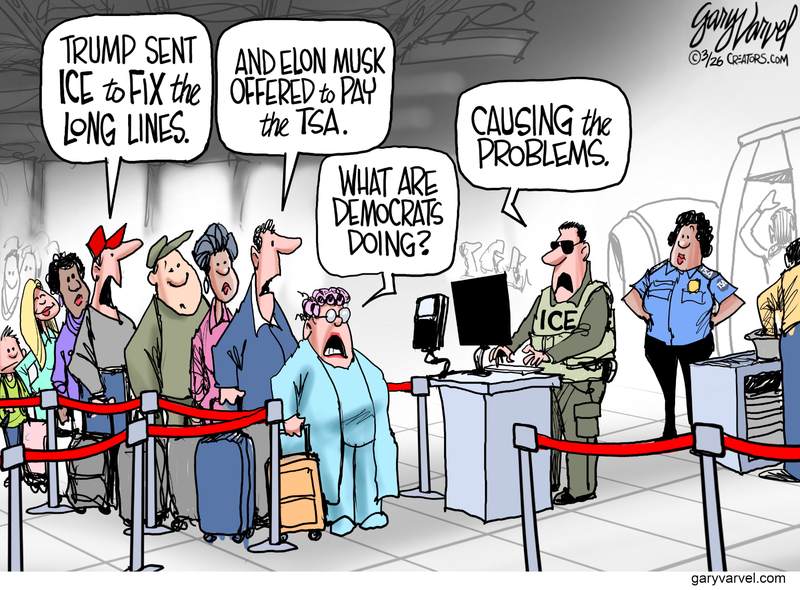
Arizona Moves Forward With K-12 Firearm Safety Education Bill
Arizona Senate Bill 1424 has passed the Senate and has passed the House Education Committee and the House Rules Committee. The bill requires school districts and charter schools to provide age-appropriate firearm safety awareness training in all grades, kindergarten through 12th grade.
The instruction is to be objective and not promote firearms ownership or any political position. The instruction is to be limited to accident prevention and personal safety awareness. It is to include guidance on safe firearms storage in homes and vehicles. The instruction is to provide guidance on what to do if a firearm is encountered, including not touching it and notifying an adult.
Inside the bill, there is a long list of restrictions on six things that may not be included in the instruction:
3. NOT INCLUDE ANY OF THE FOLLOWING:
(a) A LIVE FIREARM.
(b) AMMUNITION OR SIMULATED AMMUNITION.
(c) A DEMONSTRATION THAT INVOLVES HANDLING, OPERATING, LOADING, UNLOADING OR FIRING A FIREARM.
(d) INSTRUCTION THAT IS INTENDED TO TRAIN STUDENTS IN THE USE OF FIREARMS.
(e) A MORAL JUDGMENT REGARDING LAWFUL FIREARM POSSESSION.
(f) AN INQUIRY, SURVEY OR REQUEST FOR INFORMATION ABOUT WHETHER A STUDENT, STUDENT’S PARENT OR MEMBER OF THE STUDENT’S HOUSEHOLD OWNS, POSSESSES OR MAY POSSESS A FIREARM OR ABOUT THE FIREARMS STORAGE PRACTICES OF A STUDENT, STUDENT’S PARENT OR MEMBER OF THE STUDENT’S HOUSEHOLD.
The Arizona Citizens Defense League (AZCDL) supports the legislation.
An advocate for gun storage legislation made the argument that the legislature should pass a bill requiring safe storage of guns instead. The SB 1424 is considered a partisan bill, supported mostly by Republicans, according to Legiscan.
Fatal firearms accidents have declined greatly since the 1930’s high mark. The number of firearms per person has increased about 3X during that period.
Firearms are among the many hazards children encounter as they grow up. Education, not prohibition, is the surest answer to their safety.
The bill has passed the Arizona legislature, which is narrowly controlled by Republicans. Republicans have a 17-13 advantage in the Senate and a 33-27 advantage in the House. SB 1424 might avoid a veto from Governor Hobbs (D), but it seems unlikely. Governor Katie Hobbs has earned a reputation for the number of vetoes she has given. Governor Hobbs is facing serious re-election challenges. She might sign SB 1424 to claim she is not against rights protected by the Second Amendment.
SB 1424 severely restricts what may be taught to students. This may be necessary to secure passage in a legislature with a very small Republican majority.
The bill is a step toward greater understanding of firearms safety. It makes students more aware of firearms. It has the advantage of not being overtly against the ownership or use of firearms. As “age-appropriate” instruction on firearms safety, later grade levels might include information about the legal status of firearms in Arizona. It is difficult for people to obey the law if they do not know what the law is. Firearms are among the many potentially hazardous items children encounter as they grow up.
It is far better to gun-proof the child than to attempt to create a gun-free environment.
Be nice if they also offered it as a ‘pistol’ with a brace.
Rock River Arms Celebrates “No Tax” with the New Retro A1 Carbine SBR
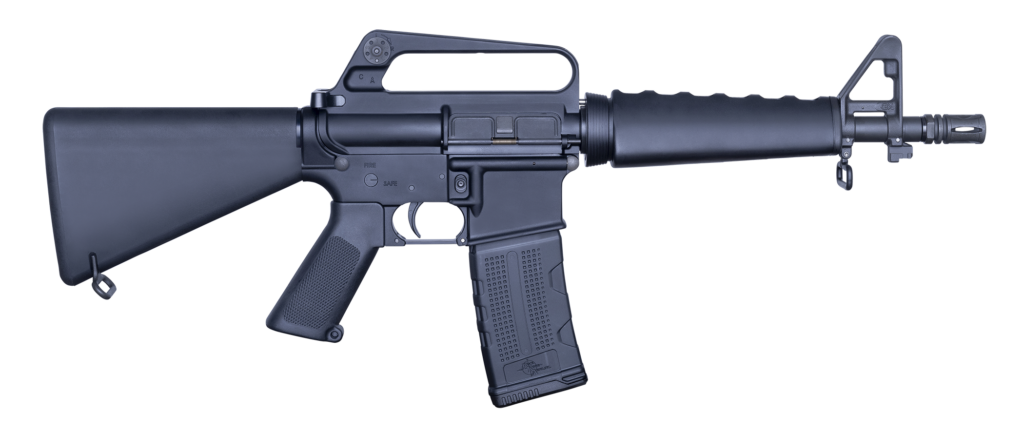
Rock River Arms wants to remind everyone that the newly implemented “zero tax” on NFA items doesn’t only apply to suppressors but also to Short-Barrel Rifles (SBRs).
To celebrate, RRA introduces the new 10.5-inch A1 Carbine SBR.
This retro A1 Carbine SBR is an ideal pairing for anyone looking to run a suppressor on a high-mobility, exceptionally maneuverable defensive AR platform. This “old school is the new cool” configuration is the perfect SBR for those who value operational simplicity and no-fail performance as the base for their suppressed home defender. With its lightweight, chrome moly 10.5-inch A-1 barrel assembly and CAR gas system, the A1 Carbine SBR with an attached suppressor (suppressor not included) is compact and easy to handle in close quarter environments.
The A1 Carbine SBR comes chambered in 5.56 NATO/223 Rem. and is built on RRA’s forged LAR-15M lower receiver and forged A1 carry handle upper. The barrel is fitted with a conventional F-style front sight/gas block and A1 flash hider (1/2-28 thread) and hosts a classic A-1 triangular handguard.
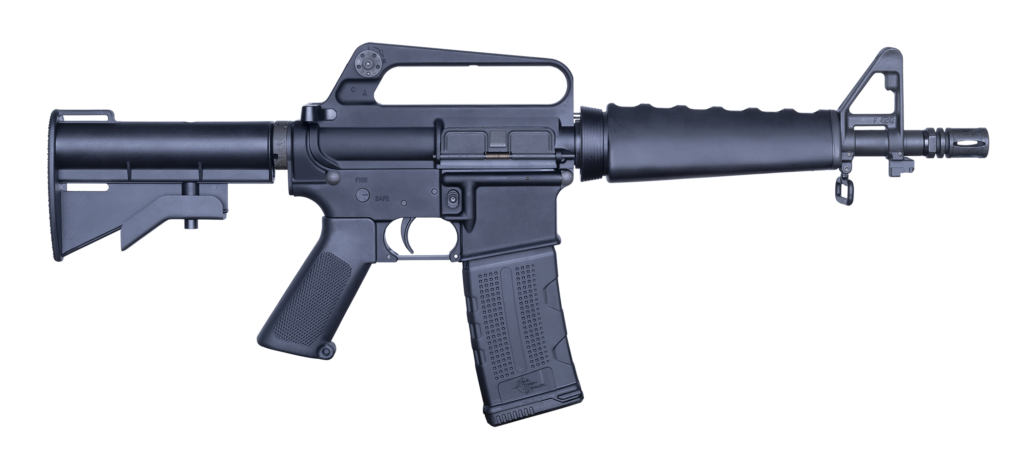
Two variants of the A1 Carbine SBR are offered: one with a multi-position M4-style stock and the other with a fixed entry stock. Both include RRA’s A1 grip and single-stage trigger.
If you’ve been considering purchasing an SBR for personal or home defense, the A1 Carbine SBR from Rock River is the ideal candidate and now is the perfect time to make your move.
RRA A1 Carbine SBR Specifications
- Caliber: 5.56 NATO/223 Remington
- Barrel: 10.5-inch lightweight chrome moly
- Upper Receiver: forged A1 w/carry handle
- Lower Receiver: forged RRA LAR-15M
- Trigger: RRA single-stage
- Handguard: A1 CAR triangle
- Buttstock: M4 adjustable or fixed entry
- Grip: RRA A1
- Muzzle: A1 flash hider / 1/2-28
- MSRP: $1,135 (entry stock); $1,150 (M4 stock)
To see the full range of firearms, components, and accessories offered by RRA, visit RockRiverArms.com.