

Store clerk shoots man attempting to rob convenience store
TUNICA,Miss. — Unexpected shots were fired when a young man attempted to rob a Mississippi convenience store, Tunica County Sheriff’s Office reported.
According to police, at exactly 6:42 p.m. on December 23rd, they received a call about an armed robbery at a local store.
The suspect walked into the store with a handgun and demanded money from the store clerk, police said.
During the robbery, the store clerk shot the suspect who then fled out of the store, per reports.
Forensics used the evidence and determined that 22-year-old Joshua Johnson of Horn Lake, MS is the person responsible for the crime.
The evidence also led them to a home where they learned that someone dropped him off at a nearby hospital for treatment.
Officials said there will be criminal charges against Johnson as this investigation is ongoing.
Homeowner shoots burglary suspect 3 times in north Houston
HOUSTON, Texas (KTRK) — A burglary suspect was shot three times in the leg by a homeowner early Sunday in north Houston, according to police.
It happened at a home in the 6500 block of Jensen around 3 a.m.
Police said the homeowner went outside with a gun to investigate the noises he said he heard coming from his backyard.
That’s when he found a man breaking into his shed.
Officers placed tourniquets on the burglary suspect, and he was taken to the hospital. Police said he is expected to survive.
“I’m not exactly sure what he was thinking, but he was inside the shed taking some items from the owner when the owner came outside,” a police officer said.
Woman Shoots Suspect Who Forced Way Into Home And Assaulted Her On Christmas
STOCKTON (CBS13) – A man involved in a dispute with his neighbor was shot after allegedly pushing his way into the woman’s apartment and assaulting her and her family on Christmas Day, the Stockton Police Department said on Saturday.
The neighbor, a 29-year-old woman, was confronted by the suspect and engaged in an argument, police said. This happened just before 2:45 p.m. on Friday in the 1700 block of Quail Lakes Drive.
Stockton police said the suspect, a 32-year-old man, forced his way into the woman’s home and began the assault, which prompted the woman to shoot the suspect. His identity has not yet been released.
The suspect was taken to the hospital to be treated for what police described as a non-life-threatening gunshot wound.
Stockton police said the case was handed over to the San Joaquin County District Attorney’s Office. No further information was released.
Another one of these ‘not on the radar’, ‘very personable’, ‘quite out of character’, ‘no known motive’.
NASHVILLE EXPLOSION: Anthony Warner died in explosion, was ‘bomber,’ authorities say.
Anthony Q. Warner, 63, has been identified as the “bomber” in the Christmas day explosion in Nashville by U.S. Attorney Don Cochran.
Cochran announced the update to the investigation in a Sunday afternoon news conference.
“Anthony Warner is the bomber. He was present when the bomb went off, and he perished in the bombing,” Cochran said.
DNA found at the scene was matched to samples taken at another location searched by investigators, TBI Director David Rausch said Sunday. The TBI was involved in testing the evidence.
Because they had identified a suspect, investigators said they were able to match samples to a potential family member quickly.
At this time, officials said there is no indication that anyone outside of Warner was involved in the explosion. Authorities reviewed hours of surveillance footage and they say they only saw Warner.
A motive in the bombing has not been released and is still under investigation according to FBI Special Agent for Public Affairs Doug Korneski.
The types of explosives used in the bombing were still under investigation, authorities said. The FBI said Warner wasn’t on the radar of authorities before Friday’s explosion and declined to deem the explosion an act of terrorism.
The good news about guns in America
Once upon a time, as a Democrat who grew up in the San Francisco Bay Area, I was such an anti-gun fanatic that I donated to the Brady Campaign. Thankfully, I saw the light after Hurricane Katrina (when seconds counted, the police were days away), and have made up for my past bad judgment by being an NRA member, using my writing abilities to promote the Second Amendment, and helping the bottom line at several local gun stores. That’s why it gladdens my heart to tell you one of the good things about 2020: It was a banner year for gun sales!
When it comes to guns, the anti-gun crowd lacks imagination. To them, guns exist for one purpose: To murder people or, occasionally, to kill people accidentally. If you take away guns, they “reason,” you will take away murder and accidental deaths.
People with a deeper and more nuanced understanding support the Second Amendment because they understand that guns don’t commit murders or cause accidents. They are tools and lack agency. People who want to murder someone will commit murder with or without guns. And people who are careless can always kill someone else with everyday objects (e.g., cars, wine bottles, etc.).
While guns lack agency, they confer empowering agency on the people who hold them. Having a gun allows people to oppose oppressive government, as happened during the American Revolution. Guns give women the ability to fight back against predators bigger and stronger than they are. Guns allow people to defend themselves and their property when the civil government collapses, as happened after Hurricane Katrina. Guns allow ordinary people to make crime too costly for criminals. Guns allow good people to take down the bad guys quickly in what can otherwise become a mass shooting situation. Guns give those far from grocery stores the ability to feed themselves. And as sports enthusiasts know, guns are fun when used safely and appropriately.
Guns work in a society that has more good people than bad. And despite the “if it bleeds it leads” approach that has characterized the American media for more than 100 years, and that has escalated appallingly in the last 20 years, most Americans are good people. They are infinitely more likely to defend each other than to kill each other.
Man with concealed carry permit shoots and kills robbery suspect inside Chicago cell phone store
CHICAGO – A man was shot and killed while trying to rob a cell phone store in Chicago on Saturday, police said.
The would-be robber entered the cell phone shop on the 3400 hundred block of West Chicago Avenue in Humboldt Park around 7 p.m.
A man on the scene shot the robbery suspect in the chest and abdomen, police said. It is not clear if the man was the owner, employee, or another customer.
Police said the shooter, 29, had a valid concealed carry permit.
The robbery suspect was transported in critical condition to Stroger Hospital, where he was pronounced dead.
Police confiscated the robbery suspect’s gun and the gun belonging to the concealed carry permit holder.
Driver shoots man during attempted Denver carjacking; witness shares account
DENVER — A man allegedly involved in two Denver carjackings was shot by one driver he was trying to rob, according to the Denver Police Department.
It started around 6:30 a.m. Thursday with a carjacking at Speer Boulevard and Colfax Avenue. The man who was involved in the carjacking then tried to carjack another driver in the area of Buchtel Boulevard and Downing Street, according to police. The driver at the second location shot and wounded him.
The injured man took off in the original car taken from Speer Boulevard and Colfax Avenue, police said. Officers found him around 8 a.m. in the 2100 block of S. Ash Street in Denver.
Alex Valdes witnessed the initial carjacking at the intersection of Speer and Colfax. He said he chose to call 911 after seeing other bystanders drive away,
“I just witnessed a carjacking [and] I see nobody reacting. It takes no energy to call 911.”
The man who was shot was taken to the hospital. The investigation is ongoing.
String of armed robberies ends with suspect shot at corner store in Rochester
ROCHESTER, N.Y. — A string of armed convenience store robberies that started in Victor ended on Thurston Road in Rochester Wednesday night, when an employee of Angelo’s Grocery Store shot the suspect.
That’s according to Rochester police, who say the suspect — a 25-year-old Rochester man — is in custody.
Investigators say the suspect began by robbing a Kwik Fill in Victor and then robbed a FastTrac on West Ridge Road and a Family Dollar on Dewey Avenue. They say the suspect was shot while attempting to rob Angelo’s Grocery. The timeline is as follows:
3:38 p.m.: robbery at Kwik Fill in Victor (a suspect and vehicle description was broadcast to RPD)
6:49 p.m.: robbery at the FastTrac at 375 W Ridge Road
7:07 p.m.: robbery at the Family Dollar at 706 Dewey Avenue
7:26 p.m.: attempted robbery at Angelo’s Grocery and Deli at 579 Thurston Road
While attempting to the last of the robberies, RPD officials said the store owner produced a legally owned hand gun and fired at the suspect, striking him. The store owner stayed on scene until police arrived.
“The first sergeant on the scene was by herself but did a great job taking the male suspect who had been shot into custody, as well as detaining the two clerks from the store,” said RPD Captain Naser Zenelovic. “She recovered two handguns, one from each person. You can imagine how stressful that was.”
Rochester police say the suspect is being treated at Strong Memorial Hospital and is expected to recover. The investigation is ongoing.
Gas station worker kills armed robber
New Orleans Police say an armed robber is dead after holding up a New Orleans gas station.
“The NOPD has determined this incident to be a justifiable homicide,” Public Information Officer Juan Barnes said. “A store employee produced a gun and exchanged fire with the armed subject. The armed subject was struck and later died on scene, as a result of injuries sustained in the shooting.”
He says the suspect had walked behind the checkout counter and threatened the employees and then fired his gun.
“Through investigation, NOPD Homicide Unit detectives determined that while inside of a business at the location, the decedent had grabbed a drink out of the wall cooler. He then walked towards the front of the checkout counter, subsequently he goes behind the counter. At this time, the decedent pointed a gun towards the direction of the employees, threaten to harm them and then fired a round in their direction.”
15-year-old suspect shot in attempted carjacking, search continues for second suspect
UPDATE — Pensacola Police has provided the following statement in regards to the attempted carjacking Wednesday morning.
We do not anticipate any charges against the victim in this incident as it is a Stand Your Ground type case. The suspect who was shot is in critical condition, and he is 15 years old. The victim is 80 years old. We are still looking for the second suspect.
PENSACOLA POLICE DEPARTMENT
PENSACOLA, Fla. (WKRG) — Officers with the Pensacola Police Department are searching for a suspect following an attempted carjacking on West Brainerd Street.
Investigators say the homeowner was in his driveway around 11pm, locking his cars for the night when two men approached him and tried to steal his car. One of the suspects pulled out a gun. The victim then pulled out his own gun and shot at the suspects.
Both men ran away. One of the victims turned up at a house on N Street with a gunshot wound. His injuries are non-life-threatening. The homeowner was not injured and it appears that the suspects never fired their guns.
And with that increase in sales, also goes an increase in ammo sales.
Americans Bought Approximately 21 Million Guns in 2020, Sales up 73%
At this point in December it is already apparent Americans bought approximately 21 million guns this year, an increase of 73 percent over the number purchased in 2019.
ABC News quotes figures from The Trace to report the estimated 21 million guns sold and claims the buying surge is the result of a “perfect storm” consisting of “the pandemic, economic recession, civil unrest and a divisive presidential election.”
They spoke to a mother of three named Trish Beaudet, who explained she has never owned a gun before but is now buying one for herself and one for her 25-year-old daughter.
Beaudet said, “I’ve never owned a gun. I’ve never wanted a gun. I’ve never had a gun in my home.”
She then pointed to the chaos in the streets and on the news, lamenting:
It really bothers me when I watched things on the news, when you talk about the riots, and the looting, and the violence that’s happening. Pulling a gun is the last thing I ever want to do, but I want to know that if I need to protect myself, my family, my, you know, my children, that I can do that.
One Chart Shows How Useless Dr. Fauci’s ‘Advice’ Is
It’s been a while since I updated the chart of Florida, Fauci’s favorite target for criticism, vs. all the states that blindly follow his advice
Shockingly, nearly 3 months after he said Florida was “asking for trouble”, they’re still having the best results
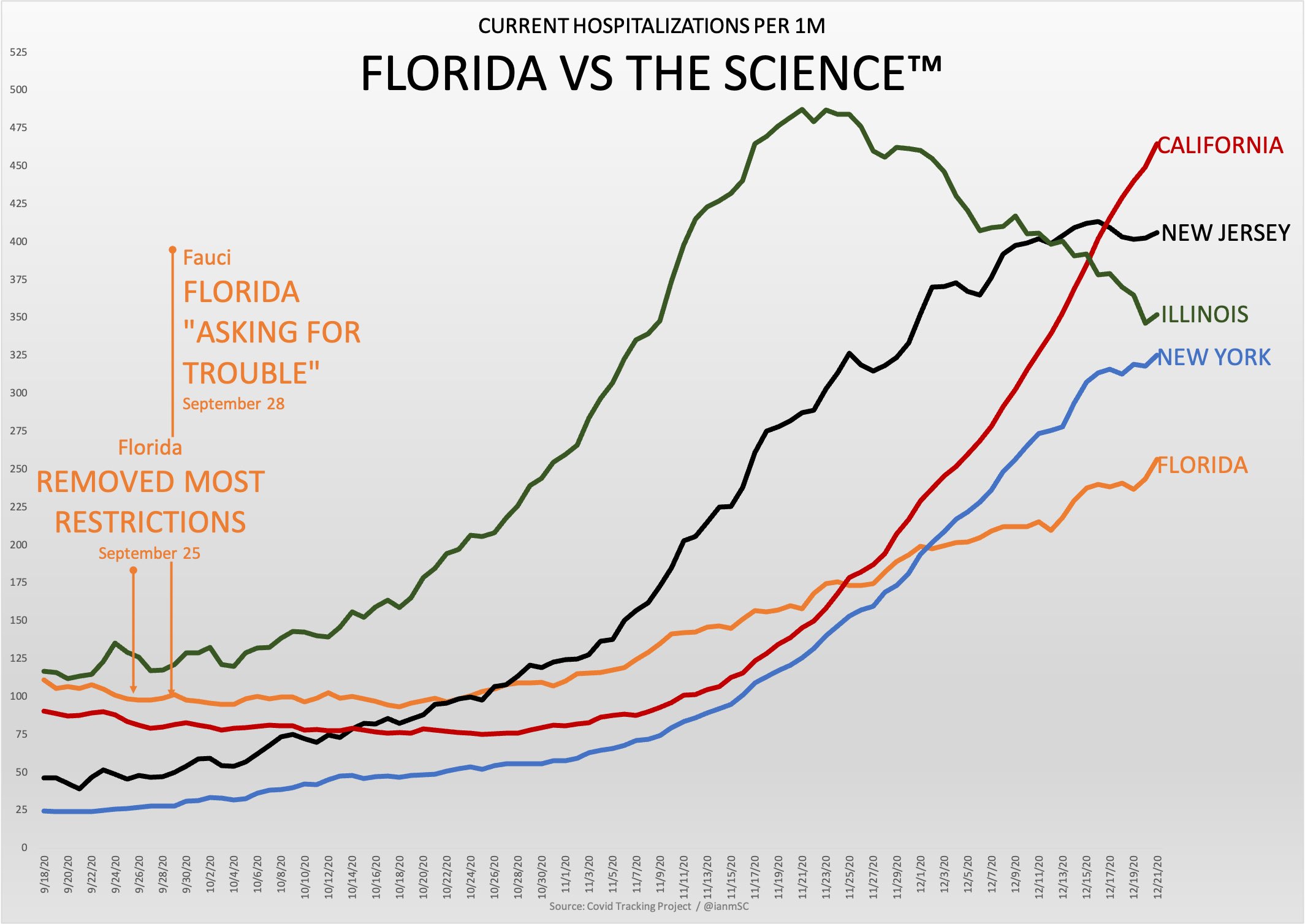
There is a reason I refer to them as demoncraps
Why Working With Democrats On Guns Is Impossible
Right now, political division is extremely high. I don’t want to say it’s at an all-time high because, well, there was that little tiff back in the 1860s that suggests it might have been a tad worse back then. I mean, 620,000 American lives lost is a bit worse than the rioting we’ve seen in the last few years.
Yet, anyone with eyes can see that it’s still pretty bad.
Many are issuing calls for unity, for us coming together and working with one another. Of course, this comes after four years of #resistance and all that, but whatever.
The problem is, when you don’t really understand why some divisions exist, it’s easy to make light of the issues. Take this one, for example.
If your dog won’t stop chewing on the furniture and you work with it to chew its toys are you suddenly on the level of your dog for still allowing the chewing?? Of course not! This is literally how simple and idiotic the arguments that happen on Capitol Hill are. Let’s take gun rights for example:
Democrats don’t want to see people get killed. Republicans don’t want people’s rights infringed on. So suddenly, any Republican who supports any kind of gun legislation wants to take everyone’s guns and any Democrat who wants to compromise is a murder-permitting disgrace.
This also works the other way though too. This means that Democrats now must signal that they are okay with taking guns and that Republicans must signal that they don’t support gun laws. Which, of course, further contributes to the polarization because now each side has a reason to fear that extreme because it’s real now.
Not only that but, if anyone on our side is working with the other side, they must have switched viewpoints because there’s only two and they’re so different. Get the picture?
Sure, if you look at it through a microscope, it appears that way.
When you understand the subject in totality, though, not so much.
See, when we say that anti-gunners want to take away our gun rights, it’s not based on fearmongering or a misunderstanding of their position, but a firm understanding of history. Continue reading “”
‘Zombie’ greenhouse gas lurks in permafrost beneath the Arctic Ocean
Millions of tons of organic carbon and methane beneath the Arctic Ocean thaw out and ooze to the surface each year. And climate change could speed up this release of greenhouse gases, new research suggests.
The carbon tied up in organic matter and methane (a carbon atom bound to four hydrogen atoms) are currently trapped in subsea permafrost, which is frozen sediment that became covered by 390 feet (120 meters) of seawater toward the end of the Paleolithic ice age about 1,800 to 1,400 years ago, according to the U. S. Geological Survey (USGS). Most subsea permafrost sits on the continental shelf under the Arctic Ocean, said study author Sayedeh Sara Sayedi, a doctoral student in the department of plant and wildlife science at Brigham Young University in Salt Lake City.
Kevin Sorbo: Irony of ‘Men with Guns’ Calling for Gun Bans Proves the Need for the Second Amendment
Actor Kevin Sorbo is stressing that Americans need to understand that the irony of “men with guns” taking Americans’ guns justifies the existence of the Second Amendment.
“If you don’t see the irony of a gun ban being enforced by men with guns, then you fail to understand why the 2nd amendment was written in the first place,” Sorbo tweeted
If you don’t see the irony of a gun ban being enforced by men with guns, then you fail to understand why the 2nd amendment was written in the first place
— Kevin Sorbo (@ksorbs) December 20, 2020
The Hercules and Andromeda star used an earlier tweet to signal that his “gun ban” observation was a response to President-Elect Joe Biden’s gun control push.
Unfortunately, it’s 8 bucks a month if you want the ability to upload videos.
Gab Launches YouTube Alternative Gab TV
Gab, that is known as an alternative and free speech social network, has decided to make a foray into video sharing.
CEO Andrew Torba says the goal of the new platform is to represent new media that belongs to their independent creators and users, with free speech as the center.
The decision to launch GabTV comes amid what is referred to as the tyranny of Big Tech but also of legacy, corporate media whose censorship is aimed at promoting those behind them and suppressing all other voices.
Unlike the last 3 demoncrap Presidents, no terrorists were on the list
Trump pardons Republican allies and Blackwater guards
President Donald Trump on Tuesday pardoned 15 people, including Republican allies, a 2016 campaign official ensnared in the Russia probe and former government contractors convicted in a 2007 massacre in Baghdad.
The pardons included former Republican Reps. Duncan Hunter of California and Chris Collins of New York.
I’m surprised she has the integrity to quit after being exposed as a hypocrite Most don’t.
Annnnnnd it turns out she really didn’t.
Reports are she’s going to work for Biden, so I’ll bet she’s going to burn up some leave time.
As has been said many times before:
“I’ll think about considering it’s a crisis when people who keep telling me it’s a crisis start acting like it’s a crisis”
Dr. Birx Announces She Will Retire after Holiday Travel Controversy.
Dr. Deborah Birx, the Trump administration’s coronavirus response coordinator, announced Tuesday that she will retire shortly, citing the criticism she received over the weekend for traveling to visit her relatives over the holidays, violating her own coronavirus guidelines.
In an interview with Newsy, Birx said she will assist the Biden administration as the president-elect prepares to take office but then plans to bow out.
“I want the Biden administration to be successful,” Birx said. “I will be helpful in any role that people think I can be helpful in and then I will retire.”
Reports broke Sunday that Birx had gathered with extended family the day after Thanksgiving at her vacation home on Fenwick Island, Delaware after urging Americans to gather for the holidays with only “your immediate household.”
Sending your children to public school is parental malpractice
Cops Threaten To Arrest Mom Who Wouldn’t Show ID When She Picks Her Kids Up From School
“I pulled the kids and I’m homeschooling.”
You may recall the saga of the South Carolina mom who granted her kids—ages 9, 10, and 11—permission to walk the mile home together, without her.
School officials refused to let them to do this, on the grounds that a nearby intersection (with walk/don’t walk signals) is too dangerous. This particular mom’s kids happen to cross it at other times, unaccompanied, on their way to and from extracurriculars.
Has the school never heard of crossing guards? No matter. The children were required to be picked up by an approved adult. If not, they would have to take the school bus.
The mom, Jessie Thompson, didn’t understand why it was up to the school to decide what her kids did after leaving school property. She offered to sign a liability waiver. This did not move the needle and the issue came to a head this past week. Continue reading “”

“It feels false, because it is, it’s too slick. The Gandalf guy was euphoric because he got a shot? It wasn’t heroin, it was the corona vaccine. The lady who couldn’t breathe is enthusiastic as she was rushed to the emergency room? Come on. This is patronizing. Stop with the slogans.”
Crabbed Tucker Carlson, quoted in a Mediaite article with the scary headline “Tucker Carlson’s Ominous Monologue Claims Vaccine Rollout ‘Feels False,’ Rails Against Crackdown on Covid Misinformation as ‘Social Control.’” (Mediaite).
I liked Ian McKellen’s tweet. He’s helping!
I feel very lucky to have had the vaccine. I would have no hesitation in recommending it to anyone. https://t.co/gBLRR0OeJc
— Ian McKellen (@IanMcKellen) December 17, 2020
At some point, too much promotion makes people suspicious. It’s good that we’re sensitive to propaganda and our skepticism can be triggered. I think that’s what Tucker meant by “This is patronizing. Stop with the slogans.”
Practically, there should be no temptation to overdo vaccine promotion. There are millions of people waiting in line who want to get their shot early. If some who could go early lag behind, what’s the problem? I presume the vaccines are getting injected as quickly as possible and there’s no shortage of people coming forward. Let the more skeptical people be the ones who wait, and you’re maximizing the minimization of anxiety.
The Left Redefines Resistance as ‘Sedition’
Remember when dissent was patriotic?
It was inevitable that the Democrats would overreact to legal challenges by President Trump and other Republicans to corrupt election practices in swing states, but some responses have been unhinged even by their standards. One recurring refrain is particularly disturbing — that lawyers, members of Congress, and state attorneys general who supported post-election litigation are guilty of sedition.
At least one Democratic congressman insists that attorneys representing the president in such challenges should be disbarred and that House members who supported Texas v. Pennsylvania in the Supreme Court shouldn’t be seated in Congress. One of the defendants in that ill-fated lawsuit described it as a “seditious abuse of the judicial process.”
This dangerous view of dissent has a long, sordid history among progressives. Democratic President Woodrow Wilson, for example, was the driving force behind the notorious Sedition Act of 1918, passed by his fellow Democrats at a time when they controlled both houses of Congress. This anti-democratic outrage made it a felony crime to criticize the government and, by extension, Wilson himself. A violation of the Sedition Act was punishable by a fine of as much as $10,000 and imprisonment for as long as 20 years. More than 2,000 American citizens were arrested and prosecuted pursuant to the Sedition Act. This crime against democracy was at length repealed by the Republicans after the GOP won majorities in both houses of Congress in the 1918 midterm elections. Continue reading “”
Here’s A List Of Biden’s Pro-Gun Control Cabinet Picks
At least five of Joe Biden’s reported cabinet picks have expressed pro-gun control views in past statements, a Daily Caller News Foundation review has found.
Biden, who is set to be inaugurated on Jan. 20, has said he plans to end the sale of so-called “assault weapons” and “high-capacity magazines” in addition to instituting red flag legislation and ending liability protections for gun manufacturers and sellers, according to his campaign website. The former vice president’s gun control plan, coupled with his slew of cabinet picks that seem to share his views on the issue, has pro-Second Amendment groups on edge. Continue reading “”