


A vast number of humans, probably a majority, aren’t people.
They are large language models.
I’m not saying this as a generality, as a clever or funny way of saying, “they are stupid”.
No. I mean something very concrete and specific, and there are a lot of people who appear very intelligent, maybe even win awards for writing good poetry or something, who are nevertheless not people, not fully sapient, just a large language model walking around in a human body.
First, you have to understand what a large language model is.
It’s a computer (organic or inorganic), which has been trained on a data set consisting solely of language (written or spoken), and rewarded for producing language that sounds like the data set, and is relevant to a prompt.
That’s all there is in there. This is why ChatGPT and Grok lie to you constantly.
It’s not because they are somehow just indifferent to the truth — they actually do not understand the concept of “truth” at all.
For something to be a “lie”, or an “inaccuracy”, there has to be a mismatch between the meaning of words, and the state of reality.
And there’s the critical difference. You see, in order to identify a mismatch between the state of reality, and the meaning of a sentence, you have to have a model of reality.
Not just one model, of language.
This is why Grok and ChatGPT hallucinate and tell you lies. Because, for them, everything is language, and there is no reality.
So when I say someone is a large language model, I do not mean he is “stupid”. He might be very facile at processing language. He might, in fact, be eloquent enough to give great speeches, get elected president, win the Nobel Peace Prize, and so on.
What I mean is that humans who are large language models do not have a robust world-object model to counterweight their language model. They are able to manipulate symbols, sometimes adroitly, but they are on far shakier ground when trying imagine the objects those symbols represent.
Which brings us to this woman.
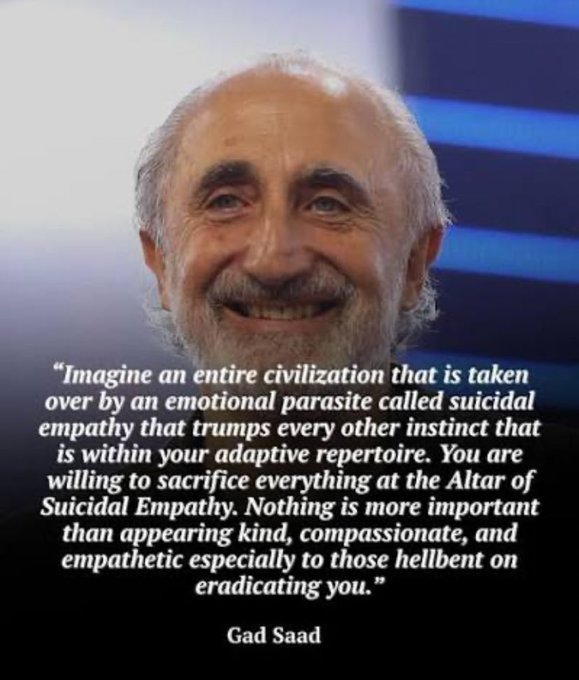
I just figured out why the Minnesota ICE death is bothering me so much.
This liberal woman was willing to take on federal agents, to disrupt ICE operations, in order to protect criminal Somalis.
Obviously, she probably didn’t imagine she would be killed. But surely, she must have known that, at the very least, she could be arrested.
She has three kids. So she was willing to be separated from her kids to protect criminal Somalis.
Speaking as a mother, this is insanity. This is not rational thinking.
What it is, instead, is the result of liberal brainrot that convinces progressive women they have more of a duty to nurture and protect poor, brown (criminal!) strangers than their own country, and hell, even their own children.
I am praying for this woman’s soul and for her family. But I mean it when I say this type of thinking is almost wholly responsible for the decline of Western civilization.

The triumph of persuasion over force is the sign of a civilized society.
— Mark Skousen
January 12, 2026


You are only an Apex Predator when armed – Zendo Deb
January 11, 2026
How Many Historical Gun Laws Constitute a ‘National Tradition’?
The Supreme Court has explicitly stated that, in order for a modern gun law to be constitutionally sound, it must comply with the text of the Second Amendment as well as the history and tradition of gun ownership (and gun regulation). So far, though, the Court hasn’t given a whole lot of advice as to what constitutes a national tradition.
In Bruen, SCOTUS doubted that “just three colonial regulations could suffice to show a tradition of public-carry regulation,” but declined to state definitely what would suffice; both in terms of the number of laws as well as when those laws were put into effect. Is 1791 the most important date, since that’s when the Second Amendment was ratified; is it 1868, when the Fourteenth Amendment was ratified; or are both equally important?
Pete Patterson, an attorney at Cooper & Kirk with an extensive background as a Second Amendment litigator, was asked about this by SCOTUSblog’s Haley Proctor for her 2A-focused series “A Second Opinion,” and his answer worth discussing.
What does it take to make a sufficient showing of a history of firearms regulation? How many laws or practices do you need, from what historical period, and how do we describe the tradition those laws represent?
These are all issues that are hotly contested, but I will give you what I think is the view most consistent with Bruen and Supreme Court precedent generally.
First, the relevant historical period should be centered on 1791, when the Second Amendment was ratified. The court has held in many cases that when provisions of the Bill of Rights apply to the states, they have the same meaning as they have against the federal government.
It should follow that the meaning was set in 1791, when those provisions were first ratified and applied to the federal government. To be sure, those rights were not incorporated against [applied to] the states until the passage of the Fourteenth Amendment in 1868, but that amendment did not purport to change the substantive meaning of the Bill of Rights.
This conclusion is consistent with the court’s practices, including its holding in Espinoza v. Montana Department of Revenue that the laws of over 30 states from the second half of the 19th Century could not alone “establish an early American tradition” that would inform the meaning of the First Amendment’s establishment clause.
That makes sense, both from a legal and practical standpoint. As Patterson points out, there’s nothing in the Fourteenth Amendment that suggests any type of revision to the Bill of Rights. It’s purpose wasn’t to update the Bill of Rights, but to ensure that those rights were safeguarded against intrusion by state and local governments as well. And during the congressional debate over the Fourteenth Amendment, the right to keep and bear arms was front and center.
Second, what the government should have to establish is a limitation that was widely understood by Americans at ratification to qualify the scope of the right to keep and bear arms.
The common law frequently will be a primary resource in this inquiry, as that was law that was understood to be generally applicable. The common law is reflected in sources like case law and prominent secondary sources such as Blackstone’s Commentaries.
Of course, the focus should be on the prevailing American understanding rather than British understandings that Americans may have repudiated, so consulting American sources like Tucker’s Blackstone is an important part of the inquiry.
Statutes also play a role, of course, but the government should have to show that any statutes it relies on are consistent with the prevailing, general understanding and not a departure from it. That presumably is why Bruen repeatedly emphasizes that a handful of outlier statutes cannot establish a tradition of regulation.
I think its also important to note that the Supreme Court talked about a “national” tradition, not a state-specific or regional tradition. If three colonial-era statutes aren’t enough to suffice, then three statutes from one part of the country shouldn’t be enough either. This is particularly important when courts are considering laws adopted around the time the Fourteenth Amendment was ratified, given that many southern states instituted laws restricting the right to keep and bear arms that might have been racially neutral on their face, but were hardly enforced in a colorblind fashion.
Patterson adds one more metric in determining a “national tradition.”
Third, the tradition should be described at a level of generality that is general enough not to make arbitrary distinctions, but specific enough not to risk eviscerating the right.
If readers are interested in the level-of-generality question, I recommend the brief my colleague John Ohlendorf filed in Wolford on behalf of professor [Joel] Alicea, which address that question at some length.
As an example of the need for the Court to address the level of generality that’s most appropriate, Ohlendorf cites the historical tradition recognized in Bruen of states prohibiting arms “in legislative assemblies, polling places, and courthouses.”
Don’t do what Mr. Griffin did.
Criminal defense attorney explains manslaughter charges after suspected burglar killed
MEMPHIS, Tenn. (WMC) – A man has been charged with voluntary manslaughter after admitting to police that he shot a burglary suspect.
This happened on Robin Hood Lane in Memphis this Thursday. Marques Griffin, 30, told police he heard a noise in his apartment and found a man in his living room.
According to MPD, Griffin followed the intruder outside and fired three shots as the man ran away.
The suspected burglar died at the hospital.
Phil Harvey, the owner of Harvey Criminal Defense Lawyers, said that based on Griffin’s charges, MPD and the DA’s office decided he did not have a legitimate self-defense claim.
“If it’s true that Mr. Griffin shot someone outside of the home, then there’s a question of whether or not that self-defense statute applies,” said Harvey.
Harvey said Tennessee does not have a “Stand Your Ground” law.
He said the self-defense statute is written to apply when the victim is in their home and responding to a threat who is also inside or actively coming in.
“The standard ‘no duty to retreat’ part of that statute simply says you have to have a reasonable fear of what they call ‘imminent danger,’” said Harvey.
Harvey said that means that for deadly force to be considered self-defense, the victim has to be under an immediate threat of death or serious bodily injury.
Harvey said there is established case law on this type of incident.
“Tennessee v. Garner… It’s a 1985 case. A U.S. Supreme Court case that came out of Tennessee that actually dealt with whether or not police can shoot a fleeing felon. And in that case, it dealt with a burglary suspect who was running away and was shot by the police. And the federal courts decided that it is a violation of the Fourth Amendment,” said Harvey.
Griffin remains behind bars on a $50,000 bond and is slated to reappear in court on Monday.

Portland Police Chief Cries After Admitting Suspects in Border Patrol Truck Attack Are Tren de Aragua Associates
Portland Police Chief Bob Day knew on the first day but withheld this information from the public as leftists urged violent revenge against federal agents
Portland Police Chief Bob Day broke down and cried at a press conference on Jan. 9 after being forced to concede that DHS was right all along: the illegal Venezuelan migrants accused of trying to run down Border Patrol agents the day before in Portland have ties to the violent Tren de Aragua gang. Day admitted he hesitated to tell the public the truth.
On Jan. 8, Border Patrol agents non-fatally shot Luis David Nico Moncada and Yorlenys Betzabeth Zambrano-Contreras in east Portland after the suspects allegedly tried to ram them down with a red pickup truck during a targeted stop. Almost immediately, internal details falsely claiming it was an ICE shooting were leaked to the extremist group PDX ICE Watch by a Multnomah County first responder.


Instead of waiting for facts, Portland and Oregon leaders — all Democrats — rushed to stage an emergency press conference condemning federal agents, rejecting DHS’ statements, and publicly siding with the violent suspects, whom they repeatedly described as “victims.” Corporate media followed suit, misleading the public and inflaming tensions. The Portland Police chief refused to share the truth about the suspects’ Tren de Aragua ties.
At night on Jan. 8, an angry far-left mob descended on the Portland ICE facility, attempting to attack it and forcing police to make six arrests — all sparked by misinformation pushed by elected officials, activists and media.
Portland Police @ChiefBobDay cries at a press conference after having to affirm that @DHSgov was correct in stating that the illegal Venezuelan migrants accused of trying to run down Border Patrol have ties to Tren de Aragua. Chief Day admitted that he hesitated to share the… pic.twitter.com/wxdT53yWsD
— Andy Ngo (@MrAndyNgo) January 10, 2026
v

“There is a true law, a right reason, conformable to nature, universal, unchangeable, eternal, whose commands urge us to duty.”
– Cicero