
Well, he’s bizarre, so……

Biden’s comments on gun violence truly bizarre

After nearly three years in office, there are a lot of things I’ve come to expect out of the Biden administration. Coherent comments by the president aren’t among them.

Yet in announcing his new Office of Gun Violence Prevention, Biden had to open up and discuss so-called gun violence more broadly. He couldn’t just announce the office and leave it there, he had to explain to the press–the same guys who wanted this for years, mind you–why it was supposedly needed.

In discussing “gun violence,” however, Biden was his typical self, saying things that raised more than a few eyebrows.

On Friday, while touting his strict gun control laws, Biden continued his trend of lying when he claimed he has been to “every mass shooting.”

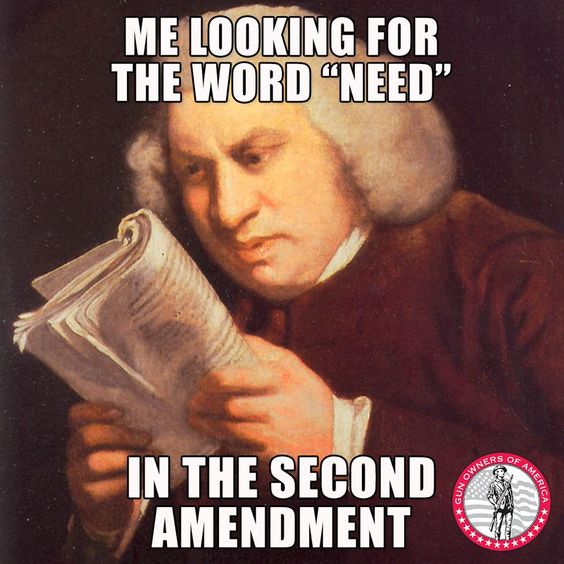
Biden furthered his support for restricting the Second Amendment, saying, “If you need 80 shots in a magazine, you shouldn’t own a gun.”

Yeah, buddy. That happened.

First, no, Biden hasn’t been to every mass shooting. Especially if you consider the definition of mass shooting that his party tends to prefer, which is the Gun Violence Archive definition that is just based on the number of people shot, not killed.

This definition inflates the number of mass shootings into a huge number, one that would make it impossible for Biden to visit every mass shooting.

Further, Biden offered no real qualifiers on those mass shootings, so even if we use the more traditional definitions that are based on the number of people killed, it’s unlikely he visited every mass shooting that ever happened in the US, much less the planet as a whole.

Because while people like Biden tend to pretend that mass shootings are uniquely American, they happen everywhere.

Then we get to the whole “if you need 80 shots in a magazine, you shouldn’t have a gun.”

First, there aren’t any 80-round magazines out there, though I suspect a company like Palmetto State Armory might be cooking up one right about now.

Yet even if there were, so what?

There is nothing in our Second Amendment that seems to support such a supposition. If we need X number of rounds, we shouldn’t have a firearm? Why is that? Under what criteria would we be allowed to have a gun? Is the limit 79 rounds? Five rounds? What exactly?

Now, generally speaking, people haven’t needed that many rounds for any lawful situation they might find themselves in. Many defensive gun uses take place with zero rounds being fired.

But many others take a lot more than some might think.

The truth is that no one who has survived a gunfight has ever said, “Gee, I wish I’d had less ammo.”

See, the problem with Biden’s myopic comment–and this is me trying to be charitable here–is that it doesn’t account for individual circumstances. There’s a difference between some guy pulling a gun on a mugger and someone who has angered an organized mob that wants their head.

Further, let’s remember that the Second Amendment isn’t about hunting or even muggers, specifically. Yes, the Tyranny of the Thug is a thing, but the amendment was essentially penned as an insurance policy on the rest of our rights. It was meant as a bulwark against tyranny as a whole.

Our Founding Fathers had just fought a war that started when the tyrannical government marched on a town to seize arms from them. It’s really unlikely that they intended to make it easier for a tyrannical leader to do the same again.

So no, there are no exceptions to the Second Amendment, no matter how many rounds you need in a magazine.

But since Biden clearly has never read the Second Amendment and definitely dismissed the Bruen decision, we’ve clearly got a long fight on our hands.

Support
About
Terms
Privacy

Pushback: California county sued for using cellphones to track movements of church-goers

They’re coming for you next: Santa Clara county in California is now being sued by Calvary Chapel San Jose and its pastor Mike McClure for using without warrant the GPS data from the cellphones of the church’s members to track their movements without their knowledge.

On August 22, 2023, a lawsuit was filed by Advocates for Faith and Freedom on behalf of Calvary Chapel San Jose against Santa Clara County, California, for utilizing geofencing methods to spy on church members during the COVID-19 pandemic. Earlier this year, Santa Clara County imposed a $1.2 million fine against the church for not abiding by the State’s and County’s COVID-19 restrictions.

Santa Clara County utilized an investigative method known as geofencing. Geofencing is a technological tool the government uses to track people relative to their location and likely locations. This tool is typically used in police investigations of criminal activity and, in these instances, requires a warrant– which is not always granted.

The lawsuit complaint can be read here [pdf]. As it notes:

Unbeknownst to the public, Defendants embarked on an invasive and warrantless geofencing operation to track residents in the County. The Defendants used this tool under the auspices of researching so-called superspreader events and activities.

Geofencing is a location-based tool used by the government to track individuals through their cell phone data. This tool is generally used in police investigations of criminal activity and requires the government to obtain a warrant, which is limited in time and scope.

The Defendants specifically targeted Calvary Chapel San Jose (“CCSJ”) to demonstrate the church was a large superspreader. The County hoped to use this information in its ongoing state enforcement action against the church. To this day, the County cannot trace one COVID-19 case to the church.

The Defendants put multiple geofences around the church’s property so they could track when and where individuals were on the premises. This operation took place over a year with seemingly no oversight, boundaries, or limitations – meaning the Defendants could track churchgoers in the sanctuary, prayer room, or bathroom.

This type of expansive geofencing operation is not only an invasion of privacy but represents a terrifying precedent if allowed to go unaddressed. As it stands, the Defendants are effectively arguing that, as long as they call it research, any level of government can target and spy on any individual or group at any time for any duration, and, if they so choose, they can wield the collected data against said individuals or groups who oppose their orders. This is not just un-American; it is downright Orwellian. [emphasis mine]

The highlighted sentence is the bottom line. Despite imposing a $1.2 million fine against the church for continuing its regular meetings during the COVID lockdowns, the county has yet to document any evidence that the church’s defiance caused COVID to spread at all. If anything, the county’s illegal data-gathering proved it did not, unequivocally.

Of course, any rational person could have told the county this. The lockdowns did nothing to stop COVID, so there was no reason for the church to stop its Sunday services. In fact, the county’s attempt to forbid religious services (while allowing many other group activities to go on), its totalitarian fining of the church, and its illegal surveillance all strongly suggest that county officials had no interest in stopping COVID, but were actually implementing an anti-religious campaign to suppress religious expression.

The county can deny this accusation, but the evidence tells us it is true. Santa Clara County officials decided to use COVID as an excuse to squelch the religious freeom and first amendment rights of this church and its members. In doing so, it is also attempting to establish a precedent that will allow the government to spy on any citizen for as long as it wants, without warrant and for any reason, and then use that data to condemn that citizen.

Note too that the surveillance was without cause, and could not have gotten a warrant even if the county had tried. The church members were not committing any crimes by going to church. If anything they were simply exercising their first amendment rights, guaranteed from this kind of government interference by the Constitution itself.

The lawsuit demands nominal and compensatory damages as well as attorneys’ fees, claiming the county violated the church’s first and fourth amendment rights. I hope a jury gives the church an award that exceeds the county’s fine by many millions.

Never, ever place any trust in “The Internet of Things” “IOT”

BLUF
If we ponder that relationship for a moment, we might conclude that many of the things that we believe we control are really on loan as a means of controlling us.

The Man Amazon Erased.

On Thursday, May 25, Brandon Jackson, a software engineer in Baltimore County, Maryland, discovered that he was locked out of his Amazon account. Jackson couldn’t get packages delivered to his home by the retail giant. He couldn’t access any files and data he had stored with Amazon Web Services, the company’s powerful cloud computing wing. It also meant that Jackson, a self-described home automation enthusiast, could no longer use Alexa for his smart home devices. He could turn on his lights manually, but only in the knowledge that Amazon could still operate them remotely.

Jackson soon discovered that Amazon suspended his account because a Black delivery driver who’d come to his house the previous day had reported hearing racist remarks from his video doorbell. In a brief email sent to Jackson at 3 a.m., the company explained how it unilaterally placed all of his linked devices and services on hold as it commenced an internal investigation.

The accusations baffled Jackson. He and his family are Black. When he reviewed the doorbell’s footage, he saw that nobody was home at the time of the delivery. At a loss for what could have prompted the accusation of racism, he suspected the driver had misinterpreted the doorbell’s automated response: “Excuse me, can I help you?”

Submitting the surveillance video “appeared to have little impact on [Amazon’s] decision to disable my account,” Jackson explained on his blog on June 4. “In the end, my account was unlocked on Wednesday [May 31, six days later], with no follow-up to inform me of the resolution.” By now, many months later, Amazon’s investigation into the matter appears to have concluded though the issue remains far from resolved. Contacted for a response, the company wrote: “In this case, we learned through our investigation that the customer did not act inappropriately, and we’re working directly with the customer to resolve their concerns while also looking at ways to prevent a similar situation from happening again.”

It was only Jackson’s technical skills and particular automated home setup that saved him from what could have been a larger lockout. “​​My home was fine as I just used Siri or [a] locally hosted dashboard if I wanted to change a light’s color or something of that nature,” he explained. His week of digital exile amounted to a frustrating inconvenience only because, as a tech-savvy user and professional software engineer, he had the ability to set up his own locally hosted network that acted as a failsafe. But Jackson’s experience is a warning to the vast majority of Alexa users and smart home dwellers who, lacking his particular skills and foresight, are increasingly at the mercy of the tech they have embedded into their lives and bedrooms.

“I came forward,” Jackson told Tablet, “because I don’t think it’s right that Amazon could say, ‘I know you bought all these devices, but we think you are racist. So we’re going to take [you] offline.’” On one side, critics lambasted Jackson as a dupe for having smart devices in the first place; others said his criticisms of Amazon implied that he didn’t support a company protecting its employees. “People missed the main point,” he said. “I don’t really care who you are, what you do, or what you believe in. If you bought something, you should own it.”

Jackson’s story of being temporarily canceled by the tech behemoth spread across the internet after it was discussed in a YouTube video by Louis Rossman, a right-to-repair activist, independent technician, and popular YouTube personality. Right to repair, or fair repair, is a consumer-focused movement advocating for the public to be able to repair the equipment they own instead of being forced to use the manufacturer’s repair services or upgrade products that have been arbitrarily made obsolete. In the early 20th century, fair-repair advocacy began with automobiles and heavy machinery, but its tenets have spread as computer chips have come to undergird contemporary life.

Following Rossman’s initial video about Jackons’s case, Amazon alleged that Rossman had abused its affilate marketing program and placed restrictions on the YouTuber’s business account, leading him to speculate in a follow-up video that the corporate giant was retaliating against him for covering Jackson’s travails. Rossman alleges that this was the first time Amazon made any allegation against him of abusing its affiliate marketing program since he enrolled in the marketing program 7.5 years ago.

Jackson’s experience is a warning to Alexa users and smart home dwellers who are increasingly at the mercy of the tech they have embedded into their lives and bedrooms.

The number of households adopting smart home devices in the United States is expected to reach 93 million by 2027 and most consumers rely on cloud services for their daily online use. But the cloud is not just a metaphor to explain a connected network; it describes the complete reorganization of digital life under the power of remote centralized databases. Light switches, lightbulbs, locks, thermostats, coffee makers, air conditioners, speakers, exercise equipment, and virtually every other piece of equipment you can find in the average home can now all be operated as interconnected pieces of a single digital network, run by an outside host, such as Amazon, which operates the massive server banks that make up “the cloud.” For consumers, this arrangement offers convenience and optimization. You can turn on the heat in your house from another state, or reorder a household good with a simple voice command. But the cost of that convenience is that consumers no longer independently control how their tech—or their homes, since the two are increasingly integrated—is operated. As Kyle Wiens, CEO of iFixit and another right-to-repair activist put it, “Who really owns our things? It used to be us.”

Brandon Jackson

Brandon Jackson

Alexa’s terms of use includes a clause stating that Amazon is permitted to terminate “access” to Alexa at the company’s discretion without notice. Jackson was told by a customer relations executive over the phone that he needed to assure the company that he would not ridicule or put future delivery drivers in harm’s way. Nearly a month later, Amazon admitted no wrongdoing, only apologizing for “inconveniences.” Given absolute power over its users, there is no pressure on Amazon to explain its decision. Indeed, the company used the same statement Tabletreceived for an earlier June Newsweek article regarding Jackson’s lockout.

Amazon’s claims of being concerned about the safety of blue-collar workers strain credibility. According to a 2021 article published in Vice, when minority delivery drivers faced violent threats and racial harassment, the company’s penchant for efficiency took priority over worker safety. Unsustainable demands from delivery drivers have translated to drivers peeing in bottles and defecating in garbage bags, a problem Amazon internally acknowledged even as it publicly denies the allegations. Inside its “fulfillment centers”—the term the company uses for its warehouses—workers suffer 5.9 serious injuries for every 100 workers, an 80% greater injury rate than competitors. Indeed employee turnover is so high in these facilities that a leaked company memo from 2022 warned that the company was on track to deplete its number of available workers by 2024.

Amazon’s intrusion into Jackson’s life, then, should not be understood within the context of protecting workers—which might begin by giving them adequate time to use the restroom—but rather as part of an emergent regime of technological control. The culmination of years of debate about political and civic norm moderation on social media and in public discourse has created a new normative standard in which “innocent until proven guilty” is now viewed as an oppressive and antiquated relic. As the new unelected masters of public discourse, tech giants like Amazon, Google, Twitter, and Facebook, have been encouraged to execute summary punishments of users for mere accusations of racism or “disinformation.”

Amazon’s enormous power in the global economy and ubiquitous presence in the U.S. supply chain and cloud computing sectors allows the company to take the power of surveillance and cancellation even further. Unlike purely social media companies like X (formerly known as Twitter), Amazon’s suite of smart home gadgets and services gives it a direct physical presence inside of people’s homes. That means that when Amazon wades into cultural issues, or decides to punish people based on offensive speech, its political values are mapped onto objects and processes used in the real world.

In Jackson’s case, in order to regain access to things he had already paid for, he was forced to submit the surveillance video from his home to Amazon to prove his innocence. Somehow, in the new cloud-based networked world these corporations are building for us, the solution to every problem always involves individuals handing over more of their private data.

Debates over censorship, free speech and its limits typically revolve around social media use. But Hayley Tsukayama, a senior legislative activist for Electronic Frontier Foundation, a digital rights group, suggested to Tablet that Jackson’s case shared a similar architecture to conversations around content moderation. Companies can choose not to allow certain forms of speech, but in doing so they can no longer be treated as neutral platforms. Tsukayama argues that social media users are offered a recourse, even if the process is stacked against them. “If [Amazon] is going to look at customer behavior as being part of the terms of service,” she said, “they [should] make that clear and set up a process that’s perhaps not unlike what we see at Facebook, YouTube or others who deal with content takedown.”

But, of course, we now know that millions of social media users had their accounts censored or banned without explanation or recourse for posts, including many that were classified as “disinformation” at the time of the alleged offense but contained statements that authorities later acknowledged as true. In that light, placing more trust in a content moderation model seems like a dangerous gamble. It could also lead to even more surveillance online as companies like Amazon claim a need to monitor their customers’ every move so they can judge them “fairly.”

Like many digital technologies, the smart home offers connectivity at a steep price—it makes individuals passive subjects of the products that surround them, including the things they own. Few of us have any real understanding of the “terms of service” on the devices and services that we rely on. Consider how streaming services replaced physical media and how the arrival of smartphones, with all their wonders, also meant that the owners of such phones became incapable of replacing their own batteries, SIM cards, and physical storage. If we ponder that relationship for a moment, we might conclude that many of the things that we believe we control are really on loan as a means of controlling us.

Markey, Ocasio-Cortez ask Biden to create Civilian Climate Corps by executive order

Sen. Ed Markey (D-Mass.) and Rep. Alexandria Ocasio-Cortez (D-N.Y.), two of Congress’ most vocal proponents for aggressive climate action, on Monday called for President Biden to establish a Civilian Climate Corps.

The CCC had been a key element in early versions of the Build Back Better Act, the sweeping environmental and infrastructure bill. It was not ultimately included in the slimmed down Inflation Reduction Act, which was nonetheless the largest climate bill in U.S. history.

Biden was a vocal backer of the Climate Corps early in his presidency, comparing it to the Civilian Conservation Corps introduced during the presidency of Franklin Delano Roosevelt. The original legislation called for $10 billion to launch the new program.

In the letter, timed to the 30th anniversary of the bill that created Americorps, Ocasio-Cortez and Markey cited polling indicating the idea has more than 60 percent support. The two have also reintroduced a bill to establish a corps legislatively, although the measure will almost certainly not be given a vote in the Republican-majority House.

“A central coordinating body, overseen by the White House, will be essential to create a successful and cohesive Civilian Climate Corps,” they wrote. “Through interagency collaboration, as well as coordination with state climate corps, other state entities, and local non-profit organizations, your Administration can realize the vision of a Civilian Climate Corps that establishes a unified front in the face of climate change — one that looks like America, serves America, and puts good-paying union jobs within reach for more young adults.”

The letter is also signed by members of Democratic congressional leadership like Senate Majority Leader Chuck Schumer (D-N.Y.) and Democratic Whip Dick Durbin (D-Ill.).

Also on Monday, a coalition of more than 50 progressive and environmentalist groups sent a separate letter calling on Biden to establish the CCC, citing its popularity among younger voters in particular.

“While previous Executive Orders and legislation under your administration demonstrate tremendous progress toward meeting our Paris climate goals and your campaign promises, this summer has made clear that we must be as ambitious as possible in tackling the great crisis of our time,” they wrote.

“We encourage your administration to create a Civilian Climate Corps through existing authorities, with existing climate funding, that can coordinate across relevant federal agencies.”

Vanderbilt professor: Climate change stories ‘cater to the white consciousness.’

A professor of English at Vanderbilt University recently gave a talk about how the genre of climate fiction, or “cli-fi,” has a problem with “its intersection [of] race and genre.”

Teresa Goddu  whose advocacy led to the creation of Vanderbilt’s Environmental and Sustainability Studies minor, told an audience at the Novel Seminar Series that climate fiction in the United States “depicts the climate crisis as a whiteness crisis,” The Hustler reports.

Such stories “often represent white, mostly privileged characters in communities becoming destabilized if not undone by climate catastrophe,” Goddu said. “Climate punctures the bubble of safety and security that cocoons the white psyche.”

Goddu added that she is “tired” of the focus on whiteness in climate stories, or “texts that actually just reify whiteness.” As a result, she’s working on “encompassing slave and neo-slave narratives” into such tales to “expand the canon.”

“I really think a lot of climate fiction is being written, but not recognized as such, especially African American literature,” Goddu said. “I want to expand […] what is considered climate fiction and [redefine] what we are actually reading and paying attention to.”

Looking ahead, Goddu said she hopes her work will expand the genre and leverage optimism, satire and new tropes to innovate the body of work and reimagine a better, more sustainable future.

“I am more interested in reading stories that reimagine possible futures or teach me about the structures, historically and currently, that I live within,” Goddu said. “I don’t like literature as policy statements. I don’t like literature to be so instrumental.”

According to her faculty bio, Goddu’s research deals with “slavery and antislavery, race and American culture [and] genre studies.” In a 2021 interview, Goddu said she began “noticing how the antislavery movement was being invoked by climate activists as a model.”

“This led me to consider what social change my own moment demanded of me and how I might bring my gifts—as administrator, teacher, and writer—to bear on the issue,” she said. “It made sense to connect my long-standing concern with racial justice to the issue of climate justice and my interest in how literature can affect social change to the climate crisis.”

Seven years ago another Vanderbilt academic, Ed Rubin, offered a pair of courses on cli-fi: “Visions of the Future in Cli-Fi” and “Climate Change Literature: A New Fictional Genre about a Real Problem.” Many of the titles on his reading list (“Earth Abides,” “The Postman,” “Do Androids Dream of Electric Sheep?”) are Euro/white-centric.

Navy Puts The Kibosh On Digital Recruiting Program After Discovering Enlistees Aren’t Into Drag Queens

The U.S. Navy confirmed on Tuesday it has discontinued an online recruiting initiative featuring an enlisted drag queen that was aimed at bringing new sailors into the service.

In May, The Daily Caller revealed that the Navy brought on Yeoman 2nd Class Joshua Kelley — an active-duty drag queen who goes by the stage name Harpy Daniels and identifies as non-binary — to be a “Navy Digital Ambassador.” The Digital Ambassador Pilot Program, which ran from October 2022 to March 2023, was reportedly “designed to explore the digital environment to reach a wide range of potential candidates” for military recruitment.

In a letter sent to Sen. Tommy Tuberville, R-Ala., on Tuesday, Erik Raven, the under secretary of the Navy, confirmed that the branch’s Digital Ambassador Pilot Program “will not be continued.”

“The Navy learned lessons from the pilot program that will inform our digital engagement and outreach going forward,” Raven wrote. “Our digital outreach efforts will maintain the important distinction between Sailors’ official activities and their personal lives.”

Tuberville — who sits on the Senate Armed Services Committee — previously sent a letter to Admiral Michael M. Gilday, the chief of Naval Operations, in May, demanding to know the identities of the officers tasked with funding and promoting drag queen shows aboard naval vessels. The letter was sent the same day the Alabama senator and his Republican colleagues submitted a separate communique to Navy Secretary Carlos Del Toro on the branch’s embrace of Daniels and whether Navy leadership is encouraging its “digital ambassadors” and public affairs personnel to use TikTok — which the Pentagon banned its members from using on government-issued devices — “on their personal devices” in order to skirt the agency’s prohibition.

In his Tuesday letter to Tuberville, Raven claimed the Navy followed existing guidelines restricting the use of TikTok and that while some sailors partaking in the digital ambassador program “had [a] personal social media presence on TikTok,” the branch did not issue government devices for purposes of participating in the venture. Raven further contended the branch will “continue to communicate” to its members the “national security risks associated with their use of TikTok on personal devices.”

The Navy’s embrace of Daniels — which generated backlash among many military veterans — comes amid the branch’s failure to meet existing recruiting targets. On Thursday, acting Chief of Naval Operations Adm. Lisa Franchetti confirmed that the Navy is expected to miss its fiscal year 2023 recruiting goals by roughly 7,000 sailors. The revelation came days after the Air Force announced it would miss its “active-duty recruiting goals for the first time since 1999.”

The U.S. Army and Coast Guard are also expected to miss their respective fiscal year 2023 recruiting targets.

Grisham responds to backlash, ruling blocking her order

New Mexico Gov. Michelle Lujan Grisham had to know that she’d get pushback with her declaration of a “public health emergency” regarding violent crime in Albuquerque and the subsequent order banning the lawful carry of firearms there.

I mean, it’s a gun order. There’s literally no way that she could be oblivious to the fact that a lot of people weren’t going to like it.

However, Grisham got a lot more than she likely bargained for.

I mean, members of her own party pushed back. Then, on top of everything, a court issued a restraining order stopping enforcement of the rule.

But Grisham isn’t taking her lumps and learning from them. No, she’s trying to push back.

The governor told “GMA3” earlier Wednesday she has the “courage” to take a stand against gun violence in response to backlash over her emergency public health order.

“Everyone is terrified of the backlash for all of these political reactions,” Lujan Grisham told Eva Pilgrim on “GMA3” Wednesday. “None of those individuals or groups focused on the actual injuries or deaths of the public.”

“They aren’t dealing with this as the crisis that it is,” she continued.…

“How would you feel in a city or a community if people had handguns in their belts, on parks, near schools, on public trails, at the grocery store?” Lujan Grisham told “GMA3.” “It’s outrageous and it must stop. And I will keep doing everything that’s based in science and fact and public safety efforts to clean up our cities to make this the safest state in America. And I will not stop until that’s done.”

The thing is, it’s not the bad guys walking around openly carrying. Criminals never open carry so far as I’ve seen.

If this is what Grisham is pushing then it’s about theater, not safety. It’s about giving the illusion of making things better. What’s more, she knows it.

Of course, much of this is about responding to the pushback to her order.

She also had this to say following the restraining order being issued.

“As governor, I see the pain of families who lost their loved ones to gun violence every single day, and I will never stop fighting to prevent other families from enduring these tragedies,” Lujan Grisham said in the written statement.

“Over the past four days, I’ve seen more attention on resolving the crisis of gun violence than I have in the past four years,” she said.

No, she hasn’t.

What she’s seen is her entire party–at least those who spoke out–calling her out for this blatantly unconstitutional action. Everyone has been telling her that she can’t do what she’s tried to do and now a federal court has done the same.

Grisham’s problem is that she can’t see beyond her own partisan blinders. She can’t comprehend that there might possibly be ways to address violent crime in cities like Albuquerque that don’t involve restricting people’s rights.

Which is funny, because this whole “public health crisis” isn’t just about restricting guns. Among other things, it calls for state police to go to Albuquerque to help crack down on violent crime in the city. It actually does do a few things that might well help all on its own, and they’re far less controversial than trying to unilaterally restrict someone’s basic, constitutionally protected rights.

Then again, so many anti-gun Democrats can’t think beyond gun control for solutions to such issues.

And that’s a problem since gun control doesn’t really solve those issues.

Does Grisham have an end game with her gun ban order?

The Albuquerque police chief says he won’t enforce it. The Bernalillo County sheriff says the same thing. Even the District Attorney in Albuquerque says he won’t enforce Gov. Michelle Lujan Grisham’s order suspending open and concealed carry in the city for 30 days, calling it “clearly unconstitutional“. With gun owners rallying in Old Town Albuquerque over the weekend, many of them openly carrying firearms in defiance of Grisham’s order, gun control activists divided over her announcement, and the governor herself unclear about what enforcement might look like, I can’t help but wonder if she has an actual end game in mind or if she’s just making it up as she goes along.

Armed American Radio’s Mark Walters joins me on today’s Bearing Arms’ Cam & Co to kick around Grisham’s order suspending the right to carry in Albuquerque for the next 30 days, and we’re both in agreement that gun owners in Albuquerque should be disregarding the governor’s edict. I won’t even call continuing to carry an act of civil disobedience, because Grisham has no lawful authority to suspend the exercise of the right to keep and bear arms simply by declaring a public safety emergency. Gun owners who continue to carry, either openly or concealed, are simply continuing to exercise their Second Amendment rights as they always have, and the multiple legal challenges that have been filed in response to Grisham’s declaration should soon make that abundantly clear to the governor and any state official willing to try to enforce it.

The biggest question isn’t whether or not Grisham’s order will stand up to legal scrutiny, but why she made the ill-fated decision to unilaterally suspend the Second Amendment right to bear arms inside Albuquerque city limits in the first place. Grisham’s move doesn’t appear to have been coordinated with any major gun control organizations, and it appeared to blindside local Democrats and public officials, including Albuquerque Mayor Tim Keller and police chief Harold Medina, as well as Bernalillo County Sheriff John Allen.

Political consultant Joe Monahan says the governor’s “grand but ultimately feckless gesture” is a sign that New Mexico Democrats are at odds with each other when it comes to addressing the high violent crime rate in the state’s largest city.

Continue reading “”

Firearms Policy Coalition @gunpolicy

The First Circuit heard oral arguments today in a lawsuit challenging Rhode Island’s magazine ban. You can listen to it here: ca1.uscourts.gov/sites/ca1/file…
“‘I struggle with the notion’ that magazines aren’t arms, said U.S. Circuit Judge Bruce Selya, a Reagan appointee. ‘The firearm isn’t operable otherwise. So I don’t understand why a magazine isn’t an essential component of a firearm and thus a firearm.'” courthousenews.com/can-states-ban…
The first federal appeals court to tackle this issue after the Supreme Court’s landmark gun-control ruling last year seemed uncertain how to proceed.
“[Judge] Kayatta was skeptical. ‘How did there get to be millions and millions of these in people’s hands if there’s a long tradition of outlawing them?’ he asked.”
wut?
Image

Staff Pulls Plug on Presser as Biden Goes Over Edge in Vietnam With Confusion, Dog-Faced Pony Soldiers

Joe Biden was in Hanoi on Sunday, meeting with Vietnam’s Communist Party leader, General Secretary Nguyễn Phú Trọng.

After the meeting, he made some remarks and took a few questions from the press. We probably don’t even have to say anymore that it didn’t go well, you can just assume that there are going to be big embarrassing issues.

Biden started in confusion about whether it was evening there (it was).

I think he was trying to make a joke about “Good Morning, Vietnam,” which was a famous Robin Williams movie, not a “famous song.” And maybe that’s not the best movie to bring up when you’re in Vietnam. As my colleague Andrew Malcolm observed in his post about Joe Biden’s visit, Biden said his Afghanistan withdrawal would not be as bad as the Saigon panic, but then it was.

But that was the good part. It was all downhill from there once the presser started. Although to be fair, it’s not much of a presser when he limits it to five preselected reporters that “they gave me here.”

Continue reading “”

MEET THE NEW PRINCIPAL OF JOHN GLENN ELEMENTARY SCHOOL

Shantel Mandlay Facebook drag queen principal

Fox News reports that the Western Heights School District in Oklahoma City, Oklahoma, has installed a drag queen as principal of the John Glenn Elementary School. Fox has confirmed that the new hire, Shane Murnan, is “a drag queen who goes by the name of Shantel Mandalay.” Although Mandalay’s Facebook account has since been deleted, the article provides screenshots of him in his full drag glory.

According to Fox, Murnan was employed as a drag queen at a venue called “The Boom.”

Continue reading “”

Gun Violence Declared a Public Health Emergency.

Gun violence has been declared a public health emergency in New Mexico following the death of an 11-year-old boy.

New Mexico Governor Michelle Lujan Grisham made the announcement following the death of a young boy in a shooting on a highway. Albuquerque Police Chief Harold Medina confirmed in a press briefing that a boy was killed and a second woman was taken to hospital in critical condition. They were attacked while traveling westbound on Avenida Cesar Chavez near University Boulevard. Neither of the victims have been named.

Declaring a public health emergency, Lujan Grisham shared a statement lamenting the death of the boy and the earlier unrelated killing of a five-year-old girl in the area. “Today, I join the family of an 11-year-old boy in mourning his violent death yesterday. And I mourn the loss of a 5-year-old girl murdered in her bed last month,” the statement read.

“These are disgusting acts of violence that have no place in our communities. As a mother and grandmother, I cannot fathom the depth of these losses, and their effects will be felt by families, friends and communities forever.”

She said new measures need to be brought in to end gun violence in the state and called for a meeting to determine what steps can be taken to reduce harm caused by guns. Lujan Grisham continued: “The time for standard measures has passed. Today I am declaring gun violence a public health emergency in New Mexico.”

The executive order signed by Lujan Grisham stated the “rate of gun deaths in New Mexico” had increased by 43 percent from 2009 to 2018, compared to an 18 percent increase nationwide. It also said guns are the leading cause of death for children and teenagers in the state.

In her comments, the governor urged New Mexicans to take action against gun violence, saying: “To my fellow citizens: get loud. Step up. Demand change: from your neighbors, from your friends, from your communities, from your elected leaders. Enough is enough.”

Lujan Grisham’s actions were met with derision from New Mexico House Republican Minority Leader Ryan Lane, who accused her of politicizing the death to “push her anti-gun agenda.” Lane said in a statement: “The Democrat’s policies have created and exacerbated the crime crisis that is literally killing New Mexicans daily. It is unacceptable that it has taken this long to notice the number of everyday New Mexicans that are being affected by criminal violence.”

Newsweek has contacted Gov. Lujan Grisham via an email form on her website for comment.

___________________________________________


You know, concealed means concealed, but as I don’t live in NM……

____________________________________________


New Mexico governor issues order to suspend open and concealed carry of guns in Albuquerque

ALBUQUERQUE, N.M. (AP) — New Mexico Gov. Michelle Lujan Grisham on Friday issued an emergency public health order that suspends the open and permitted concealed carry of firearms in Albuquerque for 30 days in the midst of a spate of gun violence.

The Democratic governor said she is expecting legal challenges but felt compelled to act in response to gun deaths, including the fatal shooting of an 11-year-old boy outside a minor league baseball stadium this week.

The firearms suspension is tied to a threshold for violent crime rates that only the Albuquerque area currently meets. Police are exempt from the temporary ban on carrying firearms.

Lujan Grisham said the restrictions “are going to pose incredible challenges for me as a governor and as a state.”

“I welcome the debate and fight about how to make New Mexicans safer,” she said at a news conference, flanked by leading law enforcement officials, including the district attorney for the Albuquerque area.

Federal Judge Issues 42-Page Ruling on Floating Border Barriers

A federal judge on Wednesday ordered the state of Texas to remove barriers from the Rio Grande, which Gov. Greg Abbott had put in place to deter migrants from entering his state illegally.

The Biden administration filed a lawsuit against Abbott in July, arguing that he had failed to obtain the federal government’s permission to place the buoys on the border between the U.S. and Mexico, CBS News reported.

In his 42-page preliminary injunction order, Judge David Ezra, a Ronald Reagan appointee, directed the state to remove the barriers from the river by Sept. 15.

Ezra wrote that Abbott needed permission to place the floating barriers in the Rio Grande because they obstructed a U.S. navigable waterway in violation of federal law.

The judge also pointed out that the water barrier raised international relations issues with Mexico, which are in the purview of the federal government.

“Mexico vigorously denounces the presence of the barrier, expressing its hope for expeditious removal of the barrier as the first topic at the August 10, 2023, meeting between Foreign Secretary Alicia Barcena and Secretary of State Anthony Blinken,” Ezra said.