
Category: Gun Schtuff
Interesting pistola. Slightly lower MSRP than the Ruger
Read all of that, then tell me the “SHOOTING ILLUSTRATED STAFF” doesn’t need some remedial training in operating systems.
First Look: Smith & Wesson M&P 5.7 Pistol.
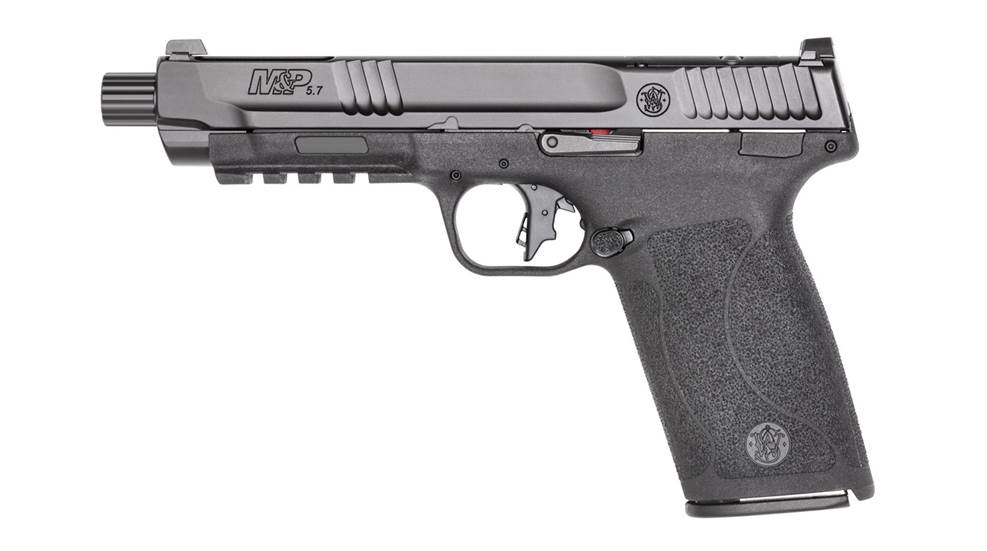
Smith & Wesson Brands, Inc. has unveiled a new M&P handgun chambered for the relatively modern 5.7×28 mm cartridge. The 5.7x28mm caliber keeps increasing in popularity across the market today and was first developed by FN during the 1980s for use in their PDW style firearms such as the P90.
This new M&P pistol has a magazine capacity of 22 rounds with a full-size 5-inch barrel and uses a gas-operated, locked-breech mechanism that supports the pressure and specifications of the 5.7mm cartridge. This system is somewhat different as opposed to the more traditional Browning inspired delayed blowback tilting mechanisms commonly seen used with standard handgun rounds that operate at lower pressures. Due to the alternative design considerations the M&P 5.7 is also slightly thinner than typical Smith and Wesson M&P Series handguns.
The M&P 5.7 includes an optics-ready cut slide ideal for micro slide-mounted, red-dot electronic sights. The 5-inch barrel on these pistols also has a threaded muzzle cut for 1/2×28 inch threads. The extremely crisp single action trigger of the pistol is enhanced by the flat face of the trigger shoe. Two 22- round magazines ship with the pistol as well.
“The M&P5.7 is an exciting new pistol from Smith & Wesson that incorporates a gas-operated Tempo Barrel System to effectively harness the 5.7x28mm round, creating a lighter recoil for an overall better shooting experience. Like all Smith & Wesson firearms, the M&P5.7 is proudly made entirely in the USA and is backed by the Smith & Wesson Limited Lifetime Service Policy. Whatever your purpose, the M&P5.7 is versatile, fun, and a must-have,” says Andrew Gore, Product Manager, Handguns.
The new M&P 5.7 has a retail price of $700. For more information on this new pistol and other firearms sold by Smith And Wesson, please visit their website at smith-wesson.com
There’s a non-threaded barrel option for the states that ban that.
SHOT Show: The Henry Homesteader 9mm Semi-Automatic Carbine
I’m a big fan of pistol-caliber carbines. I know a 5.56 rifle is better, but 9mm is a lot cheaper to shoot. I blame the restrictive nature of my home range maxing out at 100 yards. Maybe that’s why I love PCCs.
Admittedly, most PCCs are predictable. Base it on the AR design and and make it take GLOCK magazines. At SHOT Show range day, however, we were greeted by a new entry in the class from none other than the lever gun maestros at Henry.
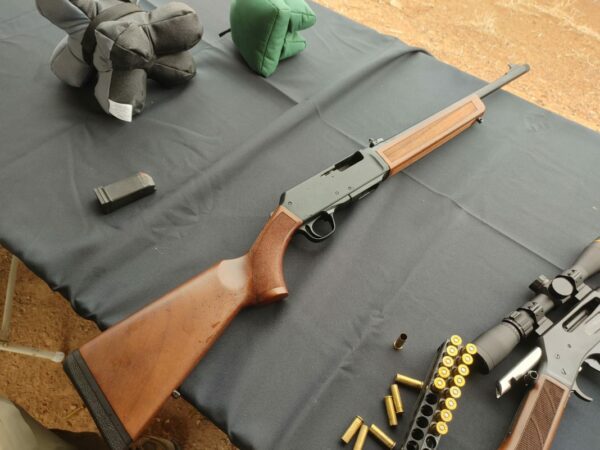
That’s right…Henry has released a semi-automatic 9mm carbine that has all the charm of a Henry rifle.
That charm is in the wood furniture and classic layout that makes me think of the early Marlin camp guns. It’s simple, but simple is good.
The Homesteader has the same beautiful finish you get on most Henry guns and it’s offset by what appears to be a stainless steel bolt. The gun is simple, but packs all the features of a more modern platform. It’s like a retromod take on a 9mm PCC.
Inside the Homesteader
The Homesteader is more than pretty wood furniture. The gun features a forward peep sight mounted to the barrel, which is quite fast and precise to use. I’m not sure if I’d prefer open sights for speed, and it would take more lead downrange to figure it out.
If you decide you want a red dot, the receiver is tapped and ready for a rail. The Homesteader features a tang safety reminiscent of the Mossberg 500 series shotguns more than bolt action rifles. It’s quick and easy to push and pull in and out of action.
In front of the trigger sits an ambidextrous bolt release. In front of the magazine sits an ambidextrous magazine release. It’s odd, but I feel like I could get used to it.
The magazines vary. Henry has five- and ten-round proprietary magazines, but the magwell is modular. You can get options to take (yes) GLOCK, Smith & Wesson M&P, and SIG P320 magazines. That’s a very smart move.
The barrel is threaded with the industry standard 1/2×28 threading for easy suppressor attachment.
The gun uses a blowback action, but they must be using some kind of tuning or a great recoil spring. You don’t have the same recoil you expect from blowback guns. It’s light and friendly, much like the Ruger PC Carbine with its dead blow blowback system. The Homesteader is a sweet shooter and had some real classic charm to it.
American walnut just appeals to me. This gun was a total surprise, but apparently, they briefly introduced it at NRAAM as a Friends of the NRA model. It flew under my radar, but no longer. Full review to come when we get our hands on one.
En Banc Fifth Circuit Denies Chevron Deference to ATF in Bump Stock Case
A majority of judges concluded the plain language of the statute does not apply to bump stocks, but they also would have denied Chevron deference had they found the statute ambiguous.
Today the en banc U.S. Court of Appeals for the Fifth Circuit held a Bureau of Alcohol, Tobacco, and Firearms regulation extending the federal prohibition on machineguns to “bump stocks” is unlawful, as Eugene noted in a post below. In Cargill v. Garland, the judges split 13-3 on the merits, and the 13 in the majority divided on the rationale. Eight of the judges concluded the statute is unambiguous. Five additional judges concluded that, insofar as the statute is ambiguous, it should be interpreted not to cover bump stocks under the Rule of Lenity.
One aspect of the opinion, that appears to be supported by half of the judges on the en banc court, is that even were the statute ambiguous, it would not merit Chevron deference because the agency had not relied upon Chevron. Seven additional judges further concluded that ATF should not get Chevron deference because the statute imposes criminal penalties and the ATF reversed its prior interpretation of the statute. (Judge Oldham joined the first part of the court’s Chevron discussion, but not the rest.)
I’ll take : Mostly what the local prosecutor thinks it is, for $500
What Does “Brandishing” a Gun Mean?
For the purpose of our discussion, brandishing is the unnecessary and unlawful display of a defensive firearm. The most important thing for everyone to understand is that the specific legal definition of brandishing may differ from state to state. For this reason, it is critically important for every defensive shooter to contact his local district attorney or a criminal defense attorney and get an accurate understanding of the local interpretation.
Even if there were no brandishing law, I would strongly advise against unnecessarily displaying the firearm. We shouldn’t be carrying a gun in order to try to impress people because it usually does not impress them. And we certainly don’t want to give the criminal any advance notice of what he is about to be up against because, now that he is forewarned, he might just simply change his tactics.
Our society requires us to let the criminal make the first move—which means that we are already behind if his attack is serious. It is far better to surprise him, and ruin his day, by drawing our gun when he thinks he has everything going his way. Drawing against an attacker who is armed with a deadly weapon, in the middle of his attack, is not brandishing….even if you don’t have to fire a shot.
In dealing with criminal attacks, we should establish mental triggers. Seeing a person with a knife in his hand is not going to cause me to shoot him. But my mental trigger is: “If he ignores my commands to drop the knife and comes close enough to strike me then I am prepared to take deadly action.” If he complies with my commands, or simply runs away, I see no need to shoot. But you can be certain that I will report the incident to law enforcement immediately.
It is important to realize that not every criminal attack is deadly in nature. And, while it is an attack, it may not justify the use of deadly force on the part of the armed citizen. Producing a firearm during an argument with an unarmed neighbor, for instance, may be a violation of the law. We should produce the defensive handgun only when our life is clearly in immediate danger, or the lives of our family.
Everyone’s personal defense plan should include plans for dealing with these less-than-lethal attacks. Training in martial arts, stick fighting, or the use of less lethal defensive tools such as pepper spray, are all important in protecting life and limb. Not every criminal encounter justifies the use of a firearm.
Understanding the law regarding brandishing is very important. Equally important is the need to develop one’s defensive skills so that we can act within the law and still protect ourselves. Knowledge of the law and professional training are the best armor that we can put on.
The National Association of Sporting Goods Wholesalers (NASGW) recently gathered in Kansas City, Mo., for its annual meeting and expo. This year, industry members enjoyed the opportunity to share and discuss new products in the works for 2023 without wading through often inconvenient COVID-19 restrictions or regulations. Here is a sneak peek at a few of the new models that will be heading out to local dealers in the near future.
For those whose eyesight is still good enough to let them use dots, this appears to be good advice.
I personally have almost completely switched to LPVO & 1X prism sights due to the degenerative effects of age and the capability of adjustable focus eyepieces to compensate.
As it is, the Steiner and Vortex LPVOs I have are of a size that co-witness of back-up iron sights is impossible, but I do have one AR ‘pistol’ with a prism sight that I will have to check out to see if this effect occurs.
PING! GARAND RIFLE PATENT TURNS 90
On Dec. 27, 1932, the U.S. Patent Office granted Patent Case File No. 1,892,141, for a Semi-Automatic Rifle to one John C. Garand. The rest is history.
Quebec-born Jean Cantius Garand, his name Americanized to John, grew up in Connecticut and learned to shoot after working at a shooting gallery after school as a kid. Working for the United States Bureau of Standards in Washington D.C. during World War I, he became a U.S. citizen in 1920 shortly after he began working at Springfield Armory, the Army’s small arms plant he would call home for 34 years.
His self-loading rifle project, incorporating several novel ideas, would go on to be adopted by the U.S. Army in 1936 as “U.S. Rifle, Caliber .30, M1” to replace several bolt-action models in the same caliber that the military had gone to war with back in 1917.
However, before all that, the patents had to be protected.
The 75-page patent application filled out and filed by Mr. Garand himself is so historical that it is on file and digitized in the U.S. National Archives. Filed in April 1930, it was endorsed by the Secretary of War with W.N. Roach, the Army’s Chief of the Patent Branch of the Ordnance Department, signing the drawing sheets and application forms as Garand’s attorney of record.
Kostas Moros
Associate Attorney at Michel & Associates Los Angeles
Represents California Rifle & Pistol Association
Yes, “assault rifle” has an actual meaning while “assault weapon” was more of a political invention (though there is some history of the gun community using the term before that).
But getting hung up on terminology is an unconvincing exercise. It’s also why I stopped caring
about correcting “clip” when someone means “magazine” (except when that person earnestly wants to learn) because it is beside the point.
Instead, our position should be that all semiautomatic* small arms should be legal to own, regardless of what grips or attachments or magazines come with them and regardless of what term, political or otherwise, is used to describe them. I don’t care if you call them a “weapon of war”. Good. The Second Amendment was indisputably meant to protect such small arms most of all, as the historical record proves.
I have to admit I roll my eyes when I hear “modern sporting rifle”.
Just say semiautomatic rifle. It’s useful for sport yes, but also personal defense, hunting, and of course, the core purpose of 2A – opposing tyranny. Own it. They are going to hate us either way.
*the logic applies equally to full auto small arms, but that’s a future battle. I don’t think this Supreme Court is striking Hughes down quite yet, hope I’m wrong.
19th century texts show us that access to “weapons of war” was seen as the core purpose of the 2A, even towards the end of the century when revolvers and lever-action rifles proliferated, which were orders of magnitude more capable than their predecessors.

Even those of the era that thought small weapons could be restricted nevertheless saw the 2A as protecting access to the arms of modern warfare.
This is a great intellectually honest video about the AR15.
And for what I mean by the use of the term “assault weapon” among the gun community, there are a few examples. This is from 1986.
Please check your baggage
Guns confiscated at US airports hit record levels
A record number of firearms was confiscated from US airport passengers in 2022, transport officials have said.
A total of 6,301 guns were taken at checkpoints as of mid-December – and of those 88% were still loaded.
The Transportation Security Administration (TSA) said it expects to confiscate 6,600 guns by year’s end – a 10% increase over 2021’s record level.
The agency said guns brought to airports consumes significant resources and is very costly for the passenger.
The number of guns found surpasses the previous record from just last year, when 5,972 firearms were detected.
Hartsfield-Jackson Airport in Atlanta, Georgia, had the highest number of recorded firearm stops, while Dallas/Fort Worth Airport in the state of Texas had the second highest.
No reason was given for why more people were attempting to clear security while carrying a weapon.
Gun possession laws vary by US state, but firearms are not allowed in the passenger cabin on an aeroplane, even if a passenger has a concealed weapon permit.
If TSA officials detect a weapon at a checkpoint, they issue a civil penalty that varies by number of previous offenses and whether the gun was loaded at the time.
The agency also said it is raising the maximum civil penalty for a firearms violation from $13,910 (£11,450) to $14,950.
Airline passengers can travel with firearms in a checked bag when they are unloaded and locked in a hard-sided case. Travellers must also tell airline representatives that they intend to travel with the weapon during check-in.
In April a US Congressman, Madison Cawthorn, was stopped attempting to bring a gun through security at the Charlotte Douglas International Airport in North Carolina, local police said. He admitted the weapon was his and cooperated with officers.
The TSA said it screened more than 2.5 million individuals nationwide on 27 November – the Sunday after the Thanksgiving holiday – marking the highest volume since the start of the pandemic.
There were an estimated 390 million guns in circulation in the US in 2018, according to figures from the Small Arms Survey – a Swiss-based leading research project.
Interesting comparisons

Dry fire – practicing without live ammunition – is an essential tool for every gun owner who wants to learn how to handle their firearms more proficiently. It saves time and money while remaining an effective training method whether you are interested in guns for a hobby, for self-defense, or for competition. While there are many books that describe specific dry fire regimens, they don’t always give you the information you need to use them best. That’s where The Dry Fire Primer comes in. It bridges the gap between “I’ve heard of dry fire” and “I’m going to be a dry fire maniac and use it to its greatest potential.” Whether you’re brand-new to dry fire or just feel like you could be getting a bit more out of it, this book is for you.
Speaking of the 10mm & Bears!
Wyoming Dentist Uses GLOCK 10mm Pistol to Stop Grizzly Attack
On October, 21, 2022, Wyoming dentist, Dr. Lee Francis, 65 years old, was hunting elk with his 40-year-old son, in the area near Rock Creek, in the Sawtooth Mountains, east of Bondurant, Wyoming.
In this video from KSAL-TV, he gives an interview and explains what happened. Dr. Francis is an avid hunter and outdoorsman. He successfully collected a large grizzly bear with a bow and arrow in 2013. Several attempts to contact Dr. Francis have been unsuccessful.
Dr. Francis had separated from his son when he unintentionally stepped in front of the entrance to a bear den. He saw the fresh dirt, had drawn his Glock 10mm, chambered a round, and was backing away when the bear charged at him out of the den from 10 feet away.
The best interview about the encounter appears to have been in an article at cowboystatedaily.com. The article says Dr. Francis used 130-grain hardcast bullets in his 10mm Glock.
“He came right at me, and he came on full blast,” the elder Francis said.
Counting the cartridge already in the chamber, he had 14 rounds loaded with 130 grain hard cast bullets in his Glock.
“I just remember shooting three or for times, right before he hit me,” he said. “Then I went down on my back.”…
Hard cast bullets will punch through a bruin’s body, instead of rapidly expanding and expending their energy in massive, shallow wounds
the way that hollow point bullets do, he said.“Hollow points are meant for stopping people, not bears,” he said, adding that it was also fortunate for him that his weapon was loaded
with hard cast bullets.“A hit from a hollow point would have probably just exploded my whole foot,” he said.
He also said he favors the high-capacity, semi-automatic Glock over magnum revolvers.
130-grain hardcast bullets for a 10mm would be unusual. Perhaps it is a typo or misreading of notes, where another weight of bullet was intended. Buffalo Bore has a 220-grain hardcast bullets loaded for bear in the 10mm.
Dr. Francis was attempting to fend off the bear with his feet when he accidentally wounded himself.
In the over 123 documented cases where pistols were fired in defense against bears, I recall only two where the person firing the pistol wounded themselves.
Coincidentally, both were with 10mm pistols. Both happened as the defender fell on their back and attempted to fend off the bear with their feet.
Smith & Wesson’s recent introduction of their Military & Police pistol in 10mm Auto is but the latest proof this caliber is undergoing a reasonably strong regeneration today. To understand why, let’s go back to the genesis of this Lazarus round.
A Brief History
In 1983, years of experimentation by Whit Collins and Col. Jeff Cooper had created the wildcat .40 G&A cartridge. The project came to fruition with the introduction of the Bren Ten and its new 10mm Auto cartridge, first produced by Norma. Produced by Dornaus & Dixon (D&D), the Bren Ten was a scaled-up version of a European 9mm pistol which had gained the colonel’s favor in almost every respect save caliber — the CZ 75, a selective-system double-action pistol that could also be carried cocked and locked. The Bren Ten even bore the raven logo of Col. Cooper’s school, Gunsite.
It had the load Cooper specified — a .40-caliber jacketed truncated cone bullet with an overall cartridge length much like the colonel’s beloved .45 ACP, stoked to a ferocious 1,200 feet per second. Chamber pressure was approximately 38,000 pounds per square inch. The colonel proudly noted the 10mm had as much energy at 100 yards as the .45 ACP did right out of the muzzle.
D&D, perhaps undercapitalized, did not last long. Guns were shipped without magazines when the subcontractor didn’t come through with them on schedule. The company was taking orders with full price to be paid in advance and many shooters were smart enough not to fall for it. When Dornaus & Dixon went out of business, it looked as if the 10mm Auto was “out of business” too.
The Range Access Act Would Bolster Public Lands and Gun Rights
As more Americans purchase firearms, opportunities to access shooting ranges on public lands should be expanded.
A newly-introduced House of Representatives bill aims to bolster public range access for new and returning recreational shooters.
Congressman Blake Moore (R-UT) introduced the timely Range Access Act to “require the U.S. Forest Service (USFS) and the Bureau of Land Management (BLM) to ensure that each qualifying National Forest and BLM district” designate—at a minimum—one public recreational shooting range without charging a user fee.
The U.S. Department of Agriculture, which manages the USFS, states some ranges located on National Forest lands impose usage fees.
“This legislation is an important step in expanding access to recreational shooting practice. Americans from coast to coast love spending time in the outdoors, and expanding our ability to recreate on and enjoy our public lands is one of my core focuses in Congress,” said Congressman Blake Moore in a press release. “The Range Access Act would establish free shooting ranges for sportsmen to safely participate in target practice while supporting our wildlife conservation and local economies.”
The legislation also received praise from the nation’s preeminent shooting sports and conservation organizations.
“The National Shooting Sports Foundation commends Congressman Blake Moore for introducing this vitally important legislation to increase access for the public to practice marksmanship at safe recreational shooting ranges,” said Lawrence G. Keane, National Shooting Sports Foundation (NSSF) Senior Vice President and General Counsel. “This legislation, which would require the U.S. Forest Service and Bureau of Land Management to have at least one qualifying recreational shooting range in each National Forest and BLM district, is crucial to ensuring safe public recreational shooting. Congressman Moore’s bill would also benefit conservation by reducing pollution at non-dedicated ranges on federal public lands while also generating additional Pittman-Robertson revenue.”
Gun control activist wants Glocks re-classified as machine guns
Not just Glocks, actually. The Violence Policy Center’s Kristen Rand (and a lot of other gun control activists) want the ATF to broadly reclassify semi-automatic firearms as machine guns, and it’s an idea that will likely gain more traction in the gun control lobby if Republicans take back one or both chambers of Congress in the midterms. With no chance of new gun control laws passing on Capitol Hill and the Supreme Court likely to undo some of the existing infringements already on the books, the White House and the executive branch agencies are going to be one of the only places where groups like the VPC can expect to find any traction, and they’re aiming big.
Rand’s argument (one that the gun control group Brady has also made in a recent lawsuit) is that many models of semi-automatic firearms are “readily converted” into machine guns, which would subject them and their owners to the provisions of the National Firearms Act.
As evidence, Rand and others point to the increase in the number of firearms recovered by police that have been illegally adapted with auto sears or switches that enable the guns to fire continuously. The Chicago Sun-Times reports that last year police in the city recovered more than 300 firearms that had been illegally modified to full-auto, and lays out in detail the struggles that law enforcement have in trying to combat their growing popularity among the city’s criminal class. The switches are small and easily available, both from online shippers who sent the switches from China and those who make their own on 3D printers, which is why Rand says the focus should be on the guns themselves.
In July, Democrats in the U.S. Senate introduced a bill to establish “a coordinated national strategy to prevent or intercept the importation and trafficking of automatic gun conversion devices.”
“Gun violence is an epidemic, and lawmakers must do all we can to combat this horrific threat — including by stopping the flow of illegal gun-modification devices into our society,” says U.S. Sen. Gary Peters, D-Michigan, a lead sponsor.
With switches, though, the effort might be too late, says Kristen Rand, government affairs director for the nonprofit Violence Policy Center, which advocates for gun control. She says concentrating on the devices is “probably a lost cause.”
“The focus should be on why so many firearms are so easily converted to full auto,” Rand says, noting that Glocks and other guns can easily be modified. “Manufacturers must bear some of the responsibility to design their guns to be more resistant to conversion.”
From 2018 through late September, 643 of the 706 modified automatic weapons recovered by the Chicago police were Glock handguns, records show.
A spokeswoman for Glock didn’t respond to questions or interview requests.
Rand says ATF should consider using its authority to reclassify certain types of firearms that are easily converted into fully automatic weapons. Other firearms besides Glocks also are “readily convertible” into machine guns by machining or adding a few parts, she says.
“ATF should be looking at using their existing authority to classify some of these firearms as ‘machine guns’ as they did in the 1980s with the KG-9, MAC-10 and STEN,” Rand says. “This is a classic example of how the gun industry escapes responsibility for problems of their own making.”
If concentrating on the switches is a “lost cause” then so is focusing on the gun. After all, we’re talking about hundreds of millions of firearms that would fall under the type of re-classification Rand and other anti-gun activists would like to see from the ATF. But for Rand and other anti-gun activists, that’s not a bug, but a feature. In fact, the more guns that are re-classified the better.
At best the vast majority of U.S. gun owners would have to register their guns with the federal government and pay a $200 per gun fee or else become a criminal subject to ten years in an federal prison for possession of an unregistered machine gun. At worst, the Biden administration and Attorney General Merrick Garland could argue that since the Hughes Amendment prohibits the registration of any machine gun made after 1986, tens of millions of Americans need to hand over their legally purchased and lawfully owned pistols and rifles. Either one would be the most significant victory the gun control lobby has ever achieved, though one that would face an immediate court challenge.
The Supreme Court has already declared that arms that are in common use are, prima facie, protected by the Second Amendment. Only those arms that are dangerous and “unusual” fall outside of the Second Amendment’s protections, and it’s hard to argue with a straight face that semi-automatic firearms aren’t in common use for a variety of lawful purposes. I have no idea what would happen if “readily converted” meets “dangerous and unusual” inside the Court’s chambers, but if the gun control lobby gets its way we’re all going to find out soon enough.
THE AYOOB FILE
READERS KNOW MASSAD AYOOB AS A WRITER, BUT HE’S ALSO A LEADER
American Handgunner and GUNS Magazine readers have known Massad Ayoob over the years for his insight and careful analysis of self-defense incidents, and for his several books on the subject, but there’s another side of this multi-talented fellow with the deep voice and New England accent.
He also serves as president of the Second Amendment Foundation, a gun rights organization that has become the national leader in firearms litigation. It’s also where I hang my hat as editor and communications director. It was a SAF case — McDonald v. City of Chicago — which won a Supreme Court ruling that incorporated the Second Amendment to the states via the 14th Amendment. It is SAF, sometimes with national and/or local partner organizations, which now has nearly 40 active lawsuits challenging restrictive gun control laws across the states.
And it is SAF, along with the Citizens Committee for the Right to Keep and Bear Arms, which annually sponsors the Gun Rights Policy Conference. This year, the event was in Dallas, Texas, and it was Ayoob — a pal of mine for decades — who delivered opening remarks and later on the agenda, some timely and important tips on how to win the “gun battle.”
Suffice to say, Ayoob did it with a style all his own; a bit of activist, some diplomat, a dash of cop humor and a heavy dose of reality.
It’s not just that I can’t afford even one of the guns. I can’t even afford the ammo he went through. And you do not shoot reloads, but ammo especially made for them.
This was taken at the ‘Big Sandy’ shoot where a course of fire is shooting at a remote controlled toy plane.