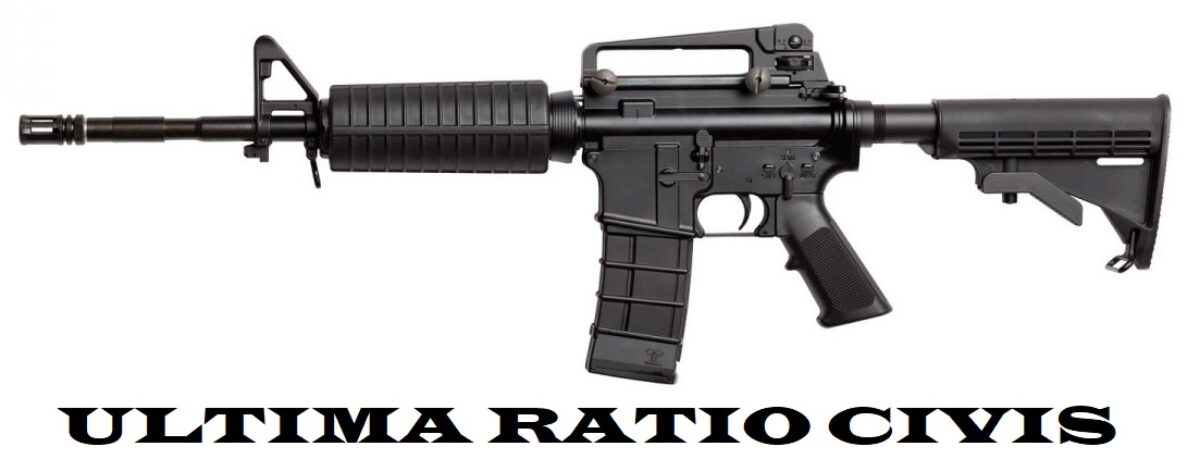
Take out “The” and  “of ‘assault weapons’” and it would still be right.


The Reality of ‘Assault Weapons’ is Far Too Boring and Inconvenient for the Media.

We’re hearing a lot of claims and counter-claims about modern sporting rifles right now. While these “modern” guns are more than half a century old, honest gun owners still buy and use them every day. Occasionally, criminals use them as well, but that’s rare. About one-out-of-eight gun owners have a modern sporting rifle today. And as we’d expect, rifles are used in armed defense situations about an eighth of the time.

Semi-automatic, magazine-fed rifles were introduced to the civilian market here in the US in 1905. The US military adopted them about three decades later for use in World War II.

The civilian version of the modern sporting rifle, the AR-15, was introduced in 1956 so it has been with us for over six decades. In addition to its low recoil and plastic stock, the AR platform’s real innovation is its modularity. The AR can be adjusted to fit people of almost any stature in seconds, which is why it’s so popular. It’s the gateway rifle, the volksgun. I think that is why the democrats want it banned.

Here are two recent news stories that involve the use of a modern sporting rifle . . .

Homeowner with an AR stops two home invaders
It was mid-morning when a homeowner in Brownsboro, Texas heard the sounds of breaking glass coming from inside his home. The homeowner grabbed his AR rifle and went to see what was happening. The homeowner saw two strangers in his house. The defender told the intruders not to move. The second intruder, a female accomplice, ran away. The defender let her go and called 911.

Police arrested the male intruder. The homeowner pointed out the broken glass near his front door. Police arrested and searched the neighborhood for the second robber.

The defender was not charged with a crime.

The homeowner never pulled the trigger as he defended himself. That’s the usual outcome and happens in over 80 percent of defensive gun uses. There are exceptions, of course.

Woman with concealed carry license stops felon with an AR
A woman with a concealed carry permit was attending a graduation/birthday party at an apartment complex in Charleston, West Virginia. The party had spilled out into the parking lot with about 40 people at the celebration. At about 10 at night, a man drove through the parking lot and people shouted for him to slow down.

The driver took offense and came back a half hour later. He climbed into the back seat of his car and started shooting at the crowd with an AR rifle. The woman shot back several times, stopping the attacker in what would have been a mass shooting. No one else was injured.

She called 911 and remained at the scene. Emergency medical services declared the shooter dead from multiple gunshot wounds. The attacker was a convicted felon with a long criminal record. Police are investigating how he got his firearm.

Gun control laws don’t stop criminals from acquiring and using guns. They never have. But there is more we can learn from these two news accounts. AR rifles don’t turn honest homeowners into enraged murderers and they don’t make criminals into unstoppable killers. Modern sporting rifles are actually mundane. And as we’d expect, our neighbors only use lethal force as a last resort.

The reality is, however, that honest reporting about ordinary citizens defending themselves doesn’t make much money for the mainstream news media. They find it more clickworthy to say that a particular piece of steel, plastic and aluminum is horribly frightening and unusually deadly. Apparently that’s the only thing that keeps us watching through the commercials.

When Shootist Ken Jorgensen was still with S&W, he brought one, likely a preproduction model, out to the 2003 Shootists Holiday. Most people who accepted the opportunity took 1 shot and with compliments quickly handed it back to Ken.

Ich Bin? Are you kidding?

With Dad owning a .500 Linebaugh and I having shot full power loads several times through it, why, shooting this hugemongeous revolver should be a cake walk and if the cylinder of this monster had 5 holes in it to hold 5 cartridges, I was gonna shoot it 5 times, and I did.

Did I say ‘cake walk’? Au contraire mon ami!

Rubber grip material was imbedded in my palm, taking several days to finally work out, and for about 2 months afterwards, if I shot anything more powerful than a 9mm pistol, my 2nd metacarpal (the bone behind the knuckle of the trigger finger) of my left hand – me being one of those sinister southpaws – ached for a couple of hours. The consensus being that I had a slight stress fracture that even an X-ray couldn’t detect.

Yeeowsa, that qualifies as a hand cannon.


500: The Smith & Wesson Gun That Is More Like A Mini-Cannon

Sure, the Smith & Wesson Model 500 is a monster of a gun and not exactly a great gun for concealed carry or a popular semi-automatic like Sig Sauer or others. And yet, this big revolver has an even bigger fan base: The Smith & Wesson Model 500 is one impressive weapon. At this point, it’s become almost as much of a classic as Ruger’s 10/22 semi-automatic rifle!

If you’re looking for one of the most accurate, reliable, and durable handguns on the market today, you won’t be disappointed with the Model 500. It’s made by one of the world’s most reliable manufacturers and backed by the S&W Lifetime Service Policy.

The specific sights you get with the Model 500 depend on the specific pistol you get. The Model 500 Magnum, for example, comes standard with an interchangeable HI-VIZ front sight and adjustable rear sight. These sights are perfectly adequate for my needs, but there is a huge variety of additional sights available to meet the goals of nearly any shooter.

Some models even include a Weaver rail mount instead of standard sights for mounting all kinds of scopes and optics. Just like Colt has improved their popular Python model to keep up with the needs of modern shooters, S&W has upgraded the 500 to do the same.

For one, Smith & Wesson recently developed the innovative “x-frame” to give you a better grip and help to handle the recoil that comes along with the immense power of this handgun.

This makes the 500 very comfortable to handle, and even features a recoil-absorbing rubberized grip complete with finger grooves to let you hold the gun at an angle that allows for optimal control and accuracy.

Another upgrade that S&W recently made to the Model 500 is an improved barrel design. This new design features a rifled tube inside of the barrel, which makes it shoot even cleaner and quicker than it did in the past. Since this handgun is so powerful, recoil is not exactly light. It’s also a pretty top-heavy pistol, which gives it even more of a kick.

Continue reading “”

The SiG Board of Directors is going to be stacked with Generals in the coming years.
Personally, even in .300 Blackout, without a suppressor on it, I wouldn’t want to be near one of these little fireball makers.


SOCOM finally found its next-generation personal defense weapon

After years of searching, U.S. Special Operations Command (SOCOM) has picked Sig Sauer to provide its next personal defense weapon for U.S. special operations forces.

On Thursday, SOCOM released a notice of intent to award a five-year fixed firm price contract to the firearms manufacturer. The new personal defense weapon of choice for SOF troops? The Sig Sauer MCX “Rattler,” which can be chambered in both .300 Blackout and 5.56mm calibers.

“After years of continuous market research, USSOCOM HQ has concluded that Sig Sauer is the only vendor that can fulfill USSOCOM’s need for the Commercial PDW requirement. USSOCOM HQ has been researching and reviewing different systems since 2017,” the notice of intent said. “We have meticulously reviewed each system for technical acceptance and whether it fits the commercial definition. Except for Sig Sauer, the vendors did not meet the technical requirements and/or the weapons do not meet the commercial definition.”

The size and cost of the order were not disclosed.

SOCOM started its hunt for a new personal defense weapon in 2017, hoping to get a new weapon built around the M4 carbine’s receiver, giving SOCOM operators more firepower while still being compact and portable. The command procured 10 Rattlers in 2018 for testing and evaluation, but kept its search going, issuing another search for weapon system designs in 2019. The goal was to find a new PDW with “a highly concealable .300 Blackout upper receiver group (URG) and buttstock kit solution for the M4A1 platform.”

Turns out that, after all of that searching, it was back to the MCX Rattler. SOCOM noted that requirements meant no prototypes or weapons were in limited development, and Sig Sauer’s new weapon fit the bill for rapid fielding.

“The PDW system will allow Operators to have maximum firepower in a concealable weapon,” SOCOM said in the notice. The order will include the guns themselves plus suppressors, magazines and cleaning gear, plus additional parts and training on the new platforms.

It’s worth noting that .300 Blackout round is designed to be quieter than regular ammunition, while still being powerful, and that personal defense weapons are meant to provide more firepower than a pistol while being much more portable and compact than carbines or rifles, making them ideal in close-quarters scenarios.

Sig Sauer has called the MCX Rattler its most “discreet platform,” and the 5.5-inch barrel certainly makes it short. The MCX Rattler is also designed to quickly switch between the types of ammunition.

The pick by SOCOM was another major contract for Sig Sauer, which previously snatched up high-profile (and lucrative) contracts for the Pentagon-wide Modular Handgun System contract and Army’s Next Generation Squad Weapon rifle and automatic rifle variants.

It’s unclear when the Sig Rattlers will go into the field with SOCOM operators, or if some of the initial orders are already in use.

Vermont: Suppressor Hunting Bill Passes Legislature

Read more: https://www.ammoland.com/2022/05/vermont-suppressor-hunting-bill-passes-legislature/#ixzz7T5bejBWa
Under Creative Commons License: Attribution
Follow us: @Ammoland on Twitter | Ammoland on Facebook

[Yesterday] morning, the Vermont State Senate passed an amended version of S. 281 – legislation that includes a provision to make The Green Mountain State the 41st state to allow the use of suppressors while hunting. The suppressor hunting language, which was championed by Representatives Pat Brennan (R-Chittenden-9-2) and George Till (D-Chittenden-3), was added to S. 281 during the floor debate in the House of Representatives and subsequently passed on May 10th. The bill now heads to Governor Phil Scott (R-VT) for his signature. Once enacted, the new law will take effect on July 1st.

“It is my pleasure to announce that with today’s passage of S. 281, the legislature has taken a tremendous step forward towards expanding the right of hunters to use suppressors in the field,” said Rep. Brennan, Co-Chair of the Vermont Legislative Sportsmen’s Caucus. “For the past seven years, law abiding citizens in Vermont have enjoyed suppressor ownership, but their use has been restricted to sport shooting at ranges only. With the passage of S. 281, Vermont outdoorsmen and women finally have the ability to protect their hearing and the hearing of the youth hunting community as well. This bill was a long time in the works, but it has finally come to fruition thanks to the cooperation of many, most especially the Department of Fish and Wildlife and its Commissioner.”

The American Suppressor Association has been fighting for suppressor rights in Vermont for a decade. Over the years we have helped draft legislation, provided written and verbal testimony, and hosted multiple live-fire suppressor demonstrations for legislators, law enforcement officers, and the Vermont Fish and Wildlife Department. In 2015, legislation introduced by Rep. Brennan legalized the ownership of suppressors in the state, but not their use in the field. Today’s passage of S. 281 brings us one step closer to full suppressor legalization nationwide.

“What Representatives Brennan and Till have accomplished is nothing short of extraordinary,” said Knox Williams, President and Executive Director of the American Suppressor Association. “It highlights the value of hard work, persistence, and bipartisanship. There should be nothing controversial about protecting hearing. We could not have asked for better partners in the fight for your suppressor rights.”

BLUF:
They’re not a bad round to carry in a snubbie

PRMRRU-2021Ballistic-test-compressed

Snubnose Revolver Ballistic Gelatin Tests

When I was a kid back in the early 1980s, my parents had some rural land where we spent weekends hiking, hunting, and shooting guns.  A man up the road from my parents’ place was a well known “gun guy.”  He shot constantly and often offered to let young Greg shoot all his cool guns.  One day my Dad and I were visiting him and I saw a gun on his kitchen table that I hadn’t seen before.  I asked if I could look at it.

The man knew I was a safe gun handler, even at my young age.  He said “It’s loaded.  It’s a Smith and Wesson revolver.  You know how to unload it.  Point it towards the ground, unload it, and then you can check it out.”

I took it out of the leather belt holster and carefully unloaded it.  It turned out to be a two-inch Smith and Wesson Model 10 round butt.  It was loaded with target wadcutters.  I knew what the bullets were because I bought a $5.00 box of wadcutter reloads at the local gun shop to shoot in my Smith and Wesson Model 19 every weekend I visited my parents’ rural property.

Even at age 14, I knew that wadcutters were target loads.  My dad’s police revolvers were all filled with the “Treasury Load” 110 grain +P+ jacketed hollowpoints that were in vogue at the time.

The man explained that this was the gun his wife carried when she walked around in the woods on their property.  I asked him about why it was loaded with wadcutters.  He explained that most hollowpoint .38 ammunition didn’t expand well out of two-inch barrels.  He said that the wadcutters would penetrate deeply, would cut a sharp hole, and had mild recoil.

He then made the statement: “Out of a short barrel, the wadcutters perform better than the hollowpoints.”

Internally, I laughed.  Everyone knew hollowpoints were better for defensive use than target wadcutters.

Continue reading “”

First prosecution of San Diego’s “ghost gun” ban shows how worthless the law really is

San Diego, California is one of several cities in the state that have banned the possession of “ghost guns” in recent months. Anyone caught with an unserialized firearm in the city is now subject to criminal charges, but the first case to actually get to the sentencing phase is a perfect demonstration of just how useless the new ordinance really is.

The ordinance, authored by San Diego Councilmember Marni von Wilpert (a name that sounds like it would also be good for a Disney villain), in essence mirrors existing California law, which already prohibits the possession of an unserialized firearm. The San Diego ordinance specifically creates a misdemeanor offense to possess or sell any firearm that does not have a serial number on it, which is supposed to make criminals think twice about carrying a home-built gun around. As of March of this year, the law wasn’t having any impact on violent crime, with homicides up 80% compared to the same time period in 2021 and 77 unserialized firearms seized by police. There were also 295 serialized firearms seized by police, which is another sign that going after “ghost guns” isn’t going to stop the individuals committing the shootings in the city.

But none of that matters to the virtue-signaling politicians in San Diego, including von Wilpert, who are instead now eagerly singing the praises of the “ghost gun” ordinance now that someone’s been sentenced for violating the law.

“The city’s novel ghost gun ordinance is an effective tool for removing untraceable firearms from the hands of criminals,” City Attorney Mara W. Elliott said. “We thank Councilmember Marni von Wilpert for bringing forward this ordinance, which keeps San Diego at the forefront of our nation’s battle against gun violence.”

… “It’s clear from this conviction that San Diego’s landmark ghost gun law is starting to work to stop the proliferation of dangerous, untraceable firearms in our community,” said von Wilpert.

Is it though? I realize I haven’t actually said what the sentence the defendant received here, so let’s delve a little deeper into the events that led to 23-year old Rene Orozco having the dubious distinction of being the subject of a press release by the city attorney.

Orozco’s arrest apparently didn’t make the news at the time, but according to the Elliott’s account he was arrested after fleeing from police and leading them on a car chase through San Diego’s City Heights neighborhood, allegedly tossing the unserialized gun as he then continued to try to elude officers on foot.

Would Orozco would have avoided arrest and prosecution if the gun he’d been caught with had a serial number? Of course not. So what exactly is the point of a misdemeanor charge for possessing a “ghost gun” when he could already be charged with illegal possession of a weapon for simply having a gun in the first place. Then there are the charges of eluding police, tampering with evidence, and any number of traffic misdemeanors that were committed during the police pursuit. But the City Attorney needs to show that this new ordinance is working, and so Orozco was charged with having a ghost gun, and now gets to experience firsthand the draconian punishment that will surely cause him to rethink the decisions he made.

He was sentenced last week to 45 days in custody and one year of probation. As a result, his driver’s license will be suspended from six months and he is prohibited from owning firearms for a year.

45 days in custody with good credit time means that Orozco will likely spend about three weeks in the county lockup, which doesn’t sound like much time considering how scary “ghost guns” are supposed to be. And again, he could have gotten that same sentence just by charging him with misdemeanor crimes in California state statute that have nothing to do with unserialized firearms. What’s the point?

San Diego’s “ghost gun” ordinance is pure political theater; designed to have an impact on the electorate, not armed criminals. As long as politicians like von Wilpert can convince constituents that she’s “doing something” to address their fears about violent crime, she doesn’t have to bother coming up with doing something that actually works. And in California, “doing something” means putting another gun control law on the books that at best is worthless, and far too often ends up harming the law-abiding instead of curtailing violent criminals.

Well, .277 Fury basically duplicates 270 Winchester (130/135 gr bullet @ 3,000 fps) specs in a smaller length cartridge in a rifle with a shorter barrel. And the rifle is a SiG MCX Spear, so….?


How good is Army’s new gun? We don’t know

XM5 Rifle on display at the Pentagon.

There are a lot of people who look to the United States Armed Forces for a certain degree of guidance on weapons. If the Army uses it, they’re more than happy to pick up the civilian version of the weapon. After all, the military does test their weapons fairly extensively–though that testing has been interesting in the past.

Still, a lot of people trust it.

Now, the Army is looking at a new rifle. However, as Military.com notes, there are questions that we simply can’t get answers to.

The new guns and ammunition the Army just married and is expected to issue to combat arms units within the next decade will require soldiers to carry an even heavier load.

But information on how those weapons should outperform the guns they’re replacing — the justification for troops to shoulder extra weight on top of mountains of gear already injuring soldiers — is classified.

In April, the Army announced that Sig Sauer will produce replacements for the M4 rifle and M249 Squad Automatic Weapon, or SAW, starting with a trial run of about 40 new guns late next year. Production is expected to ramp up when the Army opens a new ammo plant to produce the new 6.8mm rounds for those weapons around 2026.

Army officials have touted that the new XM5, the M4’s replacement, and XM250, set to replace the SAW, pack a much harder punch and will improve the combat performance of ground troops. But thus far, the service has declined to disclose evidence that those weapons outperform the M4 and SAW, including how far they can shoot accurately. And it’s unclear whether the Army has verified the ranges at which those new weapons can engage an enemy before committing to a multimillion-dollar contract.

Throughout history, the average a soldier carried was about 55 lbs. The Roman legionnaire? About 55 lbs. The medieval man-at-arms? 55 lbs.

And so on through history.

Yet, these days, loads of 150 lbs aren’t exactly uncommon. That’s three times the amount troops historically carried.

Granted, we have a lot of technology that helps make those troops much more effective than those of bygone eras had, but someone still has to carry it.

So now they’re going to have to carry even more?

That might make sense if the new weapons are that much more effective, but are they? We know that 6.8 tends to have more of a punch. It looks like accuracy is about the same.

Yet that’s just the ballistics of the round itself. We don’t know if the weapons make good use of that potential or not, which doesn’t really make that much sense to me.

I get keeping at least some of your capabilities classified, but our enemies have long known just how accurate and powerful our various firearms were for years. We openly published this information and the civilian-legal versions of the same rifles backed that information up.

So why is this version classified?

Truth be told, I don’t like it, but I’m not overly worried. While I can’t help but raise my eyebrow at Sig being the provider of both the sidearm used by the military and now the primary weapon system for the Army, the truth is that Sig produces good weapons, as a general rule. It’s unlikely the guns actually suck or anything.

Still, for people who know about firearms, the idea of our troops potentially going into harm’s way with a weapon we know so little about is a point of concern. After all, this is still the Department of Defense. Anyone familiar with the development of the Bradley knows just how that can go.

Then again, since this is basically a variant of the Sig MCX platform, we shouldn’t worry too much.

That doesn’t address the weight issue, though. Our guys are already carrying too much weight as it is. The additional weight from switching from 5.56 to 6.8 for the same number of rounds is something that might end up being too much.

Not even if you paid me to hold it for a picture.

So You Found a Gun in a Public Restroom – – Now What?

GONE TO DROP TROU AND FOUND A GUN IN A PUBLIC LAVATORY? HERE ARE THE INS AND OUT OF SAFELY ADDRESSING THE SITUATION.

Finding a firearm in a public restroom is unfortunately not as uncommon as you may think and with CCW increasing across the board, it’s something you may come across yourself.

The problem starts when someone has to drop trou outside their home. The vast majority of on-person pistols ride in holsters that attach to a pants belt, regardless if it’s designed for inside- or outside-the-waistband. Many of these holsters don’t have positive retention, especially the soft-sided IWB variety, and rely on the pressure between your belt and your body to keep it in place. Sometimes this means a pistol flops when pants come off.

Consequently, some people remove their guns (with or without the holster) while they do their business to prevent it from falling onto the hard tile floor. So they take that pistol and place it on a toilet tank, commercial toilet paper holder, or even hang it on the hook on the back of the stall door. And forget about it. This is especially common with new or infrequent carriers. This article covers the mechanics of what you should do when carrying in public restrooms.

We know that some will be surprised one could be so mindless as to forget a Stacatto in a stall, but people leave their children accidentally in the back of cars all the time.

If you find a gun in a public bathroom, let’s talk about what to do.

Continue reading “”

First Look: Walther PDP F Series
Created with over a century of engineering & precision to specifically work with a woman’s hand.

Walther PDP F Series

New from Walther is the PDP F-Series of pistols, designed for female shooters who want the versatility, dependability and effectiveness of the Walther PDP, but in a package specifically designed around their unique needs.

The new F-Series is built to meet the demands of female shooters. Walther has completely re-engineered the ergonomics of the grip to be designed for the exact biomechanics of women’s hands. The new, patented operating system of the PDP F Series reduces the amount of force needed to operate the slide. In addition to this, the new PDP F Series has a reduced grip circumference and trigger reach. F Series pistols retain other features from the PDP lineup including compatibility with holsters for both the full and compact size PDP, as well has compact PDP magazine compatibility and are red-dot ready, right out of the box. When paired with the other  performance features of the original PDP, it means the F-Series pistol is the great choice for all women who are interested in the shooting sports.

Walther Shooting team member, Olympian and Firearms Instructor Gabby Franco had this to say about it, “The PDP F-series is the result of a revolutionary approach to creating a pistol with female shooters in mind. Walther Arms took the difficult task of developing a mid-sized frame handgun that offers high ammo capacity with a smaller grip, shorter trigger, and excellent ergonomics like no other. The F-series is the best tool in the market for self-defense, law enforcement, target shooting, and competitive shooting. It makes me proud to be part of a project to bring a pistol that contributes to many women’s quests to become better shooters.”

PDP F Series Specifications

  • Caliber: 9mm
  • Barrel Length: 3.5 or 4 inches
  • Slide Length: 6.5 inches
  • Trigger Pull: 5 pounds
  • Magazine Capacity: 15 + 1 rounds
  • Magazines Included: 2
  • Sights: White Dot Adjustable

MSRP for either the 3.5 or 4 inch barrel version of the PDP F Series is $699, and more information on these pistols and other products from Walther can be found at waltherarms.com.

AK is pleased the 24 is still popular:

Combinations in Pairs: Two Savage 24s


THE OLD DO-ALL COMBO GUN: SAVAGE MODEL 24 REVIEW

Not sure whether to take a rifle or shotgun afield? That’s where combination guns come into play –that is, rifle/shotgun duos. None have been as accessible, affordable, and reliable over the years as the utilitarian Savage Model 24. Here’s why the little double holds a special allure to those who fire, collect, or otherwise adore them over 80 years after their introduction.
MEET THE SAVAGE 24

An over-under shotgun/rifle combination? Yes, please. The Model 24, available in a laundry list of chambering options, has never been more sought after than it is now, almost 85 years after its initial introduction. Remember the aptly named Stevens Model 22-410? The same year that double went out of production, Savage’s Model 24 was born.

Savage Model 24
The Savage Model 24 offered a versatile hunting platform that gave shooters the choice between shotgun and rifle barrels in the same gun. (Photo: Kristin Alberts/Guns.com)

The basis of the combination gun is a standing-breech, break-action system with a rebounding hammer. Naturally, the first was a .22 short, long, or long rifle barrel over a .410 bore. Weighing some 7 pounds and measuring only 41 inches, the combo solved the problems of whether to bring a rifle or shotgun afield, adding the best of both worlds into one handy platform.

Continue reading “”

M&P 15/22s Banned At Appleseed Events After Out Of Battery and “Run Away” Discharges

While I can’t seem to tear myself away from Bearing Arms long enough to head west to the home range at Ramseur as much as I would like, I am still an instructor at Project Appleseed. In my opinion, it offers some of the best positional rifle marksmanship training you can obtain anywhere for the price, and you’re treated to an incredible civics lesson with the cost of admission. I highly recommend it to everyone.

A warning was issued a short time ago on the Appleseed instructor forum that the popular Smith & Wesson 15-22 is banned from Project Appleseed events nationwide after a series of out of battery discharges recorded at several events.

I’m not going to embellish or sugarcoat anything for you; this is the notice, as it was written.

To: All Appleseed Instructors

Subject: TEMPORARY BAN ON SMITH & WESSON M&P 15/22 USE AT APPLESEED

EFFECTIVE IMMEDIATELY, THE USE OF SMITH AND WESSON M&P 15/22’S AT AN APPLESEED IS HEREBY BANNED UNTIL SMITH & WESSON FORMALLY INVESTIGATES THE PROBLEM AND ISSUES AN OFFICIAL CORRECTIVE ACTION. THE AOC WILL NOTIFY THE CADRE WHEN THIS BAN IS LIFTED.

The AOC has received a rash of reports regarding safety issues with the Smith & Wesson M&P 15/22, including a shooter getting injured as a result of an out-of-battery discharge (see reports below).

As responsible Instructors, we have a duty to maintain safety at our events. If we know a rifle to be potentially unsafe, we shouldn’t allow it on the line at all.

At this time the least risk course of action would be to exclude the Smith & Wesson M&P 15/22 from future events until Smith & Wesson formally investigates the problem and issues an official corrective action.

Continue reading “”

There’s an old joke:
Want a 5.56 NATO chamber? Fire 1000 rounds through your .223.
Nowadays, it’s less expensive to just have the throat reamed.


.223 Remington vs. 5.56 NATO: What You Don’t Know Could Hurt You

Is firing a 5.56 NATO cartridge in your .223 Remington chambered AR15 dangerous? Or do Internet forum-ninjas and ammunition companies selling you commercial ammo instead of surplus overstate the dangers?  Believe it or not, a real danger exists, and some gun owners who think they are doing the right thing may not be safe.

The Cartridges

The .223 Remington and 5.56×45 NATO cartridges are very similar, and externally appear the same.  But there are some differences that lie beneath the surface.

The 5.56 case has thicker walls to handle higher pressures, meaning the interior volume of the case is smaller than that of a .223.   This will alter the loading data used when reloading 5.56 brass to .223 specs.

Some 5.56 loads have a slightly longer overall length than commercial .223 loads.

The Chambers

The significant difference between the .223 Rem and 5.56 NATO lies in the rifles, rather than the cartridges themselves.  Both the .223 and 5.56 rounds will chamber in rifles designed for either cartridge, but the critical component, leade, will be different in each rifle.

The leade is the area of the barrel in front of the chamber prior to where the rifling begins.  This is where the loaded bullet is located when a cartridge is chambered.  The leade is frequently called the “throat.”

On a .223 Remington spec rifle, the leade will be 0.085”.  This is the standard described by the Sporting Arms and Ammunition Manufacturers’ Institute, Inc. (SAAMI).  The leade in a 5.56 NATO spec rifle is 0.162”, or almost double the leade of the .223 rifle.

A shorter leade in a SAAMI spec rifle creates a situation where the bullet in a 5.56 NATO round, when chambered, can contact the rifling prior to being fired.  By having contact with the rifling prematurely (at the moment of firing), chamber pressure can be dramatically increased, creating the danger of a ruptured case or other cartridge/gun failure.

The reverse situation, a .223 Rem round in a 5.56 NATO gun, isn’t dangerous.  The leade is longer, so a slight loss in velocity and accuracy may be experienced, but there is not a danger of increased pressures and subsequent catastrophic failure.

How serious is the danger of firing 5.56 ammo in .223 guns?  Dangerous enough that the SAAMI lists 5.56 military ammo as being not for use in .223 firearms in the technical data sheet titled “Unsafe Firearm-Ammunition Combinations.”

ATK, the parent company of ammunition manufacturers Federal Cartridge Company and Speer, published a bulletin entitled “The Difference Between 223 Rem and 5.56 Military Cartridges.”  In this bulletin, ATK stated using 5.56 ammo in a .223 rifle could result in “…primer pocket gas leaks, blown cartridge case heads, and gun functioning issues.”

However, the danger may be lower than SAAMI or ATK suggest.  In Technical Note #74 from ArmaLite, the company states “millions of rounds of NATO ammunition have been fired safely in Eagle Arms and ArmaLite’s® SAAMI chambers over the past 22 years,” and they have not had any catastrophic failures.

According to ArmaLite:

“Occasionally a non-standard round (of generally imported) ammunition will fit too tightly in the leade, and resistance to early bullet movement can cause elevated chamber pressures.  These pressures are revealed by overly flattened primers or by powder stains around the primer that reveal leaking gasses.”

What Do You Have?

So, if you own a rifle chambered for the .223 for 5.56, do you know for which caliber it is really chambered?

Many match rifles are chambered in .223 Remington (SAAMI specs) for tighter tolerances, and theoretically better accuracy.

Many of the AR-15’s currently sold on the market are made for the 5.56 NATO cartridge.  If you own one of these, you should be fine with any .223 or 5.56 ammunition.

However, ATK dropped this bomb in the bulletin on the .223/5.56:

“It is our understanding that commercially available AR15’s and M16’s – although some are stamped 5.56 Rem on the receiver – are manufactured with .223 chambers.”

So, even if your AR is stamped 5.56, is it really?  Check your owner’s manual or call the company directly and make sure you get an answer you feel comfortable with.

As if the confusion regarding the .223 vs 5.56 chambers wasn’t enough, there is a third possibility in the mix, that is being used by at least one major manufacturer.  The .223 Wylde chamber is a modified SAAMI-spec .223 chamber that allows for the safe use of 5.56 NATO rounds, but maintains tighter tolerances for better accuracy.

Yeah, yeah… What’s the bottom line?

Here’s the bottom line.  If you want to follow the safest possible course, always shoot .223 Remington ammunition.  The .223 Rem cartridge will safely shoot in any rifle chambered for the .223 or 5.56.

If you want to shoot 5.56 NATO rounds, make sure you have a rifle designed for the 5.56 military cartridge.  Shooting 5.56 in a normal .223 Rem rifle can result in bad things.

.44 Magnum Concealed Carry
Once known as “The most powerful handgun in the world,” with a little work, a .44 Magnum revolver can be a very effective concealed carry pistol.

.44 Magnum for self defense

One rule of thumb in the shooting world is that bigger guns are easier to shoot but harder to conceal, whereas small guns are easy to conceal but more difficult to shoot. I’ve spent most of my shooting career in the big gun arena due to a penchant for handgun hunting, but as more and more states have acknowledged the validity of the second amendment and the need for personal self-defense, my attention has been captured by the importance of concealed carry. I’ve always been comforted by the presence of large calibers when afield, especially the .44 Magnum, but when one leaves America’s vast hunting areas and ventures back into civilization, how does one maintain some level of comfort with the idea of a .44 Magnum for concealed carry?

Continue reading “”

The U.S. has fielded the launcher as the M320. It’s a much more robust, dependable and easier to maintain weapon than the M203 and has the advantage of being able to be a separate weapon, akin to the old M79, as well as be attached to a rifle. But every one of my guys who had one on his HK had it removed within a very short span of time because it is a hefty beast and the combo, with all the gear added, weighs nearly 15 pounds.


POTD: HK416N with Grenade Launcher in front of Royal Norwegian Air Force F-35A

F35

Photo Of The Day and we have a guard ahead of the F-35A aircraft from the Royal Norwegian Air Force at Evenes Air Base during exercise Falcon Deploy 2021. The F-35A is a single-seat, single-engine, stealth, fifth-generation, multi-role combat aircraft ordered by several NATO allies.  The Heckler & Koch HK416N has a AG-HK416 Grenade Launcher.