
Nothing like the oldies, but goodies.
Ukrainian Volunteer refilling his WWI Maxim gun after intense fire-fight, Peski village, Ukraine

Nothing like the oldies, but goodies.
Ukrainian Volunteer refilling his WWI Maxim gun after intense fire-fight, Peski village, Ukraine
FYI; All data pulled from massshootingtracker.site which freely and openly admit their definition of ‘mass shooting’ isn’t what the FBI uses for its Uniform Crime Report (and which just happens to increases the number of incidents)
Here are a few tidbits according to the data provided for 2021:
California has the 3rd highest number of mass shootings (54 by their definition).
New York was 5th with 41.
Both have had magazines and AR bans for 28 and 9 years respectively.
Inversely Alaska, Idaho, New Hampshire, and South Dakota have had only 1 mass shooting with no such gun control laws.
Hrmmm. I think I see the possibility of a pattern emerging. It’s like gun control doesn’t just not work, it makes the problem worse!
And Now For Something Completely Different
(and BTW, that number for the U.S. is about 1/2 of what we actually have)
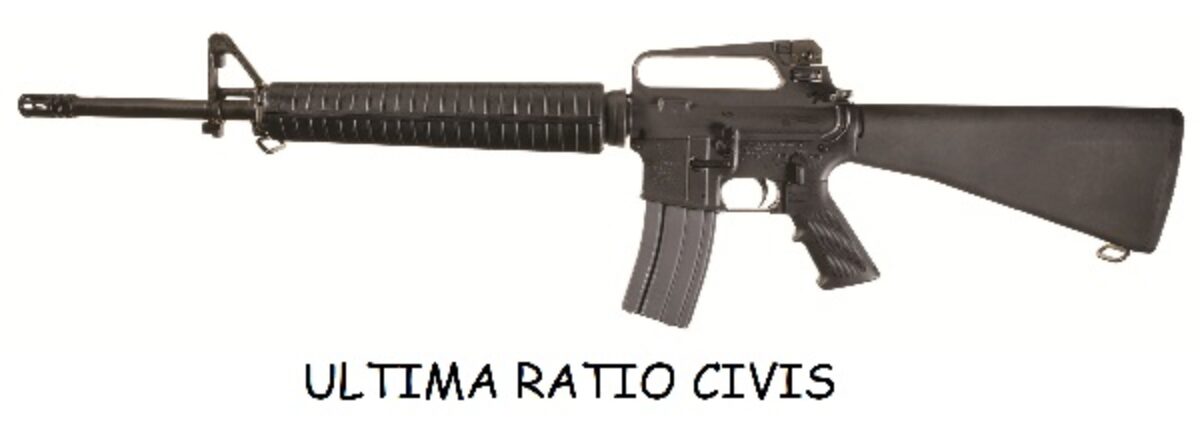
I think 25,000,000+ AR ‘style’ rifles can be termed “in ‘common use™’”
Now where have I read ‘common use’ before…Oh! Oh! Oh! Mistah Cahtahr!
I’ll take Caetano V Massachusetts for $500, Alex
So, guns in ‘common use’ are especially protected by 2nd amendment restrictions on goobermint?
Who Da Thunk It!
Common Use: Academic Survey Shows Over 30% Of Gun Owners Have Owned AR Style Rifles
Wake Forest sociology professor David Yamane is an active analyst of America’s gun culture and runs the Gun Curious blog. He also teaches a course in the sociology of guns. In his latest Light Over Heat video, Dr. Yamane calls attention to a survey done last year by Georgetown Professor William English.
From the survey’s abstract . . .
This report summarizes the findings of a national survey of firearms ownership and use conducted between February 17th and March 23rd, 2021 by the professional survey firm Centiment. This survey, which is part of a larger book project, aims to provide the most comprehensive assessment of firearms ownership and use patterns in America to date. This online survey was administered to a representative sample of approximately fifty-four thousand U.S. residents aged 18 and over, and it identified 16,708 gun owners who were, in turn, asked in-depth questions about their ownership and their use of firearms, including defensive uses of firearms.
English is also the author of a paper last year titled The Right to Carry Has Not Increased Crime: Improving an Old Debate Through Better Data on Permit Growth Over Time.
In the 2021 national survey, English set out to, among other things, determine exactly how prevalent AR-pattern rifle and “high capacity” magazine ownership really is among America’s gun owners. That’s not merely an academic question as the Heller decision established the “common use” standard for firearms that can’t be regulated out of existence by hoplophobic politicians.
What exactly constitutes “common use” is, of course, an angels-on-the-head-of-a-pin, you-know-it-when-you-see-it style subjective legal question. But as Professor Yamane notes, Professor English’s survey found that just over 30% of gun owners report ownership (past or present) of an AR-15 style rifle. He also found almost half of gun owners surveyed report owning “high capacity” magazines, those that hold over 10 rounds of ammunition.
Yamane isn’t an attorney and neither are we. But English’s survey has turned up AR ownership by roughly 25 million (higher than the number usually quoted) and “high capacity” magazine ownership by close to 50 million gun owners (which seems low to us).
As Yamane puts it . . .
If we look at one-third to half of gun owners, I would say that ownership of AR-15-style rifles and high or standard capacity magazines is fairly common empirically.
We couldn’t have said it better ourselves. Whether you’re a fan of the “common use” standard or not, that’s the law of the land right now. And data such as these demonstrate — quite clearly — that any efforts to limit magazine capacity and ban scary-looking firearms are, by any measure, unconstitutional. That’s hopefully something that the Supreme Court’s pending decision in the New York case and others will help to further clarify.
See Professor English’s full 2021 National Firearms Survey results here.
Unless you’ve had a grounding in how the Stoner system really works, a good set of tools and Technical manuals, and a certain amount of experience working on ARs (like say having been a military and/or civil service small arms repairer as I was) you may wind up better off buying either a whole factory built rifle, or factory built uppers to go with factory built lower. From my experience, the manufacturers, especially those that have or have had military contracts, don’t just meet the standards of the Technical Data Package, but purposefully exceed it.
Is It Better to Go Factory or Build a One-Off AR-15?
You can build your own AR! You could probably also buy a better AR with included liability protection (in the form of headspacing and specification pairing) and a brand name cohesive look for less than the build price.
Sure, price isn’t always everything, but it matters, especially when you can get factory integrated high end rifles with desirable third party accessories or brand collaborations, and it costs less than the parts total for your buildout.
Is it always the truth that factory builds are cheaper or offer more bang for the buck? No. In fact, for large swaths of time in the past 15 years there were periods where builders enjoyed a parts glut on the market and the manufacturers were more expensive for the same thing as what you could build for a couple hours (or less) of assembly time.
Right now, it’s pretty close to even, with a slight advantage on the low end side of the market for the factories over a parts build.
The NICS image reminding me……
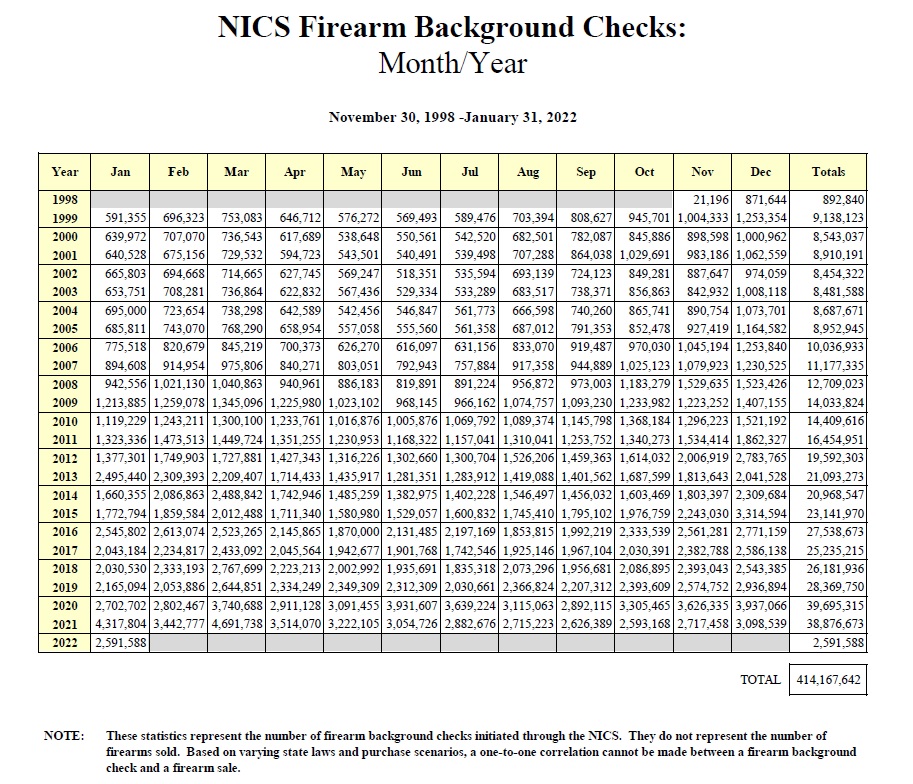
We have another month where it appears the fury of 20/21 may be ended and we have a return to the ‘normal’, nearly usual steady increase.
Tiger shooters take state title
The Ozark High School JROTC battalion rifle team earned a clean sweep of the championship trophies at the Civilian Marksmanship Program (CMP) State Championship on Jan. 15.
The Tigers came in first place in both the precision and sporter rifle divisions of the team competition that was held in Washington, Missouri.
“We continue to work hard day in and day out and I’m very proud to see this team rewarded for all of their hard work,” said 1st Sgt. William Crawford, Ozark High School JROTC instructor and rifle team coach. “There were roughly 15 schools with over 25 teams, which made for a highly-competitive field. Consistency is accuracy and accuracy is consistency.”
Ozark’s triumphs also extended to the individual competition, as the Tigers claimed the top three spots in both the precision and sporter divisions.
“As a team, we have worked very diligently and put in many long hours to better ourselves as shooters, competitors and fellow teammates,” said Ozark rifle team captain Elijah Glenn. “Our performance at the state championship was a reflection of our dedication to each other and our commitment to representing Ozark JROTC to the best of our abilities.”
The state meet marked the first competition of the new calendar year for the Ozark rifle team. The shooting Tigers are headed into the home stretch of their 2021-22 season, and will compete next at the CMP Army Service National Championship in Anniston, Alabama, Feb. 2-6.
‘Proprietary magazines’ *cough* stupid *cough*
Now, I understand the business model concept, but if I were going to introduce something this close to the AR pattern 9mm ‘pistol’, it would either take the modified Uzi mags that Colt developed for their 9mm AR, or it would take Glock magazines. It’s like all the different versions of 1911s or HiPowers.
One magazine to rule them all

The gun has been in development for a while. At SHOT Show 2015, we got our first glimpse of it. Frank DeSomma, who tragically lost his life in an automobile accident in 2020, showed it to Guns.com. Back then, it was called the PSG, which stood for Patriot Sub Gun.
Despite DeSomma’s passing, POF-USA has continued to produce high-quality and innovative firearms. The Phoenix is no exception. It was officially released at this year’s SHOT Show. POF-USA engineer John Capps was there to show it to us.
DIRECT WEIGHTED BLOWBACK
It features a direct-weighted blowback system making it very easy to control according to Capps. “It is a monolithic upper. Billet lower. Has all AR-15 fire controls and ambidextrous buttons like our AR does. Bolt release, mag release button is ambi like our other rifles are. It’s going to ship with a MIL-SPEC trigger. It’s 4.6 pounds, so it’s fairly light and small for its size. It has a very small handguard compared to its competitors,” said Capps.
SMALL, LIGHT PACKAGE
It is 17.5 inches long and is compatible with a brace or stock that has a 1913 Picatinny rail on the back. It has a forward non-reciprocating charging handle that can be moved to the left or right side. It also hosts a new 9mm 1/2×28-threaded dual-port compensator.
PROPRIETARY MAGAZINES
The Phoenix will ship with a single proprietary 35-round magazine. The reason POF decided to do this was for reliability and to make the gun as much like an AR platform as possible. Twenty and 10-round mags will also be available. The price point for additional mags will be around $30 according to Capps.
Inspecting the FN 502™ Tactical Manual Safety
FN America, LLC, has become aware that a very limited number of FN 502 Tactical pistols in the field may have an improperly installed manual safety. In these cases, the external safety lever will not function as designed and may result in unintended firing. To ensure the pistol’s safe operation, FN is asking owners of the FN 502 Tactical to suspend use of their pistol and perform a function check to verify the manual safety is operating correctly, following the inspection procedure below.
This safety bulletin applies to FN 502 Tactical pistols with a serial number range lower than LR007999. If your serial number is above this range, it is not subject to this bulletin.
This safety bulletin provides instructions on how you may check to see if your FN 502 Tactical is affected.
However, if you would like FN to inspect your pistol, please contact FN Customer Service at 1-800-635-1321, ext. 145. You may also take your pistol to your local firearms dealer or gunsmith for inspection.

Before inspecting your FN 502 Tactical, ensure your pistol and magazine are unloaded and that there is no live ammunition in your work area. For more details on safe handling and unloading, please reference your owner’s manual.

Note: Please do not ship any affected product to FN until FN has generated and sent to you a return label. If the firearm is not affected by this safety bulletin, no action is necessary.FN is deeply committed to providing customers with the safest, most reliable firearms possible. Patience and cooperation are appreciated as we receive, inspect and service these firearms. We will make every effort to return the product to customers within 14 days.
For questions about the safety bulletin or assistance in returning a firearm, contact the FN customer service team at 1-800-635-1321, ext. 145, or by email at customerservice@fnamerica.com.
Hours of operation are 10 a.m. to 4 p.m. Eastern time, Monday through Friday.
Geez. Elite, Elite, Elite XD-Elite, now SiG Elite.
Everything’s “Elite” these days.
The real deal high speed/low drag ‘Elite’ guys I knew? Carried Glocks.
Quip O’ The Day
“My Gun is Cute” by Michelle Spillane
First Look: SIG Sauer Equinox Elite Family of Pistols
SIG Sauer has launched a new line of pistols, the Equinox Elite.


The Equinox line of pistols is an iconic series of pistols from SIG Sauer with distinctive features which make them stand out from the crowd. The SIG Custom Works team is once again paying homage to the Equinox Series with a new line of Elite Series pistols. The new, limited edition Equinox Series from SIG Custom Works is a modern take on these SIG Sauer classics. Each pistol features the unique Equinox slide design and contrasting nickel-plated controls paired with a black Hogue SL G-10 grip, XRAY Day/Night sights, and an SRT trigger, with the Elite Series extended beavertail, the new Equinox Elite series blends classic styling with modern performance, giving you the best of best of both worlds.
This limited-edition run from Sig Custom Works includes the following models:
A new addition to the Equinox line is the P320 AXG Equinox that is chambered in 9 mm. The pistol ships with three 17-round magazines and includes all the innovative features of the P320 series such as removable Fire Control Unit (FCU) and almost limitless upgrade possibilities. The P320 AXG Equinox also comes with an AXG Grip Module, which combines the look and feel of a classic metal-bodied Sig Sauer pistols with flexibility of the P320 series.
Each pistol comes packaged with two magazines in a Custom Works Negrini case complete with a SIG Custom Works challenge coin and a certified custom certificate.
So FN drops the HiPower a few years ago, then Springfield Armory introduces their version……and now FN decides to reintroduce it…..
*snerk*
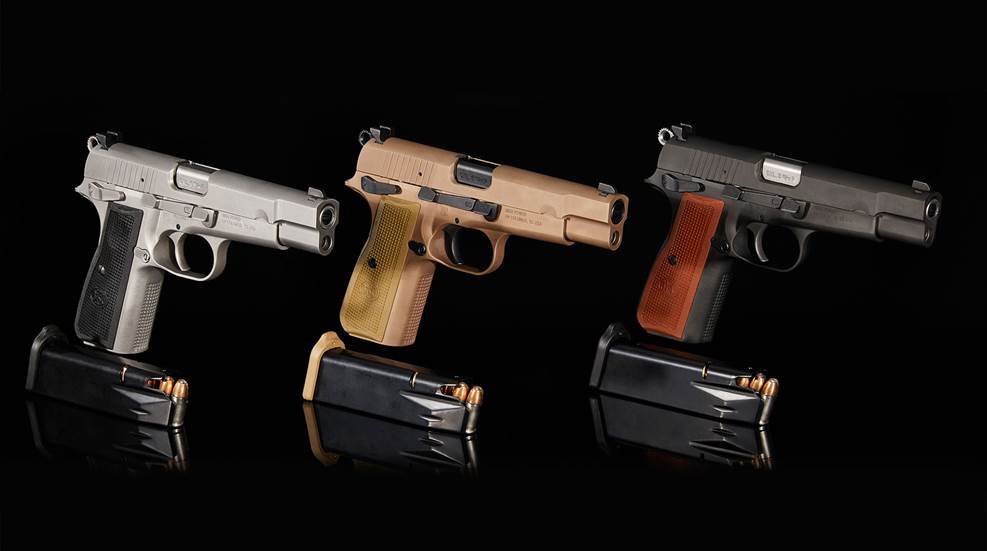
What I like over the SA version? Ambidextrous safety and slide release.
Annnddddd FN has deleted that magazine disconnect as well.
You can’t stop the signal
THE FGC-9 IN MYANMAR: 3D GUNS AND THE FUTURE OF GUERILLA WARFARE
February 1st, 2021, is the day the Myanmar military seized power, which immediately led to civil unrest. That unrest began as peaceful, pro-democracy street demonstrations, but in short order, peaceful demonstrations gave way to guerilla warfare. The situation evolved and changed rapidly due to an ever-escalating and violent military-lead government. Now it seems the power of the internet has delivered a Christmas present to Guerilla fighters in Myanmar, in the form of the FGC-9.
Government forces outnumber and out-arm the Myanmar guerillas by a wide margin, and have made use of machine guns, rockets, and tanks over the past year of conflict. The Guerrillas constantly find themselves outclassed by the government’s superior firepower, and have been searching for a means to turn the tide.
I’ve heard it said that ‘nothing cleanses quite like fire‘.
Keep a lookout for us at #SHOTShow
We got something new and spicy for you to check out pic.twitter.com/krNBUlfutX— Exothermic.tech (@Exothermic_Tech) January 17, 2022
I got one as swag from Graf & Sons a couple of years ago. Checking it vs. a RCBS beam scale showed it to be very accurate. Mostly we use it for weighing bullets and cases since it’s a lot faster than a beam scale when segregating components.
TFB Armorer’s Bench: Closer Look – Frankford Arsenal DS 750 Scale
The Frankford Arsenal DS 750 Scale is a budget-friendly scale that comes in the typical Frankford Arsenal clamshell packaging. It comes with the scale, powder pan, 50-gram calibration weight, manual, and soft case for the lot of it. The scale is called the DS 750 because its maximum accurate reading capacity is 750 grains or 50 grams. This scale has a grain/gram accuracy of 0.1 grain (0.01 gram).
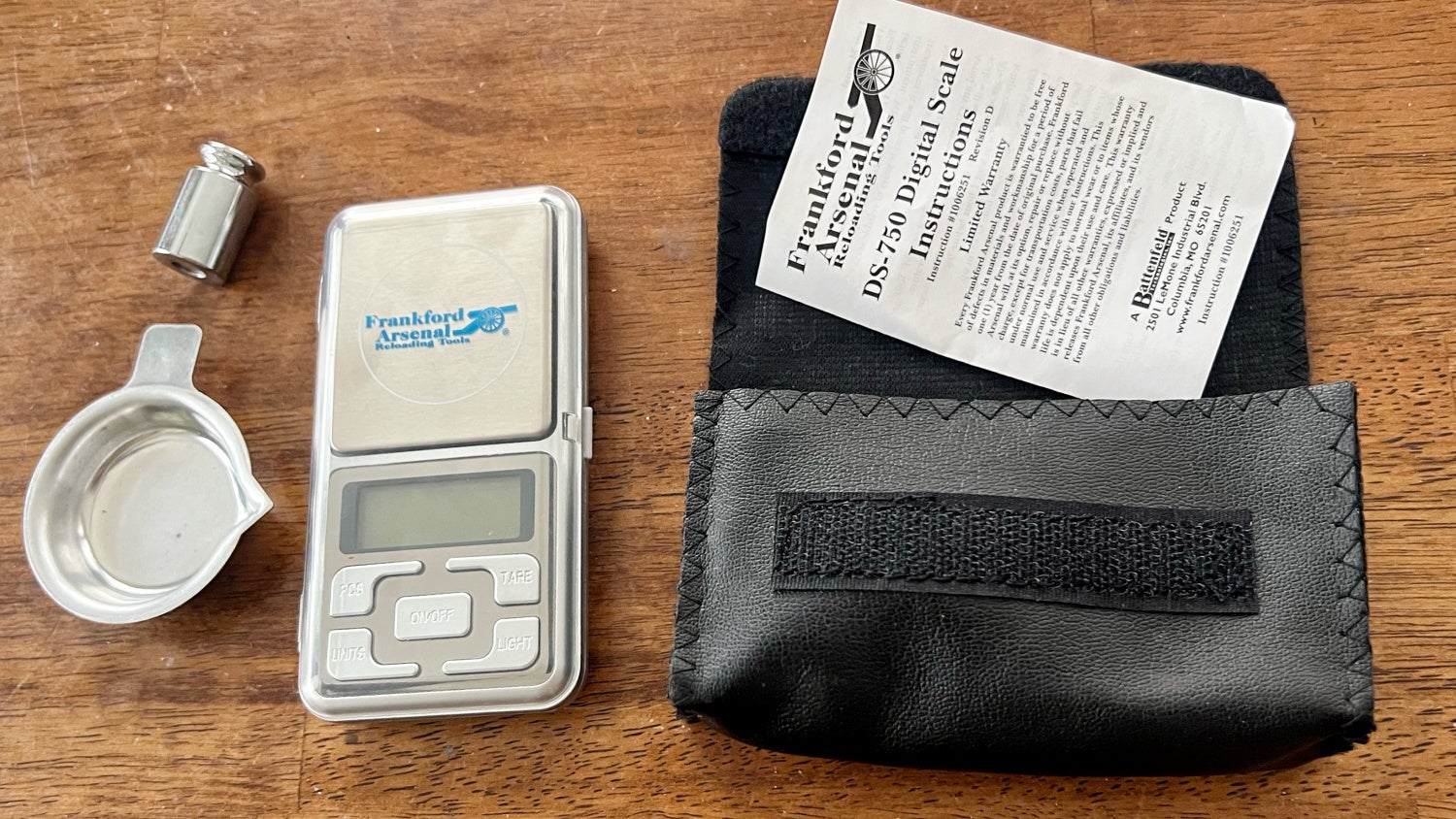
The scale itself is smaller than the average smartphone. It utilizes a plastic flip-over cover that protects the screen from scratches as well as other forms of wear and dust accumulation. Four buttons are present on the scale. You have PCS (counts how many measurements taken), TARE (sets weight to 0.0), UNITS (changes weight measurement), LIGHT (turns the backlight on or off), and ON/OFF.
I personally bought this scale years ago and it has been very useful and hasn’t really presented much as far as quirks. The scale reads accurately but it is good to let your measured weight sit for a good 10-20 seconds to see if the weight fluctuates beyond comfort (usually, it does not). I have since upgraded to the next step up from this scale so it has not been utilized in quite a while but I do not remember having any complaints.
Specifications and Highlights: Frankford Arsenal DS 750 Scale
The MSRP of the Frankford Arsenal DS 750 Scale is $44.99. For the beginner reloader or for an enthusiast on a budget, this scale really is probably one of the best in its category of the price range. I have heard next to no complaint when others have used it only that they hope to upgrade to something that can handle more weight or have better precision. Remember that there is nothing wrong with double-checking your powder charges with another scale if you have one on hand just to get an idea of consistency.
The Frankford Arsenal® DS-750 delivers extreme accuracy for precise measurement of powder, bullets, cases or loaded rounds. Simple controls allow for easy changes of units and calibration. Powder pan, carry bag and calibration weight included.
750 GRAIN (50 GRAM) CAPACITY, 0.1 GRAIN (0.01 GRAM) ACCURACY
LCD DISPLAY WITH BLUE BACKLIGHT
INTEGRATED PROTECTIVE COVER
AUTO CALIBRATION
MEASURES IN: GRAIN, GRAMS, OUNCES AND CARATS
Closing Thoughts: Frankford Arsenal DS 750 Scale
All in all, this is a decent scale for the money and one that has lasted me years in my little shop while exposed to 100 plus summer heat and freezing well below zero. I have not noticed any fluctuation or variation. It does its job and it is very simple to use. In my opinion, it is a great option for someone just starting out reloading.
Federal Premium Releases NEW Force X2 Shorty Shotshells
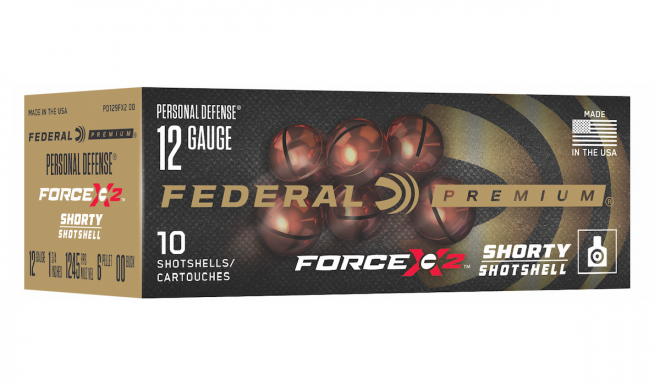
The Force X2 Shorty shotshells are new from Federal for 2022. These shells are aimed at the personal defense market. Crammed into their small 1 3/4″ hulls are six 00 buck pellets. The segmented pellets are designed to split in half on impact, doubling the number of wound channels left in the target. The buckshot is also designed to lessen the chance of overpenetration through walls. The pellets are copper-plated for increased target penetration, as well, and fly at 1,245 FPS (feet per second). When used in shotguns that are optimized for using shorter shells, the X2 Shorty shotshells offer a much higher tube capacity, giving you even more chances to make sure you’re the one that’s still standing. Each box comes with a total of 10 shells.
SPECS
Gauge: 12
Length: 1 3/4″
Shot size: 00 Buck
Shells per box: 10
MSRP: $28.99
Welcome to Sioux Falls, South Dakota where – at the airport – you can find a guy advertising a gun auction between your gate and baggage claim
Updated update on the updated Tisas Tanker ‘Commander’ 1911 pistol.
Earlier I figured I had gotten to a stopping point, but as someone once observed. ‘You never know’.
A few weeks ago, I noticed a seller on Ebay advertising manufacturer overrun parts with a stated non-disclosure agreement on source. The prices were quite reasonable, so, I decided to splurge and bought a 416R stainless steel barrel with link & bushing – that to me happens to look a lot like what Springfield Armory uses, but whatever – which pleasingly dropped in with no fitting, locked up tight and cycled dummy rounds with no problems.

Weather and physical conditions of all parties concerned finally intersecting, Dad & I took a day trip Saturday afternoon to the backyard range of a friend to try it – and several other guns – out.
Every type of ammo I shot, factory 230 gr FMJ from several manufacturers and Remington 185gr JHP, which is our standard load when carrying a .45 for self defense, I was able to keep on 6 inch round steel at 20 yards, standing, off hand, without any sight adjustment. Accuracy has been improved and reliability was not effected, so this appears to have been a worthy endeavor .
What’s one millimeter more? 9mm vs 10mm… Number’s wise, it might seem minor at best, like having $9 vs $10, but as far as ammunition calibers are concerned, that increase of one millimeter makes all the difference.
The average grain weight of a 9mm bullet is around 115 grains, and the average 10mm is around 180 grains. Making the 10mm bullet 63% heavier of a round over the 9mm, that one digit millimeter difference, is really the equivalent of 63% more mass.

Now, you might also be familiar with .45 ACP, a long-standing low velocity, high powered round. Surprisingly enough, the 10mm and the .45 look an awful lot alike when you put them side by side, they’ll pack a similar punch but perform in different ways. The muzzle velocity of .45 is 840 feet per second, versus the 10mm’s 1008 feet per second. With greater muzzle velocity also comes added benefits, such as flatter shooting and better accuracy at further range. Advantages like these are why the 10mm caliber has become widely regarded as the ideal round for personal protection in the backcountry.
The new M&P®10mm M2.0™ pistol was designed to match the M&P®45 M2.0™ pistol frame size, with new aggressive front serrations traditionally only seen on law enforcement M&P® firearms. Working your way back on the slide, you’ll notice that the 10mm comes standard with the C.O.R.E.™ (Competition Optics Ready Equipment) slide and optics mounting kit. But let’s not forget one of the most recognizable changes to the M&P®10mm M2.0™ pistol, the new flat face trigger geometry. Following the success of the Shield™ Plus pistol flat face trigger, the 10mm is the first in the M2.0™ pistol lineup to feature a newly updated trigger.
With a capacity of 15+1, backcountry bears and cougars won’t stand a chance against your M&P®10mm M2.0™ pistol. You can now rest assured that your ideal backcountry sidearm will have your covered.
A little known product is HilCo Lube in aerosol and wipes.
When I was working on the 16th Cavalry officer side of the Armor School, the Marines brought up a tub of them that they had used during OCS at Quantico. Hill Company actually specializes in commercial and industrial cleaning gear, but this product impressed all of us and I have used it ever since.
My Unit Armorer instructor at Fort Lewis – a retired Master Sergeant by the name of Butterfly – apparently had a standard joke he would roll out for each class when asked if there was something better than CLP.
His answer was;
“Yes, there are better products than CLP, but it has one overriding quality that really can’t be beat….(long pause)…..it’s free.”
Shooting is a ton of fun, but it’s also inherently dirty. There’s powder residue, carbon fouling, copper and lead buildup, and more.
Whether it’s your granddad’s single-shot shotgun that you’re going to pass down to your own kids or a brand new long-range shooting rifle that you spent far more on than you care to admit, the goal is to keep them both running smoothly for decades to come. In order to do this, you’ve got to keep your guns clean. Regardless of what it cost or how old it is, the best way to do this is to use the best gun oil.