ESSE SINE METU IN FACIE INIMICI TUI. TUENDAM INOPS ET FACERE NON MALI.
Category: Health & Medicine
This is a protease inhibitor, which is a class of drugs that were originally developed to fight the AIDS virus and have been adapted to other virus caused illnesses.
Pharma company Pfizer announced on Friday that its experimental, antiviral COVID-19 treatment pill Paxlovid showed during testing that it’s almost 90% effective in preventing hospitalization and death in high-risk patients.
The company said when combined with a low dose of ritonavir and taken within five days of the onset of symptoms, it cut severe illness and death attributed to the coronavirus by 89%.
“Today’s news is a real game-changer in the global efforts to halt the devastation of this pandemic,” Pfizer CEO Albert Bourla said in a statement.
“These data suggest that our oral antiviral candidate if approved or authorized by regulatory authorities has the potential to save patients’ lives, reduce the severity of COVID-19 infections, and eliminate up to 9 out of 10 hospitalizations.”
Pfizer said it’s now requesting emergency use authorization from the Food and Drug Administration, which would allow it to be distributed nationwide. If authorized, Pfizer’s would be the first COVID-19 treatment tablet on the market.
Paxlovid joins a coronavirus treatment drug from Merck, molnupiravir, in the federal review category. Regulators are presently assessing molnupiravir for emergency authorization, and British regulators authorized the Merck drug on Thursday.
“We have remained laser-focused on the science and fulfilling our responsibility to help healthcare systems and institutions around the world while ensuring equitable and broad access to people everywhere,” Bourla added.
Pfizer said its double-blind study examined a group of non-hospitalized, high-risk adults with COVID-19. In the trial, just six of more than 600 volunteers were hospitalized after taking Paxlovid — compared to 41 of 612 who were given a placebo.
Pfizer said no volunteer who took Paxlovid during the trial died, compared to 10 from the placebo group who did.
Dr. Risch from Yale says if they mandate the vaccine for his children he would pull them out of school and homeschool them. He would only recommend the vaccine to children if they have some kind of chronic illness. pic.twitter.com/eUNMVHJ02a
Last week the Biden White House rolled out a plan, ahead of FDA authorization, to administer the Wuhan coronavirus vaccine to children ages 5-11. The administration is moving forward despite the disease being low risk to children.
“In anticipation of the FDA’s independent advisory committee meeting on October 26 and the CDC’s independent advisory committee meeting on November 2-3, today the Biden Administration is announcing a plan to ensure that, if a vaccine is authorized for children ages 5-11, it is quickly distributed and made conveniently and equitably available to families across the country,” the White House released in a “fact sheet.” “The start of a vaccination program for children ages 5-11 will depend on the independent FDA and CDC process and timeline, but our planning efforts mean that we will be ready to begin getting shots in arms in the days following a final CDC recommendation.”
California’s Democrat Governor Gavin Newsom also prematurely mandated the vaccine for admission to public schools.
But during an interview over the weekend with Fox News, Yale epidemiologist Dr. Harvey Risch explained why he’d rather pull a healthy child from school than give them the vaccine.
“If the child has chronic conditions that make their risk appreciable, then there’s reason they should be considered for vaccination. Other than that if it were my child, I would homeschool them. Honestly, I would organize with other parents to take them out of the school and create homeschooling environments,” Risch said. “On the average the benefit is higher for homeschooling than it is for vaccination and being in school.”
Meanwhile the CDC and U.S. Surgeon General are insisting that even after children are vaccinated, they must wear a mask while in school.
This is getting out of hand. At some point, when a child/spouse/elderly parent is denied care, I can see a family member deciding that who made that idiotic decision pays for it more dearly than they can possibly imagine.
A teen boy in Indiana was refused treatment for multiple infections because he was not vaccinated against Covid 19. In the video made by the teen’s mother, it’s not just the denial of treatment but the borderline violent behavior of a medical personnel that is shocking.
Let us stipulate that states mandate vaccines for students attending government schools. Measles, mumps, rubella, diphtheria and tetanus vaccine requirements are a good thing, in my opinion. There should also be exceptions, even with those vaccines. The death rate, before vaccines, for measles was quite high. According to the Centers for Disease Control (CDC):
In 1912, measles became a nationally notifiable disease in the United States, requiring U.S. healthcare providers and laboratories to report all diagnosed cases. In the first decade of reporting, an average of 6,000 measles-related deaths were reported each year.
In the decade before 1963 when a vaccine became available, nearly all children got measles by the time they were 15 years of age. It is estimated 3 to 4 million people in the United States were infected each year. Also each year, among reported cases, an estimated 400 to 500 people died, 48,000 were hospitalized, and 1,000 suffered encephalitis (swelling of the brain) from measles.
On the other hand, the death rate from Covid for teens 15-19 is .00049, according to the Kaiser Family Foundation. When one takes into account the lack of reliable data regarding long term effects of the mRNA jabs, we could understand parents who thought 100 or more times before jabbing their teens. There is also the fear of myocarditis:
Federal health officials have verified 226 cases of myocarditis or pericarditis in people ages 30 and younger who have received an mRNA COVID-19 vaccine and are investigating about 250 more reports.
While rare, the rates for ages 16-24 following a second dose are above what is expected, prompting an emergency meeting of the Centers for Disease Control and Prevention’s (CDC’s) Advisory Committee on Immunization Practices (ACIP) next week.
Teens and children are not good spreaders of the Covid. The have a very, very low death rate. So, parents could be forgiven for casting a gimlet eye at a vaccine that could put their teen out of commission for three to six months and whose long term effects have not begun to be studied.
When our children are sick, mothers (fathers, too) turn into vicious beasts with killing claws. Don’t get in our way, because we will cut you. You may not even know when we will take our revenge on you or how. Case in point is the Indiana teen boy who was denied treatment for multiple infections. I got this story from Defiant America.
The mother, in this case, brings her teen boy in to be checked because he is not feeling well. The young man looks athletic. What we don’t see before the mother starts filming is that the Nurse Practitioner has already diagnosed the teen with sinusitis, an ear infection and bronchitis. Then, because the teen has not been vaccinated for Covid, the Nurse Practitioner refuses to prescribe antibiotics. That is when the mother starts filming. This is short. Don’t miss a second:
Cray cray. Give the kid some antibiotics for goodness sake. Nurse “Karen” at RediMed in Fort Wayne grabs the mom’s phone.
Wake up people. Not about healthcare. Has anyone told this her what’s coming? pic.twitter.com/zh1FhByGKU
Having had a teenage son, I know that my son would be saying, “Mom, Mom”, too. I feel for the kid. But that Nurse Practitioner is one sick twisted Nurse Practitioner Karen Ratched. How inhuman can one person be? Don’t answer that. I know. The hatefilled Leftists have been “othering” the unvaccinated for months. This is the logical outcome of this othering. This woman has already diagnosed the young man. She is refusing to prescribe antibiotics. That is some sick shite.
Let’s watch it one more time:
When NP Ratched tried to grab the Mom’s phone, I gasped. That’s some crust. Power drunk Ratched there. I understand why the mother didn’t bite off Ratched’s hand, her son’s prescriptions were more important. Yes, Ratched go call security.
In case you are interested, this power mad woman works at the RediMed in Fort Wayne, Indiana.
We used to believe in our medical professionals. We used to have faith in them. We believed their Hippocratic Oath. Everything has been politicized.
Nurse Practitioner Ratched let down her patient and her profession. Her license should be cancelled.
The Eatonville School Board voted Thursday afternoon in a vote of 2-1 not to terminate employees who would not comply with Democrat Governor Jay Inslee’s mandate for Washington state.
In August, Inslee implemented what was then the strictest vaccine mandate for state workers in the US and provided no option for workers to submit frequent testing in place of the COVID-19 vaccine. Since then, Mayor Bill de Blasio in New York City has done the same. Inslee also announced a vaccine requirement for all employees, on-site contractors and on-site volunteers in K-12 schools.
On Tuesday, Inslee fired nearly 1,900 state workers, including hundreds of first responders, that did not submit vaccination records, a requirement ordered by Inslee that had an October 18 deadline. Those numbers don’t include workers that were fired by their local governments or those that opted to quit or retire early after hearing about the mandate. Those numbers combined are predicted to be in the thousands.
The meeting was called to order at 3:39 PM and lasted barely four and a half minutes. Only one agenda item was discussed a motion to approve the non-disciplinary termination in accordance with the Governor’s proclamation mandating vaccination for state employees.
Ronda Litzenberger said she made the motion “with a heavy heart.” After the motion was seconded, Litzenberger said during a brief discussion, “…just for public record, to know that we have done everything in our ability as a school board to try to accommodate, and hopefully offer multiple opportunities for these individuals to really work with them. That is my understanding as a school board director, and it’s my hope that that has been the experience of every individual on this list. And we’re very grateful for the service that they’ve given to Eatonville School District.”
Paulette Gilliardi, assistant to the chair, concurred and turned out to be the only ‘yes’ vote after Litzenberger voted no. Before the vote, the other director Matt Marshall said, “I understand that we have a proclamation, but at some point, I can’t stand to watch us lose employees. And I know none of you want to see us lose employees either. And this is painful to put us between a rock and a hard place.”
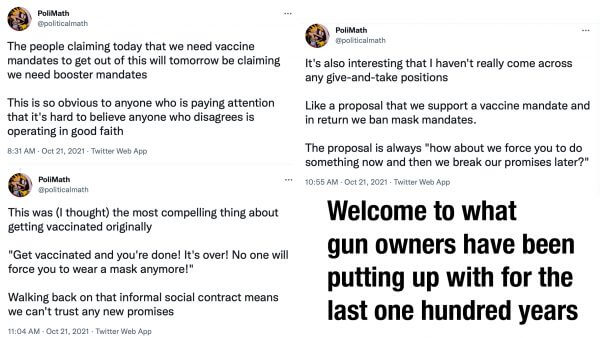
“Just give up a little bit of your rights, and you’ll make the rest of us feel safer” has been the motto of the gun control movement since day one. Now that same logic, (if you want to equate emotion of feeling safe as logic) is being applied to public health as a whole, and people aren’t liking what they’re hearing.
Stephen Kruiser once said that firearms are the gateway drug to freedom. In this case, however, firearms ownership is the canary in the coal mine. What big government and runaway political corruption have been doing to our freedoms under the Second Amendment, they’re now doing to every other civil right as well.
Welcome to the party, everyone. Don’t say we never tried to warn you.
There are a great many unknowns and controversies associated with the COVID pandemic. Among the most urgent are those associated with appropriate therapeutic and prophylactic interventions. Some of the most intense disputes involve repurposed therapies — i.e., drugs that have been approved for treatment of some other condition being used as therapy for COVID. This is the case with the anti-parasitic agent ivermectin.
Much of the controversy regarding ivermectin involves “evidence” that the drug has a benefit in treatment of COVID. Detractors will often use the hyperbolic claim that there is no evidence that ivermectin is useful in this setting. The truth is that there is, in fact, some evidence. Ivermectin has been known since at least 2012 to have antiviral activity. It has been shown to have at least some antiviral activity against a number of viruses, including HIV-1, Zika, flaviviruses, and dengue. It is known to have in vitro activity against SARS CoV-2, the coronavirus that causes COVID. It has been shown to have some efficacy in Middle East Respiratory Syndrome, a disease caused by a coronavirus with similarities to SARS CoV-2. There are plausible mechanisms proposed for why ivermectin might be useful against viral infections: it inhibits a class of proteins that are necessary for the virus to replicate within human cells.
These observations are evidence. They are not definitive evidence. They are probably not sufficient, or even persuasive evidence, but these assessments should not be confused with “no evidence.”
Joe Rogan has found himself at the center of a debate over the COVID-19 vaccines, despite never presenting himself as anti-vaccine. His great sin was daring to get treated for the virus after contracting it earlier this year. The fact that Rogan’s doctor included ivermectin in the medicinal regime sent heads exploding, as he was accused of taking “horse dewormer” amid other unfair, out-of-context claims.
Today, though, Rogan got a bit of redemption by running circles around CNN’s chief COVID hysteric, Sanjay Gupta. You may recall Gupta as the same guy who touted Chris Cuomo’s COVID X-ray, only to be embarrassing fact-checked by actual radiologists.
During the long-form discussion with Rogan, there were several key moments that showed just how out of his element Gupta was. Here’s one of them.
Not one media personality – trust me I’ve faced down almost all of them personally – can withstand even basic Socratic inquiry. They are idiots. This is why they almost never do long form discussions. This is what happens 👇
What Rogan is doing in the above clip is showing the absurdity by which COVID hysterics shift their viewpoints to meet what ultimately boils down to a political narrative. Because he wants to insist the vaccines are highly effective, Gupta presents himself as not worried about a breakthrough infection.
far more people have acquired immunity from having had and recovered from covid. this immunity is long lasting and extremely effective. (much more so than vaccines)
high risk cohorts were significantly reduced last year. there is less “dry tinder” now.
we have FAR more people vaccinated now. it’s 50-90% in many places and in many high risk groups. last year it was zero.
and yet in many of the high vaccine uptake places, we’re seeing deaths from covid (and excess mortality) rise to levels ABOVE last year.
this has led many to posit that vaccines not only don’t work, but that they make you worse.
but on an individual level, this does not appear to be true. (though there is quite a lot of evidence that vaccines induce higher risk in the two weeks post administration and that this is being accounted for dishonestly, added to the “unvaccinated” butcher’s bill, and artificially enhancing reported VE.
BUT, even if we control for this, vaccines are showing efficacy in preventing deaths among the vaccinated. it’s more like 50% than the 90%+ being claimed, but VE against death in the 50%’s should still be showing BIG community effects with so many people in the high risk groups vaccinated.
all else equal even without vaccines, we’d expect to see attenuation in covid deaths for the reasons laid out above. instead we see acceleration.
the case rate in covid would need to be 3X last year to drive equivalent deaths and higher than that to show excess. but, it’s nothing like that, especially once you control for testing levels.
this is showing up in excess deaths as well as covid deaths, so the signal looks real.
the data has caused a lot of hand wringing and confusion.
grab a seat, because i have an idea to inject into the debate, i sincerely hope that i am wrong, and i suspect a fair few folks are not going to like hearing it, but it’s the best fit i can find for the data.
so here we go:
the current surge in covid deaths is caused by the vaccinated.
Doctors should think less about the health of their patients and more about the health of the planet, an editorial in the BMJ (formerly the British Medical Journal) has urged.
The editorial, published as part of a special edition dedicated to the forthcoming COP26 climate summit in Glasgow, Scotland, says that medical treatment contributes significantly to “greenhouse gas emissions” and that this carbon footprint can be reduced if only “health professionals” can learn to reduce “overdiagnosis” and “overtreatment”.
Healthcare contributes 4-5 per cent of global greenhouse gas emissions. In the NHS, 62 per cent of these emissions are from its supply chains and 24 per cent from delivery of care. Health professionals can be institutional leaders who drive decarbonisation in hospitals through reducing overdiagnosis and overtreatment in healthcare, eliminating waste, streamlining services, and better managing suppliers and procurement. All of these efforts will bring us closer to making healthcare more sustainable.
One of the bigger problems, a separate piece argues, is all those pesky suspected cancer patients who tiresomely insist on getting as early a diagnosis as possible. They need to learn to wait, argues one Rammya Mathew:
The pressure to diagnose cancers earlier and earlier is another major contributor to modern medicine’s carbon footprint. Over successive years we’ve been told to continually lower our threshold for suspecting cancer, and we’re encouraged to investigate sooner and more extensively. In primary care, most patients with mildly elevated or even high normal platelet counts now undergo a barrage of investigations in case thrombocytosis is an early indicator of underlying cancer. What does the yield of these tests have to be to make this an acceptable approach? And shouldn’t we be considering the environmental impact of putting so many patients on a conveyor belt of investigations, as part of cost-benefit calculations?
But hey, why stop at letting the occasional undiagnosed cancer patient die? What we should really be doing is forcing everyone to go vegan and make everyone travel by bicycle…
Adopting the largely plant based planetary health diet and taking most journeys using a combination of walking, cycling, and public transport would substantially reduce greenhouse gas emissions and improve our health.
Animal sourced foods (meat, dairy, fish) generally use much more land and water and create more greenhouse gases than plant sourced food. Sustainable and healthy diets consist largely of diverse plant foods with low amounts of animal source foods, unsaturated rather than saturated fats, and limited amounts of refined grains, highly processed foods, and added sugars. The nature and scale of change required depends on existing dietary patterns and nutritional status of local populations. For example, to meet the planetary health diet recommendations, average meat consumption in Africa can slightly increase (2 per cent), whereas in North America and Europe it needs to fall by 79 per cent and 68 per cent, respectively.
Sustainable land travel will involve substantially fewer journeys by car and more journeys taken by foot, bicycle, and public transport, ensuring that all transport is carbon neutral and powered by renewable energy. This requires a transformation of the energy sector and transport infrastructure, prioritising active and public transport over road building. Estimates of the nature and scale of change needed vary. In the UK, for example, a central net zero pathway includes car mileage per driver falling by 10 per cent by 2050, whereas other analysis calls for a reduction between 20 per cent and 60 per cent by 2030, depending on the speed of transition to electric vehicles.
Old fashioned types who imagine doctors should be concentrating on healthcare rather than engaging in environmental activism may be puzzled by this. But they shouldn’t be. The Climate Industrial Complex — and the sinister billionaire backers behind it, such as the World Economic Forum — has run a hugely successful gaslighting operation in which schools, universities, the entertainment industry, big business, and the mainstream media now broadcast nothing but environmental scare stories. Any stories providing evidence that the global warming scare has been massively overblown are ruthlessly suppressed.
Hence, for example, the recent announcement by Google that it will demonetise media that “contradicts the scientific consensus on climate change”. (Spoiler: there is no such thing as “consensus” in science. There is definitely no “consensus” on climate change, neither on the causes nor the solutions. If there were a consensus Google would not need to indulge in censoring dissident voices because everyone would agree on the subject already).
People are saying that SloJoe has lost his mind,
but that would mean he had a mind to lose in the first place.
President Biden on enacting vaccine mandates: "We're making sure healthcare workers are vaccinated because if you seek care at a healthcare facility, you should have the certainty that the people providing that care are protected from COVID and cannot spread it to you." pic.twitter.com/eiS2nQM4QA
One of the more bizarre twists in the saga of the COVID pandemic has been doctors growing increasingly frustrated and even angry with patients asking for medical treatment rather than wholesale vaccination. We have been told for almost two years that COVID is a deadly disease. Naturally, when people test positive for COVID, they want to be treated to avoid serious illness. Instead, they are sent home to quarantine, with no medical treatment until they become seriously ill.
Some patients take exception to this approach and ask for ivermectin, which is being used outside of the United States to treat early COVID. There is a significantly lower incidence of serious cases of COVID in countries that use ivermectin for early exposures.
Doctors are not taking kindly to the suggestion that patients should have access to medication that can prevent serious illness. They are denouncing ivermectin as a veterinary drug as if they were not aware that it was developed for human use, that the FDA approved it for human use back in the 1990s, and that almost 4 billion doses have been administered around the world in the past 30 years. It’s true ivermectin was developed to treat parasites, not viruses, and that it is used for livestock as well as humans. However, there are a number of life-saving medications that are not being used for their original purpose.
It’s common knowledge that penicillin was discovered by accident when it was noticed that moldy bread destroyed bacteria. Less commonly known is that the heart medicine nitroglycerin was developed from the compound used in dynamite. Warfarin, a common blood thinner, started out as rat poison. Arsenic, another deadly poison, is used to treat acute promyelocytic leukemia. Even if ivermectin was originally developed for animals, there is no reason to discard it on that basis when it is being used successfully around the world to prevent dangerous illness and death from COVID.
Doctors are having none of it. Instead, they lash out at the very idea that patients should expect to be treated for COVID. They complain of being imposed upon by people who refuse to be vaccinated, overlooking the fact that even the vaccinated have become seriously ill or died of COVID or one of the many variants that have emerged since mass vaccination began. Doctors are not supposed to hurt us—yet I can’t think of anything more hurtful than telling people who test positive for COVID to go home and wait to see how sick they will get, then getting angry at those same people when they ask for a treatment that might prevent them getting sick at all.
New data coming out of Florida school districts show virtually zero difference between masked vs. unmasked counties, even as Covid-19 cases plummet across the state.
Leftists hellbent on forcibly masking every child in schools across the country never had any solid data to back up their position, only emotional pleas and scare tactics. In truth, however, this virus has never posed any statistical risk to children, nor were they a significant transmitter to adults. And besides, if teachers were vaccinated, what were they worried about?
While many districts refused to implement mask mandates in their schools, others stubbornly insisted upon them, even defying an order from Republican Florida Gov. Ron DeSantis to allow parental exemptions. We were assured that the masked counties would fare far better than the ‘Wild West’ unmasked ones, where the bodies of schoolchildren would presumably be stacked in the streets, or something.
Except, none of that happened (via press release from DeSantis’ press secretary, Christina Pushaw):
NEW PEDIATRIC CASES:
New COVID-19 cases for children ages 5-17 – the vast majority of the school-aged population – have decreased 79% in the month of September, in the 54 Florida counties where school districts have no masking policy or are following state law by honoring the parental opt-out rule.
For comparison, COVID-19 cases for children 5-17 in the 13 districts that imposed forced-masking in schools have decreased 77%, on average.
POSITIVITY RATES:
The 54 districts with opt-outs or no mask policy have seen an average decrease of 65% in positivity from week ending Aug. 19 (when school started) to the week ending Sep. 30.
The 13 districts that broke the law to impose forced-masking have seen an average decrease of 67%.
That is to say, the data for this school year to date shows no impact of forced masking in schools on pediatric COVID-19 prevalence. This is not surprising, since there were no statistically significant differences in case rates in forced-masking versus mask-optional schools during the 2020-21 school year in Florida.
Let’s do a little math, shall we?
Doesn’t that also mean that two thirds of their cases ARE vaccinated?
As in, if those numbers are to be taken as factual (and why not), what good is the shot?
A third of people with confirmed Covid cases in Wales in the past week were unvaccinated, according to new figures released by Public Health Wales.
The figures also showed 99% of people who tested positive for Covid in the past week in Wales were under 60. Of these, 37% were unvaccinated…………
BLUF: If the information contained in this article becomes widely known to physicians and other healthcare providers, not to mention the general public, it could very well change our attitude toward mass vaccination and lead to the more targeted approach Malone and others advocate. How likely that is to happen, I suppose, depends on how many read the article, draw similar conclusions, and have the courage to act on them.
Every now and then, right in the middle of the ongoing politicization of our universities and public health institutions, some actual science breaks out, almost spontaneously, as if it simply can’t be contained. Science, after all, is the pursuit of truth, and in Shakespeare’s immortal phrase, fromThe Merchant of Venice, “Truth will out.”
Such is the case with a recent article published in Toxicology Reports by Ronald N. Kostoff, et al., titled “Why are we vaccinating children against Covid-19?”According to Dr. Robert Malone, inventor of the mRNA technology used to produce the current Covid “vaccines,” the article is peer-reviewed and appears in a reputable journal. It is not a new “study” but rather an in-depth analysis of existing data from various government sources. And it isn’t just about children. It basically confirms everything Team Reality has been saying since the push for mass vaccination began.
In early August, in an op-ed for The WashingtonTimes, Malone and former Trump advisor Peter Navarro (one of the driving forces behind Operation Warp Speed) called for a halt to the Biden administration’s mass vaccination program, which they argued will do more harm than good. Instead, they said, we should target the most vulnerable while allowing those at lower risk to make their own cost-benefit analysis. They likened over-vaccination to overuse of antibiotics and warned that it could produce vaccine-resistant strains or “variants.”
A bit more than a month ago I wrote about “My troubling COVID vaccine story experiences.” Aside from citing a friend who developed heart inflammation after taking a coronavirus genetic-therapy agent (GTA, a.k.a. a “vaccine”; more on this later), I mentioned that I’d had some unusual experiences: I encountered two men within a relatively short period of time, at the same recreational facility, who told me they’d had heart attacks — after taking SARS-CoV-2 GTAs.
One man suspected the GTA induced his coronary; the other fellow was oblivious, though his attack occurred the month after his shot.
At the time, I mentioned that though I’d been reporting on GTA-coincident complications for a while, I aimed to be objective and thus had to consider that my experiences *could* have been mere coincidences. All the men in question are over 60, at ages where heart issues are more common, after all. On the other hand, I pointed out that I wasn’t looking for these stories or asking related questions, and I’m not a social butterfly who regularly interacts with large numbers of people.
But then it happened again. At the same recreational facility approximately two weeks ago, I saw a man I’d met there previously. After extending mutual greetings, one of the first things he said was, “I had a heart attack.”
Sure enough, I learned that he’d taken a GTA.
He didn’t connect the two occurrences; in fact, when I mentioned I’d met other men suffering the same fate, he suggested it was a coincidence.
But this thesis appears to have gone out the window.
Consider the testimonial of Steve Kirsch, executive director of the COVID-19 Early Treatment Fund and also identified as a Food and Drug Administration (FDA) panel member. In an eight-hour virtual discussion of the Vaccines and Related Biological Products Advisory Committee released Friday by the FDA, Kirsch said there “are four times as many heart attacks [as is normal] in the treatment group in the Pfizer six-month trial report — that wasn’t bad luck.”
What’s more, “The VAERS [Vaccine Adverse Event Reporting System] shows heart attacks happen 71 times more often following these vaccines compared to any other vaccine,” he continued (video below. It should automatically start at 4:20:17; if it doesn’t, you’ll have to fast-forward to that point).
Among other things, Kirsch presents the following table:
Kirsch is, of course, not the only informed person warning about or wary of the GTAs. Though the shot-hesitant are portrayed as knuckle-dragging, medieval scientific obscurantists, a study found that the education-level-defined group least likely to be vaccinated is Ph.D. holders. Even more strikingly, it emerged in May that at least 40 percent (this figure may be different now) of FDA employees and those at Anthony Fauci’s NIAID hadn’t yet been vaccinated. Did they know something Fauci wasn’t telling? Continue reading “”
On Thursday, Florida Governor Ron DeSantis announced he had secured additional doses of the lifesaving monoclonal antibody treatments the Biden administration significantly cut to his state. DeSantis said in a press conference he acquired 3,000 doses of Sotrovimad, manufactured by GlaxoSmithKline (GSK).
“It got emergency use approval just a few months ago. The clinical data that they had was really, really strong. In fact, that was even stronger than Regeneron,” said DeSantis. “And we know Regeneron has been very, very effective and in the real world.”
“So we’re going to be able to use that Sotrovimad to bridge some of the gaps that are going to be developing as a result of the Biden administration cutting — dramatically cutting medications to the state of Florida,” DeSantis continued.
Earlier in his speech, DeSantis slammed the Biden administration for drastically cutting the number of doses his state received after the administration took over control of distributing the treatment from the states.
“Cutting the medication to Florida and other states is wrong. It’s not consistent with the promise that was made just a couple of weeks ago. And we are going to continue to fight against that,” added DeSantis.
“And so yes, we have much lower hospital numbers, much lower cases, everything like that is much better than it was a month ago,” he continued but noted “COVID doesn’t go away.” The rate vaccinated people are testing positive is increasing in pace from six months ago.
“And so we know there’s going to be a continuing need to make this early treatment available for folks,” said DeSantis.
DeSantis’ action comes after expressing his displeasure last week with the Biden administration for withholding the treatment from the state.
“Just last week on September 9th, President Joe Biden said that his administration would be increasing shipments of monoclonal antibodies in September by 50%, and yet on September 13th, HHS announced that it was seizing control of the monoclonal antibody supply and that it would control distribution. Then on September 14th, the announcement was more than 50% of the monoclonal antibodies that had been used in Florida were going to be reduced,” he said.
“What the HHS and the Biden administration is now doing is they’re saying that all of the reduced amounts will go to the state, and we’re responsible not only for sourcing our sites, which we’re happy to do but any infusion center,” he continued.
“Any provider, any hospital will have to come through the state, and to spring this on us starting next week, we’re going to have to do that. There’s going to be a huge disruption, and patients are going to suffer as a result of this,” DeSantis added.