
CIVICS REVOLUTION: Conservatives Are Reviving Traditional Education With a Modern Twist.

The classroom subject of “civics” evokes antiquated images of Cold War-era conformity, but Andrew Hart describes a recent teacher workshop on civics with a schoolboy’s exuberance: “It was really refreshing. I was, like, wow.”

The weeklong seminar at the Museum of the American Revolution in Philadelphia delved into the writings of Aristotle and Cicero, the Founding Fathers, Abraham Lincoln, Frederick Douglass, and civil rights titans W.E.B. Du Bois, Martin Luther King Jr., and Malcolm X.

“We spent the first full day just talking about philosophy,” said Hart, who teaches history and government at a Florida private school. “It was almost like a graduate course with a professor who is an expert.”

Forty-five states are considering 198 bills related to K-12 civics education.

The Jack Miller Center, a leading civics education provider, organized the seminar, part of a cottage industry that is reviving the tradition of studying the rights and duties of American citizenship, updated for modern sensibilities. After decades of neglect in the wake of the 1960s social upheavals and emphasis on STEM competency, civics is making a comeback. Universities are opening multimillion-dollar civics schools, some with deans and doctoral programs, and more than half the states now have civics requirements or competency tests in K-12. The boom reached a crescendo this summer with 45 states considering 198 bills related to K–12 civic education.

But reintroducing the subject in today’s hyper-partisan climate is not simply about making students learn the ABCs of government and practicing the art of rhetoric. Civics now comes with a warning label – “the most bitterly contested subject in education today,” according to The Atlantic – placing it squarely in the crosshairs of the culture wars.

The tension around civics reflects the national disagreement about the meaning of the United States in the 21st century: Is America a land of opportunity and freedom for all? Or is it designed to award unearned privilege to a select few, and second-class status to everyone else? The answer determines how middle schoolers and high schoolers are taught about the Declaration of Independence, the Constitution, the Gettysburg Address, Dr. King’s “I Have a Dream” speech, and other key texts of the American experience.

Ideological disagreements over the nation’s identity have led to bitter clashes over curricula, reading assignments, and library books in local school boards and state legislatures.

Continue reading “”

Teaching Liberty: Hillsdale College & The Second Amendment

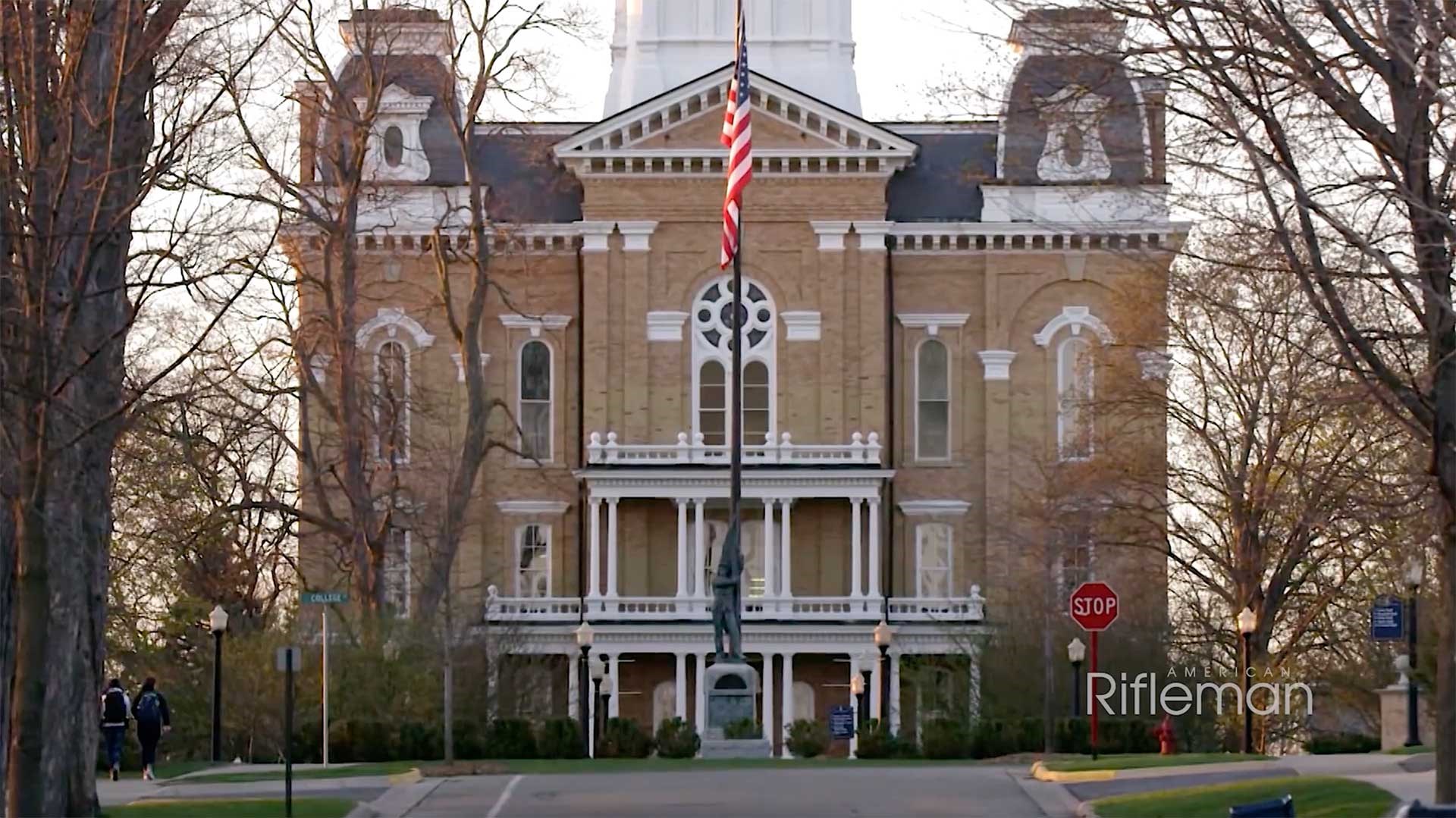
Hillsdale College, founded in 1844 by a group of Freewill Baptists, has established itself as one of the preeminent private educational institutions in the United States, with a particular defense of the traditional liberal arts, as well as a robust focus on the foundational principles of the United States. Of these foundational principles, the college educates its students on the meaning of the Second Amendment in theory and practical application. Watch our “American Rifleman Television” feature segment above to see how Hillsdale approaches teaching the Second Amendment to a new generation of Americans.

“The college, from its origins, was given to four principles or what we call “pillars,” and that is high learning, it’s here to promote and to furnish high learning,” said Dr. David Whalen, associate vice president for curriculum at Hillsdale college, as well as a professor of English. “Faith. The Christian faith is foundational here. Moral formation of our students, so moral character is important. And then finally, freedom. The college, in fact, was said to exist by virtue of gratitude for the inestimable blessing of civil and religious freedom. So freedom is very important here.”

Even as early as the mid-19th century, Hillsdale College practiced what it preached regarding its defense of freedom, liberty and the U.S. Constitution. A higher percentage of Hillsdale College students enlisted to fight for the Union in the Civil War than any other western college. Four Hillsdale college students earned the Medal of Honor. Sixty students gave their lives during the war.

In front of Hillsdale College’s Central Hall, a monument commemorates the Hillsdale students who gave their lives in the Civil War.

“The curriculum here is robust. It’s rich, but it’s also, and this is important, integrated. These courses aren’t designed to provide smatterings of knowledge. They are not designed to create little dilettantes who know a little bit about a lot of the different things,” Whalen said. “Instead, they all presume upon and lean upon each other. They bespeak a unity of knowledge. There’s a kind of integration in these courses, or at least we strive for a high degree of complementarity and integration in these courses so that, you know, you’re not just graduating students who have minds full of clutter, but who have intellects capable of a kind of comprehensive vision of the world at large.”

As part of its core curriculum, a series of courses that every Hillsdale student must take, there’s a comprehensive look at early American political thought, culminating in an intensive look at the U.S. Constitution. Courses also explore the historical roots of Western civilization, as well as the American heritage, specifically in cultivating a greater understanding of the “American experiment of liberty.”

“ As I often tell my students, it’s important to remember that both reason and experience show us that it is true that liberty is not a grant from a government, but is rather a gift from God. And so we spend a lot of time in class talking about what that means,” said Dr. David Raney, NRA Director and professor of history, John Anthony Halter Chair in American History, the Constitution and the Second Amendment. “At a very basic level, in a free society, it’s each citizen’s not just right, but responsibility, to step forward and provide the means by which they can defend all of their God-given liberties. And that typically means the ability to keep and to bear arms.”

Continue reading “”

92 Ohio school districts now allow staff to carry blasters

Ohio has been doing this since 2022, a year that saw 22 school districts arm their staffs after the passage of a new law allowing the practice. Fast-forward to 2025 and that number is 92.

The main argument for arming these teachers is that in rural areas like Eastern Ohio where Benjamin Logan Local School District is located, it takes too long (about 10-15 minutes) for police to arrive during an active shooter situation. With armed staff, this isn’t as much of a problem.

These armed staff members are required to take basic firearms training before they can carry in school.

Believe it or not, 30 states allow school staff to carry firearms.

From Newsweek:


Here’s what the comments look like on Twitter when it comes to the above report on Benjamin Logan:


South Dakota Regents Finally Adopt Campus Carry Policy

When the fall semester kicks off at South Dakota’s public universities in less than a month, there’ll be at least one big change awaiting students and staff when they return to campus. Orientation materials will now include guidance on lawful carry, because for the first time, lawful gun owners who possess an enhanced carry permit or an out-of-state carry license recognized by South Dakota will be able to lawfully carry in many on-campus locations.

Earlier this year Gov. Larry Rhoden signed SB 100 into law, establishing a legal way for folks to bear arms on the state’s public colleges, universities and technical schools. Though the law took effect on July 1, the South Dakota Board of Regents didn’t get around to adopting its own campus carry policy in accordance with the statute until last week.

Pistols and ammunition must be stored in a locked case or safe when not being carried. The policy sets standards for schools to designate restricted spaces and rules for special events, establishes signage requirements, and addresses storage rules for dormitories. It also requires members of the public using campus facilities to adhere to the same regulations. “

The safety and well-being of our students and campus communities remains at the forefront, and we wanted to make sure that we were very thoughtful, very intentional, on the policy framework that we put together to do that to the best of our abilities,” [Regents Executive Director Nathan] Lukkes said.

Students who live on campus and want to carry will have to provide their own locking case or safe, which seems fair. The new law also allows for the lawful carry of stun guns, mace or pepper spray in addition to or instead of a firearm, with no enhanced carry license required for those items. That’s also a common sense provision, and it allows those who aren’t comfortable carrying a lethal weapon to choose a non-lethal way to protect themselves on campus.

San Francisco students can graduate with FAILING grades under new ‘Grading for Equity’ guidelines

On Tuesday, the San Francisco public school district announced a new grading policy that will allow students to graduate classes with a score as low as 21 percent. The “Grading for Equity” method eliminates homework and weekly test scores from a student’s final semester grade.

Instead, there will be one test at the end of each semester to decide if a student has passed the class. The final exam can be retaken several times, The Voice San Francisco reported.

Maria Su, the Superintendent of the San Francisco Unified School District, enacted the new guidelines without seeking approval from the board, according to the nonprofit. The changes will impact 10,000 students across 14 high schools in California’s Bay Area.

Students may submit assignments late, fail to attend class, or choose not to attend at all without consequence to their academic performance. As of current, receiving an A requires a minimum score of 90 percent, while a D is set at 61 percent. Under the new scale, a student can obtain an A with a score as low as 80 percent, typically a B- and a D with a score as low as 21 percent, which is otherwise known as an F.

Educators, students, and parents have expressed concerns regarding the diversity, equity, and inclusion (DEI) initiative, particularly how it would impact academic standards and college readiness, Newsweek reported. The San Francisco school district’s experiment comes in spite of President Donald Trump’s executive order signed in January that eliminated DEI programs in federal taxpayer-funded institutions.

Supporters of the policy argue that by reducing the emphasis on behavior-based penalties like missing or late assignments, it more accurately reflects a student’s learning, while critics believe it would hurt students who are already on pace for college placement.

Ben B@dejo

I think I’ve figured it out.

Harvard never disciplined certain foreign students who harassed and assaulted Jews on campus. They didn’t suspend them, so that they wouldn’t lose their F-1 visa status. That’s what they’re “hiding” from DHS.

Harvard keeps saying they provided all records, which is not entirely false — because there is no disciplinary record for students who were not disciplined. They aren’t failing to produce disciplinary records. The disciplinary records don’t exist. DHS is looking for disciplinary records that should exist, but don’t.

Harvard won’t explicitly say that they didn’t discipline them, because the moment they say that, the Trump administration can issue a finding, on that basis alone, that Harvard violated Title VI by failing to discipline them. And then Harvard has to either agree to a “voluntary” resolution agreement with the federal government (the Office for Civil Rights in either the Department of Education or the Department of Health and Human Services), or be issued an involuntary resolution agreement on terms that it doesn’t decide, or begin losing its federal funding — in a manner that cannot easily be challenged in a suit alleging violations of the Administrative Procedures Act (because the procedures will have been followed).

Harvard doesn’t want to admit that they didn’t discipline foreign students. And it’s too late to discipline them now, because if they do so now, it will be clear that they only disciplined them after DHS started asking questions.


DC_Draino

This is a brilliant analysis of why Harvard is refusing to work with DHS and why Trump is punishing them

DHS wants to deport foreign criminals who violated the rights of others in violent protests on campus

Harvard never punished them and is hiding surveillance footage of their crimes

Once its proven they failed to protect the Civil Rights of American citizens to protect foreign extremists, Harvard loses its federal funding

Harvard is backed into a corner by Trump

In 2025, an attorney for a government school district is able to make it all the way to the U.S. Supreme Court defending exposing children as young as three years old to books about sexuality. Imagine going back in time to any point—even just a few years ago—and explaining that this is considered a serious argument.

What I find most remarkable about the exchange is the attorney’s acknowledgment that their intent is to “influence” children. He begins to explain that the goal is to install “civility,” which is the “natural consequence of being exposed to—” before he is cut off. Was he going to say that “civility” results from exposure to sexual content at a very young age? What could “civility” possibly mean here?

MR. SCHOENFELD: Pride Puppy was the book that was used for the pre-kindergarten curriculum. That’s no longer in the curriculum.

JUSTICE GORSUCH: That’s the one where they’re supposed to look for the leather and things—bondage, things like that, right?

MR. SCHOENFELD: It’s not bondage. It’s a woman in a leather—

JUSTICE GORSUCH: Sex worker, right?

MR. SCHOENFELD: No. That’s not correct. No.

JUSTICE GORSUCH: I thought—gosh, I read it.

JUSTICE BARRETT: It’s a drag queen in drag.

JUSTICE GORSUCH: Drag queen in—drag queen?

MR. SCHOENFELD: So, correct. The leather that they’re pointing to is a woman in a leather jacket, and one of the words is drag queen in this—

JUSTICE GORSUCH: And they’re supposed to look for those?

MR. SCHOENFELD: It is an option at the end of the book, correct.

JUSTICE GORSUCH: Yeah. Okay. And you’ve included these in the English language curriculum rather than the human sexuality curriculum to influence students, is that fair? That’s what the district court found. Do you agree with that?

MR. SCHOENFELD: I think, to the extent the district court found that it was to influence, it was to influence them towards civility, the natural consequence of being exposed to—

JUSTICE GORSUCH: Whatever, but to influence them.

MR. SCHOENFELD: In the manner that I just mentioned, yes.

While this is a serious thing, “education standards” are not a specifically enumerated right. Several well known pro-RKBA people on line, as well as yours truly, are irritated, to put it mildly, that SCOTUS will take such a case while lingering for months about a couple of 2nd amendment cases


The Most Important Parental Rights Case in Years Is Before SCOTUS Right Now

If there’s one thing that undergirds parental rights, it is this: Parents know what’s best for their own children.

If there’s a second, it’s Pierce v. Society of Sisters, where the Supreme Court ruled that the child “is not the mere creature of the state” and that parents have the right “to direct the upbringing and education of children under their control.”

Enter Mahmoud v. Taylor, which is currently before the Supreme Court. At issue, according to Amy Howe at ScotusBlog, is “Whether public schools burden parents’ religious exercise when they compel elementary school children to participate in instruction on gender and sexuality against their parents’ religious convictions and without notice or opportunity to opt out.” Moreover, it will rule on who knows best: parents or school bureaucrats.

The case involves a school district in Montgomery County, Md., which thought it would be a good idea to force LGBTQ+ materials on children as young as age three—including vulnerable kids with special needs.

Here’s one example:

Howe explained on Tuesday, as oral arguments before the Supreme Court began:

When the county announced in 2023 that it would not allow parents to opt to have their children excused from instruction involving the storybooks, a group of Muslim, Catholic, and Ukrainian Orthodox parents went to federal court.

They contended that the refusal to give them the option to opt their children out violated their constitutional right to freely exercise their religion – specifically, their ability to instruct their children on issues of gender and sexuality according to their faith and to control when and how these issues are introduced to their children.

The school district claimed that it’s just too hard to allow parents to opt their kids out of the explicit content and, rather than getting rid of the highly controversial books, told parents to suck it up. Several of them sued, citing the aforementioned Wisconsin v. Yoder. 

Continue reading “”

Idaho Panhandle School Board Okays Armed Teachers

The St. Maries, Idaho School District, located in Benewah County at the confluence of the St. Joe and St. Maries rivers southeast of Coeur d’Alene Lake, has okayed teachers to carry guns on campus and in classrooms following a 4-0 vote to finalize the policy.

Under the policy described by the Spokane Spokesman-Review, in order for a staff member to be approved to carry on campus, he/she must have an Idaho enhanced concealed carry license, go through a background check and 40-hour firearms training course which includes de-escalation and threat assessment instruction, and they must be screened and interviewed by local law enforcement.

St. Maries is the largest city in Benewah County.

MyNorthwest noted that School Board Chairman Seth Stoke said none of the volunteer teachers or staff who are armed will be identified.

“They can assume that everybody is armed,” he said. “The whole idea is not knowing who is carrying.”

The plan is in reaction to a rise in school shootings over the past 25 years. MyNorthwest pointed to a report from the American Academy of Pediatrics, which said “there were 1,453 school shootings from the 1997–1998 school year to the 2021–2022 school year.

“The most recent five school years have had a substantially higher number of school shootings than the prior 20 years,” the group said.

Firearms carried by staff must be personally owned, and either carried or placed in a district-approved lock box at all times.

The Spokesman-Review noted another development in school security is also in the works. The school board approved a three-year agreement with Panacea NW Region Corporation, a school security consulting firm based in Hayden, which is north of Coeur d’Alene. Panacea NW will conduct emergency response training with school district staff and parents.

The Spokane newspaper said a majority of residents in the community support the armed teacher program, while school staff is “about evenly split.” Some staff reportedly support having an armed school resource officer with the Sheriff’s Department on campus instead. Such an officer was hired last month, the Spokesman-Review reported.

GSCC police set to host Advanced Women’s Self-Defense Class

The Gadsden State Community College Police Department will host a free Advanced Women’s Self-Defense Class on Saturday, April 19, at the Beck Conference Center on the Wallace Drive [Gadsden, Alabama] Campus.

This empowering and educational course is open to the public for women ages 13 and up and will run from 8 a.m. to 11:30 a.m. and resume after lunch from 12:30 p.m. to 2:30 p.m., for those wanting to attend the shooting range portion.

Designed to build confidence and equip participants with valuable tools to protect themselves, the class will include hands-on training and cover the following key topics:

  • Situational Awareness
  • Legal Insights
  • Hands-on Self-Defense Techniques
  • Firearm Awareness and Safety

An optional shooting range session will be available to participants from 12:30 to 2:30 p.m. for those who bring a functioning handgun and 50 rounds of ammunition.

The event is made possible through the support of our exceptional instructors from various agencies and local sponsors.

“This class is about more than just physical defense—it’s about empowering women with knowledge, confidence, and a strong sense of preparedness,” said Jay Freeman, Chief of Police at Gadsden State Community College. “We want every participant to leave feeling stronger, smarter, and more capable of protecting themselves and those around them.”

How Did an Honors Student Who Says She Can’t Read or Write Get Into College?

Aleysha Ortiz, 19, alleges she cannot read or write yet says she graduated with honors from Hartford Public High School in 2024. She has since filed a lawsuit against the Hartford Board of Education and city officials, accusing them of negligence in failing to provide adequate special education services throughout her schooling, per reporting from Connecticut’s News 8 WTNH.

Ortiz, who is now enrolled at the University of Connecticut (UConn), said she relied heavily on assistive technology such as speech-to-text and text-to-speech programs to complete schoolwork, according to CNN.

Why It Matters

Ortiz’s lawsuit underscores broader concerns about systemic failures in public education, particularly in providing adequate support for students with learning disabilities. The case has drawn attention to how academic achievement is measured and whether special education students are truly receiving the skills they need to succeed beyond high school.

Additionally, it raises questions about how colleges assess applicants, especially those facing severe academic challenges.

Ortiz told CNN she was promoted through school without acquiring fundamental literacy skills. In a May 2024 city council meeting, she testified that after 12 years in Hartford Public Schools, she was unable to read or write, despite being awarded an honors diploma.

Days before her graduation, school officials reportedly offered her the option to defer her diploma to receive additional support, but she declined, according to CNN.

How Did She Get Into College?

Her admission to UConn was possible due to the school’s holistic application process, which does not require SAT scores. According to UConn admissions, the university evaluates applications based on GPA, coursework, extracurricular activities and essays.

Ortiz, who told CNN she used voice-to-text software to complete her application, also received financial aid and scholarships to support her education.

Once in college, Ortiz faced academic difficulties. She shared with CNN that while UConn has provided support services, she took a leave of absence starting in February 2025 for mental health reasons. She has stated she intends to return to her studies but has faced challenges in adapting to the rigor of college coursework.

Experts have pointed out that Ortiz’s case is not unique. Literacy advocates argue that disparities in educational resources disproportionately affect students in underfunded districts, contributing to cases where students graduate without essential skills.

Continue reading “”

BLUF
The Harvard Kennedy School might want to go back to basics. Taxing a Constitutional right doesn’t add up. Locking up criminals equals less crimes and less victims.

Harvard Scholar Argues to Tax Freedom for ‘Public Health’

Leave it to the “scholars” at Harvard Kennedy School to come up with a scheme that combines the arrogance of the “intellectual elite,” increasing taxes, administering gun confiscation plans and – again – purposefully conflating “public health” policies for crime control for the latest pie-in-the-sky gun control plan.

It would be an absurd April Fool’s joke if the researchers at Harvard Kennedy School weren’t serious. Just to be sure, a little digging shows that they received a grant for the study from Arnold Ventures, a known antigun philanthropy organization that funds gun control efforts across the country. What the idea shows is how out-of-touch the “intellectual elite” are when it comes Americans’ – and the firearm industry’s – commitment is to ensuring free exercise of Second Amendment freedoms. These are foundational to the unique American identity – that the rights are granted to Americans by their Creator and guaranteed by the U.S. Constitution, specifically in this case by the Bill of Rights. That’s not the case with two ivy-bound researchers. When it comes to the right to keep and bear arms – they’ve got a plan.

Trust me. It’s not better.

Luis Armona, an economic and assistant professor of policy at Harvard Kennedy School, and Adam Rosenberg, a doctoral candidate at Stanford University, believe they’ve come up with a way to reduce the criminal misuse of firearms – specifically murder. They just need to tax the snot out of them.

Continue reading “”

New Ohio law bans DEI, outlaws faculty strikes, requires U.S. civic literacy course.

Ohio Gov. Mike DeWine on Friday signed a sweeping higher education bill that forbids diversity, equity and inclusion programs and trainings, bans faculty strikes, and requires students pass a course on American civic literacy to earn a degree.

The new law also requires public institutions maintain institutional neutrality, and not weigh in on controversial political or social issues not relevant to their primary mission. It also enacts tenure review, which will allow administrators to fire poor-performing professors. And it bans DEI statements for admissions, hiring and promotion decisions.

What’s more, it requires classes to “demonstrate intellectual diversity” for approval, as well as to be included in universities’ general education requirements.

Continue reading “”

Rubio says at least 300 foreign students’ visas have been revoked.

Secretary of State Marco Rubio said Thursday that at least 300 foreign students have had their visas revoked amid the Trump administration’s immigration crackdown, a far higher number than was previously known.

“Maybe more, it might be more than 300 at this point,” Rubio said at a press conference in Guyana when asked to confirm Axios reporting on the topic.

“We do it every day. Every time I find one of these lunatics, I take away their visa,” he added, saying he hopes it’s even more than the 300 estimate.

“I hope at some point we run out because we have gotten rid of all of them, but we’re looking every day for these lunatics that are tearing things up.”

Axios was the first to report that 300 foreign students’ visas had been revoked and that administration officials are looking to block some colleges that have too many “pro-Hamas” foreign students from admitting any international individuals.

The Hill has reached out to the State Department for comment.

Multiple high-profile cases have come out of Columbia University, Tufts and the University of Alabama as the Trump administration’s crackdown on pro-Palestinian foreign students escalates.


Marco Rubio on Rumeysa Ozturk, the Turkish student who was detained:

“We revoked her visa. It’s an F-1 visa, I believe. We revoked it, and here’s why—I’ve said it everywhere, and I’ll say it again.

Let me be abundantly clear: If you apply for a student visa to come to the United States and you say you’re coming not just to study, but to participate in movements that vandalize universities, harass students, take over buildings, and cause chaos—we’re not giving you that visa.

If you lie, get the visa, and then engage in that kind of behavior once you’re here, we’re going to revoke it. And once your visa is revoked, you’re no longer legally in the United States. Like every country, we have the right to remove you. It’s that simple.

It’s crazy—stupid, even—for any country to let people in who say, ‘I’m going to your universities to riot, take over libraries, and harass people.’ I don’t care what movement you’re with. Why would any country allow that?

We gave you a visa to study and earn a degree—not to become a social activist tearing up our campuses. If you use your visa to do that, we’ll take it away. And I encourage every country to do the same.

Every country has the right to decide who enters as a visitor. If you invite me to your house for dinner and I start putting mud on your couch and spray-painting your kitchen, you’re going to kick me out. We’ll do the same if you come to the U.S. and cause a ruckus.

We don’t want that here. Go do it in your own country—but not in ours.”

Trump Signs Executive Order Dismantling Department of Education.

President Donald Trump signed an executive order Thursday shuttering the Department of Education, fulfilling a long-standing conservative wish to do away with the agency.

Trump’s order directs Education Secretary Linda McMahon to take the “necessary steps” to close the $268 billion agency and transfer its authority back to the states. The order does not immediately shutter the agency, and it will require programs and services to continue uninterrupted.

“Everybody knows it’s right,” Trump said moments before signing the order, which he said was 45 years in the making. “We have to get our children educated.”

The long-expected executive order will likely face significant legal challenges over whether Trump has the authority to dismantle the agency. Fully closing down the Department of Education will require congressional approval.

Since the days of President Ronald Reagan, Republicans have sought to eliminate the Department of Education, created in 1979 under former President Jimmy Carter, for its role in promoting left-wing ideology and encroaching on state authority. The Education Department’s responsibilities primarily consist of allocating grant money, administering student loans, and enforcing federal civil rights laws

Continue reading “”

Bill Allowing Armed Teachers, Staff Moving in West Virginia House

Legislation to allow armed teachers and staff for classroom defense is set to come before the West Virginia House.

The bill, HB 2187, passed the West Virginia House Education Committee, according to WSAZ.  It is next scheduled for the House Judiciary Committee.

HB 2187 amends the language of current West Virginia law “relating to possessing deadly weapons on premises of educational facilities; authorizing teachers, administrators, or support personnel in elementary or secondary schools to carry concealed firearms and be designated as a school protection officer (SPO).”

The bill also sets forth “information” and “certain qualifications” that must be met in order for a teacher or staff member to become an SPO.

In addition to concealed firearms, SPOs would be able to carry “stun guns or tasers.”

LootPress pointed out that SPO applicants must already have a concealed carry permit and will undergo additional training under the auspices of the “Security Protection Officer Training Program.” The training program includes “firearms training, de-escalation techniques, crisis intervention, active shooter response, trauma care, and other security-related topics.”

Rand.org noted that “at least 28 states allow schools to arm teachers or staff (not just trained guards or peace officers) in at least some cases or as part of specific programs,” as of January 1, 2024.

CNN observed that on April 26, 2024, Tennessee Gov. Bill Lee (R) signed legislation allowing armed teachers in the Volunteer State. This puta the number of states allowing armed teachers for classroom defense up to at least 29.

Tennessee moved to arm teachers after Nashville Metropolitan Police Chief John Drake indicated the March 27, 2023, school shooter originally planned to hit another target, but chose the Christian school instead because it had less security. Six innocents were killed in the school, where no one was armed for classroom defense.