

Sen. Eric Burlison’s Second Amendment Preservation Act Passes Legislature

JEFFERSON CITY — State Sen. Eric Burlison, R-Battlefield, is proud to announce that House Bills 85 and 310, the Second Amendment Preservation Act (SAPA), has passed both chambers of the Missouri legislature.

The Second Amendment Preservation Act declares all federal laws, rules, orders or other actions which restrict or prohibit the manufacture, ownership and use of firearms, firearm accessories or ammunition exclusively in Missouri will not be enforced by state law enforcement, state municipal officials and other state officials.

“This is an issue that could not wait any longer. I am increasingly concerned about the president and his administration attempting to restrict our right to keep and bear arms,” Sen. Burlison said. “Ultimately, I believe the purpose of the Second Amendment is to provide the citizens of our country with the ability to defend ourselves, and, if it comes to it, to push back against a tyrannical government. I am thrilled so many of my colleagues stood with me and worked to protect the Second Amendment rights of all law-abiding Missourians.”

Senator Burlison filed the Senate version in the Missouri Senate this year and led the debate on SAPA in the Senate on Thursday, May 13.

“I have been advocating for SAPA for years now,” Sen. Burlison said. “Finally getting this crucial legislation across the finish line and sent to the governor’s desk is an incredible feeling, and I am thankful for my colleagues and their hard work to protect Missourians from overreaching federal gun laws. I am optimistic that the governor will sign this legislation into law.”

On Monday, May 17th, Senator Burlison, along with other lawmakers who championed SAPA, will hold a press conference at The Sounds of Freedom USA in Ozark, MO at 12:00 p.m. The public is invited.

Some state lawmakers want a say in U.S. Constitution
The ‘convention of states’ bill backed by the GOP aims to give states the power to propose constitutional amendments.

COLUMBIA, S.C. — At the State House, Republican lawmakers are hoping South Carolina will join the list of states signing up to be part of the convention of states.

The U.S. Constitution allows constitutional amendments to be proposed by Congress, which is what typically happens, or by a convention of states. For the convention of states to propose changes to the Constitution, 34 states must pass a law saying they will be part of the group.

A bill to join the convention has just passed in the South Carolina House.

Idaho Gov. Signs Bill Barring Enforcement of Biden’s Executive Gun Control

Idaho Gov. Brad Little (R) signed legislation Monday to prohibit enforcement of the executive actions for gun control put forth by President Joe Biden.

One outworking of those executive actions has been the Department of Justice’s attempt to reclassify certain gun parts kits as “firearms.”

The executive actions are also expected to lead to DOJ action against AR-pistols with stabilizer braces.

But KTVB reports that the bill signed by Gov. Little “[prohibits] Idaho government entities from upholding Biden’s March executive actions.”

The Associated Press notes the bill passed the House and Senate with veto-proof majorities and “carried an emergency notice, meaning it went into effect with Little’s signature.”

The new law is retroactive to January 20, 2021. It is designed to prevent “Idaho government entities from enforcing executive orders, federal laws, treaties, agency orders and rules of the U.S. government involving firearms, firearm components, firearm accessories or ammunition that conflict with the Idaho Constitution.”

Arizona Governor Signs Law Designating Gun Stores As Essential Firms

Arizona Gov. Doug Ducey (R) has signed into law legislation that designates gun stores as essential businesses allowed to remain open during an emergency—a move that will further protect gun stores, manufacturers, and trade associations from lawsuits.

The new law, Senate Bill 1382, introduced by Republican Sen. Wendy Rogers, applies to any store selling guns or ammunition, or their components, and mirrors federal law that was passed on a bipartisan basis.

Ducey’s office said in a release that the measure will protect the Second Amendment rights of Arizonans by “safeguarding against frivolous lawsuits that have no connection to unlawful use of firearms.”

Continue reading “”

Local [Texas] law enforcement preparing for impact of permitless carry

Hunt County’s law enforcement officials say they are ready to deal with the ramifications of the constitutional carry bill, which was nearing final approval in the Texas Legislature Friday morning.

But proponents of the measure say it still needs to cross the final hurdles.

“I applaud the Senate for finally passing the House’s Constitutional Carry bill yesterday, a bill that will further secure our second amendment rights,” said State Representative for District 2 Bryan Slaton. “But there is still plenty of work to be done to make sure this bill becomes law.”

Under current state law, Texans must generally be licensed to carry handguns openly or concealed. Applicants must submit fingerprints, complete four to six hours of training and pass a written exam and a shooting proficiency test. Texas does not require a license to openly carry a rifle in public.

“HB 1927 allows law-abiding citizens aged 21 who can legally own a firearm to carry it in a holster in public places without a state-issued license,” said State Senator Bob Hall, after the House bill passed the Senate Wednesday.

The bill was still being worked on in a committee Friday morning to hammer out the differences remaining in the House and Senate versions, before it is sent to Governor Greg Abbott, who has said he intends to sign the measure into law when it reaches his desk.

Greenville Police Chief Scott Smith and Hunt County Sheriff Terry Jones said they were prepared for the eventuality of the law being implemented.

“I am a firm supporter of the 2nd Amendment,” Jones said. “We will take the actions required by law and implement our policies accordingly.”

Smith was wanting to see a final version of the law, but knew it was on its way regardless.

“It will present some challenges that perhaps we haven’t had in the past,” Smith said, as he realizes the law may increase the appeal to the public of buying and wearing a handgun. But he also knows there are responsibilities involved in owning and maintaining any weapon which may eventually temper some of the enthusiasm.

“I think at some point it will settle down into a new reality for all of us,” Smith said.

ND: Burgum designates North Dakota as a ‘Second Amendment Sanctuary State,’ signs bills protecting gun rights

Gov. Doug Burgum on April 26, signed a proclamation designating North Dakota as a “Second Amendment Sanctuary State,” reinforcing the state’s support for the constitutional right to keep and bear arms.

Burgum signed the proclamation during a ceremonial signing with legislators for several bills approved this session to protect the rights of North Dakotans to possess and carry firearms.

“Both the U.S. Constitution and North Dakota Constitution recognize our citizens’ inalienable right to keep and bear arms, and designating North Dakota as a Second Amendment Sanctuary State sends a strong message to Congress and the White House that we will firmly resist any attempts to infringe on those rights,” Burgum said. “We are deeply grateful to all of the legislators who sponsored and supported these bills and worked to strengthen North Dakota’s commitment to the Second Amendment.”

Continue reading “”

Unwritten firearm policies under the gun as Gov. DeSantis signs preemption bill

Republicans hope local governments think twice about abridging gun rights.
Gov. Ron DeSantis on Friday signed a measure to crack down on local governments creating gun control measures.

Lawmakers last week passed a bill (SB 1884) clarifying that existing preemptions on local firearm and ammunition laws also apply to unwritten rules and policies. The proposal, which the Legislature formally sent to the Governor earlier in the day, will also make clear local governments can’t bypass court cases simply by scrapping gun laws.

State law expressly prohibits a local government from creating an “ordinance, regulation, measure, directive, rule, enactment, order or policy” relating to guns that is more restrictive than state law. The broad list was intended to show it includes unwritten policies, but some courts have sided with cities and counties on unwritten rules.

Rep. Cord Byrd, a Neptune Beach Republican who has carried the issue in the House, said the Legislature needs to shore up the law because of defiant local officials. He cited multiple examples just this year of local governments passing ordinances despite preemption laws in place since 1987. It’s the same reason in 2011 that the Legislature put in penalties for local officials who vote for local ordinances regardless of state law.

Continue reading “”

Kansas lowers concealed gun carry age to 18 as Legislature overrides Gov. Laura Kelly veto

The Kansas Legislature on Monday overturned Gov. Laura Kelly’s veto of a bill lowering the minimum age to carry a concealed weapon in the state from 21 to 18.

After less than five minutes of debate, House Republicans pieced together the 84 votes needed to override Kelly’s veto of House Bill 2058, which allows persons 18, 19 and 20 to get a concealed carry permit.

The bill also makes it easier in some cases for felons convicted of violent crimes to reacquire their rights to possess and carry firearms.

The override later passed 31-8 in the Senate, where the outcome was never in doubt.

Although she proclaims herself a strong supporter of the Second Amendment, Kelly cited on-campus carry at state colleges and universities as her primary reason for rejecting HB2058.

“We can respect and defend the rights of Kansas gun owners while also taking effective steps to keep our children and families safe,” she said in her veto message “Legislation that allows more guns on campus is neither safe nor effective, and it will drive prospective students away from our schools.”

Rep. John Barker, R-Abiline, carried the veto measure on the House floor and questioned Kelly’s commitment to gun rights.

“The governor in her message indicated that she has always supported the Second Amendment. Well, I find that hard to believe sometimes, because we already have 18-year-olds that can carry a gun (openly) in the state of Kansas,” Barker said. “This requires them, if they’re going to carry a concealed weapon, to get training and to get a permit and to have a background investigation.

“I think that’s a positive move. Any time people can get training, that’s a good thing.”

He said the law started out as a way for Kansas to honor out-of-state concealed-carry permits, including those from states that already allow 18-20 year olds to carry. “So they would be able to carry in the state, yet a Kansas resident would not be able to carry at that age,” he said…….

Idaho Becomes First State to Ban Discriminatory Critical Race Theory

When Idaho Governor Brad Little (R) signed HB 377 into law this week, he made Idaho the first state in the country to ban its public educators from forcing the damaging ideology that underlies critical race theory on students.

The law’s objective is simple and should be noncontroversial, but the current state of education in America that begs action to prevent discrimination and protect intellectual freedom means Idaho’s anti-indoctrination measure is somewhat of a novel idea.

As the law explains, the principles of critical race theory “exacerbate and inflame divisions on the basis of sex, race, ethnicity, religion, color, national origin, or other criteria in ways contrary to the unity of the nation and the well-being of the state of Idaho and its citizens.”

Simply put, those who advance critical race theory are attempting to institutionalize racism by teaching the next generation that certain individuals and their ideas are more valuable than others simply because of the color of their skin or the things they believe.

To prevent this in Idaho’s public schools, Republican leaders have enacted a prohibition against students being forced to adopt the key tenets critical race theory’s proponents use to inflict their damaging goals.

“No public institution of higher education, school district, or public school, including a public charter school, shall direct or otherwise compel students to personally affirm, adopt, or adhere to any of the following tenets: That any sex, race, ethnicity, religion, color, or national origin is inherently superior or inferior; That individuals should be adversely treated on the basis of their sex, race, ethnicity, religion, color, or national origin; or That individuals, by virtue of sex, race, ethnicity, religion, color, or national origin, are inherently responsible for actions committed in the past by other members of the same sex, race, ethnicity, religion, color, or national origin.”

Critical race theory’s nefarious aims undermine the foundation of American freedom and our long-running work to create a more perfect union. To follow the Left’s direction and teach students their appearance—rather than their individual actions—determines their rights and value is to return to the very bigotry the Left claims to oppose.

Idaho’s bill protects the critical American principle that all life is inherently valuable and created with the same inalienable rights as everyone else. It’s a principle that we, as a country run by fallible people, have not always lived up to, but it’s one we’ve always strived for. Certainly, schools should not follow the Left’s attempts to institutionalize critical race theory. To do so would be to run in the opposite direction and undo the progress our country has made.

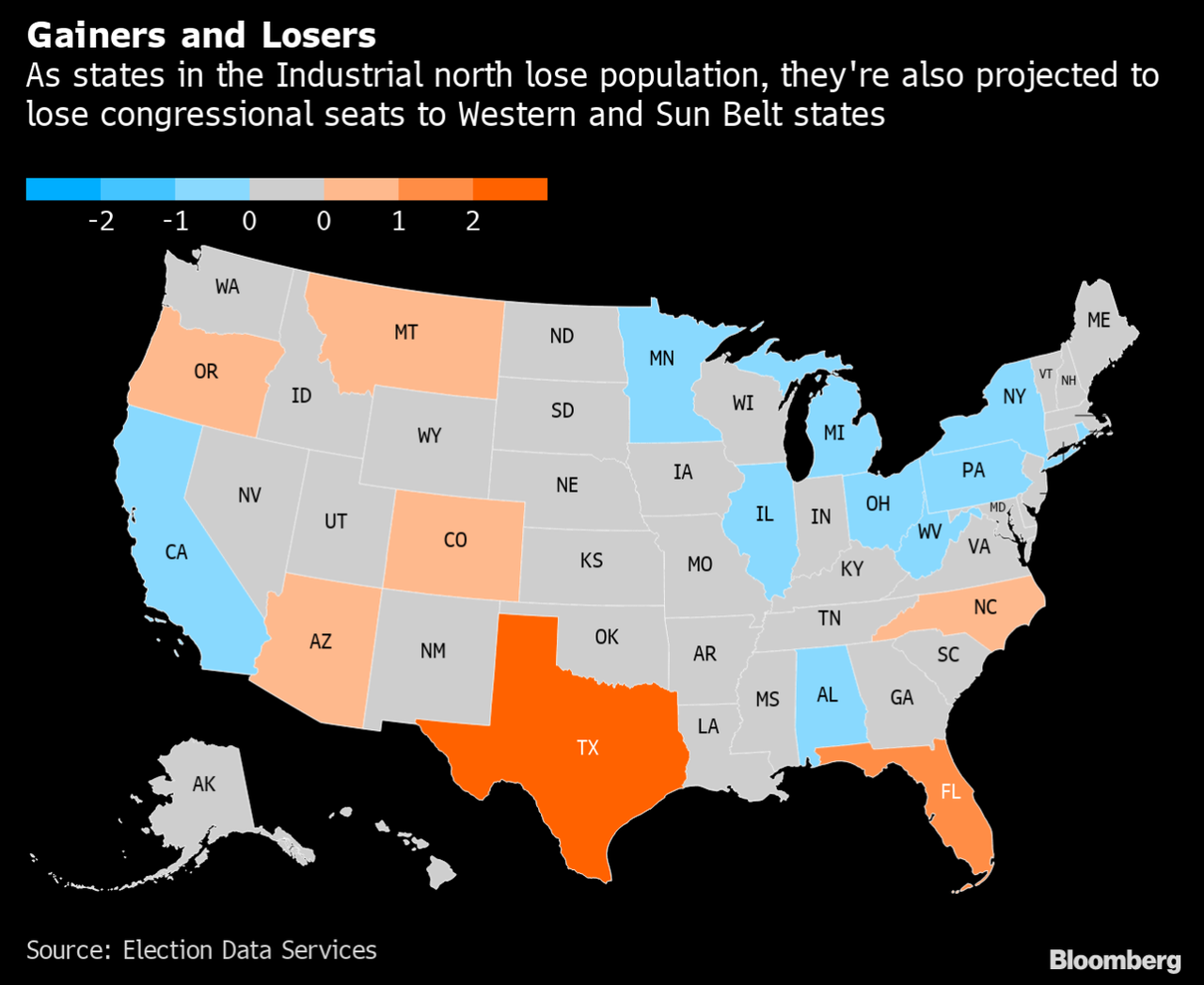
Census: TX Gains 2 House Seats, CA, NY Lose One As US Political Map Is Redrawn.

The first set of results from the 2020 census are in, and reveal that the red state of Texas is set to gain two House seats, while California and New York will each lose one. This will bring the red state of Texas to a total of 38 seats and 40 electoral college votes – the 2nd highest behind California.

Also gaining seats are Colorado, Florida, Montana, Oregon and North Carolina, while states losing House seats also include Illinois, Michigan, Ohio, Pennsylvania and West Virginia.

The states which gained seats are largely those won by former President Donald Trump in 2020, while states which Biden won during the election are “losers” according to Bloomberg.

And because the Electoral College factors in House representation, those states will lose influence in the 2024 presidential vote.

There is one bright spot for Democrats, as demographic changes also mean that Republican strongholds such as Texas are becoming more Democratic, putting the party closer to its long-term goal of someday moving the Lone Star state out of the Republican column.

According to the Census Bureau, the US population grew by 7.4% over the past decade to a total of 331,449,281 people.

The constitutionally mandated count of all people living in the US was delayed due to the Trump administration’s unsuccessful efforts to remove undocumented immigrants from the count, which would have likely increased the number of GOP-held districts in the next Congress.

The Census Bureau announced the first installment of figures during a 3PM Monday press conference. More detailed data on demographics will be released Aug. 16. It will show the growth in various population centers which will guide states in redrawing congressional district maps.

Montana Gov Is Latest to Sign State Bill Nullifying Federal Gun Restrictions

Gov. Greg Gianforte on Friday signed a bill that prohibits state and local law enforcement in Montana from enforcing federal bans on firearms, ammunition and magazines.

Supporters of the law have said it would protect the Second Amendment from stiffer gun control laws that could come from federal legislation or executive orders by President Joe Biden in the wake of several mass shootings that took place this year, including a shooting last week that killed eight people in Indianapolis.

Continue reading “”

OKLAHOMA PASSES SECOND AMENDMENT SANCTUARY STATE ACT

The Oklahoma House of Representatives just passed Senate Bill (SB 631) the “Second Amendment Sanctuary Act yesterday afternoon (04-20-21). Across the country more and more states are introducing legislation to uphold the 2nd Amendment and refuse any additional gun control measures from Federal, state, county and even local governments. This would mean that the state of Oklahoma wouldn’t adhere to, or enforce, any new gun control measures such as bans, buy backs, capacity limits or other restrictions that may be introduced in the future. This would include both legislation as well as executive orders. 

(SB 631) will now head to Governor Kevin Stitt’s desk for final approval and signature. Chances are better than good that the Governor will sign it and Oklahoma will join the ever growing list of states who have proclaimed themselves as Second Amendment Sanctuaries and have passed similar legislation. There was a rally yesterday (04-20-21) at the state capitol as pro Second Amendment supporters gathered to celebrate and show their appreciation to our state lawmakers for passing the bill. (SB 631) is just one of many bills Oklahoma legislators are working on to protect and uphold the citizen’s right to keep and bear arms. There’s lot of misinformation about the new bill and what it does. Here’s a quick look at what SB 631 says:

SECTION 2 (A) “The State Legislature hereby occupies and preempts the entire field of legislation by the federal government, any agency of this state or any political subdivision in this state to infringe upon the rights of a citizen of the State of Oklahoma, the unalienable right to keep and bear arms as guaranteed to them by the Second Amendment of the United States Constitution.”

SECTION 2 (B) Any federal, state, county or municipal act, law, executive order, administrative order, court order, rule, policy or regulation ordering the buy-back, confiscation or surrender of firearms, firearm accessories or ammunition from law-abiding citizens of this state shall be considered an infringement on the rights of citizens to keep and bear arms as guaranteed by the Second Amendment of the Constitution of the United States and Article II, Section 26 of the Constitution of Oklahoma.”

Continue reading “”

3/4 of States Are Now Stand Your Ground; only 12 Are Duty to Retreat

I wrote about this several months ago, but several states have gone stand-your-ground since then—Ohio, Arkansas, and now North Dakota—so I thought I’d repeat it.

[A.] The “duty to retreat” is something of a misnomer (though a very common one); it’s not actually a legally binding duty (the way a parent has a duty to support a minor child, or a driver has a duty to exercise reasonable care while driving). Rather, it’s a provision that, under certain circumstances, failing to retreat from a confrontation will effectively strip you of your right to use deadly force for self-defense.

Continue reading “”

This is the only state now that restricts permitless carry for only state residents. While changing the residency requirement from 1 year to 30 days is good; better would be for all citizens, state resident or not.


North Dakota: Pro-Gun Measures Passed out of Legislature and Sent to Governor’s Desk

[Friday] House Bill 1293 and House Bill 1297 were passed on a concurrence vote from the House, and will now be sent to the desk of Governor Doug Burgum for his signature. Please contact Governor Burgum and ask him to sign these important measures into law.

House Bill 1293 expands the list of firearms that an individual can carry in their vehicle under North Dakota’s Constitutional Carry law. HB 1293 also removes the restrictions on certain times of the day when one can open carry, and reduces the residency requirement for Constitutional Carry from one year to 30 days.

House Bill 1297 expands the list of locations that law-abiding gun owners can carry a concealed firearm for self-defense. HB 1293 clarifies that athletic events are only a prohibited location if they are “school” sporting events. Further, the measure allows for concealed carry in churches if the church has adopted a policy to allow it instead of previously having to obtain specific permission from the preacher or counsel.

 Gov. Ricketts Declares Nebraska a ‘Second Amendment Sanctuary State.’

Nebraska Gov. Pete Ricketts signed a proclamation that designates his state as a “Second Amendment Sanctuary State,” reaffirming the state’s support for gun rights.

“Nebraska has always been a state that has supported our Second Amendment rights,” Ricketts said, according to a video of the signing event. “As a symbol of that support, I am signing a proclamation declaring Nebraska a Second Amendment Sanctuary State, and with my signature, it will become official.”

A number of counties in the state have already declared themselves Second Amendment “sanctuaries.”

The move comes in light of recent federal gun-control proposals and orders following several mass shootings.

Continue reading “”

Governor Gordon Stands Up for Second Amendment, Signs Firearms Industry Non-Discrimination Act

CHEYENNE, Wyo. (Release) – Reinforcing his overarching belief in protecting Second Amendment rights in the face of today’s Executive Actions by President Biden, Governor Mark Gordon signed House Bill 236/House Enrolled Act 87- Firearms transactions – financial discrimination into law. The bill prohibits financial institutions and payment processors in Wyoming from discriminating against firearms businesses that support or are “engaged in the lawful commerce of firearms, firearm accessories or ammunition products.”

“Wyoming is,  has always been, and will continue to be a state where Second Amendment rights are recognized and protected. I oppose any orders or actions imposed from  the federal level that infringe on this fundamental right,” Governor Gordon said. “I will relentlessly defend our  Second Amendment and the Wyoming businesses involved in the firearms industry.”

Earlier this week Governor Gordon signed two other pieces of firearms-related legislation. First, Governor Gordon signed Senate File 155/Senate Enrolled Act 40. That legislation ensures that during emergencies the government cannot impose improper restrictions on Wyoming citizens’ lawful access to firearms. This is the way the Governor handled the COVID-19 emergency earlier this year.  He appreciated the Legislature developing a bill that backed up his approach.

The Governor also signed House Bill 116/House Enrolled Act 70, which extended permit-less carry in Wyoming to all law-abiding Americans. Wyoming was one of the first states to recognize the right to carry without a permit for its citizens, and the bill extends the same privilege to all legal gun owners who otherwise legally qualify to carry a firearm in the state.

Ducey signs ‘Second Amendment sanctuary’ bill

Gov. Doug Ducey signed a bill Tuesday evening that makes Arizona a “Second Amendment sanctuary” and bars law enforcement agencies in the Grand Canyon State from enforcing federal gun control measures, ignoring a last-minute plea from gun control groups urging him to veto it. 

“We want him to know that his constituents don’t agree with this,” Sophia Carrillo, a volunteer with gun safety group Moms Demand Action said to Arizona Mirror Tuesday morning after the group delivered nearly 2,500 signatures urging him to veto the bill. 

Moms Demand Action collected 2,485 signatures which they delivered to Ducey’s office Tuesdaymorning in the hopes that it will persuade the governor to veto House Bill 2111

The bill, sponsored by Rep. Leo Biasiucci, R-Lake Havasu, makes it illegal for local governments, the state and employees to enforce or cooperate with any federal law, act, treaty, rule or regulation that is “inconsistent with any law of this state regarding the regulation of firearms.” 

Continue reading “”

Juveniles don’t have the mental development to make such decisions.
Not that those who have reached the age of majority who want this have a fully developed adult mentality either.


Arkansas Legislature Overrides Governor’s Veto, Bans Gender-Transition Surgery for Minors.

The Arkansas General Assembly voted Tuesday to enact a ban on gender transition surgery for minors, overriding a veto by Governor Asa Hutchinson.

Arkansas is the first state to ban transition surgery for minors, although similar legislation is under consideration in other states. The bill also prohibits doctors in Arkansas from administering hormones or puberty blockers to residents under age 18.


Hutchinson acknowledged on Monday that the General Assembly would likely override his veto, which state lawmakers can do with a simple majority vote.

However, Hutchinson said the bill “would put the state as the definitive oracle of medical care, overriding parents, patients, and health care experts,” adding that the legislation was an example of government “overreach.”

“Government under a conservative philosophy should be restrained,” Hutchinson said. “This is an example of where restraint is better than over-broad actions that interfere with important relationships in our society.”

Hutchinson’s veto came after South Dakota governor Kristi Noem vetoed a state bill that would have restricted girls’ sports at public schools to biological females. Noem said her veto stemmed from concerns over possible punitive measures from national organizations, such as the American Civil Liberties Union or the National Collegiate Athletic Association.

The South Dakota legislature will consider overriding Noem’s veto, which would require the support of two-thirds of state lawmakers.