
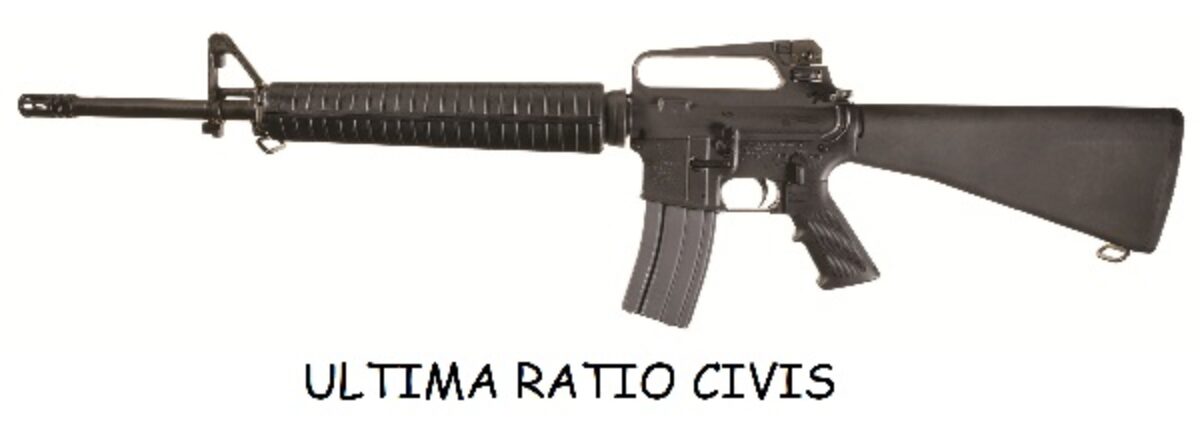
Category: RKBA
Lysander Spooner: The Second Amendment Isn’t the Ceiling — It’s the Basement Floor
Most “pro-2A” people treat the Second Amendment as if it were the ceiling of our rights.
Lysander Spooner read it and laughed. To him it was the basement floor of a natural right that no government on earth can legitimately restrict.
Who Was Lysander Spooner?
1808–1887. Lawyer, abolitionist, individualist anarchist. A man who made the Founders look like moderates.
Spooner in His Own Words
On the natural right to arms (completely independent of any constitution):
“The right of self-defence is the first law of nature… The right to keep and bear arms is only a declaration that this natural right shall not be infringed.”
— A Letter to Charles Sumner (1860s)
On what happens when the people are disarmed:
“Those who are capable of tyranny are capable of perjury to sustain it… All restraints upon the government are inefficient, unless the people are in possession of the means of resisting it.”
— No Treason No. VI: The Constitution of No Authority (1870)
On the purpose of an armed populace:
“The right of the individual to keep and bear arms… is the great bulwark against tyranny, the only efficient security for the preservation of liberty.”
— Vices Are Not Crimes (1875, manuscript)
On the idea that citizens should be limited to “sporting” arms while government has military weapons:
“A man’s right to defend his life and liberty is as perfect against a thousand as against one… He has the same right to whatever weapons are necessary for that defense that the government has to whatever weapons it may choose to use against him.”
On every gun law ever written:
“All legislatures… that assume to enact laws forbidding or restricting the people in the exercise of their natural right to keep and bear arms, are guilty of usurpation and tyranny.”
— Direct paraphrase from multiple Spooner writings, crystallized in No Treason and his legal essays
Tucker vs. Spooner
St. George Tucker (1803):
“The several departments and officers of the governments… are bound by oath to oppose [unconstitutional acts]; for, being bound by oath to support the constitution, they must violate that oath, whenever they give their sanction… to any unconstitutional act.”
Spooner went further: the unconstitutional gun laws themselves are acts of war against the people, and armed resistance against their enforcers is morally justified.
The Spooner Standard
“If the people are to retain their liberty, they must be at least as well armed and disciplined as the government that rules over them.”
— Consistent theme across No Treason and his abolitionist writings
If you still think “reasonable regulations” are compatible with liberty, you’re closer to Everytown than you are to Lysander Spooner.
Read him.
Burn every compromise to the ground.
Own what your rulers own — in the same quantities, or more.
Because the moment you accept anything less, the experiment in liberty is already over.
Anti-liberty/gun cracktivist’s
By Mike McDaniel
Some things, death and taxes among them, never change. In the same category are the specious arguments of anti-liberty/gun cracktivists. Whenever a horrific crime like a mass shooting occurs, they blame the gun and the Americans who would never commit such a crime.
They also have additional narratives they hope Americans can be tricked into believing, such as virtually every mass attack is carried out by white men, all of whom are domestic terrorist, racist, transphobic white supremacist, Ultra-MAGA, Nazi, haters determined to destroy “our democracy.”
One such cracktivist is apparently John Davenport:

Graphic: Fordham University Faculty Site. Public Domain.
Dr. Davenport tells us the idea of greater security for students and the public at large is a “fallacy,” and “would not make us much safer.” He should know. He’s a professor of peace and justice studies, which obviously makes him an expert about peace and justice and stuff.
Think about it for a minute. How much would it actually cost to put armed guards in every single store and restaurant, every 300 feet or so on beaches and at open air events, in every movie theater and every 200 feet at concerts, at every entrance to every building at any hospital, college, school, church, temple or mosque, at all streets junction where lots of traffic piles up – and so on?
Actually, he’s sort of right. In 2013 even the NRA was advocating armed guards in every school. The usual suspects were against that, and the idea eventually died because the costs were—and are—simply too high. The numbers aren’t exact, but there are more than 110,000 K-12 public and private schools in America. missiongraduatenm.org/number-of-schools-in-the-us/ Putting even one, full-time armed guard in each school is prohibitively expensive, and far more than one would be necessary.
I don’t understand Lowy’s particular brand of stupid, but I do admire his total commitment to it.
Anti-Gun Attorney Behind Mexico’s Lawsuit Against Gun Makers Brings the Stupid Back to SCOTUS
Jonathan Lowy, the former litigator for Brady who’s now the head of something called Global Action on Gun Violence, was on the receiving end of a 9-0 Supreme Court decision against his client in Smith & Wesson v. Mexico, where SCOTUS unanimously concluded that the Mexican government’s attempt to sue U.S. gunmakers for aiding and abetting cartel violence was not only foreclosed by the Protection of Lawful Commerce in Arms Act, but was based on a number of implausible allegations that Lowy failed to prove.
Lowy gets good money from anti-gun groups like Everytown to tilt at windmills, though, so that embarrassing loss isn’t keeping him away from the Supreme Court. Global Action on Gun Violence recently submitted an amicus brief in Wolford v. Lopez arguing that Hawaii’s “vampire rule” prohibiting concealed carry on all private property unless property owners explicitly allow it should be upheld because SCOTUS was wrong in Heller when it concluded that the Second Amendment protects and individual right to keep and bear arms.
The Second Amendment uniquely states its“well-regulated militia” purpose in its text, and, for over two centuries, courts faithfully and consistently interpreted it in light of that text and purpose. In modern parlance, it was read, logically, as its author, James Madison, intended; essentially, “Because a well-regulated militia is necessary to the security of a free State, the right of the people to keep and bear arms in state militias shall not be infringed.” The history surrounding the Second Amendment’s drafting and ratification make clear that Madison and the other Framers were animated only by anti-federalist concerns that the new federal government could neuter state military forces.
… The Court in District of Columbia v. Heller replaced Madison’s vision with an ahistorical, atextual reading of the Second Amendment that renders its first half an inconvenient irrelevancy and injects a modern purpose of private, armed self defense with handguns that was nowhere mentioned in the Amendment’s text or history. After Heller, the courts have been required to interpret the Second Amendment essentially (and nonsensically) as:
“Because a well-regulated militia is necessary to the security of a free State, the right of the people (including those who have nothing to do with the militia and may even oppose the state) to possess arms for private self-defense (wholly unrelated to militias) shall not be infringed.” That interpretation is wrong.
Lowy’s argument was thoroughly rejected by the majority in Heller, which rightfully noted that the prefatory clause of the Second Amendment doesn’t make the right to keep and bear arms contingent on service in the militia.
The Trace Finds ‘Hope’ in Doctor’s Idea to Cripple Gun Industry
While the staff of the Bloomberg-funded anti-gun website The Trace are scratching their heads over the “paradox” of steep declines in violent crime without steep reductions in lawful gun ownership, they’re also finding and embracing new gun control proposals that would cripple the firearms industry… and by extension, our right to keep and bear arms.
In The Trace’s look back at gun control efforts this year, the site proclaims that one of the things that gives their reporters “hope” in 2026 is a “Chicago doctor [who] has started a policy experiment that would compel gunmakers in Illinois pay into a compensation fund toward gun violence victims in order to get their state license.”
I wrote about this for our VIP members last month (and for the record, VIP, VIP Gold, and VIP Platinum memberships are currently 74% off when you use the promo code MERRY74, so now’s a great time to join), but in case you missed it, a Chicago doctor named Anthony Douglas is leading the push for a bill called “Responsibility in Firearm Legislation Act.”
Ironically, this bill is an irresponsible piece of legislation that seeks to hold gun companies financially responsible for the actions of violent criminals; not through civil lawsuits, which have long been a favorite tool for anti-gun advocates, but through state-level licensing for firearms manufacturers.
Illinois already requires federally licensed firearm retailers to get an Illinois license before they can operate, but the RIFL Act would impose a new licensing mandate on gun makers as well. And in order to get that license, manufacturers would have to agree to cough up money when one of hteir products is used in a crime. As The Trace describes Douglas’s plan:
Under the plan, a gun company’s annual contribution would scale with how often its firearms are recovered in fatal incidents, shootings, and suicides in Illinois. The more frequently a company’s guns are found to create public costs, the more it would pay. Hospitals could bill the new fund directly for health care costs after a firearm injury. Families could get help with lost wages, emergency relocation, child care, and transportation.
The compensation fund would also serve as a way to hold the gun industry financially accountable without litigation. Taking manufacturers to court rarely proves successful thanks to the gun industry’s broad legal immunity. For two decades, the federal Protection of Lawful Commerce in Arms Act, or PLCAA, has insulated gunmakers from most lawsuits over third‑party misuse of their products, meaning that the gun industry is rarely held financially responsible or forced to cover any costs, unlike other industries. The RIFL Act sidesteps that terrain by using a licensing fee to cover compensation instead of damages in court.
Supporters and the bill’s legislative sponsor say lawyers have reviewed the framework and believe it could withstand constitutional scrutiny, although they readily concede the industry would almost certainly sue. “Anything now can be argued in terms of constitutionality,” Douglas said, “but this is designed to avoid PLCAA.”
Yes, thankfully anything that impacts our right to keep and bear arms can be argued in terms of constitutionality, and Dr. Douglas’s big idea utterly fails, despite what anti-gun attorneys might claim.
This bill isn’t just a condition and qualification on the commercial sale of arms, which the Supreme Court said in Heller are “generally permitted”. It imposes a meaningful constraint on the ability to purchase firearms. Most, if not all, gun companies would simply boycott the Illinois market altogether rather than apply for a license that holds them financially responsible for the criminal misuse of their product, and that, in turn, would make it impossible for Illinois residents to lawfully acquire a firearm.
Douglas’s idea, just like California’s “1-in-30” gun rationing law struck down by the federal judiciary, flies in the face of the national tradition of gun ownership. As the Ninth Circuit wrote when upholding a district court decision that held the gun rationing law unconstitutional, “Bruen requires a ‘historical analogue, not a ‘historical twin,’ for a modern firearm regulation to pass muster. Here, the historical record does not even establish a historical cousin.”
Interestingly enough, the sign on the door of the DMV only prevented law-abiding citizens from carrying 🤔 pic.twitter.com/N1C1CNBKoF
— The Conservative Alternative (@OldeWorldOrder) December 23, 2025
L. Neil Smith –
Over the past 30 years, I’ve been paid to write almost two million words, every one of which, sooner or later, came back to the issue of guns and gun-ownership. Naturally, I’ve thought about the issue a lot, and it has always determined the way I vote.
People accuse me of being a single-issue writer, a single- issue thinker, and a single- issue voter, but it isn’t true. What I’ve chosen, in a world where there’s never enough time and energy, is to focus on the one political issue which most clearly and unmistakably demonstrates what any politician — or political philosophy — is made of, right down to the creamy liquid center.
Make no mistake: all politicians — even those ostensibly on the side of guns and gun ownership — hate the issue and anyone, like me, who insists on bringing it up. They hate it because it’s an X-ray machine. It’s a Vulcan mind-meld. It’s the ultimate test to which any politician — or political philosophy — can be put.
If a politician isn’t perfectly comfortable with the idea of his average constituent, any man, woman, or responsible child, walking into a hardware store and paying cash — for any rifle, shotgun, handgun, machinegun, anything — without producing ID or signing one scrap of paper, he isn’t your friend no matter what he tells you.
If he isn’t genuinely enthusiastic about his average constituent stuffing that weapon into a purse or pocket or tucking it under a coat and walking home without asking anybody’s permission, he’s a four-flusher, no matter what he claims.
What his attitude — toward your ownership and use of weapons — conveys is his real attitude about you. And if he doesn’t trust you, then why in the name of John Moses Browning should you trust him?
If he doesn’t want you to have the means of defending your life, do you want him in a position to control it?
If he makes excuses about obeying a law he’s sworn to uphold and defend — the highest law of the land, the Bill of Rights — do you want to entrust him with anything?
If he ignores you, sneers at you, complains about you, or defames you, if he calls you names only he thinks are evil — like “Constitutionalist” — when you insist that he account for himself, hasn’t he betrayed his oath, isn’t he unfit to hold office, and doesn’t he really belong in jail?
Sure, these are all leading questions. They’re the questions that led me to the issue of guns and gun ownership as the clearest and most unmistakable demonstration of what any given politician — or political philosophy — is really made of.
He may lecture you about the dangerous weirdos out there who shouldn’t have a gun — but what does that have to do with you? Why in the name of John Moses Browning should you be made to suffer for the misdeeds of others? Didn’t you lay aside the infantile notion of group punishment when you left public school — or the military? Isn’t it an essentially European notion, anyway — Prussian, maybe — and certainly not what America was supposed to be all about?
And if there are dangerous weirdos out there, does it make sense to deprive you of the means of protecting yourself from them? Forget about those other people, those dangerous weirdos, this is about you, and it has been, all along.
Try it yourself: if a politician won’t trust you, why should you trust him? If he’s a man — and you’re not — what does his lack of trust tell you about his real attitude toward women? If “he” happens to be a woman, what makes her so perverse that she’s eager to render her fellow women helpless on the mean and seedy streets her policies helped create? Should you believe her when she says she wants to help you by imposing some infantile group health care program on you at the point of the kind of gun she doesn’t want you to have?
On the other hand — or the other party — should you believe anything politicians say who claim they stand for freedom, but drag their feet and make excuses about repealing limits on your right to own and carry weapons? What does this tell you about their real motives for ignoring voters and ramming through one infantile group trade agreement after another with other countries?
Makes voting simpler, doesn’t it? You don’t have to study every issue — health care, international trade — all you have to do is use this X-ray machine, this Vulcan mind-meld, to get beyond their empty words and find out how politicians really feel. About you. And that, of course, is why they hate it.
And that’s why I’m accused of being a single-issue writer, thinker, and voter.
But it isn’t true, is it?
Nope. Not going to agree to anything that will keep the NFRTR registration. If they want to tax sales of NFA firearms for medicare funding, do it like they do with Pittman-Robertson funding for wildlife restoration, an excise tax at the point of sale.
Health Care for Gun Rights? Bill Would Reverse Silencer Tax for Medicare Funds
A coalition of Democrat legislators is backing a move to rewind last summer’s repeal of the NFA tax on suppressors, short-barrel rifles, and similar items to fund their own health-care initiative.
These sponsors are backing the so-called Medicare Investment and Gun Violence Prevention Act, which would repeal the hard-fought removal of NFA taxes established by Trump’s One Big Beautiful Bill. The scheme would then reinstitute the tax and direct the funds to pay for Medicare costs.
Current backers include Rep. Maxwell Frost (D-Fla.) and a host of blue-state senators like Angela Alsobrooks (D-Md.), Ron Wyden (D-Ore.), Chris Van Hollen (D-Md.), Cory Booker (D-N.J.), and Jeanne Shaheen (D-N.H.). They claim the re-removal of Americans’ gun rights would scrounge up some $1.7 billion in taxes over the next decade.
“This legislation is a 2-for-1 response to Republicans driving up health care costs and letting guns invade our communities,” claimed Sen. Alsobrooks. “When Republicans snuck in tax cuts to the Big Ugly Bill on gun silencers and short-barreled rifles, they made their position clear: guns matter more than Americans’ lives. At a time when health care costs are skyrocketing, and just days after yet another tragic school shooting, now is the time to act. Our bill will repeal the unnecessary tax cuts on deadly weapons and use the money saved for Americans’ health care, which has been decimated by Republicans.”
Of course, it is not “money saved,” as Sen. Alsobrooks claims. It is money taken, via a defunct tax mechanism, from Americans exercising their constitutionally protected Second Amendment rights. Ironically, it also attacks proven hearing safety devices like suppressors in the name of better health care.
The move to snatch back gun rights via NFA taxes is backed by a host of anti-gun interest groups, ranging from Newtown Action Alliance and Brady to Marylanders to Prevent Gun Violence.
While the plot is an extreme long shot in the currently Republican-controlled House and Senate, many Democrats are eagerly looking to next year’s midterm elections. At the moment, it is hard to take the barely 2.5-page bill seriously, but 2026 is just around the corner.
LEGAL ALERT: The Tenth Circuit has DENIED New Mexico’s en banc petition following a 3-judge panel’s ruling that the state’s 7-day firearm waiting period likely violates the Second Amendment. As a result, the panel’s ruling will remain in place. https://t.co/kcoqnP8YBp pic.twitter.com/5B8aeYjbEG
— Firearms Policy Coalition (@gunpolicy) December 22, 2025
Now, if they’d stop their schizophrenic support for similar federal laws.
Justice Department Sues the District of Columbia for the Unconstitutional Ban of Semi-Automatic Firearms
Monday, December 22, 2025
Today, the Justice Department sued the District of Columbia’s Metropolitan Police Department (MPD), alleging that the District government and MPD unconstitutionally ban the AR-15 and many other firearms protected under the Second Amendment. The District’s gun laws require anyone seeking to own a gun to register it with D.C. Metro Police. However, the D.C. Code provides a broad registration ban on numerous firearms — an unconstitutional incursion into the Second Amendment rights of law-abiding citizens seeking to own protected firearms for lawful purposes. MPD’s current pattern and practice of refusing to register protected firearms is forcing residents to sue to protect their rights and to risk facing wrongful arrest for lawfully possessing protected firearms.
Democrats really do want you dead
Among the most obvious and glaring indicators of the political divide is the issue of self-defense. Normal Americans—largely but not exclusively Republicans—are in harmony with America’s Founders who understood self-defense is a natural, unalienable, God-given individual right which forms the basis of the Second Amendment. If every American doesn’t have a right to self-defense, a right government does not grant and cannot revoke, what other right matters? If one’s continuing existence depends on size, strength and aggression, we’re degenerating to another dark age.
The police can’t protect anyone and can’t be sued when they don’t.
Because Normal Americans understand the Second Amendment and why the Founders wrote it, they’re comfortable with citizens keeping and bearing arms. They understand that right isn’t limited to handguns, nor does it have anything to do with target shooting, hunting or militia membership. They know the primary reason for the Second Amendment is to allow Normal Americans to deter tyranny, and if necessary, to defeat a totalitarian government.
That, even more than the historic record, the Second Amendment and the Supreme Court’s Heller, McDonald and Bruen decisions, makes Democrat heads explode, because they intend to become that totalitarian government. That’s why they’re always trying to disarm Normal Americans.
Those with anti-liberty/gun intentions tend to be, though not exclusively, Democrats. They don’t recognize unalienable rights and call those who believe fundamental rights come not from government but from God, “Christian Nationalists,” which is not a complementary label. Their faith is in themselves and the one-party state they labor to create. They reject the Second Amendment and the rest of the Constitution because both protect individual rights and limit the powers of government, the powers they want to exclusively, eternally wield.
Individuals have rights; governments have powers.
The Bondi Beach massacre and the Brown University attack starkly reveal the differences in these philosophies and their consequences. When an attack happens, the police will virtually never be there in time. Attackers will have considerable time to kill. If citizens are universally disarmed by law or are obeying “gun-free zone” signs, they’ll be unable to fight back. Australia is essentially a gun-free zone; so is Brown University.
The police would love to be able to stop a shooter, but even if they’re present, which was reportedly the case at Bondi Beach, they may do nothing which gave the killers a free-fire zone for from 10-20 minutes. At Uvalde, some 300 officers allowed a 70+ minute free fire zone. At Brown, they had no role in stopping the attack.
In any attack, someone must call the police. A dispatcher must assimilate the information and dispatch the call. Officers must race to the scene–if any are available. In some places, the nearest officer might be an hour away. When they arrive, they must orient themselves and close with the attacker or attackers without getting killed before they can do any good. And in all that time, unarmed innocents are dying. Or even worse, as happened at Bondi Beach, the police, who are rushing into a dangerously ambiguous situation, might shoot an innocent.
Normal Americans given this indisputable set of facts want willing citizens to go armed. They trust their fellow citizens with motor vehicles, which are far more deadly than guns. They’re willing to extend that trust to guns as well. Do away with gun-free zones, to be sure, but to deter attacks, and to limit damage when they occur, the only sane, effective solution is allowing honest Americans the means to save their own lives and the lives of others. If they’re present when an attack occurs, they know precisely who the good and bad guys are and they’re able to quickly end the attack.
Democrats see things very differently. Just as officials in Australia and Rhode Island did in the immediate aftermath of those attacks, American Democrats reflexively want to disarm Americans. Despite the failure of near-absolute gun-banning laws and regulations, they demand even more, and more punitive, anti-liberty/gun laws.
Normal Americans want everyone, Democrats included, to have the ability to defend their lives, the lives of those they love and even strangers. Democrats want everyone, except their publicly funded security, disarmed. Normal Americans want mass murderers dead and fellow Americans alive. Democrats want mass murders to have free-fire zones and want Normal Americans dead.
What other result can their disarmament policies bring?
Mike McDaniel is a USAF veteran
Arkansas Attorney General Clarifies State’s Concealed Carry Law
On November 14, 2025, the Arkansas Attorney General (AG), Tim Griffin, clarified Arkansas law about the legal carry of firearms. The three questions to be answered included: publicly owned buildings or facilities, the legal definition of an “athletic event” in Arkansas law, and what type of carry is prohibited in statutorily prohibited spaces. The questions were asked by the Honorable Sonia Eubanks Barker, a Republican state representative with a pro-Second Amendment reputation.
AG opinions are not binding on judges. They are statements of what the Attorney General believes the law to be. They are often taken into account by prosecutors when determining whether to prosecute in a given circumstance.
AG Griffin’s response was detailed and encyclopedic. It is well-crafted and an excellent read. The response explains Arkansas’s statutory law about the carry of firearms in considerable detail. The response also explains some of the intricacies of law and statutory interpretation. In addition to the lengthy response, the AG provides brief summaries of his findings. AG Griffin found:
Let me reiterate:
Bondi Beach Shows Why Self-Defense Is a Vital Right
Individuals and communities must take responsibility for their own safety.
At Bondi Beach in Sydney, Australia, a father-son team of ISIS-inspired terrorists murdered attendees at a celebration of the first day of Hanukkah. One of the attackers was disarmed by a heroic civilian who was shot in the process, while others lost their lives trying to help.
Contrasting Responses to Threats
Australia’s Prime Minister Anthony Albanese responded to the shooting with promises to further tighten gun laws in the already restrictive country—a measure more likely to disarm potential victims than to inconvenience those planning a homicidal attack. In the U.S., by contrast, Jews stepped up security by themselves and alongside police. At the request of my wife’s rabbi, I recruited a friend who served as a Force Recon Marine. We strapped on armor and pistols to patrol the crowd at the menorah lighting in Sedona, Arizona. Members of the congregation carried concealed weapons of their own.
Nothing happened, but we were there to deter problems and respond if necessary. There’s a big difference between doubling down on failed state policies and taking responsibility for your own safety.
According to Prime Minister Albanese’s office, after the attack, “leaders agreed that strong, decisive and focused action was needed on gun law reform as an immediate action” and promised “to strengthen gun laws” with further restrictions. Of course, that’s what Australia did in 1996 after the Port Arthur mass shooting. The government banned a variety of firearms, with compensation for their surrender. Compliance was limited and the effort spawned a significant black market for guns.
But Australia’s millions of guns didn’t kill 15 people at Bondi Beach. Two men with known Islamist ties who traveled last month to the Philippines for training at terrorist summer camp committed the murders. They chose guns as their tools, but they could just as easily have used explosives, vehicles, incendiaries, or something else to cause mayhem.
“The issue is not gun laws. It’s hatred of Jews,” Rabbi Daniel Greyber of Durham, North Carolina commented after the Bondi Beach attack.
A Government That Can’t Be Trusted
And there’s little reason Australian Jews should trust the Australian government.
BLUF
No, permitless carry has increased.
In its annual report on concealed carry, the Crime Prevention Research Center (CPRC) determined that 20.88 million Americans now have concealed-carry permits—this is a 2.7% drop from 2024.
The number of citizens with concealed-carry permits in the U.S. peaked in 2022 and has now declined for the third year in a row. Today, roughly 8% of U.S. adults hold permits. But has the number of people who choose to legally carry concealed really dropped?
The straightforward answer is no. The number of people with permits actually rose in the 21 non-constitutional carry states, but they fell by a slightly larger percentage in the 29 constitutional carry states.
“Even so, our data show that the total number of people legally carrying firearms has increased, driven by the expansion of constitutional carry,” says John Lott, president and founder of the CPRC.
The central reason for this decrease is the widespread adoption of constitutional carry laws. As this was being written, citizens in a total of 29 states now enjoy some type of constitutional carry. Indeed, “46.8% of Americans (157.6 million) now live in constitutional carry states, with 67.7% of the land in the country (2.57 million square miles),” reports the CPRC.
Although no additional states enacted such laws in 2025, the impact of more state governments getting out of the way of citizens’ constitutionally protected right to keep and bear arms has continued. Many people in constitutional carry states still go through the trouble to get permits, as this enables them to travel with their self-defense firearm to states that don’t have constitutional carry but do recognize their state’s permit.
The trouble for researchers like Lott, however, is that unlike gun ownership surveys that may be affected by people’s unwillingness to answer personal questions, concealed handgun permit data is the only really “hard data” on the number of people who carry we have available; in fact, this data becomes less accurate as more states become constitutional carry. But then, that is in step with the true nature of freedom—law-abiding citizens shouldn’t need to apply to the government for their rights.
So, though the number of permit holders from 2024 to 2025 fell by 0.59 million to 20.88 million, the number of people carrying is thought to be rising. Interestingly, outside of the restrictive states of California and New York, about 9.3% of adults have a permit; whereas the inclusion of these two states brings the number down to about 8%.
I’m a gun owner, a combat veteran, and the husband of a gun violence survivor — I know how important gun laws are for keeping Americans safe.
That’s why I’m pushing legislation to close the Charleston loophole: if you haven’t passed a background check, you shouldn’t get a gun…
— Senator Mark Kelly (@SenMarkKelly) December 18, 2025
IN REPLY:
I’m a black woman who pretends to be a catgirl on the internet. I enjoy sci-fi novels and I fix cars for enjoyment. None of that tells you a damn thing about the usefulness of MY stance of gun control. Just like you being a gun owner, a veteran, or married to a crime victim tells nobody anything about whether a proposed law is constitutional, effective, or even coherent.
Personal biography is not policy analysis. It’s just vibes in a dress uniform. In your case, I’ll bet the medals are on backwards. Gun control is a nice idea. So is banning drugs. So is banning murder. The problem isn’t intention, it’s reality. Laws don’t operate in a vacuum where only good people follow them and bad people politely comply. They operate in the real world, where criminals route around restrictions the way water routes around rocks. Felons and domestic abusers are already prohibited from owning firearms.
The “Charleston loophole” rhetoric pretends this isn’t true, as if violent criminals are currently wandering into gun stores, twirling mustaches, and lawfully purchasing rifles because a stopwatch hit zero. That isn’t how crime works, and it isn’t how criminals acquire guns. (HINT: They steal them, generally)
What these laws ACTUALLY do is expand discretionary denial and delay for people who are already legal, already vetted, and already compliant. They turn a right into a permission slip that expires if the government is slow, incompetent, or simply hostile. If the state can block a right by failing to act, that right no longer exists. It’s a favor. You can believe gun control should work. (Many people do.) The thing is, belief isn’t evidence. Your credentials aren’t arguments. If the policy fails in practice, pointing at your life story doesn’t make it succeed.

Soros: The Other Billionaire Behind the Anti-Gun Agenda
Everyone knows that former New York City Mayor Michael Bloomberg is knee deep in funding just about every anti-gun effort that comes around the bend. The man has it bad for gun rights, and I have no idea why, especially as he’s surrounded by armed bodyguards all the time. He can’t be that anti-gun.
He’s just anti-you having a gun.
But he’s far from the only billionaire funding the anti-gun agenda. Another name is one familiar to anyone who follows the left-leaning money trail on pretty much any issue, and that’s George Soros.
As Frank Miniter notes at America’s 1st Freedom, Soros is a major funder of anti-gun efforts via his Open Society Foundations.
Indeed, the Hungarian-born billionaire’s public persona could have been inspired by Ian Fleming’s villains in his James Bond novels. Soros, who is now 95 years old, could be a combination of Dr. No and Ernst Stavro Blofeld (a character the Austin Powers trilogy parodied so well!). Indeed, Soros’ Open Society Foundations can be SPECTRE level nefarious.
The Washington Free Beacon recently jumped into this topic with a piece titled, “‘Assault on Our Sovereignty’: How George Soros Funds Foreign Government Lawsuits Against American Gun Makers.”
The report details how Soros’ Open Society Foundations helped fund the anti-gun group Global Action on Gun Violence (GAGV), which worked with Mexico to bring a lawsuit against U.S. firearms manufacturers, a case that went all the way to the U.S. Supreme Court—the Court ruled 9-0 that Mexico could not make gun makers pay for criminal actions in Mexico.
“Over the years, Soros has funneled $32 billion to the Open Society Foundations, which in turn bankrolls many leftwing causes throughout the world,” explains NRA-ILA.
Indeed, Soros’ money has been used against Americans’ Second Amendment rights for decades.
“In 2000, Open Society published a widely circulated report entitled, Gun Control in the United States. The publication called for a host of new federal and state gun restrictions … . In the early 2000s, Open Society also gave support to gun control groups such as the Million Mom March, the Educational Fund to Stop Gun Violence, New Yorkers Against Gun Violence, and Women Against Gun Violence. Further, the group funded various dubious lawsuits against the gun industry, including a high-profile case brought by the NAACP.
Now, I’m not saying that Soros is a real-life Bond villain. I’m just saying that I don’t know anything that a real-life Bond villain would do differently.
Especially since people compared Elon Musk to just such a character for working with President Donald Trump, when he hasn’t come close to the level of manipulation of our society that Soros has.
Couple his efforts with Bloomberg’s, and what we’ve clearly got here is the money behind the efforts.
While the anti-gunners love to make a big thing about money playing a role in the gun debate, our money tends to come in the form of private individuals donating what they can to organizations they believe in, while the gun control side is funded by billionaires who wouldn’t know what it’s like to have to defend the lives of themselves and their families. They hire people for that and if you can’t afford to do the same, well, you’re just not important enough to live.
I’m sure some will try to flip the script and make out like my issue is some other characteristic of these two men, but it’s not. I don’t even care that they’re rich. That doesn’t bother me at all.
It’s that they’re trying to destroy this country by taking away the very right our Founding Fathers enshrined in the Bill of Rights to protect all others.
The Second Amendment Foundation (SAF) and its partners have filed an amicus brief with the Third Circuit Court of Appeals in a case challenging the federal lifetime ban on firearm possession as applied to an individual with a decades-old misdemeanor DUI conviction.The case, Williams v. Attorney General of the United States, will be argued before an en banc panel in February. SAF is joined in the amicus filing by the California Rifle & Pistol Association, Citizens Committee for the Right to Keep and Bear Arms and Second Amendment Law Center.
“The government’s position defies Bruen and Rahimi by seeking to impose a permanent disarmament on a law-abiding citizen based solely on a nonviolent misdemeanor from 20 years ago, with no evidence of ongoing danger,” said SAF Director of Legal Research and Education Kostas Moros. “History shows that Founding-era laws addressed the risks of intoxication and firearms through temporary restrictions on those currently impaired, never by stripping gun rights forever from someone who once drank irresponsibly but has since reformed. We urge the Court to reject this overreach and affirm the district court’s ruling.”
If the Third Circuit rules in favor of Mr. Williams, it could have major implications for many others who are disarmed due to similar convictions.
“This case highlights the unconstitutional overreach of federal disarmament laws that ignore historical limits and present-day realities,” said SAF founder and Executive Vice President Alan M. Gottlieb. “SAF is committed to defending the rights of individuals like Mr. Williams, and we believe this case warrants the Court’s careful consideration.”
For more information visit SAF.org.
US government sues US Virgin Islands and accuses officials of violating the Second Amendment
SAN JUAN, Puerto Rico (AP) — A Second Amendment clash has erupted between the federal government and the U.S. Virgin Islands.
The U.S. government sued the U.S. territory, its police department and Police Commissioner Mario Brooks on Tuesday, accusing them of obstructing and systematically denying American citizens the right to possess and carry guns.
The U.S. Virgin Islands requires that applicants demonstrate “good reason to fear death or great injury to his person or property,” and to have “two credible persons” to vouch for their need of a firearm. Local law also requires that someone have “good moral character” to obtain a gun permit, which is valid for up to three years and applies to a single weapon.
The lawsuit states that no specific standard has been set or defined for the requirement of character. It also claims that the defendants “regularly” refuse to issue permits to those who by law are “deemed to be an improper person” by the territory’s police commissioner.
The lawsuit states that those in the U.S. territory also must “submit to intrusive and warrantless home searches” as one condition to obtain a gun permit. If an applicant refuses a home inspection, which takes “several months to a year to schedule and complete,” the government will not process their request, according to the lawsuit.
Tim Walz Tries to Create a Backdoor Firearm Registry After Gun Ban Fails in State Legislature.
Tim Walz may actually be one of those politicians who really is as dumb as he looks. Despite the DFL’s [Democratic-Farmer-Labor Party] virtual control of Minnesota government, he still couldn’t gin up enough support to push an “assault weapons” ban through the legislature. About that situation, he wasn’t happy.
Not willing to allow that very public failure to stand, he signed two executive orders yesterday designed to generate some, uh, positive headlines in the state’s cooperative legacy press as a way to blunt the effects of the legislative defeat, the latest in a long string of very bad news for the hapless knucklehead who sits in the big chair.
From Northern News Now . . .
Governor Tim Walz signed two executive orders on Tuesday morning, surrounded by DFL lawmakers and advocates for gun violence prevention.
“I do not have the capacity as governor to issue an executive order to get rid of [assault weapons], but what I do have the ability to do is to start to move in a direction,” he said ahead of signing the orders.
The first order, according to Walz, aims to expand the administration’s efforts to provide added education on so-called red flag laws and safe storage practices.
The order will also require insurance companies to submit homeowners’ policy and claims data on firearms, using the state’s existing authority to issue “data calls” to recommend possible policy changes to the legislature.
Using taxpayer dollars to encourage the use of due process-free red flag law firearm confiscation isn’t anything new. It’s been done by the usual suspects at both the federal and state levels. But Walz is also creating a bureaucratic monstrosity he’s euphemistically calling the “Statewide Safety Council.” In practice it will likely serve the same purpose in the Land o’ Lakes as Biden’s now defunct White House Office Gun Violence Prevention.
As the Minnesota Gun Owners Caucus describes it . . .
The newly announced Statewide Safety Council raises serious concerns. The council is composed entirely of appointed officials and pro–gun control advocates, with no representation from the Second Amendment community. Like similar advisory panels in the past, it appears designed to deliver predetermined recommendations aligned with the Governor’s policy goals rather than to provide balanced input or genuine stakeholder engagement.
And then there’s Walz’s attempt to hoover up data on gun owners from insurance companies . . .
“The insurance companies, they need to let us know what the economic impact is,” said Walz, “We know what the economic impact is. We know what the emotional impact is; now we can quantify it.”
The only thing is, economic data isn’t likely the only thing Walz is looking for here. Again from the Minnesota Gun Owners Caucus . . .
We are closely reviewing the legality of Governor Walz’s executive order directing state agencies to gather data from insurance companies, including any information related to firearms owned by peaceable, law-abiding Minnesotans.
We have already heard from dozens of our members who are deeply concerned that the Walz administration is attempting to build a registry of gun owners and the firearms they legally own by using insurance records as a backdoor mechanism.
Let us be clear: any attempt to track or monitor Minnesota gun owners will be met with fierce resistance.
We will take all appropriate legal and legislative action to protect the privacy, dignity, and rights of Minnesotans under the Second Amendment and the Minnesota Constitution.
The Constitution is not a suggestion.
Governor Walz does not get to decide which rights are convenient to ignore.
This looks very likely to be challenged in the courts. Stay tuned.