

Gun Business: Indicators of Industry Unease Moving Toward Full-Blown
Earlier this week, I wrote that there was a climate of unease through the industry. Since then, that unease has become full-blown concern. That concern is reflected in Ruger’s quiet announcement of a reduction in headcount sent to employees last week from recently-appointed CEO and President Todd Seyfert (it was also disclosed in a filing with the SEC which is how we learned of it). Seyfert’s letter indicated a coming “organizational realignment” that would come with “severance and separation-related costs.”
Those costs were estimated at about three million dollars this year, but would produce “about $4 million in annual savings when fully implemented.” Translation: more to come.
“In support of our new structure— which is designed to improve alignment, efficiency and effectiveness — we made difficult but necessary personnel changes,” Seyfert wrote, “These moves were necessary for us to move forward with clarity and momentum.”
Included in the changes: “a leadership transition,” “inventory rationalization,” and “product repositioning.” Writing about the leadership changes, Seyfert referred to “right-sizing” Ruger’s Connecticut operations. In any business climate, especially today’s slowing one, “right-sizing” is generally considered a corporate euphemism for either layoffs of workers or termination of managers…or both.
The changes, Seyfert wrote, were strategically made “thoughtfully and intentionally” to position Ruger for consistency, stability and profitable growth in 2026 and beyond.” That having been said, Seyfert said there would be a “cost to the company in 2025.” Those costs were expected to total approximately $15 to $20 million over the remainder of the year.
Additionally, he indicated “price repositioning” would move to impact the overall bottom line over that same period.
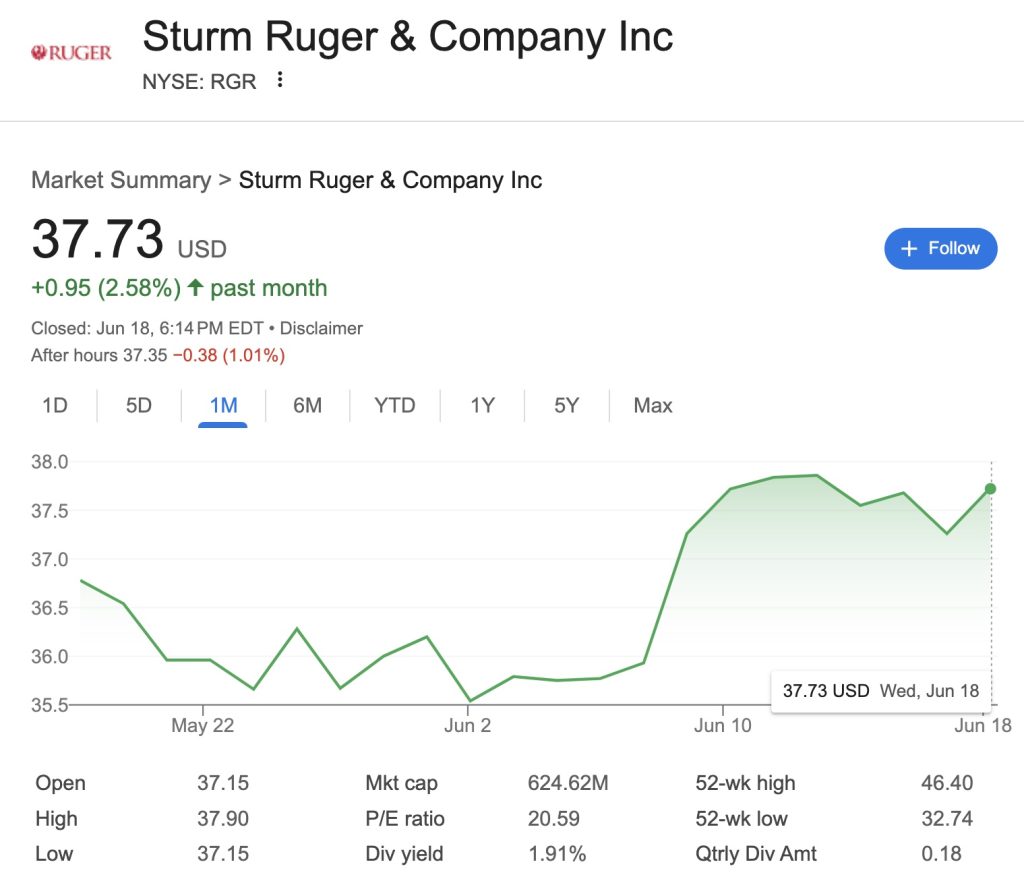
Wall Street wasn’t shocked. After all, earnings across the industry, including Ruger have indicated trouble on the horizon. For the first quarter, Ruger’s sales were flat, and showed a nearly 10% year-over-year industrywide decline in quarterly retail unit sales.
Other companies have quietly reduced staffing, slashed expenditures, and made preparations for what increasingly appears to be a change in fortunes from the past three years of good times. The industry has been roiled by recent layoffs of familiar faces at other companies along with the cancellation of events generally held to announce new products. Those cancellations seen as another indication of harder times ahead and decreasing consumer spending.
Speaking with manufacturers, distributors, and dealers this week, I’m being told that while every company or industry category is down, consumer purchasing patterns indicate very deliberate buying. As one executive told me, “we are seeing people make smaller more targeted intentional purchases.” Amplifying, he explained that impulse items weren’t being added to purchases.
For manufacturers, the “price positioning” referred to by Ruger’s Seyfert generally means markdowns and blowout pricing on slow-moving inventory. While pushing out aging inventory reduces profits, it turns aging inventory into working capital. In slow times, capital availability not only means the ability to weather slowed sales, it offers cash that can either be used to bolster a company’s bottom line or position it to go bargain hunting as unprepared companies get into money trouble.
It’s not terribly different for distributors. They’re going to be blowing out slow-moving inventory across all categories. Inventory blowouts, unfortunately, leave dealers holding the short end of the proverbial stick. While new inventory may be coming to their shelves at lower prices, any of their existing products’ value is reduced accordingly. With firearms — not high-margin items — that can leave dealers essentially under water on existing inventory. Some prudent retailers began slowing their orders some time ago. Others have stepped up customer service, increased outreach and tried to engage newcomers to the outdoor community.
Ruger, as a longtime advocate and champion of the three-legged stool of the manufacturer-distributor-
Today, it appears slow times are the new reality across the industry. Today’s customer bases, especially in the shooting sports, aren’t as large as the sales through COVID and beyond seem to have indicated.
While millions of new customers bought guns, it appears they didn’t buy into the shooting sports community. Consequently the sales projections that drove manufacturing, distribution, and retail are looking overly optimistic.
We’ll keep you posted.