

Record-Sized Comet Seen Belching Jets From Surface as It Heads Our Way
An absolutely gigantic comet is currently barreling into the inner Solar System at full steam. And we mean that almost literally – astronomers have now detected big outbursts of carbon monoxide belching from its surface.
It’s a little unsettling that something that big is currently hurtling in our direction, but thankfully it won’t come any closer than the orbit of Saturn, when it reaches its closest approach on 29 January 2031.
“These measurements give us a look at how this enormous, icy world works,” says astrochemist Nathan Roth of American University and NASA Goddard Space Flight Center. “We’re seeing explosive outgassing patterns that raise new questions about how this comet will evolve as it continues its journey toward the inner Solar System.”
On March 8, ALMA spotted a pair of jets blasting out of the comet’s nucleus – its solid icy core. Spectrometry revealed that these jets were mostly made of carbon monoxide. The team also detected the beginnings of a coma, the ‘atmosphere’ of dust and gas that surrounds comets and forms their tails.
By the March 17 observation, however, the comet was down to a single jet, although the team speculates that the other could have just rotated out of view. There was also no longer any sign of the coma.
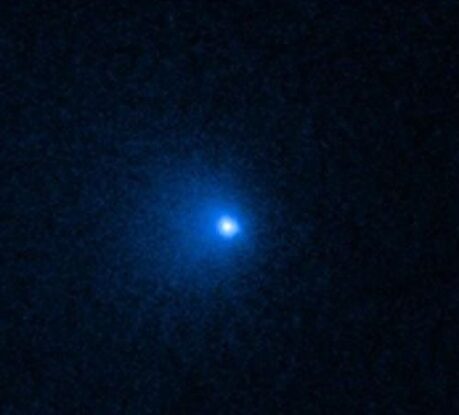
Although previous observations had noted hints of a coma before, this marks the first direct detection of the jets of gas coming out of UN271. Even more impressive is that they were spotted so far away – at the time, the comet was just inside the orbit of Uranus, some 16 times the distance between Earth and the Sun.
That said, it’s not the largest known comet of any type. That honor belongs to 95P/Chiron, which could be more than 210 kilometers wide. Thankfully it doesn’t journey in and out of the Solar System but sticks to a stable orbit around the Sun between Saturn and Uranus.