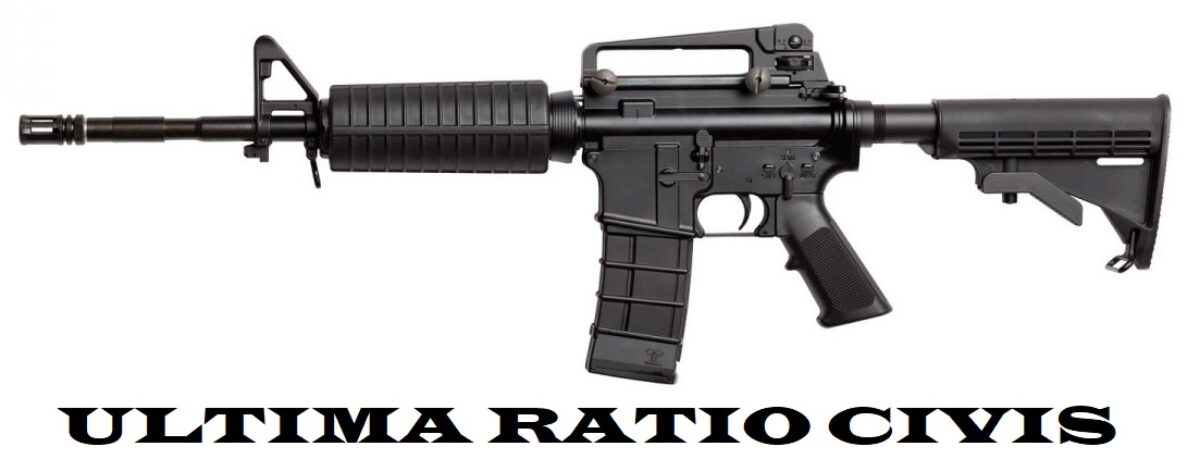
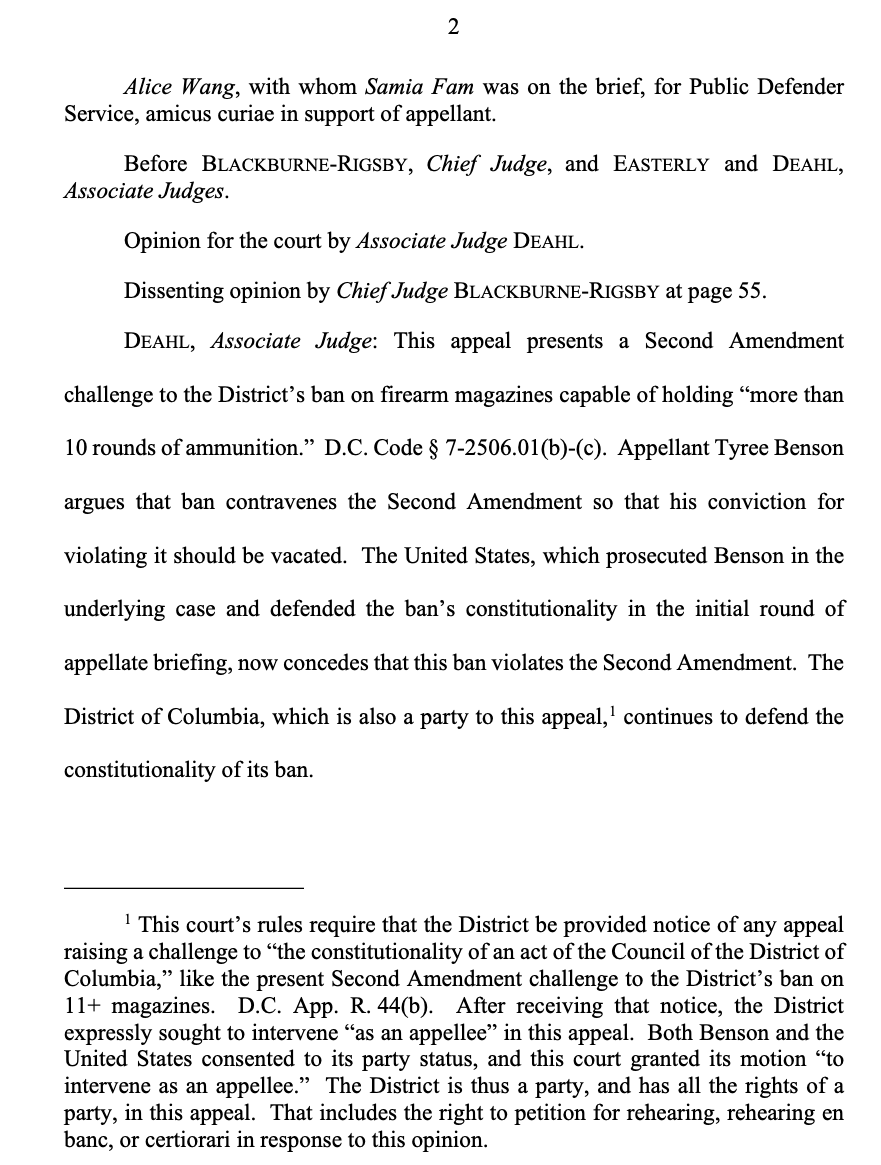
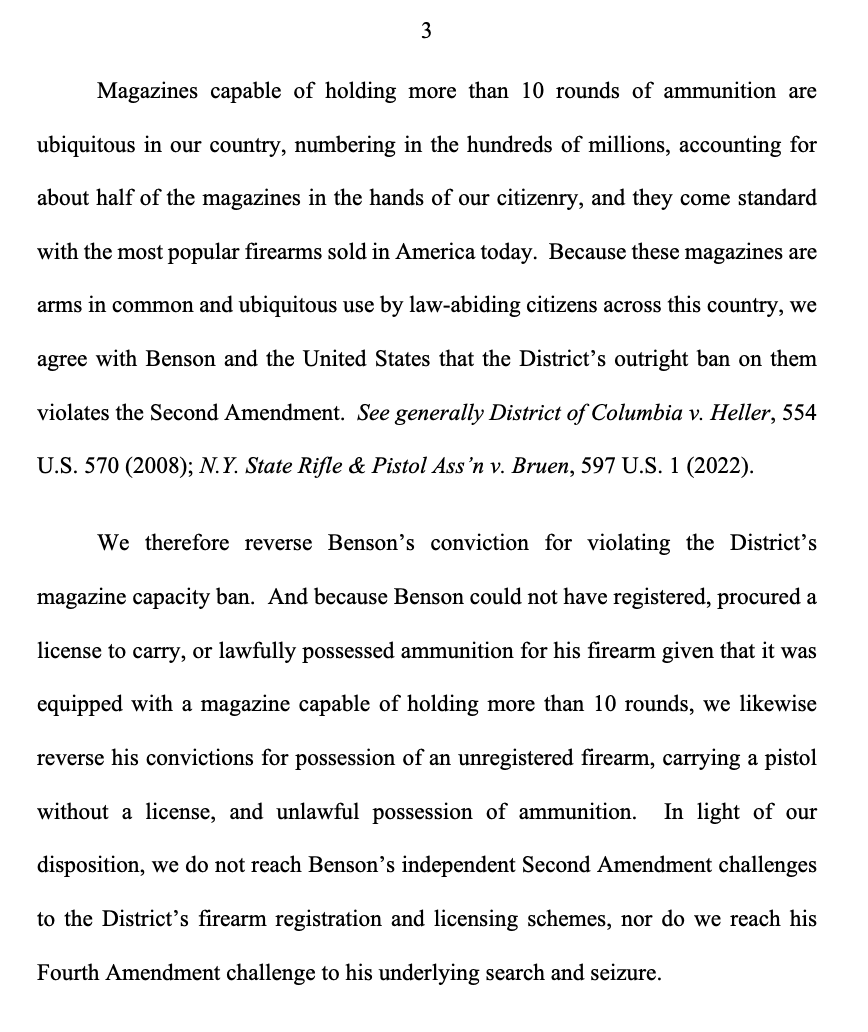
LEGAL ALERT: The DC Court of Appeals (the highest local court in the district) has ruled that DC’s ban on magazines over 10 rounds violates the Second Amendment.

“…we use that term rather than ‘large capacity’ magazines to avoid any misleading suggestion that they are outside the norm or larger than your average magazine.”
“Most people would conclude that the non-voter’s right to read Harry Potter is protected under this first analogy, if only because they think that is an individual right regardless of the prefatory language.”
“By simply invoking the Second Amendment a defendant is quite obviously claiming that his conduct is covered by it.”
“The District next counters on the merits that 11+ magazines, by themselves, are ‘practically harmless’ and of ‘no use’ without ammunition and a receiver… a gun is also practically harmless and of no use without ammunition, but it is still obviously an arm.”
The court calls out the Ninth Circuit: “…the District’s view reduces to the absurd proposition that legislatures can prohibit all of the core components of firearms—the trigger, the hammer, the slide, the firing pin, the sights, etc.—because none of them do much good without the others, and none of them is strictly necessary to a functioning firearm.”
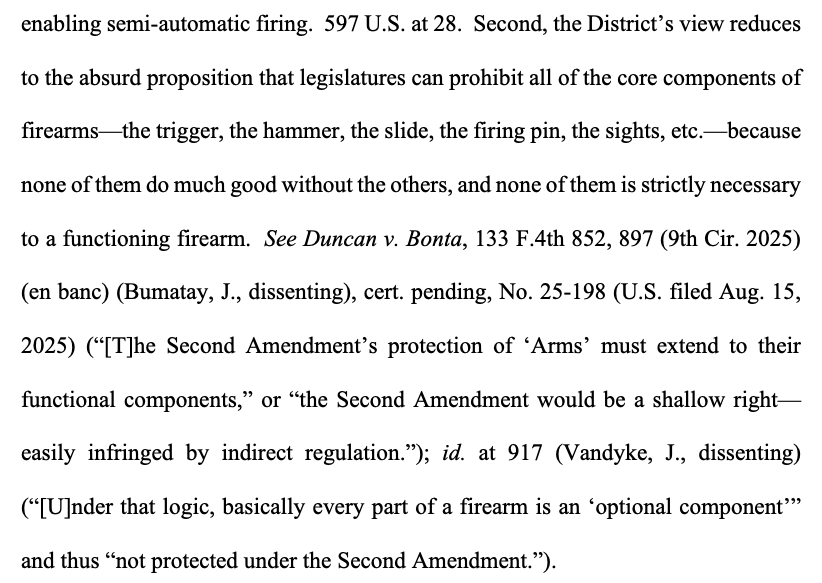
“On the District’s logic, states could ban two-round or even one-round magazines—there’s no reason a semiautomatic firearm cannot fire with an empty or ‘dummy’ magazine so long as there is a round in the chamber.” “In fact, under the District’s view the state could just directly outlaw the semi-automatic firing mechanism because, by itself, that is a harmless component of a firearm and it is not a necessary feature of any gun.” “For that matter, modern cartridges are not necessary for firing a gun either. If the Second Amendment applied only to those things that are strictly necessary for a gun’s operation, states could ban cartridges so long as primitive musket balls remained a legal alternative ammunition.”
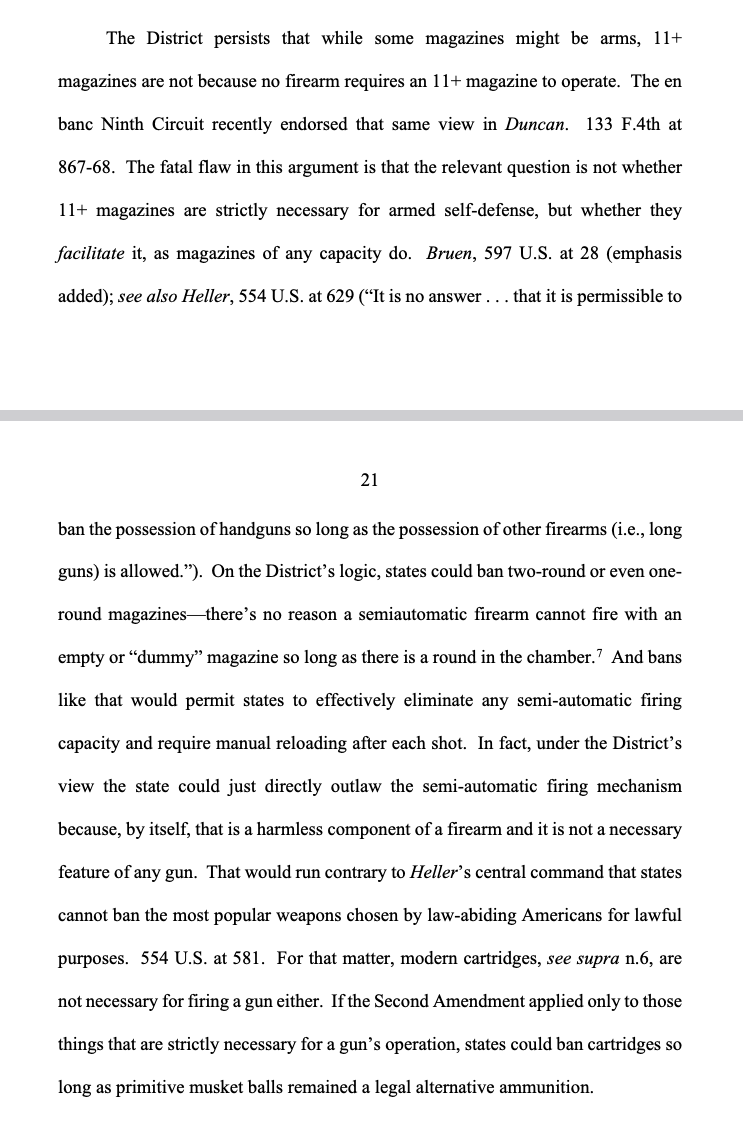
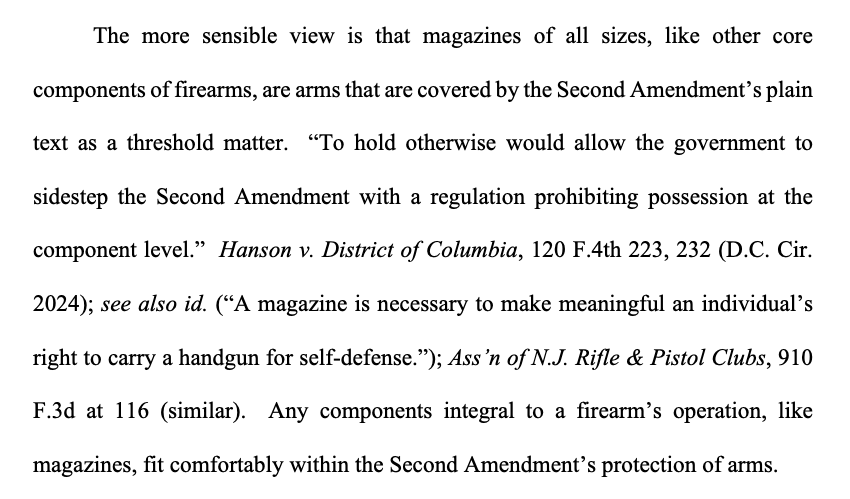
“The more sensible view is that magazines of all sizes, like other core components of firearms, are arms that are covered by the Second Amendment’s plain text as a threshold matter.”
“Both short-barreled shotguns and fully automatic machineguns are self-evidently arms, contrary to the District’s suggestions, at the threshold Second Amendment inquiry.”

“That brings us to the critical question of whether 11+ magazines are in common and ubiquitous use. They are.”
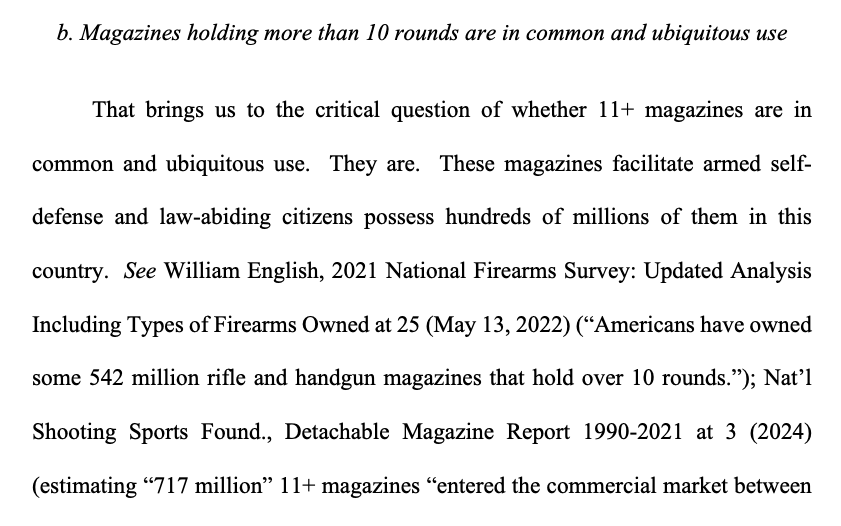
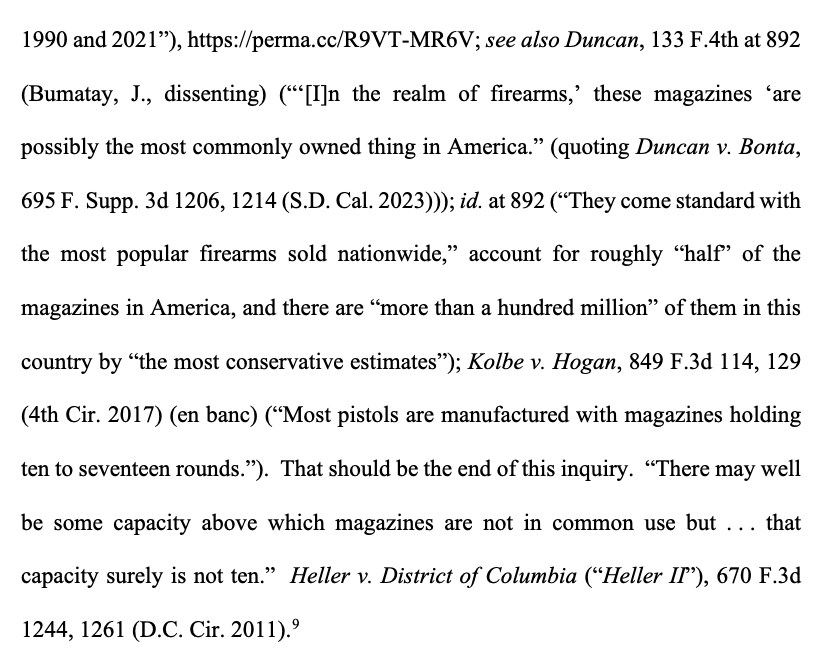
“The District and our dissenting colleague critique some of these sources substantiating the ubiquity of 11+ magazines, but they conspicuously offer no contrary authority, nor will they brave even a bare assertion that there are fewer than hundreds of millions of 11+ magazines in the hands of law-abiding citizens in this country.”
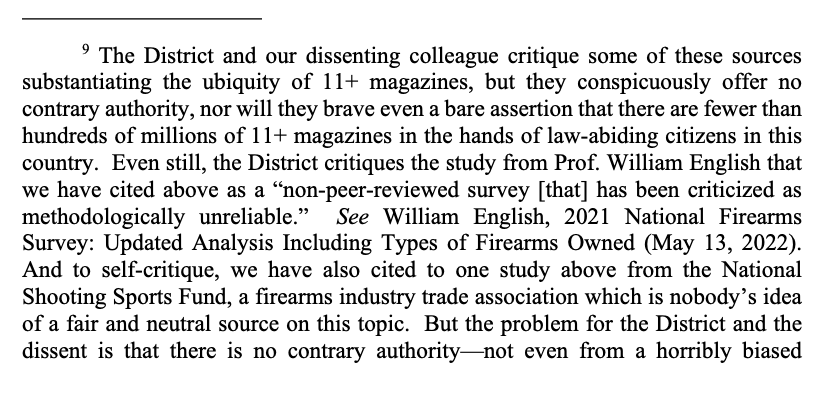
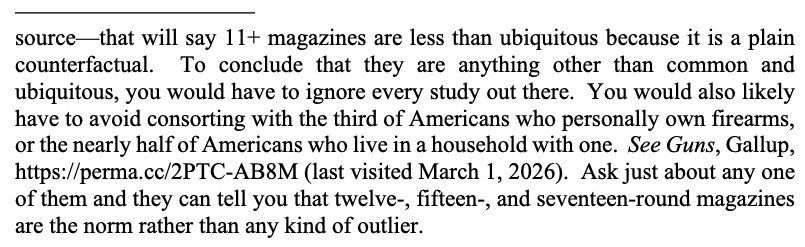
“But the problem for the District and the dissent is that there is no contrary authority—not even from a horribly biased source—that will say 11+ magazines are less than ubiquitous because it is a plain counterfactual. To conclude that they are anything other than common and ubiquitous, you would have to ignore every study out there.”
“First, the District argues that ‘unusual’ does not mean what you think it means… That is a tortured argument. We cannot ignore what Heller and Bruen actually said…”
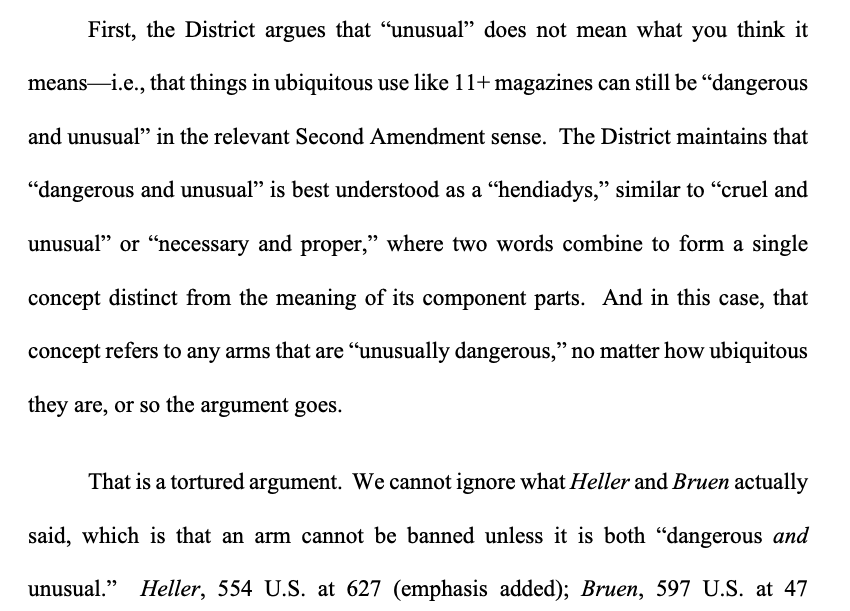
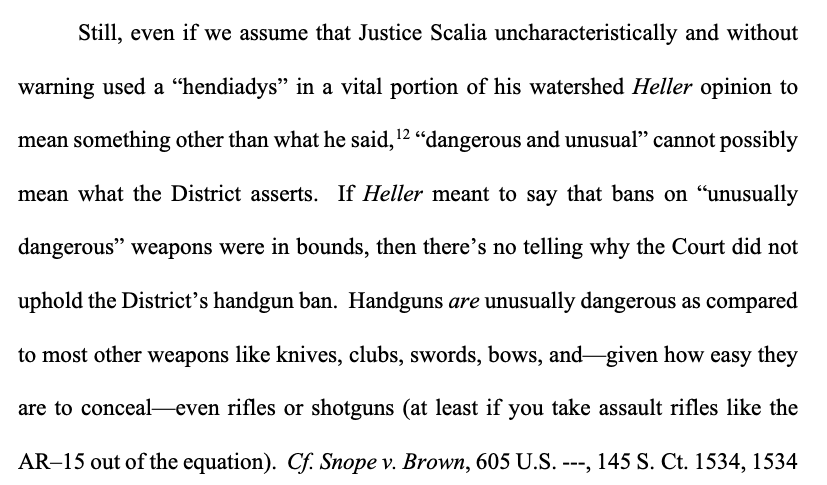
“If Heller meant to say that bans on ‘unusually dangerous’ weapons were in bounds, then there’s no telling why the Court did not uphold the District’s handgun ban. Handguns are unusually dangerous as compared to most other weapons…”
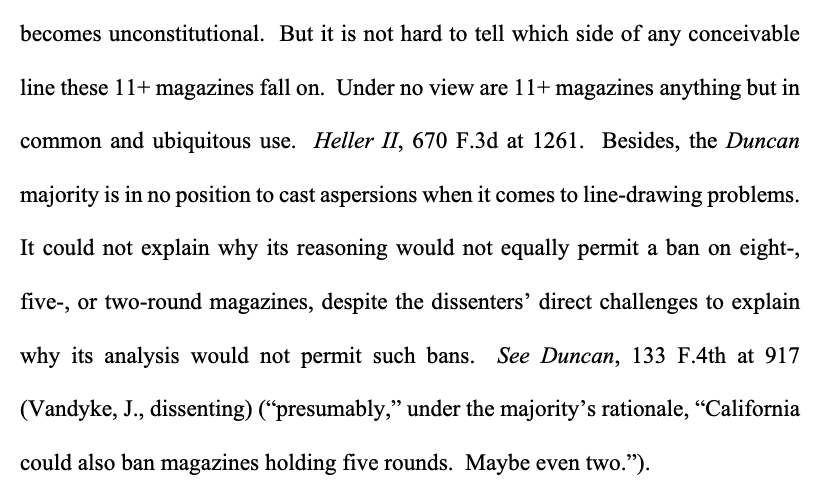
“Besides, the Duncan majority is in no position to cast aspersions when it comes to line-drawing problems. It could not explain why its reasoning would not equally permit a ban on eight-, five-, or two-round magazines, despite the dissenters’ direct challenges…”
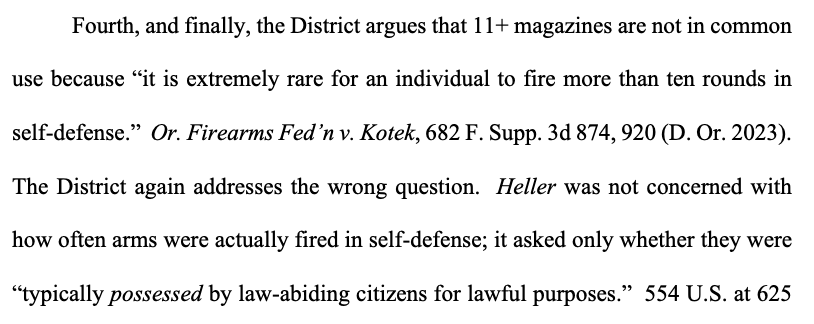
“Fourth, and finally, the District argues that 11+ magazines are not in common use because ‘it is extremely rare for an individual to fire more than ten rounds in self-defense.’ The District again addresses the wrong question.”
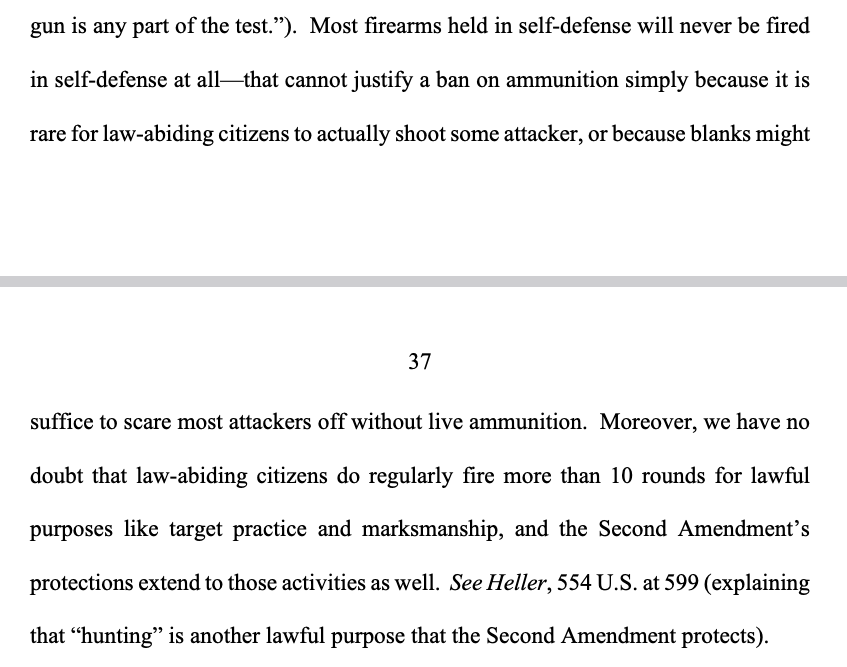
“Moreover, we have no doubt that law-abiding citizens do regularly fire more than 10 rounds for lawful purposes like target practice and marksmanship, and the Second Amendment’s protections extend to those activities as well.”
“If that test sounds familiar, it is because it is indistinguishable from the interests-balancing tests that the circuit courts routinely applied after Heller, the Supreme Court then decisively repudiated in Bruen, and yet a handful of circuits still cling to.”
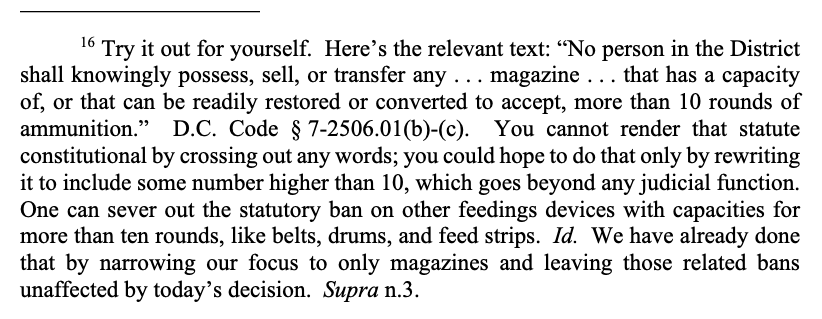
“You cannot render that statute constitutional by crossing out any words; you could hope to do that only by rewriting it to include some number higher than 10, which goes beyond any judicial function.”