

Remember the 2003 movie The Core?
GPS Glitched Across The US by as Much as 33 Feet. Scientists Have Never Seen This Before.
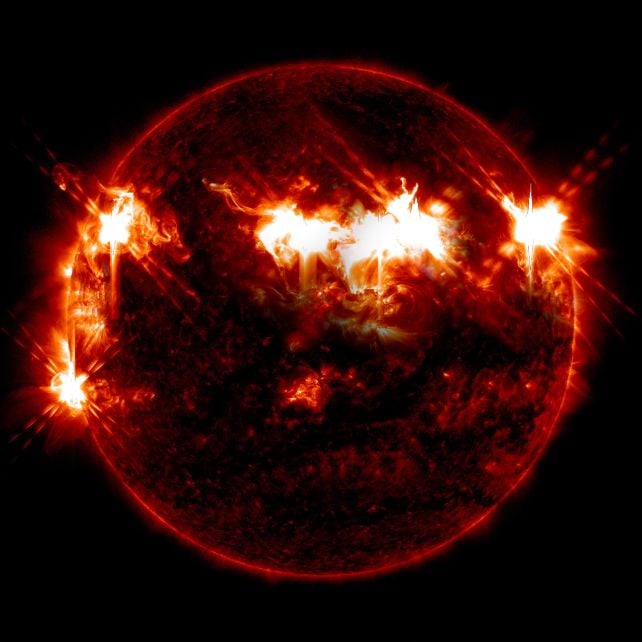
In November 2025, Earth was buffeted by several massive eruptions of solar material that slammed into the magnetosphere.
For many, the result was wonder. Much of the world watched in awe as a solar superstorm lit up Earth’s skies with dazzling auroras to rare low latitudes.
And now, scientists led by space physicist Endawoke Yizengaw of The Aerospace Corporation in the US have discovered that the disruption was stranger – and more widespread – than anyone realized.
“The results underscore the importance of accurate understanding of various space weather phenomena to enhance our predictive capabilities through coordinated observations and physics‐based modeling and ultimately reducing disruptions to RF applications during space weather events,” they write in a paper published in Geophysical Research Letters.
The impact of solar outbursts on human technology is already well known. Solar flares, which unleash powerful bursts of X-rays and ultraviolet radiation, can slam into Earth’s upper atmosphere, temporarily disrupting high-frequency radio communications.
The effect Yizengaw and his colleagues investigated is produced in a similar way. During a geomagnetic storm, energetic particles can rain down into the ionosphere, a region GPS signals have to travel through.
This mixing and roiling can create density fluctuations in the upper atmosphere. Think of an antique window pane, where the glass is unevenly distributed. Light traveling through that glass can distort and magnify the image it carries, so you see a skewed representation of the world outside.
Ionospheric scintillation isn’t unusual, particularly towards the poles and around the equator. The mid-latitudes, however, are generally considered relatively calm and safe when it comes to this particular space-weather hazard.
The November 2025 superstorm said PSYCH.
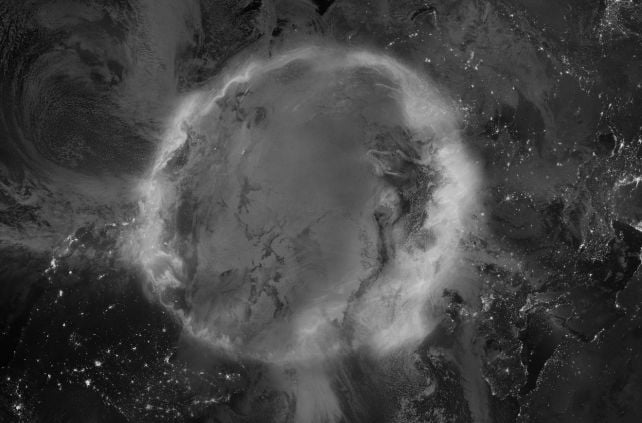
Yizengaw and his colleagues pieced together what happened using observations from multiple instruments across North America, including aurora cameras and a network of ground-based Global Navigation Satellite System (GNSS) receivers.
And those irregularities were everywhere.
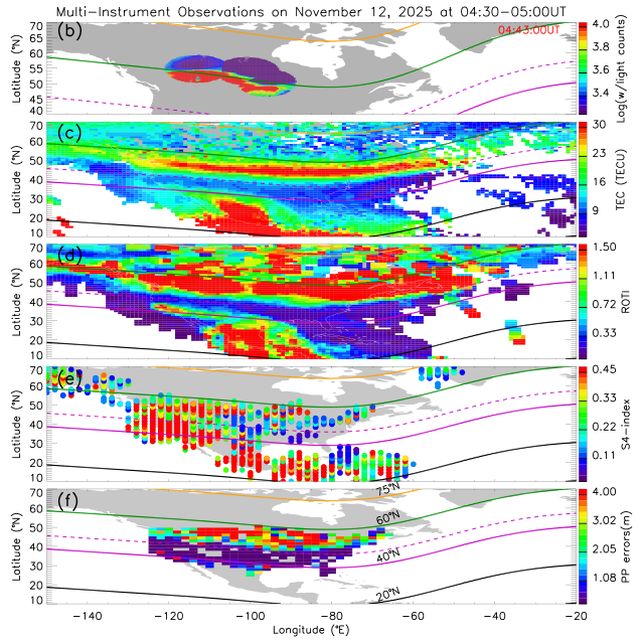
The timing lined up, too. The researchers saw that, as the aurora brightened, electron density and irregularities intensified. At the same time, satellite signals began to scintillate, and GPS accuracy deteriorated.
In some regions, the resulting horizontal positioning errors exceeded 10 meters. Even an error of just one or two meters can spell serious trouble for technologies that depend on precision positioning, including autonomous vehicles and agricultural machinery.
“If the November superstorm onset had occurred during farming season in the American sector, it could have led to significant losses for the American farming and transportation industries,” they write in their paper.
“Hence, understanding the storm time high‐ and mid‐latitude irregularities – and characterizing their impact on radio-frequency applications – requires knowledge of physical processes that control and describe the dynamics of auroral features, such as energy flux, expansion velocity, and precipitation scale sizes present in the auroral arc, all of which contribute to generating density irregularities that can cause scintillation.”
The analysis has been published in Geophysical Research Letters.