Fired 7-Eleven clerk sparks debate over self-defense and company policy

Oklahoma City, Okla. — The firing of Stephanie Dilyard, a former 7-Eleven clerk in Oklahoma, has ignited widespread debate over self-defense rights and corporate policies.

Dilyard, 25, was terminated after using her personal firearm to shoot Kenneth Thompson, 59, who she claims attempted to strangle her when she refused a counterfeit bill.

Despite being protected under Oklahoma’s self-defense law, 7-Eleven cited a violation of company policy as the reason for her dismissal.

The incident has drawn significant public attention, with many criticizing 7-Eleven for prioritizing protocol over employee safety.

Attorney Noble McIntyre commented, “It’s unfortunate she didn’t shoot him twice,” highlighting the tension between self-defense rights and employment policies.

McIntyre noted that Oklahoma is an at-will employment state, allowing employers to terminate workers for almost any reason, provided it doesn’t violate public policy.

However, he emphasized that Oklahoma’s stand-your-ground law supports Dilyard’s right to defend herself.

Ed Blau, a criminal defense attorney, explained the company’s stance, stating, “7-Eleven as a corporation, they do not want all of their employees packing heat while working all over the country. That presents a tremendous liability risk for them.” Blau suggested that Dilyard might face challenges in pursuing a wrongful termination lawsuit, as the company’s policy was clear.

The case raises questions about the responsibility of employers to ensure the safety of their employees.

Blau noted, “If an employee of a convenience store such as 7-Eleven is injured or even killed while working and that store did not provide either adequate safety measures or security, that store could be held liable for putting their employee in an unsafe space.”

As the debate continues, Dilyard remains resolute, stating she would make the same decision again to ensure she returns home to her children.

The story has sparked a broader conversation about employee safety and corporate accountability, with many calling for 7-Eleven to reconsider its policies.

“People who pride themselves on their ‘complexity’ and deride others for being “simplistic” should realize that the truth is often not very complicated. What gets complex is evading the truth.” – Thomas Sowell

“History doesn’t repeat itself, but it often rhymes” – Mark Twain

America Is in a Golden Age. Are We Headed Toward a Roman Ending?
“Once you have an ever-expanding system of entitlements that you can’t afford, that’s often the beginning of the decline and fall,” says historian Johan Norberg.

We media types obsess about America’s problems.

But we should acknowledge that today, life in America is better than life has been anywhere, ever.

For most of history, the norm was hunger, disease, illiteracy, slavery, and war.

There were a few exceptions (from some of those problems)—so-called golden ages, Ancient Athens, Rome, the Renaissance, etc.

In our new video, historian Johan Norberg, author of the new book Peak Human, looks at the miracle of the Roman Empire, which at one point extended throughout most of Europe, and parts of Africa and Asia.

Continue reading “”

Just another long serving bureaucrap. Will he ever learn?


Trump Has Found His Pick for ATF Director

Since Donald Trump began his second term as president and Biden’s ATF Director Steve Dettelbach resigned ahead of being fired, the Bureau of Alcohol, Tobacco, Firearms, and Explosives has been run by a couple of different interim directors, starting with FBI Director Kash Patel. Patel was replaced after reports surfaced that he was essentially a non-entity at the agency, and Army Secretary Dan Driscoll has been doing double duty interim director alongside his work with the Department of Defense in April.

Shortly after Driscoll was named as the interim head of the agency, the ATF’s Deputy Director Marvin Richardson stepped down (or was pushed out), and was replaced by Robert Cekada, who was previously Executive Assistant Director and oversaw the agency’s Office of Regulatory Operations, Office of Field Operations, and the Office of Intelligence Operations.

Now President Trump has nominated Cekada to become the agency’s permanent director; not exactly a surprising move, but not completely expected either. Trump has shown a desire to install outsiders at the helm of many agencies and cabinet positions, but Cekada has worked for the ATF for 20 years. He started as a field agent Hyattsville, Maryland and worked on the Regional Area Gang Enforcement Task Force from 2005 to 2011 before transferring to the Tampa field office for two years. He’s been at ATF headquarters since 2013, moving up the ranks from his position as project officer in the Firearms Operations Division’s Frontline Branch.

Before joining ATF, Cekada was a part of the NYPD and a member of the Plantation, Florida police. He held a variety of roles in those departments, including serving in the NYPD’s Anti-Gang Enforcement Unit and the Street Crime Unit and the SWAT unit in Plantation.

When Cekada was named the agency’s second-in-command back in April, the news was received positively by the National Shooting Sports Foundation. As we reported at the time:

The National Shooting Sports Foundation, which represents the firearms industry, was quick to praise Cekada as Trump’s choice as the ATF’s Number Two, pointing to his extensive history going after violent criminals and his respect for the right to keep and bear arms.

“Deputy Director Cekada has the experience, wisdom and respect of his colleagues to effectively lead the men and women of the ATF,” said Lawrence G. Keane, NSSF Senior Vice President and General Counsel. “Deputy Director Cekada respects the Second Amendment and understands that the firearm industry is not the ‘enemy’ but valuable partner that assists ATF in its core mission of combatting violent crime. Firearm retailers are on the front lines helping to prevent the criminal acquisition of firearms. They are a vital source of information to ATF special agents on illegal straw purchasing of firearms.”

As a Special Agent-in-Charge, Deputy Director Cekada has been on the ground with the firearm industry to promote public awareness to stop these crimes from occurring and has the career history of working with the firearm industry to ensure law-abiding citizens can exercise their Second Amendment rights.

The fact that Cekada has already established a good working relationship with the firearms industry is a good sign, and I’ve heard from sources who have knowledge of the ATF’s day-to-day operations that he was instrumental in getting rid of the “zero tolerance” policy on gun dealers that Richardson continued to enforce even after Steve Dettelbach resigned as ATF Director when Trump assumed office for his second term.

Since his appointment as Deputy Director, Cekada has been working alongside the agency’s new Assistant Director and lead attorney Robert Leider, a former professor at George Mason’s Antonin Scalia School of Law specializing in Second Amendment issues. The pair have been overhauling many of the ATF’s rules and regulations, and though the shutdown sidelined much of their work for the past month, the agency has already announced it’s rolled back the Biden administration’s “zero tolerance” policy that treated minor paperwork errors cause to revoke federal firearms licenses.

Biden’s pistol brace ban has been undone as well, with the DOJ deciding not to appeal a court decision that found the rule was a violation of the Administrative Procedures Act, and it’s expected that Biden’s “engaged in the business” rule treating almost every gun owner who sells a firearm from their personal collection as an “unlicensed gun dealer” will also soon be axed.

That doesn’t mean that Cekada’s nomination will be smooth sailing, however. Senate Democrats are likely to challenge Cekada’s reforms, while Republicans may bring up issues like the agency’s railroading of Patrick “Tate” Adamiak, who’s currently sitting in a federal prison after being convicted of selling restricted firearms that weren’t really functional or illegal to possess, purchase, or sell.

Cekada should have the support of NSSF, which could also hurt his chances among Senate Democrats, but that could prove valuable among the Senate Republicans who will decide if he should take the helm of the agency.

Cekada is no David Chipman, the former ATF agent turned gun control advocate who was Biden’s first choice to head up the agency. Cekada has already demonstrated a willingness to be a change agent at the ATF, and I’m looking forward to seeing what he has to say about the need for more fundamental reforms within the agency and how he plans to accomplish those goals as the confirmation process gets underway.


Grassroots Judicial Report—November 19, 2025

What’s New— SCOTUS: Duarte v. United States—Useful article by Jacob Sullum on this case; Gustafson v, Springfield: PLCAA case; Two “Assault Weapons Ban” cases—National Association for Gun Rights v. Lamont; Case No: 25 – 421, and Viramontes v. Cook County: Case No: 25-238; The Four Boxes Diner interviews Judge VanDyke; District Court:Missouri: Brown v. ATF: Case No. 4:25-cv-01162: Plaintiffs argueargues that because Congress eliminated the making and transfer taxes on most NFA-regulated firearms in 2025, the NFA’s remaining registration and recordkeeping mandates are now unconstitutional: Vermont: Second Circuit:

VT. Fed of Sportsmen’s Clubs v. Matthew Birningham: Case No. 24-2028: An appeal regarding a denied preliminary injunction, and an amicus curiae;New Jersey: Third Circuit: Struck v. Platkin: Case No. 3:24-cv-09479: On Nov. 13, the Firearms Policy Coalition joined the NRA’s lawsuit to challenge New Jersey’s ban on purchasing more than one gun every 30 days.

Continue reading “”

Reality Caught Up to ‘Climate Change.’

For decades, the monolithic and sacrosanct international climate change hierarchy went unquestioned.

Western nations in particular spent trillions of dollars over the past half-century to subsidize expensive but erratic wind and solar energy while demonizing carbon fuels as toxic threats to the planet.

Like Diversity, Equity, and Inclusion dogma, climate change orthodoxy was embedded into every aspect of Western culture, from the corporate boardroom to the university campus.

Question whether man-made global warming was truly responsible for increased temperatures rather than natural, often centuries-long cycles of heating and cooling of the planet, and one was labeled a climate crank.

Everything from declining fertility to forest fires was ridiculously attributed to climate change.

But the causes of both demographic crises and charred landscapes were more likely the result of new affluent lifestyles that saw child-rearing as too expensive and time-consuming, and misguided forest policies or underfunded firefighting.

Yet reality has caught up with the near-religious climate change cult.

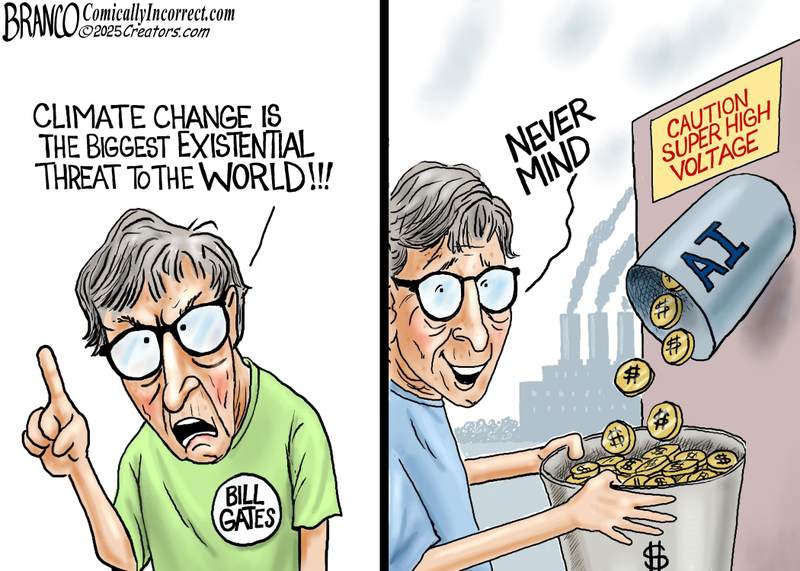
One, the left-wing tech billionaires—exemplified by former climate change zealot Bill Gates—have become apostates of the green movement. Now they do not warn of a planet threatened by too much man-made heat but rather by too little man-made kilowattage.

They believe artificial intelligence will prove as transformative as the Industrial Revolution. But to win the AI revolution will require vast increases in electricity production, of up to a staggering 100 gigawatts a year of additional capacity.

Such enormous demand—to build the equivalent of a hundred huge power plants per year—is far beyond the ability of “renewables” alone.

Instead, the only solution is an “all of the above” strategy of building more nuclear, natural gas, clean-coal, wind, and solar generation plants.

Two, ascendant China’s massive arms buildup and its bullying Belt and Road imperialism have finally put international “climate accords” into question.

Even the environmentalist King Carl XVI Gustaf of Sweden has recently let it slip that he is troubled by why Europe sandbagged its own economy by shutting down its formerly efficient nuclear and fossil fuel plants. He reminded the world that the European Union nations contribute only six percent of the planet’s carbon emissions.

The West finally realizes that a cynical China has been playing it for years by funding green propaganda abroad.

Continue reading “”

This Gun Case Harks Back to Constitutional Concerns About the Limits of Federal Power That Now Seem Quaint
Congress justified that National Firearms Act of 1934 as a revenue measure—a rationale undermined by the repeal of taxes on suppressors and short-barreled rifles.

Testifying in favor of the National Firearms Act (NFA) in 1934, Attorney General Homer S. Cummings noted that the federal government “of course” had “no inherent police powers to go into certain localities and deal with local crime.” Rather, “it is only when we can reach those things under the interstate commerce provision, or under the use of the mails, or by the power of taxation, that we can act.”

Cummings explained how “the power of taxation” worked in this context: “If we made a statute absolutely forbidding any human being to have a machine gun, you might say there is some constitutional question involved. But when you say, ‘We will tax the machine gun,’ and when you say that the absence of a license showing payment of the tax has been made indicates that a crime has been perpetrated, you are easily within the law.”

Last July, Congress eliminated that legal pretext for several NFA provisions by repealing the federal taxes on sound suppressors, short-barreled rifles, and short-barreled shotguns. That change, several gun rights groups argue in a memorandum they filed last Friday in the U.S. District Court for the Eastern District of Missouri, fatally undermines the constitutional rationale for the NFA’s requirement that dealers and owners register those products, which was supposed to facilitate the collection of the taxes.

The case, which Reason‘s Brian Doherty covered after the original complaint in Brown v. ATF was filed on August 1, might seem of little moment unless you own the covered products or would like to acquire them. But the lawsuit goes to the heart of congressional authority to intervene in matters that were long understood to be outside the federal government’s purview.

Continue reading “”