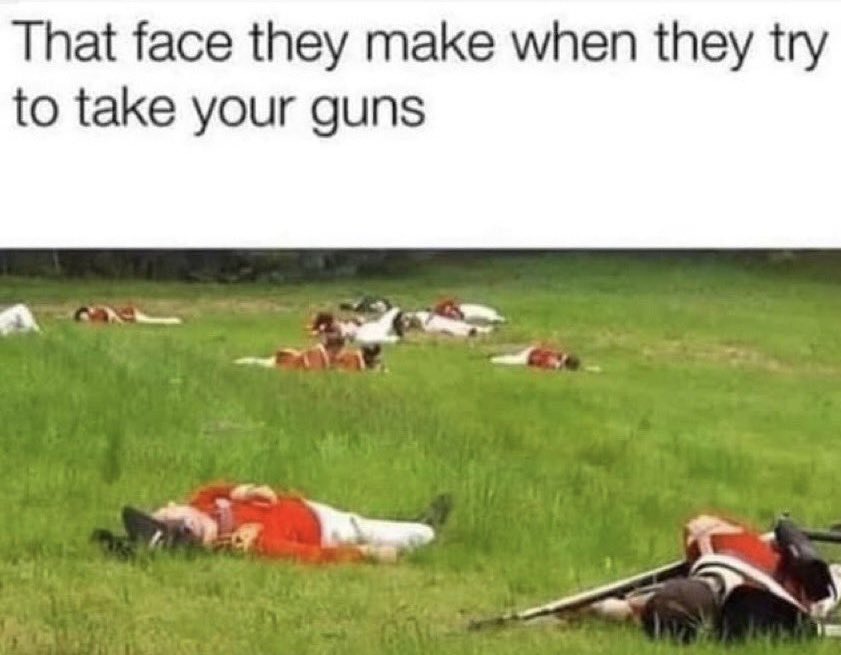
When exactly were the blind fans allowed to feel them..? https://t.co/z2wNkZC865
— Whiskey Tango Foxtrot (@WingDynasty) July 9, 2023
Fifth Circuit poised to strike down another prohibited persons statute?
Unless you’re Hunter Biden, the Department of Justice takes a very dim view of possessing firearms and using illicit drugs of any kind; even those that have been decriminalized or legalized at the state level. But is the federal prohibition on that activity constitutionally permissible? The Fifth Circuit is asking that question in a case called U.S. v. Daniels, and this week both the Second Amendment Foundation and Firearms Policy Coalition gave their answers in amicus briefs filed with the appellate court. The short version? Absolutely not.
Patrick Darnell Daniels, Jr. was indicted by a federal grand jury last year for allegedly violating 18 U.S.C. § 922(g), which forbids gun possession for “unlawful users of controlled substances”; a charge, incidentally, that the media insisted is rarely brought against defendants. Guess Mr. Daniels was just extra unlucky, because not only was he charged but he was convicted and sentenced to 46 months in federal prison for illegally possessing firearms while regularly consuming marijuana.
Daniels’ public defenders appealed that verdict to the Fifth Circuit, arguing that 18 U.S.C. § 922(g) is both unconstitutionally vague because it fails to adequately define “unlawful user” and a violation of Daniels’ Second Amendment rights. The Fifth Circuit heard oral arguments in the case back in early June, but as SAF’s founder Alan Gottlieb says, the three-judge panel took the somewhat unusual step of soliciting amicus briefs from interested parties who could flesh out the historical record on just how longstanding and widespread similar prohibitions may have been.
While SAF Executive Director Adam Kraut says the organization isn’t taking a position for or against certain laws, attorneys failed to turn up any evidence of “historical gun regulations that essentially strip someone of their Second Amendment rights for life, because they may have been under the influence of, or impaired by, an intoxicating substance.”
As the brief explains:
… there were less than a handful of laws enacted during the colonial/pre-Founding Era and zero known laws during the Founding Era itself relating to the possession of firearms by users of illicit or intoxicating drinks or substances, and few known such laws during the 19th century, whether before or after the Civil War.
None of these laws were distinctly similar or relevantly similar to § 922(g)(3) because (1) in contrast, “the restrictions imposed by each law only applied while an individual was actively intoxicated or using intoxicants,” (2) “none of the laws appear to have prohibited the mere possession of a firearm,” or (3) “appear to have applied to public places or activities” rather than “being a total prohibition applicable to all intoxicated persons in all places . . . .” Harrison, 2023 U.S. Dist. LEXIS 18397, at *14. Whereas these laws “took a scalpel” to the right to bear arms, § 922(g)(3) “takes a sledgehammer to the right.”
The amicus brief notes that the DOJ itself has failed to come up with any Founding-era historical analogues to § 922(g)(3), which SAF’s attorneys say should be the fact that should carries the most weight, “given the Supreme Court’s command that the historical analysis required by Bruen must flow from 1791.”
Instead, the federal government cites three laws from the colonial/pre-Founding era; a 1655 law in Virginia that prohibited “shoot[ing] any guns at drinkeing (marriages and ffunerals [sic] onely [sic] excepted),” a New Jersey law from 1746 authorizing militia officials to disarm any soldier who “appear[ed] in Arms disguised in Liquor,” and a 1773 New York statute that prohibited the “fir[ing] or discharge [of] any Gun, Pistol, Rocket, Cracker, Squib or other fire Work [sic]” in certain areas between December 31 and January 2,” a restriction the SAF attorneys explain was meant to address “great Damages [] frequently done on . . . New Years Days, by persons going from House to House, with Guns and other Fire Arms and being often intoxicated with Liquor.”
The SAF brief found a few post-Civil War statutes that dealt with intoxicating liquors and guns, but none of them prohibited gun ownership for any regular consumer of alcohol or drugs (illicit or otherwise). Instead, these were mostly “time, manner, and place” restrictions; individuals may have been barred from carrying while actively intoxicated, but getting intoxicated wasn’t cause for them to be stripped of their Second Amendment rights.
The FPC brief treads similar ground, pointing out that firearms and alcohol were both ubiquitous in the colonial and Founding era, and yet prohibitions on gun ownership for users of intoxicating spirits is nowhere to be found in the historical record. Even when we get to the age of the temperance (and eventually teetotaler) movement, laws prohibiting gun ownership for drinkers are simply absent from the statutes.
Attorney Joseph Greenlee argues that the only historical justification for prohibiting gun ownership to someone is their “dangerousness”, but the “DOJ failed to make any serious effort to establish that connection” in relation to modern day drug use, illegal though it might be.
The DOJ’s fallback argument is that even if there aren’t any historical analogues to support the modern prohibition, the Second Amendment only protects “law abiding citizens,” so any illicit drug use is automatically cause to strip someone of their right to keep and bear arms. That argument is going to be tested by the Supreme Court in the Rahimi case this fall, and I suspect the Fifth Circuit will weigh in with their own views on the DOJ’s position as it applies to § 922(g)(3) before Rahimi‘s oral arguments take place.
The Fifth Circuit has already taken a dim view of several other gun control provisions, including the ATF’s ban on bump stocks and unfinished frames and receivers, as well as determining that those subject to a domestic violence restraining order like Zachey Rahimi still possess the right to keep and bear arms, and this should be a relatively easy call for the judges to make. The history, text, and tradition of the right to keep and bear arms is at odds with § 922(g)(3)’s lifetime prohibition on gun possession for “unlawful” users of drugs, and Hunter Biden shouldn’t be the only one to avoid federal prosecution for doing so.
A TikTok boat jumping challenge that sees people jump from the rear of the vessels while moving at high speed has been blamed for four deaths in Alabama. The challenge, which has been popularized on TikTok, involves individuals engaging in dangerous water activities.
Those participating in the challenge launch themselves from the rear of a boat and into the wake behind it, as the boat continues to move.
Now, officials in Alabama have said the new fad has claimed the lives of four people, after they broke their necks instantly. Officials said in the last six months, they had to deal with four drownings that were ‘easily avoidable’.
Those participating in the challenge launch themselves from the rear of a boat and into the wake behind it, as the boat continues to move
Captain Jim Dennis with the Childersburg Rescue Squad told WPDE said: ‘Last six months we have had four drownings that were easily avoidable. ‘They were doing a TikTok challenge. It’s where you get in a boat going at a high rate of speed, you jump off the side of the boat, don’t dive, you’re jumping off feet first and you just kinda lean into the water. The four that we responded to when they jumped out of the boat, they literally broke their neck and, you know, basically an instant death.’
Capt. Dennis continued: ‘I think people, if they’re being filmed on camera, I think they’re more likely to do something stupid because they want to show off in front of their friends for social media.
He said one incident was in February when the victim was a father with his three children, wife, and other loved ones in the boat – with his death being recorded.
WPDE said the most recent incident in Alabama occurred in May and involved a middle-aged man.
One video is believed to have been captured on Lake Norman, North Carolina, and shows five people jumping and black flipping into the water.
Social media users expressed their concern over the videos, citing the rest deaths related to the craze After the news from Alabama over recent days, the footage, which was originally shared in 2021, has been inundated with comments warning of the deaths.
One person commented: ‘That’s so dangerous, not cool.’ Another posted: ‘So dangerous! Four people have broken their necks and died from this.’
It is not the first trend to claim lives that has gone round the social media app, with two teens dying after participating in the Benadryl Challenge. It sees people, usually kids, swallow multiple antihistamine tablets to induce hallucinations before posting videos of their experience.
Jacob Stevens, 13, died in April of this year after Chloe Marie Phillips, 15, died in August 2020 after partaking in the trend.
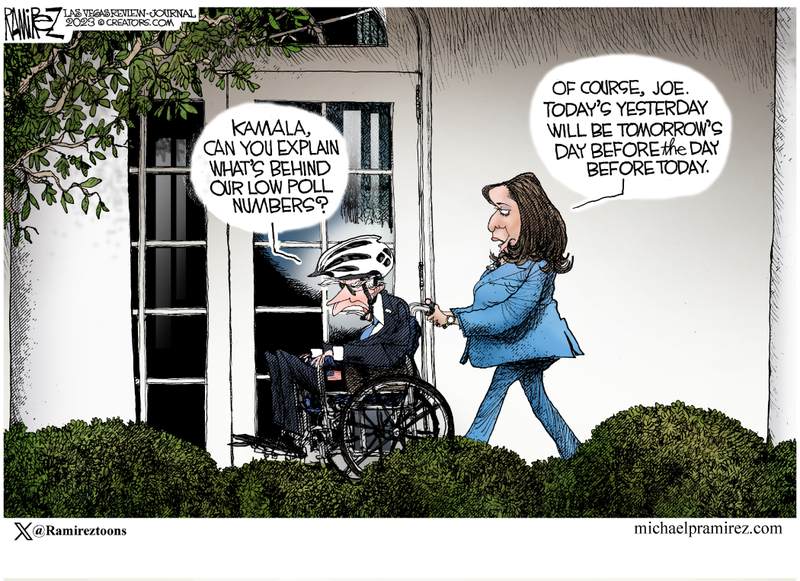
Yes, he’s always been stupid. Now he’s also senile
Joe Biden Is Not Senile — He’s Stupid.
Now people chalk up to age what we all knew way back was IQ.
Joe Biden, like Forrest Gump, is not a smart man. His latest Ron Burgundy moment comes as Exhibit 1,322b.
On Monday, he quoted a woman calling high-speed internet “the best thing that has happened to rural America since the Rural Electrification Act brought electricity to farms in the 30s and 40s.” When he finished reading that off a teleprompter, he read the words: “End of quote.”
When you lead the No. 1 news team in San Diego, this sort of thing can lead to job loss, beard growth, alcoholism, depression, and drinking milk from the carton on a hot day. But Joe Biden merely serves as president of the United States. And Monday’s teleprompter snafu does not come as the first, anyhow. Must one repeat the line about “repeat the line”?
From dressing protectors as the Easter Bunny to screening “journalist” questions in advance, there seems no easy solution. Certainly going off teleprompter without a safety net strikes his on-edge handlers as no solution at all.
Earlier this month, for instance, the president startled League of Conservation Voters by announcing, “We have plans to build a railroad from the Pacific all the way across the Indian Ocean.”
Hmmm.
Why not sail a boat all the way across the Indian Ocean instead? Aviation exists as an option, too. Biden may or may not have traveled more than 1 million miles on Amtrak. But that’s not good reason to cover ocean with track. And what happens upon the occasional derailment?
If only he had added an “e” to potato or failed to cite a publication he read regularly — perhaps then the press, Saturday Night Live, and every late-night comic would have associated him with his gaffes forever. As it stands, the notion of building a railroad across the ocean does not indict one as a dullard the way misspelling a word does.
A few days before floating the idea of a transoceanic railway, the president, in non sequitur fashion, punctuated remarks with “God save the queen.”
Not just June but every month one could pen a column on all the president’s blunders. Still, books, not columns, remain the appropriate format in which to document the president’s gaffes.
They fuel speculation about his fitness for office that implicitly revolve around his age. Even Chuck Todd on this past weekend’s Meet the Press raised to Sen. Amy Klobuchar the question of the president’s mental and physical fitness for office.
Is it possible that the same man unfit for office at 80 was also unfit for it at 45? If so, it means that stupidity, not senility, disqualifies him from high office.
Consider Joe Biden at 45.
When a voter asked about his academic credentials, Biden showed not just a massive inferiority complex but a tiny brain. “I think I probably have a much higher IQ than you do, I suspect,” he said in New Hampshire. “I went to law school on a full academic scholarship, the only one in my class to have a full academic scholarship.” He went on to boast about his “three degrees,” how he “ended up in the top half of my class” in law school, and how he won “outstanding student” in the political science department.
None of it was true. All of it was checkable. Unlike, say, Bill Clinton, Biden did not understand that even politicians required the good sense about what lies to tell and which ones to avoid telling. Biden seemed to tell his lies on impulse because of a bruise to his ego and not out of any Machiavellian reason.
During that same presidential run, he infamously expropriated British Labour Party Leader Neil Kinnock’s life story. Again, the lies seemed quite disprovable not only because whether Biden came from a family of coal miners struck as either true or false but because Kinnock ran against Margaret Thatcher for prime minister two years earlier largely on that tale. He delivered the speech on his life not in Cameroon or some other distant place, but in the U.K., which witnessed television commercials showing Kinnock telling the story of his life that Biden adopted, verbatim at times, as his shortly thereafter.
This required recklessness. It also required a degree of stupidity. How does one think one could get away with that?
Fifteen years ago, then-Sen. Claire McCaskill conceded, “My friend Joe Biden has a tendency to talk forever and sometimes say stuff that’s kind of stupid.”
Now people chalk up to age what we all knew back then was IQ. There’s no fool like an old fool.

July 9
1755 – During the French and Indian War, the British Braddock Expedition is soundly defeated by a smaller French and Native American force in its attempt to capture Fort Duquesne in what is now downtown Pittsburgh.
1776 – General George Washington orders the Declaration of Independence to be read out to members of the Continental Army in Manhattan.
1795 – Financier James Swan pays off the $2,024,899 US national debt that had been accrued during the American Revolution.
1811 – Explorer David Thompson posts a sign near what is now Sacajawea State Park in Washington state, claiming the Columbia District for the United Kingdom.
1850 – President Zachary Taylor dies of acute gastroenteritis, called Cholera Morbus at the time, after eating raw fruit and iced milk on the 4th of July while attending holiday celebrations at the Washington Monument. He is succeeded in office by Vice President Millard Fillmore.
1863 – The Siege of Port Hudson ends, giving the Union complete control of the Mississippi River during the Civil War.
1868 – The 14th Amendment to the Constitution is ratified
1875 – Due to the harsh treatment by the rulers of Bosnia, Christian Serbians in Herzegovina rise up against moslem Ottoman rule in the Balkans.
1893 – At Provident Hospital in Chicago, Dr. Daniel Williams performs the first successful open heart surgery in the U.S on a patient who had been attacked and suffered a stab wound in the chest.
1896 – William Jennings Bryan delivers a speech advocating bimetallism (Gold and Silver as legal specie) at the Democratic National Convention in Chicago.
1918 – In Nashville, Tennessee, 2 trains operated by the Nashville, Chattanooga and St. Louis Railway collide head on, killing 101 people and injuring 171 more, the deadliest rail accident in U.S. history.
1922 – Johnny Weissmuller swims the 100 meters freestyle in 58.6 seconds, setting a new world record for the distance.
1932 – The state of São Paulo revolts against the Brazilian Federal Government, starting the Constitutionalist Revolution.
1943 – Allied forces begin the invasion of Sicily
1944 – American forces complete the invasion of Saipan
1958 – A magnitude 7.8 earthquake in Alaska causes a landslide that produces a tsunami wave reaching 1,722 ft up the rim of Lituya Bay, killing 5 people.
1962 – During Operation Fishbowl on Johnston Island in the Pacific, a Thor rocket with the 1.4 megaton thermonuclear device Starfish Prime on board, is launched and detonated at an altitude of 250 miles to test the effects of a nuclear explosion at orbital altitudes.
1982 – Pan Am Flight 759, a Boeing 727, crashes in Kenner, Louisiana, killing all 145 passengers and crew on board and 8 others on the ground.
2019 – Ross Perot, Rip Torn, and Freddie Jones apparently confirm that ‘Celebrity Deaths Come in Threes’ as they all pass away on the same day
What’s next for the Blue Grass Army Depot?
RICHMOND, Ky (WTVQ)- A piece of national and world history was made Friday afternoon right here in Central Kentucky when workers at the Blue Grass Army Depot in Madison County destroyed the last of more than 500 tons of chemical agent stored there since the 1940s.
The rockets containing the deadly nerve agent sarin also were the last declared chemical weapons in the United States and the world.
Closure and cleaning up the site will take three or four more years and keep many of the 1500 workers employed. But local leaders already are looking at the opportunities the multi-billion dollar effort offers the army depot and community for the future.
“The workforce here is highly skilled, highly trained, highly security-cleared. They will be looking for work in the next year and a half to two years. We would like to have that work force as an entre’ for corporations that could use those talents to come here. We’re also looking at a number of projects be erected inside the depot fence line that will add to the depots military value and keep it viable,” says Craig Williams, co-chair of the Citizen’s Advisory Board.
The Blue Grass facility is the last of nine across the country and the Pacific Ocean where thousands of tons of obsolete chemical weapons were destroyed since 1990.
Construction of the pilot plant began in 2006. Destruction of chemical weapons began in 2019.
Once the plant is completely closed in 2026, the army depot will continue its mission serving the country.
So White Supremacy is now so diverse and inclusive that blacks, Hispanics, Asians and LGB are all part of it. As @ZeekArkham pointed out, the potluck will be GREAT!
And thanks to the LGB, well and tastefully decorated.
— EndOfPatience #🟦 (@EndOfPatienceV2) July 9, 2023
Bruen might thwart Tennessee special session on gun control
Following the shooting at a Nashville school, the previously pro-gun governor decided what the state needed was some gun control. There wasn’t much chance of that happening, mind you, but he wanted to push it anyway.
In fact, he called a special session of the legislature just to address the issue.
However, it seems that in some circles, there’s concern that Bruen might prevent much of anything from happening.
Tennessee lawmakers hoping to take on gun control in an August special session could face hurdles from a landmark U.S. Supreme Court ruling that is now causing turmoil in courts across the country.
The so-called Breun decision in June 2022 overturned a New York law limiting the right to carry guns in public and has since sparked hundreds of legal challenges to gun laws, with varying opinions from judges.
While gun rights groups like the National Rifle Association have lauded the ruling as a major win for the Second Amendment, others say it’s causing more legal questions than answers.
“There’s a lot of confusion and a lot of chaos right now,” said Janet Carter, senior director of issues and appeals at Everytown Law, a gun control nonprofit. “Supreme Court decisions are supposed to provide clarity and certainty, but instead what we see is decisions just going all over the palace.”…
Here in Tennessee, the ruling has already impacted the state’s permitless carry law and it could affect the governor’s push for an emergency protective order law in the wake of the Covenant School shooting, as a local gun rights group has said it plans to sue if the state passes new legislation.
Gun control advocates hope to see clarity from an upcoming Supreme Court case out of Texas that would be the first to test the ruling, but for now, states in some cases have been left scrambling to change their laws.
Now, to be fair, challenges for red flag laws have survived plenty and Gov. Bill Lee’s proposal has fewer due process concerns than most.
That said, I don’t think there have been any challenges to red flag laws post-Bruen, which might well change everything.
The truth is that most gun control laws were always unconstitutional. The Bruen decision’s text and history test is testimony to that. After all, efforts to defend gun control measures have come up short because no one can find historical gun control laws similar to those being challenged.
A red flag law isn’t likely to fare any better.
That, however, is ultimately a good thing. There are other ways to address potentially dangerous people besides just taking their guns and leaving them to go about their way, potentially finding other ways to kill people.
I get that Lee was impacted by the shooting in Nashville, having known a couple of the victims. I’m genuinely sympathetic. I mean, I’ve been there. In the wake of something like that, you want to do something. I was a newspaper publisher at the time. All I could do was talk about what happened. Lee is a governor and he can do a lot more.
The problem is, what he’s wanting to do is wrong.
So, if Bruen puts the kibosh on this, so much the better.
Hunter Biden probe shows corruptness in America’s two-tier justice system.
America’s two-tier justice system keeps rolling along.
And Delaware US Attorney David Weiss, who snubbed the House’s request for documents pertaining to his probe of Hunter Biden, is the latest to show how far the Department of Justice will go to keep it rolling.
Hunter, President Joseph Robinette Biden’s black-sheep son, is facing tax and weapons charges that would represent deep hot water for most Americans. But Hunter isn’t most Americans.
He’s the president’s son, and, allegedly, bagman as well. And our Justice Department, headed by Attorney General Merrick Garland, is out to spare him the consequences of his actions.
IRS whistleblower Gary Shapley has come forward to report that Department of Justice officials took care to ensure that Hunter couldn’t be charged by ordering US attorneys in Washington, DC, and California not to prosecute.
Weiss didn’t charge Hunter because he allegedly said he lacked the authority to charge for things outside his home jurisdiction.
Garland could have granted Weiss the power to do so, but despite claiming that Weiss had unlimited powers, Garland never made the grant.
Hunter’s charges thus fell through a crack.
IRS whistleblower Gary Shapley has come forward to report that Department of Justice officials took care to ensure that Hunter couldn’t be charged by ordering US attorneys in Washington, DC, and California not to prosecute.
But hey, the tax fraud was only one of Hunter’s legal problems where the Department of Justice was happy to help out.
Hunter did get charged in Delaware, but only with two misdemeanor tax charges and a felony gun charge, for which he’ll get pretrial diversion and no prison time.
The tax charges could carry as much as two years in prison, and the gun charge could produce a 10-year sentence, but Hunter’s plea deal is expected to produce none.
Columnist J.D. Tuccille writes, “If, as expected, Hunter Biden’s plea deal on tax and firearms charges keeps him out of prison, it would be a remarkable display of leniency. . . . It’s enough to make a suspicious person wonder if the deal was meant to give the appearance that justice was done to divert attention from more serious matters. It’s also a hint of the restraint prosecutors exercise for the powerful, and which the rest of us would appreciate.”
The tax charges could carry up to 2 years in prison along with the gun charge producing a possible 10-year sentence, but Hunter’s plea deal is expected to produce none. Ya think?
As law professor Jonathan Turley notes, the charges also allow Hunter to avoid discussing the (likely unsavory) sources of the money.
How convenient.
“The House Oversight Committee has documented potentially millions in financial transfers from foreign sources to Biden family members. . . . Garland took the most important step in pulling off the controlled demolition by steadfastly refusing to appoint a special counsel. Such an appointment would allow the release of a report that would detail the alleged corrupt practices of the Biden family and the knowledge and involvement of the president,” Turley wrote.
That’s why they didn’t do it.
This seems deeply suspicious, and the House Judiciary Committee is investigating.
But Weiss, ignoring a subpoena, is stonewalling.
People used to say that it’s the coverup that gets you, not the crime, but today’s Democrats obviously don’t believe that.
It’s been obvious for a while that there’s a two-tier justice system in America.
If you’re a Jan. 6 protester who just wandered around the Capitol, you can expect solitary confinement before trial, and prosecutors who’ll throw the book at you.
But if you’re the son of a (Democratic) president, you can expect to be handled with kid gloves.
Our Constitution forbids “titles of nobility,” whereby the elite live by different rules than the rest of us.
It doesn’t seem to be working very well, does it?
A well planned ambush simply to commit murder is almost always highly effective and lethal.
But since such as this is usually over something personal – as it appears to me in this case -the list of suspects will likely not be long.
Homeowner shoots rooftop burglar in Lincoln Park
CHICAGO — A Lincoln Park resident shot and critically injured a burglar who tried to break into their home from the roof on Thursday night, Chicago police said. It’s at least the second time this week that would-be crime victims have shot suspected offenders on the North Side.
Police were initially called to the 2200 blocks of North Clybourn and Janssen to handle reports of a suspicious person on rooftops around 10:28 p.m. But no CPD units were assigned for nearly 20 minutes, even though one homeowner called 911 three times to report the situation, according to dispatch records.
Around 11 o’clock, just a couple of minutes after the call was finally assigned, 911 callers reported shots fired and a person shot on the block.
Cops arrived to find a woman shot on the roof of a home in the 2200 block of North Clybourn, according to a CPD media statement. A man who lives in the house, a concealed carry license holder, shot her to keep her from entering his residence, police said.
The woman received gunshot wounds to her chest and wrists. She’s at Advocate Illinois Masonic Medical Center in good condition, according to police.
Officers at the scene said it appeared that she entered the property through a nearby construction site and used rope to get onto the roof. Cops found a bag containing hypodermic needles and possible heroin at the scene.
The burglar is the seventh person shot in Lincoln Park this year. Five of those victims were shot during a single incident near the Lincoln Park Zoo last month.
The neighborhood had four shooting victims in total in 2022. There were four shooting victims at this point in 2021; three as of July 4, 2020; and six at this point in 2019.
The 2019 victims were shot in just two incidents: a double shooting in the 100 block of West North Avenue and a quadruple shooting on the lakefront at Fullerton.
On Wednesday morning, a concealed carry holder shot a man who tried to rob him at gunpoint in West Ridge, according to CPD.
The victim, 26, and two male companions were outside a car in the 2600 block of West Devon when the robber walked up and announced a robbery at 3:33 a.m. But the concealed carry holder fired shots at the masked man, striking him in the chest and grazing his head, police said.
After being shot, the man ran into a nearby alley. Police found him in the 2600 block of West Rosemont and brought EMS to treat his injuries. He was taken to St. Francis Hospital in Evanston in critical condition. Officers said they found a handgun in a trash can near the injured man.

July 8
1099 – Christian soldiers of the 1st Crusade begin the siege of Jerusalem by marching in a religious procession around the city.
1497 – Vasco da Gama sets sail from Portugal on the first direct European voyage to India.
1758 – French forces hold Fort Carillon against the British at Ticonderoga, New York during the French and Indian War.
1760 – British forces defeat French forces on the Restigouche River in what is now southeastern Quebec during the French and Indian War.
1775 – In a final attempt to avoid war between Great Britain and the Colonies, the Second Continental Congress sends the Olive Branch Petition affirming American loyalty to Great Britain and beseeching King George III to prevent further conflict.
1776 – The Liberty Bell is rung after John Nixon delivers the first public reading of the Declaration of Independence of the United States on the steps of Independence Hall in Philadelphia.
1853 – Under orders from President Millard Fillmore, the Perry Expedition arrives in Edo Bay with a treaty requesting trade with Japan.
1876 – The Hamburg massacre, in Hamburg, South Carolina, prior to the 1876 United States presidential election, results in the deaths of 6 black members of the Republican Party, along with one white assailant.
1889 – The first issue of The Wall Street Journal is published.
1898 – Crime boss Jefferson ‘Soapy’ Smith is killed by vigilantes in the ‘Shootout on Juneau Wharf’ in Skagway, Alaska.
1932 – The Dow Jones Industrial Average reaches its lowest level of the Great Depression, closing at 41.22.
1947 – Reports are broadcast that a UFO had crash landed in Roswell, New Mexico in what became known as the Roswell UFO incident.
1948 – The U.S. Air Force accepts its first female recruits into a program called Women in the Air Force (WAF).
1960 – U-2 pilot Francis Gary Powers is charged with espionage resulting from his downed flight over the Soviet Union.
1968 – Autoworkers in Detroit, Michigan stage a wildcat strike against the Chrysler corporation.
1970 –President Nixon delivers a special congressional message proclaiming Native American Self Determination as official US Indian policy, leading to the Indian Self-Determination and Education Assistance Act of 1975.
1972 – Israeli Mossad assassinate Ghassan Kanafani, a leader of the moslem terrorist group responsible for recruiting the Japanese Red Army terrorists who committed an attack at Lod Airport in Israel in May, killing 26 people and injuring 80 others.
2011 – Space Shuttle Atlantis is launched on mission STS-135 the final mission of the U.S. Space Shuttle program.
2021 – President Biden announces that the official conclusion of U.S. involvement in the War in Afghanistan will be on August 31.
BLUF
If we’ve learned anything from the pandemic and earlier disasters, we ought to be doing precisely the opposite by enacting new limits on government power during emergencies. Americans need what Swedes have enjoyed: legal protection against autocrats posing as saviors.
Long before Covid struck, economists detected a deadly pattern in the impact of natural disasters: if the executive branch of government used the emergency to claim sweeping new powers over the citizenry, more people died than would have if government powers had remained constrained. It’s now clear that the Covid pandemic is the deadliest confirmation yet of that pattern.
Governments around the world seized unprecedented powers during the pandemic. The result was an unprecedented disaster, as recently demonstrated by two exhaustive analyses of the lockdowns’ impact in the United States and Europe. Both reports conclude that the lockdowns made little or no difference in the Covid death toll. But the lockdowns did lead to deaths from other causes during the pandemic, particularly among young and middle-aged people, and those fatalities will continue to mount in the future.
“Most likely lockdowns represent the biggest policy mistake in modern times,” says Lars Jonung of Lund University in Sweden, a coauthor of one of the new reports. He and two fellow economists, Steve Hanke from Johns Hopkins University and Jonas Herby of the Center for Political Studies in Copenhagen, sifted through nearly 20,000 studies for their book, Did Lockdowns Work?, published in June by the Institute for Economic Affairs (IEA) in London. After combining results from the most rigorous studies analyzing fatality rates and the stringency of lockdowns in various states and nations, they estimate that the average lockdown in the United States and Europe during the spring of 2020 reduced Covid mortality by just 3.2 percent. That translates to some 4,000 avoided deaths in the United States—a negligible result compared with the toll from the ordinary flu, which annually kills nearly 40,000 Americans.
Even that small effect may be an overestimate, to judge from the other report, published in February by the Paragon Health Institute. The authors, all former economic advisers to the White House, are Joel Zinberg and Brian Blaise of the institute, Eric Sun of Stanford, and Casey Mulligan of the University of Chicago. They analyzed the rates of Covid mortality and of overall excess mortality (the number of deaths above normal from all causes) in the 50 states and the District of Columbia. They adjusted for the relative vulnerability of each state’s population by factoring in the age distribution (older people were more vulnerable) and the prevalence of obesity and diabetes (which increased the risk from Covid). Then they compared the mortality rates over the first two years of the pandemic with the stringency of each state’s policies (as measured on a widely used Oxford University index that tracked business and school closures, stay-at-home requirements, mandates for masks and vaccines, and other restrictions).
The researchers found no statistically significant effect from the restrictions. The mortality rates in states with stringent policies were not significantly different from those in less restrictive states. Two of the largest states, California and Florida, fared the same—their mortality rates both stood at the national average—despite California’s lengthy lockdowns and Florida’s early reopening. New York, with a mortality rate worse than average despite ranking first in the nation in the stringency of its policies, fared the same as the least restrictive state, South Dakota.
Meantime, the lockdowns did have other significant effects on health. Rates of smoking, drinking, and obesity increased. The number of excess deaths from non-Covid causes in the U.S. rose by nearly 100,000 annually due to extra deaths from stroke, heart attack, diabetes, obesity, drug overdoses, alcohol-induced causes, homicide, and traffic accidents. Many of these excess deaths, which occurred disproportionately among working-age adults, were presumably related to the lockdowns’ disruptions in people’s lives and in medical treatments. The delays in screening for heart disease and cancer will continue to have a deadly impact in the years ahead.
So will the economic and social consequences of the lockdowns, which showed up clearly in the Paragon Health Institute comparison of states’ performance. The researchers found that states with the more stringent pandemic restrictions had worse declines in economic output and higher rates of unemployment, and that children in those states lost more days of in-person schooling. These disruptions contributed to a substantial increase in domestic migration, the Paragon researchers found, as people escaped from the more restrictive states and moved to states with less stringent policies.
The lockdowns were the most radical experiment in the history of public health, implemented without evidence that they would work. (In fact, before Covid, officials at the Centers for Disease Control and other nations’ health agencies had specifically advised against lockdowns in their plans for dealing with a pandemic.) The experiment was promoted by computer modelers who projected that 2 million Americans would die by the end of the summer in 2020 unless governments mandated lockdowns, which they estimated would reduce mortality by 80 percent or more. Both estimates turned out to be absurdly wrong—and so was the modelers’ assumption that government mandates were the only way to change people’s behavior.
“Studies early in the pandemic assumed that without lockdowns everyone would be infected because people wouldn’t make any voluntary changes in their behavior,” says Herby, a coauthor of the IEA report. . “But in fact the voluntary social distancing and other changes in behavior had a huge impact, much larger than the lockdowns.” He points to Sweden, where elderly people drastically reduced their shopping and other activities outside the home without being ordered to do so. By avoiding lockdowns and school closures, Sweden fared as well or better than the rest of Europe in preventing Covid deaths while allowing younger people to go on with their lives. It also suffered less social and economic damage: while more people were dying from non-Covid causes in the U.S. and the rest of Europe, that rate of excess mortality declined in Sweden.
Swedes avoided lockdowns partly because of the wisdom of their public-health leaders, and partly because of a provision in the Swedish constitution guaranteeing freedom of movement to citizens. Constraining the power of government officials improved Sweden’s ability to cope with Covid. That lesson applies to other emergencies, too, according to Christian Bjørnskov, a Danish economist who has compared casualty rates in natural disasters around the world.
Bjørnskov and a German colleague, Stefan Voigt, have found that fewer people die from natural disasters in countries with laws that restrict the power of national leaders during an emergency. If leaders are unconstrained—if they can suspend people’s personal and economic liberties—then the disruptions hinder people’s voluntary efforts to deal with the disaster. After a hurricane, for instance, local officials and citizens will normally aid their stricken neighbors, but they’re less inclined to act if the national government takes charge by suspending property rights to commandeer boats, vehicles, and other local resources. “Civil society is more likely to help if the authorities are not allowed to run roughshod over private citizens,” Bjørnskov says. “It is also much more likely that the authorities will misuse their emergency powers for their own uses, diverting resources toward purposes that have nothing to do with the emergency. They increase spending and regulation, and it takes longer for the country to get back to normal.”
That was certainly the case during the pandemic, as politicians went on budget-busting binges that showered money on special interests and pet projects that had nothing to do with Covid. To reward teachers’ unions for their support, politicians kept schools closed long after it was obvious that they could be safely reopened. The inflationary effects of the spending have slowed the economic recovery from the pandemic, and the school closures have set children back so far that many will never catch up. One estimate suggests that the average American student will earn 6 percent less over the course of a lifetime because of learning loss during the pandemic.
Predictably, the officials responsible for the damage are ignoring these consequences and seeking even more power in the future. CDC officials are planning to be more aggressive in the next pandemic, and the World Health Organization wants countries to sign a new pandemic treaty giving the WHO the authority of international law to order lockdowns and other measures.
If we’ve learned anything from the pandemic and earlier disasters, we ought to be doing precisely the opposite by enacting new limits on government power during emergencies. Americans need what Swedes have enjoyed: legal protection against autocrats posing as saviors.
Unless, of course, that drug user is the designated salesman for my innovative influence “consulting” services products. https://t.co/v6sC8hU4r0
— The Truth About Guns (@guntruth) July 7, 2023
No integral light or even the ability to mount a light
No luminous sights or ability to mount optics (and the sights are not adjustable!)
Not FULLY ambidextrous as you have to order either a left, or right handed version for the fingerprint reader. Lose the ability to use that hand and what you’ve got left is a image reader that you hope will read your face when it matters.
No independent tests for failure modes
In other words: Not ready in any respect for self defense use.
BLUF
“If even one or two cases get out where it’s found that someone was unable to protect themselves because the gun didn’t recognize them… I think that’s going to kill the movement for a long time,” Wolf said.
Metro company offers first commercially available ‘smart guns’
Kai Kloepfer is the CEO of the Broomfield-based company Biofire. He said making a gun like this was impossible until very recently.

At first glance, the Biofire Smart Gun is different from other firearms. The large handgun looks part Halo, part Cyberpunk in design.
It’s an appropriate look since the gun is made with new technology ripped straight from science fiction. It’s unlocked biometrically, meaning it can only be activated with an authorized user’s fingerprint or face. That, in turn, means only authorized users can shoot it.
Kai Kloepfer is the CEO of the Broomfield-based company Biofire. He said making a gun like this was impossible until very recently.
“A lot of the technology we’re using did not exist two years ago, in most cases,” Kloepfer said.
Kloepfer began thinking about the smart gun in high school. He grew up in Colorado and remembers the 2012 Aurora theater mass shooting, where 12 were killed. He brought an early design to an international science fair and won first place. More than a decade later his plastic prototype has evolved into a fully functional handgun.
“I’ve gotten a chance to be shooting it, handling it. Even got to take one home for a little bit. It’s just been really cool to see something that I only dreamed of like 11 years ago,” Kloepfer said.
Experts say putting a computer into a gun is a remarkable feat—a gun’s explosive force once made it unthinkable. But beyond the computer, the gun is unremarkable in its function. Biofire’s smart gun is a semiautomatic 9mm handgun, meaning a user can pull the trigger, a round goes downrange, and a new round is fed into the chamber. It functions exactly like any other handgun of its class and caliber—and that’s by design.

It takes an expert like Bryan Rogers, the lead designer at Biofire, to bring the gun to commercial production. He said the secret to making a reliable smart gun is to enable more than one way to unlock it.
“It uses both fingerprint and facial recognition to recognize you as the owner,” Rogers said.” It’s either/or—whichever one it gets first.”
Analysis: The Murder Rate Appears to Be Dropping. How Will That Impact Gun Politics?
After a multi-year spike following the onset of the COVID pandemic, the U.S. homicide rate looks to be falling. If that continues, it could usher in a reshuffling of the country’s current gun politics.
The murder rate is down roughly 11 percent in 100 major U.S. cities through the first half of the year, according to crime analyst Jeff Asher. Though the overall murder rate is still about 12 percent above pre-pandemic levels, according to the AH Datalytics dashboard, the numbers are on track to land about 10 percent lower than last year.
That drop would “be among the largest declines in murder ever formally recorded,” according to Asher.
He found that the U.S. homicide rate declined slightly in 2022 from 2021 levels as well, though not to the same degree as in the first half of 2023. That means that the decline in murder has been more sustained than just a simple six-month window of good fortune. If Asher’s analysis is anything close to accurate, and the reduction in homicide continues to be as substantial as it appears, the American people will eventually take notice.
As it stands now, they don’t seem to know quite yet. A series of recent polls have identified violent crime and gun violence as a significant focus for voters, so much so that the public has even begun to sour on the need to defend gun rights.
A May NPR/PBS NewsHour/Marist poll found the highest number of Americans in over a decade who say the need to defend gun rights is less important than reducing gun violence. It found 60 percent of Americans now think controlling gun violence is more important, including 55 percent of self-described political independents, while just 38 percent say the opposite. That’s up significantly from a decade ago when the public was evenly split on the question.
Additionally, a June poll from Pew Research found 60 percent of Americans now say violent crime and gun violence are “a very big problem.” The number of respondents who rated gun violence as a “very big problem” increased 12 percent since 2016 and was up nine percent since May of last year.
That same poll found that 58 percent of Americans want gun laws to be stricter, up five points from 2021. There was also an 11-point increase since 2018 in the number of Americans who say overall gun ownership does more to “reduce safety by giving too many people access to firearms and increasing the chances for misuse.”
In other words, as broader concerns over gun violence and violent crime began to increase alongside real-world increases in homicide, so too did support for gun control and negative feelings toward guns. As the reverse starts to happen with homicides, support for gun rights may begin to rise again.
However, some important caveats could complicate that. While murder appears to be declining, mass shootings do not appear to be abating. According to the Gun Violence Archive, which takes an expansive definition covering any incident in which four or more people are shot, the U.S. is currently on a record pace for mass shootings in 2023.
Even under a more traditional definition like the one used by the Violence Project—which tracks events where four or more people are killed in public shootings, except those attributable to underlying criminal activity, such as robberies or gang fights—2023 is shaping up to be a particularly grim year. The site tracked seven such incidents in all of 2022, while there have already been five recorded this year.
Though such events only represent a small fraction of the country’s homicides every year, they tend to disproportionately capture the psyche of the American public, shape political narratives around guns, and have the largest impact on public opinion over gun control. That means that whatever boost gun-rights supporters might otherwise receive from an overall decline in homicide could ultimately hinge on the frequency of mass shootings moving forward.
Ultimately, it remains to be seen what happens over the next six months. If current trends hold and there is a substantial reduction in homicides, historical polling dynamics would suggest that could be a boon for political support for gun rights. But the ongoing scourge of mass shootings could thwart any potential polling boost unless those also start to decline.
Why the Marines Are Ditching Tanks and Howitzers to Prepare for America’s Next Big War.
The U.S. Marine Corps is undergoing its biggest reorganization in decades, slimming down and chopping weapon systems, such as tanks and howitzers, in an effort to become quicker, more agile, and more lethal, while specializing in operating in island chains and coastal areas. It’s all built on the service’s belief that the next war will resemble World War II far more than Iraq or Afghanistan.
After the Cold War, the Marine Corps began to resemble a second American land army; the Marines invaded Iraq over land in 1991 and again in 2003, and were functionally a land army in Afghanistan from 2001 to 2021. While the Marines were successful in this role, it was clear that with an aging U.S. population and rising entitlement spending, defense budgets would soon come under increasing scrutiny. Those inside the Marine Corps believed its role as a second land army would make the service seem redundant, bracing for future cuts.
If the Marines were to survive the coming budget wars, the Marine Corps’ leadership argued, the service would need to be seen as necessary within a well-defined and relevant niche. The result was Force Design 2030, a radical plan to sculpt the Marines to operate against Russia and China in coastal areas, the so-called littorals, and island chains and archipelagos. This included areas such as the Baltic Sea against Russia and the South China Sea against China—both areas where fighting would likely take place if the U.S. and its allies traded blows with Moscow and Beijing. Perhaps most importantly, it is the sort of warfare the U.S. Army has shifted its attention away from, giving the Marines the opportunity to seize it for themselves.