

Federal Appeals Judge Speaks to The Four Boxes Diner about the 2nd Amendment, Justice Thomas & Originalism
Sad to hear this. Paul Harrell has been diagnosed with pancreatic cancer.
Federal court rules Measure 114 constitutional despite criticism
The ruling (hold onto your hat for the legal acrobatics the judge used)
PORTLAND, Ore. (KOIN) – Oregon’s Measure 114 is constitutional, according to a ruling by the U.S. District Court for the District of Oregon.
The federal court ruled in Oregon’s favor in a lawsuit against the gun control measure approved by voters by a slim margin in 2022. The ruling means the state may ensure Oregonians get a permit before obtaining firearms, require a state police-maintained permit/firearm database and prohibit “large capacity” ammunition magazines.
There is an exception for military and law enforcement.
The measure describes “large capacity” magazines as “fixed/detachable magazines (or functional equivalent) that can accept ‘more than 10 rounds of ammunition and allows a shooter to keep firing without having to pause to reload.’” The measure also includes exceptions for “’lever-action’ firearms and permanently altered fixed magazines, 10 rounds or fewer.”
The plaintiff’s attorney made the case that magazines are critical for the gun, so they should be considered arms, but attorneys defending Measure 114 argued that detachable magazines are accessories – not firearms – and don’t affect the operability of the gun itself.
In response to the measure’s ruling, Jess Marks, the executive director of the Oregon Alliance for Gun Safety, issued the following statement:
“We know Measure 114 is an effective and life-saving policy, and now a federal judge has ruled it is also in line with the U.S. Constitution. The Supreme Court has articulated that Second Amendment rights are not unchecked — they come with responsibilities — and the U.S. District Court affirmed this in our case. This victory belongs to those who have lost loved ones to gun violence and to every Oregonian who demanded change.”
“Our team looks forward to ultimately prevailing in the state courts as well,” she said. “Measure 114’s provisions – passed by Oregon voters – are common sense safety measures that will save lives.”
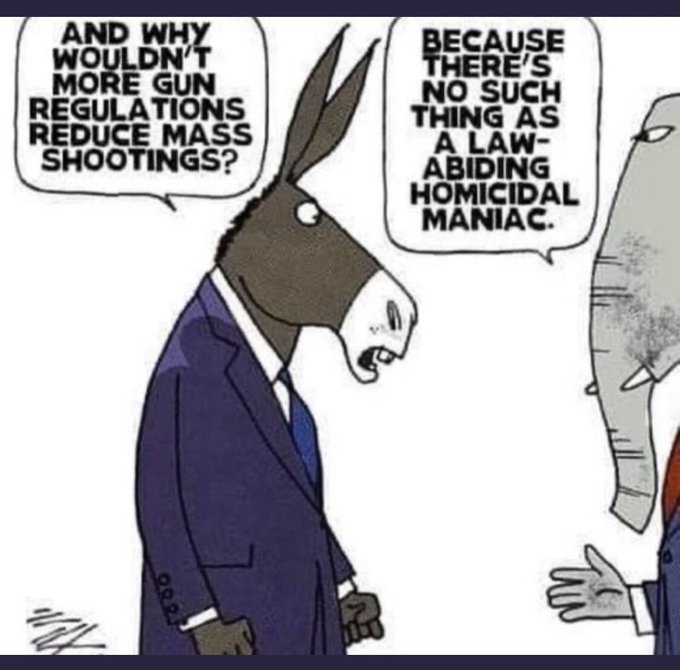
The insane arguments for gun control…if you can call them that

SAF FILES AMICUS BRIEF SUPPORTING CHALLENGE OF HAWAII GUN LAW
BELLEVUE, WA – The Second Amendment Foundation has filed a 29-page amicus brief supporting a motion for a temporary restraining order and preliminary injunction in a challenge of Hawaii’s restrictive concealed carry law, in a case known as Wolford v. Lopez.
The brief was filed in U.S. District Court for the District of Hawaii.
As explained in the court document, Hawaii “has followed New York, New Jersey, and Maryland in taking deliberate action to undermine the Supreme Court’s landmark Bruen ruling and the fundamental general right to carry an effective mechanism of self-defense it affirmed. Hawaii’s SB 1230 and similar laws specifically, and unfairly target those who have taken their rights most seriously in attempting to exercise them, even submitting to Defendants’ background check and training requirements.”
Following the 2022 Supreme Court ruling in New York State Rifle & Pistol Association v. Bruen, Hawaii passed SB 1230, a sweeping law designed to severely limit the places where licensed, law-abiding citizens can legally carry firearms for personal protection. So restrictive in its nature, the new legislation was colloquially dubbed the “Bruen response bill.”
“As we contend in our brief,” said SAF founder and Executive Vice President Alan M. Gottlieb, “Hawaii’s new law is written to make citizens afraid to exercise their constitutional right to bear arms, to the point they’re even afraid to enter a coffee shop without first being invited. We cannot have law-abiding citizens afraid to exercise a right for fear of being prosecuted and made into criminals. That is not how constitution works, and specifically, it is why the Second Amendment includes the phrase ‘shall not be infringed.’ SB 1230 constitutes a serious infringement.”
“There are no historical analogues supporting the extreme nature of Hawaii’s gun law,” added SAF Executive Director Adam Kraut. “To the contrary, as we explain to the court, history shows lawmakers respected Second Amendment rights as part of everyday life, to the point of encouraging people to bring their guns to public meetings and even church. Hawaii, on the other hand, is trying to make have a gun outside of one’s home or private vehicle a crime.”
July 15
70 – After 3 days of siege the army of Roman general – and later emperor – Titus breaches the walls of Jerusalem.
1099 – Christian soldiers of the First Crusade take the Church of the Holy Sepulchre in Jerusalem after a final assault.
1149 – The reconstructed Church of the Holy Sepulchre is consecrated in Jerusalem.
1482 – Muhammad XII is crowned the 22nd and last moslem king of Granada.
1741 – Aleksei Chirikov sights land in Southeast Alaska. He sends men ashore, making them the first Europeans to visit Alaska.
1789 – Gilbert du Motier, Marquis de Lafayette, is named by acclamation Colonel General of the new National Guard of Paris during the French revolution.
1799 – The Rosetta Stone is found in, of all places, the Egyptian village of Rosetta by French Captain Pierre François Bouchard
1806 – Lieutenant Zebulon Pike begins an expedition of the west from Fort Bellefontaine, Missouri
1834 – The Spanish Inquisition, which no one ever expected, is officially disbanded after nearly 356 years of operation.
1862 – On the Mississippi river, the Confederate ironclad Arkansas, under the command of Captain Isaac N. Brown engages the Union flotilla of the Carondelet, Tyler, and Queen of the West, commanded by Admiral David Farragut. All ships sustain heavy damage but the Arkansas breaks through to Vicksburg
1870 – Georgia becomes the last of the former Confederate states to be readmitted to the Union under Reconstruction.
1910 – In his book Clinical Psychiatry, Emil Kraepelin gives a name to Alzheimer’s disease, naming it after his colleague Alois Alzheimer.
1916 – In Seattle, Washington, William Boeing and George Conrad Westervelt incorporate Pacific Aero Products, later renamed Boeing.
1918 – The Second Battle of the Marne during World War I begins with a German attack.
1948 – General of The Armies, John J. ‘Black Jack’ Pershing, age 87, dies at Walter Reed General Hospital in Washington, D.C.
1954 – The prototype for both the Boeing 707 and C-135 series, the Boeing 367-80 makes its maiden flight
1975 – The Apollo–Soyuz Test Project features the dual launch of an Apollo spacecraft and a Soyuz spacecraft on the first joint Soviet/United States human crewed flight.
2002 – “American Taliban” John Walker Lindh pleads guilty to supplying aid to the enemy and to possession of explosives during the commission of a felony.
2006 – Twitter is launched.
2016 – Steven Fjestad, age 68 author of multiple editions of the Blue Book of Gun Values dies of a short illness at his home in Minnesota.
Experts See Uncertainty in New Supreme Court Gun Case
The nation’s highest court is set to decide a new Second Amendment case, but how the justices might come down is murky at best.
A collection of experts from across the ideological spectrum who have spent decades studying the Second Amendment and American gun laws told The Reload United States v. Rahimi presents a unique challenge for the Court that will likely flush out its new test for gun cases. But they were less confident about the direction the justices might take or the conclusion they might arrive at.
“It is still too early to tell what the Supreme Court will do in Rahimi,” George Mason University professor Robert Leider, who writes about the Second Amendment and teaches at the Antonin Scalia Law School, said.
Rahimi will be the first gun case the Supreme Court takes up since it handed down a new Second Amendment test in last year’s New York State Rifle and Pistol Association v. Bruen. It is an appeal of a Fifth Circuit panel’s ruling that found the federal ban on those subject to domestic violence restraining orders possessing guns was unconstitutional under the Bruen test. It stems from a case against a Texas man who pled guilty to violating a restraining order his child’s mother had against him over accusations he assaulted her when police found he had guns in his home. The police were able to search his home and find the guns because he is also accused of carrying out multiple shootings unrelated to the situation with his ex-girlfriend.
“Doubtless, 18 U.S.C. § 922(g)(8) embodies salutary policy goals meant to protect vulnerable people in our society,” Judge Cory T. Wilson wrote for the panel. “Weighing those policy goals’ merits through the sort of means-end scrutiny our prior precedent indulged, we previously concluded that the societal benefits of § 922(g)(8) outweighed its burden on Rahimi’s Second Amendment rights. But Bruen forecloses any such analysis in favor of a historical analogical inquiry into the scope of the allowable burden on the Second Amendment right. Through that lens, we conclude that § 922(g)(8) ‘s ban on possession of firearms is an ‘outlier that our ancestors would never have accepted.’ Therefore, the statute is unconstitutional, and Rahimi’s conviction under that statute must be vacated.”
The Department of Justice (DOJ) decided to skip appealing to the full Fifth Circuit and head straight to the Supreme Court, which agreed to take up the case late last month. All of the experts who spoke with The Reload agreed that move was a potentially-smart piece of strategic litigating by Attorney General Merrick Garland (D.) and the DOJ.
Actually they’ve made more than one movie about this……..
‘World’s first mass-produced’ humanoid robot to tackle labour shortages amid ageing population.
The company behind GR-1 plans to release 100 units by the end of 2023 mainly targeting robotic R&D labs. GR-1 will be able to carry patients from the bed to wheelchairs and help pick up objects.
In China, the number of people aged 60 and over will rise from 280 million to more than 400 million by 2035, the country’s National Health Commission estimates.
To respond to the rising demand for medical services amid labour shortages and the ageing population, a Shanghai-based firm, Fourier Intelligence, is developing a humanoid robot that can be deployed in healthcare facilities.
“As we move forward, the entire GR-1 could be a caregiver, could be a therapy assistant, can be a companion at home for the elderly who stay alone,” said the CEO and Co-founder of Fourier Intelligence, Zen Koh.
Standing 1.64 metres tall and weighing 55 kilograms, GR-1 can walk, avoid obstacles and perform simple tasks like holding bottles.
“The system itself can achieve self-balance walking and perform different tasks. We can programme it to sit, stand and jump. You can programme the arms to pick up utensils and tools and perform tasks as the engineers desire,” said Koh.
Though still in the research and development phase, Fourier Intelligence hopes a working prototype can be ready in two to three years.
Once completed, the GR-1 will be able to carry patients from the bed to wheelchairs and help pick up objects.
The company has developed technology for rehabilitation and exoskeletons and says that the patients are already familiar with using parts of robotics to, for example, support the arms and legs in physical therapy.
Koh believes humanoid robots can fill the remaining gap.
“Eventually they [patients] will have an autonomous robotics that is interacting with them.”
GR-1 was presented at the World AI Conference in Shanghai along with Tesla’s humanoid robot prototype Optimus and other AI robots from Chinese firms.
Among those was X20, a quadrupedal robot developed to replace humans for doing dangerous tasks such as toxic gas detection.
“Our wish is that by developing these applications of robots, we can release people from doing dreary and dangerous work. In addition to the patrol inspection,” said Qian Xiaoyu, marketing manager of DEEP Robotics.
Xiaoyu added that the company is planning to develop X20 to be used for emergency rescue and fire detection in future, something “technically very challenging” according to him.
The World AI Conference runs until July 15.
Kamala Harris anti-gun comments a warning
Vice President Kamala Harris has never been a fan of the right to keep and bear arms. We’ve long known this and no one will be surprised to hear this.
Yet as vice president, she hasn’t been all that outspoken about guns, all things considered. Why would she need to be? Her boss is making plenty of anti-gun waves as it is.
Harris isn’t going to stay out of the debate, though. She’s ready to push the anti-gun agenda as well.
Kamala Harris Takes Aim at NRA and Guns: The National Rifle Association’s convention in Indianapolis was in Vice President Kamala Harris’ crosshairs during a speech before the non-profit civil-rights group the National Action Network back in April.
The speech, at the time, could be seen as a start to the 2024 campaign season on the Democratic side…
Her speech marked a clear departure from the rambling and incoherent statements she made that landed her in hot water with Democrats and Republicans alike.
It was clear and focused, and filled the vice presidential attack dog role.
Kamala Harris ridiculed the convention slogan about freedom asking “freedom for who?”? She noted that it was not freedom for gun-violence victims or their families.
“This is not for the parents who pray their children will come home from school safe,” Harris said.…
Whether Harris can stay on message remains to be seen, but she appears to have found a message that Democrats think can be effective.
Yes, this isn’t exactly breaking news. I get it.
But the point is that it’s clear that gun control is going to be a big issue in 2024 and both Biden and Harris are doing battlespace prep for that fight.
What’s more, it seems that Harris is ready to make this a racial issue, but only by telling one side of the story.
“Gun violence is now the number one cause of death of children in our nation,” she said. “And while all this violence impacts all communities in devastating ways, we know it does not do so equally. Black people are only 13% of America’s population but more than 60% of homicide victims from gun violence.”
FBI statistics also show that the number of black offenders in homicides is significantly higher. In 2019, the last year for which national statistics are available shows that 55.9% offenders in gun crimes were black compared with 41.1% who were white.
Honestly, this isn’t surprising.
The White House isn’t interested in having a discussion. They’re not interested in a debate. When Harris said this, it made it clear that they want to paint this as a racial issue and that if you’re not for gun control it’s because you want black people to die.
But the problem is that it’s black people doing damn near just as much of the killing.
What’s more, though, they’re disproportionately represented among those convicted of firearm possession crimes. If we’re going to play that game, how is gun control not racist?
This is what we’re in for in 2024, folks, so buckle up.
And it’s what we need the various gun rights organizations combatting as we go forward. We need the spokespeople out in front on this one.
Unfortunately, far too many of them have been silent. That’s not a heartwarming fact if you ask me.
The upside, however, is that while they think this is an issue they can win on, this is also the administration that thinks the economy is doing great and seems to want to tout that as a winning issue, too, so there might not be too much to worry about.
SAF FILES REPLY BRIEF IN CHALLENGE OF MARYLAND CCW LAW
BELLEVUE, WA – Attorneys representing the Second Amendment Foundation and its allies in a federal challenge of Maryland’s restrictive concealed carry statute today filed their reply to the state’s arguments against an earlier motion for a preliminary injunction in the case known as Novotny v. Moore.
The response brief was filed in U.S. District Court for the District of Maryland.
SAF is joined in the case by Maryland Shall Issue, the Firearms Policy Coalition and three private citizens, all of whom possess “wear and carry permits,” including Susan Burke of Reisterstown, Esther Rossberg of Baltimore, and Katherine Novotny of Aberdeen, for whom the lawsuit is named. They are represented by attorneys David H. Thompson and Peter A. Patterson at Cooper & Kirk in Washington, D.C., Mark W. Pennak at Maryland Shall Issue in Baltimore, and Matthew Larosiere from Lake Worth, Fla.
The lawsuit focuses on SB1, a bill signed by Gov. Wesley Moore, which has added new restrictions on where legally-licensed citizens may carry firearms for personal protection. Maryland is attempting to wildly expand so-called “sensitive places” in an attempt to virtually prohibit lawful, licensed concealed carry in almost every venue in the state outside of someone’s home or business.
“As we maintained in our initial lawsuit, the State of Maryland is desperately trying to justify its extremist policy by offering alleged historical analogues that don’t really exist,” said SAF founder and Executive Vice President Alan M. Gottlieb. “As we noted earlier, instead of trying to comply with the new guidelines set down in the Supreme Court’s Bruen ruling last year, Maryland lawmakers responded by adopting gun laws more restrictive than they were before. This is tantrum-level stubbornness usually confined to elementary school playgrounds, and it doesn’t belong in state legislatures or governors’ offices.”
“Today’s brief further underscores the fact that Maryland’s recently enacted restrictions on carry are incompatible with this nation’s history and tradition of firearms regulation,” said SAF Executive Director Adam Kraut. “In defense of its law, Maryland grasps at straws and reasoning well removed from a logical pathway to justify its new existence. Our brief systemically refutes the positions put forth by the government and demonstrates that the challenged restrictions are constitutionally impermissible.”
The tail wags the dog

Every red state should follow Montana's lead and separate themselves from the corrupt ALA. State and local efforts to reform libraries are undercut when national groups control and rain money on the library system. Fed $$ are reinforcements in this cultural battle. https://t.co/Jve9XKlPQ3
— Anna K. Miller (@annakate_miller) July 13, 2023


July 14
1430 – Joan of Arc, taken by the Burgundians in May, is handed over to Pierre Cauchon, the bishop of Beauvais.
1769 – An dual land and sea expedition led by Gaspar de Portolá, Governor of the Californias, leaves its base in Baja California and sets out for Alta California, to find the Port of Monterey, now Monterey, California, as described by Sebastián Vizcaíno in 1602.
1789 – The citizens of Paris storm the Bastille, seizing control of the fortress and releasing the few political prisoners jailed there.
1798 – The Sedition Act becomes law in the United States making it a federal crime to write, publish, or utter false or malicious statements about the United States government. Less than 3 years later, it expires.
1853 – The first major US world’s fair, the Exhibition of the Industry of All Nations, opens in New York City.
1874 – The Chicago Fire of 1874 burns down 47 acres of the city, killing 20 people.
1881 – Billy the Kid is shot and killed by Pat Garrett outside Fort Sumner at the Maxwell house. 140 years later, the Colt’s Frontier Model single action revolver used by Garrett sells for over $6 million at auction.
1900 – Armies of the Eight Nation Alliance capture Tientsin during the Boxer Rebellion.
1911 – Harry Atwood, an exhibition pilot for the Wright brothers, lands an airplane on the South Lawn of the White House.
1933 – In Germany, all political parties are outlawed except the Nazi Party.
The Nazi eugenics program begins with the proclamation of the Law for the Prevention of Hereditarily Diseased Offspring that calls for the compulsory sterilization of any citizen who suffers from alleged genetic disorders.
1943 – In Diamond, Missouri, the George Washington Carver National Monument becomes the first United States National Monument in honor of an African American.
1950 – North Korean troops initiate the Battle of Taejon.
1965 – The Mariner 4 probe takes the first close up photos of another planet during its flyby of Mars.
1983 – Nintendo released the computer game Mario Bros.
2015 – NASA’s New Horizons probe performs the first flyby of Pluto, completing the first survey of the Solar System.
2016 – A moslem terrorist vehicular attack in Nice, France kills 86 people and injures over 400 others.
Supreme Court Considering a Case That Might Upend Hundreds of January 6 Prosecutions
Prosecutorial overreach is not uncommon in high-profile cases. The prosecutors pile on the charges to frighten defendants with the prospect of long prison terms so they plead out. The state also hopes to throw enough charges against the wall to see what sticks.
But the danger of overreach is that a judge may want to smack a prosecutor down for bringing unnecessary charges. Such is the case in the January 6 prosecutions.
One of the rioters, Edward Lang, is facing 11 charges and pleaded not guilty to all of them. But a district court judge threw out the charges relating to “obstruction of an official proceeding” concerning Lang and two others accused of violence at the Capitol.
The law in question sentences a guilty party to up to 20 years in prison for anyone who “corruptly alters, destroys, mutilates, or conceals a record, document,” or “otherwise obstructs, influences, or impedes any official proceeding, or attempts to do so.” Lang is questioning whether the Sarbanes-Oxley statute fits the behavior of hundreds of rioters.
Sarbanes-Oxley was passed in response to financial malfeasance in the 2002 bankruptcies of telecom giant Worldcom and Enron, an energy company based in Houston. Lang argues that the obstruction defined in Sarbanes-Oxley bears no relationship to the violence that occurred on January 6, 2021.
The panel of the United States Appeals Court for the District of Columbia, though, by a 2-to-1 margin, upheld the use of the obstruction charge, deciding that Judge Nichols’s reading was too cramped. Judge Pan, writing for the majority, ruled that the “broad interpretation of the statute — encompassing all forms of obstructive acts — is unambiguous and natural.”
The request for a hearing before the Nine asks whether the statute, intended to clamp down on financial malfeasance, “can be used to prosecute acts of violence against police officers in the context of a public demonstration that turned into a riot.” Mr. Lang argues that a “statute intended to combat financial fraud has been transformed into a blatant political instrument to crush dissent.”
Lang’s petition before the high court warns that a “revolution is underway, with ambitious federal prosecutors reworking the penal code to make it do work never intended to be done, work that threatens to chill, and does chill, ordinary Americans in their First Amendment rights.” The petition says there’s no need to “create a new and novel application of a statute to capture the violence that took place that day.”
Lang argues that the obstruction must be done “corruptly,” which doesn’t appear to be the case in his prosecution. And finally, Lang warns that this prosecutorial strategy “will serve to chill political speech and expression on the eve of one of the most consequential events in American life — the election of the next President of the United States.” He says it “falls to this Court to rein in the Department of Justice.”
It’s easy to argue that there is a certain amount of vindictiveness in many of these prosecutions. The question facing the court will be, did prosecutors go too far in fashioning a legal argument to prosecute based on a loose interpretation of a statute that was never meant to cover violence during a riot?
Courts are reluctant to reign in prosecutors, but in this case, there’s a chance the Supreme Court might look to cut the DoJ’s misused freedom of action and bring them down a peg.
For some rioters, it could mean the difference between prison and freedom. For others, taking a 20-year sentence off the table will be, if nothing else, a relief.
“Operation Atlantic Resolve” is the catchall name for the response to Russia’s invasion of Ukraine.
Why the hell is this NOT major news!?! https://t.co/FOKQFf4goI
— MomAtArms (@mom_at_arms) July 13, 2023