

A Senator threatening a "popular revolt" seems kinda insurrectionrry. https://t.co/qc0pyWo9Vq
— Just a RKT guy….. (@barnacles71) May 14, 2023
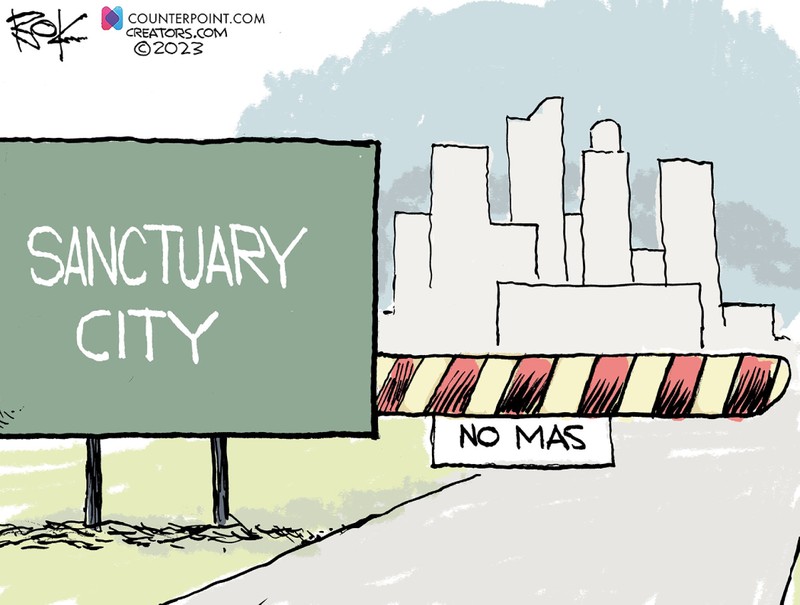
What Are All These Illegals Going to Do?
So, the gate to illegal entrance into America is now open wider than it was before. Well, since Biden became President, there hasn’t been a gate. By the time he leaves office, there will be…how many people illegally in the United States, having crossed our non-existent southern border, by far the greatest breakdown of the federal government whose first job is to protect Americans from invasion by those who are not legally allowed into the land. This will be Biden’s most horrendous legacy historically—the worst of all his failures.
What will the total figure end up being? 25 million? 30 million? There is no way we will know, until they are all given amnesty, which will happen eventually. That’s what the Democrats want and, well, what else can we do with them? Ship them back across the Mexican border and let them die in the desert? They are here to stay, folks, you know it, I know it, they know it, and Biden knows it. And that’s been the plan all along.
But what will they do? Well, a variety of things, none good because they are here illegally—at least for a while. But here are some possibilities to keep them occupied.
1. Pick crops. Many of them are already doing that, and have been for years. They shouldn’t be doing it, of course, not just because they shouldn’t be here in the first place, but because they are taking work from American citizens. How about starting with the hundreds of thousands of homeless that are on the streets? They need jobs. Round ‘em up and send them to the fields. But can’t do that because Democrats need them on the streets for—something. Political gain surely. Young people could start their careers by doing farm labor, but they are too lazy to work, period, so it would be hard to coax them to do it. So, bottom line, lots of the newcomers will be in the fields as well. At least they will be working. They will have jobs that Americans don’t want to do, and that says something about the country. And also about leadership, in all areas, which is not encouraging especially young people towards the virtues of hard work and diligence. But people on welfare means votes for politicians.
2. Some illegals will sell drugs. That’s what many of them came to do—work for the cartels. They can make pretty good money killing Americans. Frankly, I place most of the blame here on the people who take drugs. It is an utterly useless, dangerous, stupid thing to do. Nobody forces anybody to take drugs, although I’ve heard a few fentanyl deaths were innocent. But I really struggle to feel sorry for people who ruin their lives, or die, by voluntarily putting something into their body that doesn’t belong there and can only harm them. The drug problem in America is completely the fault of the fools who take them. I have never smoked one weed in my life or taken a single illegal drug, and that by choice. I’m not very smart, but I’m not THAT stupid. We could stop the drug problem tomorrow if every American would just have the sense to quit using them. But that isn’t going to happen, and thus there is a tremendously lucrative market for drugs. So many of the illegals will be in America getting rich off the recklessness of the millions who take drugs.
3. Menial jobs, welfare, homelessness, crime. Very few of the illegals are skilled laborers (except for picking Nancy’s crops), so they won’t be able to get high paying jobs. They will live together in hovels, 8, 10, 12 to a house, or on the streets, and be in poverty. Many will, of course, get on welfare and you and I will take care of them through our tax dollars. There are a lot of other criminals crossing the border as well, and thus the Democrat-caused crime wave will escalate. All this chaos is exactly what the Left wants because…
These people are a revolution waiting to happen. The illegals are going to discover that Joe Biden’s America is not what it was advertised to be. Most of them will exist in squalor and deep poverty, with no easy avenue of escape. Many children will end up in some kind of child labor or maybe even sex slavery to help their families subsist. It is a horrible situation Biden is creating. Many of these people left their countries to get away from this, but they will find a concomitant situation in the United States.
If we think a revolution cannot happen in America, then we are only deluding ourselves. Adolf Hitler actually came to power legally, but Mao Zedong required a civil war. Lenin took advantage of mass discontent to take over Russia, and that appears to be the most likely scenario in America. The Democrats are creating hatred of America in many groups, especially blacks and millennials. Thus, they will have no qualms about rebelling against a country they despise, which they believe is unfair, unequal, and full of injustice. This is a classic recipe for revolution. And just what the Democrats crave.
And if the situation proves intolerable for the illegals, they, too, will become a discontented mass, angry, and ripe for Leftist propaganda. In history, when this kind of brew is stirred into a national pot, it usually takes a strongman (dictator) to step forth and subdue it, taking away everyone’s liberties in order to create stability. Once he gets power, he never gives it up. It happened in many countries in the 20th century, and it can happen in the 21st, too.
Welcome to Joe Biden’s America, deliberately manufactured. An increasingly seething, boiling cauldron of discontent. I have no answers to this one. I’ve seen it too many times in history. Once the avalanche starts, there is no way to stop it.

A new report from the United Nations’ Food and Agriculture Organization (FAO) has determined that meat, eggs and milk are vital sources of much-needed nutrients, such as proteins, fats and carbohydrates, that aren’t easily found in plant-based foods.
The comprehensive study, which is based on data from more than 500 scientific papers and 240 policy documents, also stated that these nutrients are critical during key life stages, such as pregnancy and lactation, childhood, adolescence and older age.
“Nutrient needs of humans vary substantially over their life course. While there are a variety of dietary patterns that can meet those needs, foods that are rich in nutrients are a critical part of a healthy diet,” FAO Deputy Director-General Maria Helena Semedo and Chief Economist Máximo Torero Cullen wrote in a foreword to the report. “Terrestrial animal source foods provide energy and many essential nutrients, such as protein, fatty acids and several vitamins and minerals that are less common in other food types.”
Health benefits of eating animal source foods
Some of the crucial nutrients found in animal sources include:
- High-quality protein, which is necessary for increasing muscle mass
- Essential fatty-acids, which help with cognition, neurodevelopment and ant-iinflammatory processes
- Iron, which prevents iron deficiency anemia
- Calcium, which contributes to bone health
- Zinc, which supports vital functions in growth, development and immunity
- Selenium, which is anti-inflammatory and supports genome-level processes
- Vitamin B12 for neurodevelopment and cell formation
- Choline for growth, brain function and gene interactions
- Bioactive compounds such as carnitine, creatine and taurine that promote good health
Consuming unprocessed red meat, such as beef, pork and lamb, in moderate amounts (between 9 to 71 grams per day), carries minimal risk, but is generally considered safe as it pertains to chronic disease outcomes.
Additionally, the report noted that “the evidence of any links between milk, eggs and poultry consumption in healthy adults and diseases such as coronary heart disease, strokes and hypertension is inconclusive (for milk) or non-significant (for eggs and poultry).”
The bigger picture
Food from animal sources are deemed part of a healthy diet and can go a long way toward achieving FAO’s Sustainable Development Goals, such as reducing wasting among children under five years of age, low birthweight, anemia in women of reproductive age, and obesity and non-communicable diseases in adults.
In the report, Semedo and Cullen also wrote that the livestock sector “must contribute to addressing a range of challenges,” including environmental issues; herd management; animal health related issues; human-livestock related issues; and social issues.
Democrats’ Nightmares–African Americans See Racism in Democrat Attacks on Clarence Thomas.
An idea for a poll: Survey black Americans to see if they think racism is any way behind the three-decade-long, never-ending criticism of Supreme Court Justice Clarence Thomas.
This shouldn’t be a controversial notion. Progressives and Democrats have long attributed racism to criticism of black government officials they like. Only last month, former White House chief-of-staff Ron Klain said racism is behind the criticism of Vice President Kamala Harris (of course along with sexism).
The left never tires of telling us how deeply racism infects the nation, that American institutions are embedded with systemic racism, that white people can’t recognize the unconscious racist attitudes they harbor about people of color, that white children develop racial bias as early as 4 years old, that racism permeates even math and science, that “white privilege” remains an ongoing injustice, and on and on.
With racism so deeply entrenched in American society, criticism of black politicians and government officials can be — even sometimes must be — based on race, according to progressive thinking.
That is, it applies when the criticism is aimed liberal office holders and public figures, according to the progressive narrative. You never heard that accusation when black conservatives are attacked.
That’s a double standard at the heart of liberal cries of racism.
But, if America is so deeply and intrinsically racist, as the far left never hesitates to remind us, why would any black official, including conservatives, be immune from race-based attacks?
Which brings us to the case of Justice Thomas.
Now it’s true that there is a bigger picture at work at the present. The most recent criticism of Justice Thomas comes amid a broad-based Democrat and left-wing assault on the Supreme Court, a full-scale, no-holds-barred campaign to delegitimize the nation’s highest court.
Like the segregationists of the 1950s and ’60s who sought to undermine the high court because of its rulings ending segregation in schools and public places, today’s progressives attack the independence and integrity of the court because they hate its prominent rulings, most notably the one returning the issue of abortion to the people to deal with through their state legislatures.
But the brunt of the anti-court blitz falls on Justice Thomas. And it’s just the latest example.
BLUF
The only silver lining in this minatory storm cloud is the fact that such movements, though unconscionably cruel, arbitrary, and destructive, are also astonishingly fragile.
“Because he can.”
That’s the answer one has to give to those who ask how Alvin Bragg, a local district attorney in office by the slimmest of margins—and then only because of a huge subsidy from the anti-American billionaire George Soros—can get away with antics like indicting Donald Trump, a former (and, possibly, future) president of the United States, and, now, with charging former Marine Daniel Penny with manslaughter because he (along with at least two others) intervened to stop Jordan Neely from attacking fellow passengers on a New York subway.
Because he can. As a friend remarked when digesting the spectacle of Penny being led away in handcuffs, totalitarian movements often start slowly, almost timidly, but as they gain power, they become more brazen. After a certain point, they do outrageous things just to intimidate the public and demonstrate their power.
We now know that the FBI, the CIA, and other elements of America’s security apparatus intervened directly in the decision making of Twitter and other social media companies to influence the course of the 2020 election. One part of that intervention had to do with organizing 51 senior former intelligence figures to sign a letter declaring that Hunter Biden’s laptop was “Russian disinformation.” That was a lie. They knew it was a lie. It didn’t matter. They did it because they knew they could get away with it.
The United States is on the verge of being inundated with thousands upon thousands of illegal aliens. Many are from South or Central America. Hundreds are from China, even though they are crossing that notional line we used to be able to call, without irony, our southern border. Why did the Biden Administration decide to enact a real-life Camp of the Saints invasion of the United States? Because it could. There was no immediate price to pay.
In her classic study, The Origins of Totalitarianism, Hannah Arendt makes several observations that bear on our current situation. “There is no doubt,” she observes,
Explaining Constitutional Amendments pic.twitter.com/oYkMPBe9Zi
— Elon Musk (@elonmusk) May 13, 2023
May 14
1097 – The Byzantine Siege of Nicaea, under control of moslem Turks since 1081, begins during the First Crusade.
1607 – James Fort, later Jamestown, Virginia is settled as an English colony, the earliest permanent English settlement in the Americas.
1787 –Delegates to the Convention of the States begin to assemble in Philadelphia to revise the Articles of Confederation.
1796 – Edward Jenner administers the first smallpox inoculation on James Phipps, the 8 year old son of his gardener.
1800 – The 6th United States Congress recesses, and the process of moving the U.S. Government from Philadelphia to Washington, D.C., begins.
1804 – William Clark and 42 men depart from Camp Dubois in modern Illinois, to join Meriwether Lewis and form the “Corps of Discovery” at St. Charles, in modern Missouri, to begin an exploration up the Missouri River region of the Louisiana Purchase.
1836 – The Treaties of Velasco are signed in Velasco, Texas by Interim President David G. Burnet for Texas and Santa Anna for Mexico, concluding hostilities between the two armies and beginning the first steps toward the official recognition of Texas’ independence from Mexico.
1878 – The last witchcraft trial in the United States begins in Salem, Massachusetts, with Lucretia Brown, an adherent of Christian Science, accusing Daniel Spofford of attempting to harm her through his mental powers.
1913 – Governor William Sulzer of New York approves the charter for the Rockefeller Foundation, which begins operations with a $100 million donation from John D. Rockefeller.
1948 – The Declaration of the Establishment of the State of Israel which establishes a Jewish state in Eretz-Israel, is declared by David Ben-Gurion in Tel-Aviv, to come into effect on termination of the League of Nations British Mandate for Palestine at midnight. Immediately after the declaration, Israel is attacked by the neighboring Arab states, triggering the 1948 Arab–Israeli War.
1955 – 8 Communist bloc countries, including the Soviet Union, sign a mutual defense treaty called the Warsaw Pact.
1973 – The Skylab space station is launched from the Kennedy Space Center in Florida.
1988 – A drunk driver traveling the wrong way on Interstate 71 near Carrollton, Kentucky, hits a converted school bus carrying a church & youth group from 1st Assembly of God church in Radcliff, Kentucky, killing 27 of the 67 people aboard, becoming the impetus for MADD – Mothers Against Drunk Drivers – to be formed by the mothers of several of the victims.
2004 – Rico Linhas Aéreas Flight 4815, an Embraer EMB 120, crashes into the Amazon rainforest during approach to Eduardo Gomes International Airport in Manaus, Brazil, killing all 33 passengers and crew aboard.
2010 – Space Shuttle Atlantis launches on the STS-132 mission to deliver the first shuttle launched Russian ISS component – Rassvet.
2022 – At a grocery store in Buffalo, New York, 10 people are killed and 3 wounded when shot by a teenage racist.
Observation O’ The Day
For now, the New York City mayor is asking citizens to house illegals in their “spare” property. Soon, he will force landlords to house them. Then he will force homeowners.
It’s the commie way. Go ahead New York, keep electing Democrats.
– Divemedic
Jarrell homeowner shoots suspected burglar entering home
JARRELL, Texas (KXAN) — A homeowner shot a suspected burglar Thursday morning in Jarrell after he forced his way into the home, according to a Williamson County Sheriff’s Office release.
The suspect, identified as 29-year-old Juan Sanchez Palafox, was found dead by WCSO deputies after they were called to the home on County Road 239, the release said.
Biden casting Bolshevik spells:
Lenin/Stalin’s “greatest danger principle” accused the ethno-racial majority culture of being a threat to justify to discrimination.
It dialectically progressed to minorities being the greatest danger once socialism succeeded.
(Martin, 2001) https://t.co/Pq3mWEBaD4 pic.twitter.com/AcQN94lW8C
— Steven Welliever (@StevenWelliever) May 13, 2023
They’re starting to realize they’re considered obsolete as a demoncrap constituency, and are being replaced.
Chicago residents are told that 250 illegals are coming to their neighborhood
This is how they reacted: pic.twitter.com/YDRIBhqCxg
— End Wokeness (@EndWokeness) May 11, 2023
They let the truth slip out, and then are so stupid, they believe we’re so stupid, we’ll believe they didn’t really mean what was said.
After “no more guns” comment, Giffords claims she’s seeking common ground
Giffords co-founder and gun control activist Gabby Giffords is out with a new puff piece in Rolling Stone that’s audaciously headlined “cynicism is not an option when it comes to gun control“. Why’s that so audacious? Because the same person who said just a few weeks ago that her goal is “no more guns” is once again claiming that she’s only looking for “common ground” and blaming Second Amendment supporters for “extremism”.
The gun lobby has done its best to divide our nation and to polarize the conversation around guns. They want their base to believe that their Second Amendments rights are under attack, and that threats are lurking around every corner. This extremism drives votes and sells guns.
Rather than relying on extremism, I’ve sought to find common ground. Most Americans agree that gun violence is a problem we need to address. No American wants to worry that their child might not come home from school because of a mass shooting. Policies like closing loopholes in our federal background checks system, making sure every state has an extreme risk protection order or “red flag” law, and ensuring guns are kept away from kids have broad popular support.
Why would anyone believe their Second Amendment rights would be under attack? Could it be the states that are banning commonly-owned firearms and threatening gun owners with prison time for simply holding on to the guns and magazines they lawfully purchased? Could it be the four-figure fees some localities are charging folks who want to exercise their right to bear arms in self-defense? Maybe it’s the activists who are calling on Colorado Gov. Jared Polis to issue an executive order banning all gun sales and ordering a mandatory “buyback”… or the founder of one of the country’s biggest gun control groups who says her goal is simply “no more guns“?
As we wrap our interview in her office, I ask how she keeps coming back to a challenge so deeply ingrained in politics. She pauses for 12 pregnant seconds.
“No more guns,” she says.
Ambler, her aide and adviser, tries to clarify that she means no more gun violence, but Giffords is clear about what she’s saying. “No, no, no,” she says. “Lord, no.” She pauses another 32 seconds. “Guns, guns, guns. No more guns. Gone.”
An aide clarifies that she’s talking about Australia, where gun sales were outlawed after a mass shooting and existing weapons were purchased by the government. Giffords nods in the affirmative. It’s an idealistic goal, for sure, and one perhaps mismatched for the moment in this country. But Giffords has an answer for that: “Legislation, legislation, legislation.”
Time Magazine’s Phillip Elliott is wrong about the Australia gun ban, which didn’t outlaw all gun sales. In fact, there are more guns legally owned in Australia now than before the 1996 ban, which didn’t remove every gun in the country to begin with. In 1996 there were about 3.2-million privately owned firearms in the country. After the compensated confiscation, the number dipped to 2.7-million, but by 2017 there were an estimated 3.6-million guns in the hands of Australians.
Maybe Gabby Giffords herself is unclear about the effects of the Australian gun ban, but there seems to be no doubt about her end goal here in the United States. It’s not red flag laws, storage mandates, or “universal background checks.” It’s “no more guns. Gone.”
So yeah, I think it’s pretty cynical for Giffords and her handlers to pretend she never let the mask slip and revealed her true intentions, especially when she turns around and calls Second Amendment supporters extremists. What position is more extreme: the right to keep and bear arms in self-defense is a fundamental civil right that cannot be infringed upon, or “no more guns”? Where’s the common ground in that statement?
Look, I don’t begrudge Gabby Giffords’ gun control views, even if I don’t agree with them. She’s entitled to her opinion and is free to advocate for any gun control laws she wants. But when she tells a reporter that she wants to eradicate gun ownership and then puts her name behind an opinion piece pointing the finger at gun owners for dividing our nation and polarizing the conversation around guns, she’s engaging in the same cynical and dishonest approach she claims to condemn. I’d have more respect for Giffords if she’d simply come out and announce that the mission of her organization is to repeal the Second Amendment, but I doubt that will ever happen. Giffords may have let the mask slip while talking to Time, but her missive in Rolling Stone shows she knows how to play the gun control long game; claiming moderation and using an incrementalist approach, but always with the end goal of gun prohibition in mind.
“Infringed” – finally – defined by a federal court; From the summary judgement that prohibiting 18 to 20 year old people from purchasing firearms is unconstitutional.
****
The Second Amendment accords protection of “the right of the people to keep and bear Arms,” by providing that the right “shall not be infringed” U.S. Const. Amend. II (emphasis added). The Second Amendment is unique in its use of “infringed” for the word does not appear anywhere else in the Constitution. Despite its uniqueness, the term “infringed” has received little attention by scholars or courts. However, Heller took the view that “infringed” “implicitly recognizes the pre-existence of the right.” 554 U.S. at 592 . As articulated in Heller, the Second Amendment does not serve to grant a right but rather preserves a right that the people already possessed. Therefore, to “keep and bear” serves to identify the right protected, not to define the right in the first instance.
The definition of “infringe” further supports the conclusion that the pre-existing right includes a right to purchase. “Infringe” is defined in modern dictionaries as “to encroach upon in a way that violates law or the rights of another.” “Infringe,” Merriam-Webster.com. “Encroach,” in turn, has two definitions: “to enter by gradual steps or by stealth into the possessions or rights of another” and “to advance beyond the usual or proper limits.” “Encroach,” Merriam-Webster.com. Those words have possessed the same meaning since the sixteenth century and the Founders would have understood them in the same way.9 Not simply protecting the heartland of the preserved right, the Second Amendment protects the environs surrounding it to prevent any encroachment on the core protections. Thus, by virtue of the word “infringed,” the Second Amendment ‘s protective textual embrace includes the conduct necessary to exercise the right (“to keep and bear”) and that, as explained above, includes the right to purchase arms so that one can keep and bear them.
*****
Police release name of Nacogdoches man shot after breaking into home
NACOGDOCHES, Texas (KTRE) – Nacogdoches police say it was the intruder who was shot in a home invasion Saturday afternoon.
Brandon Horton, 34, of Nacogdoches was fatally shot after breaking into a home on the 700 block of Rock Oak St.
According to a press release from the Nacogdoches Police Department, two people were inside the home, one female resident and a male friend, when Horton knocked on the door to the residence.
When no one came to the door Horton used a “large metal object” to break down the door and enter the home.
Once inside, while still carrying the object, Horton broke down a door to a bedroom where the male was hiding. The man discharged his firearm, hitting Horton.
The resident and male friend both immediately called 911 after the shooting. Both subjects have been questioned and no charges have been filed.
Miss Swearer hit a line drive out of the park again
11 Defensive Gun Uses Show How Lawful Gun Owners ‘Get It Right’
Often lost in conversations about gun violence is the reality of who is responsible for the bulk of that violence. Most gun crimes aren’t committed by lawful gun owners but by a small subset of repeat violent offenders who already are prohibited from legally possessing firearms.
At the same time, the vast majority of the nation’s millions of lawful gun owners will never use their firearms to harm themselves or others (excluding, of course, actions taken in lawful self-defense).
Nevertheless, sometimes people make questionable—or even downright abhorrent—decisions with their lawfully owned firearms. This was quite apparent in recent weeks as several gun owners made national headlines for all the wrong reasons, recklessly resorting to the use of lethal force when it likely wasn’t warranted.
Although these individuals rightly should have their actions scrutinized, the reality is that Americans with legally possessed guns are far more likely to “get it right” than they are to “get it wrong.”
Almost every major study has found that Americans use their firearms in self-defense between 500,000 and 3 million times annually, as the Centers for Disease Control and Prevention has acknowledged. In 2021, the most comprehensive study ever conducted on the issue concluded that roughly 1.6 million defensive gun uses occur in the United States every year.
For this reason, The Daily Signal publishes a monthly article highlighting some of the previous month’s many news stories on defensive gun use that you may have missed—or that might not have made it to the national spotlight in the first place. (Read other accounts here from past months and years. You also may follow @DailyDGU on Twitter for daily highlights of recent defensive gun uses.)
Just me, but it appears the younger man likely knew of the older ones violent past and decided to make his own plans for personal safety.
No charges will be filed in Germantown canvasser shooting, District Attorney’s Office says
Philadelphia prosecutors said the fatal shooting between two canvassers for political group One PA self-defense.
Prosecutors will not charge a 22-year-old man accused of fatally shooting a 46-year-old in East Germantown on Monday afternoon while both were canvassing for a political group. Authorities say the shooting was in self-defense.
Jane Roh, a spokesperson for District Attorney Larry Krasner, said Friday that both their office and the Police Department were in agreement about what happened between two paid canvassers for the progressive group One PA.
“This is nonetheless a tragic loss of life,” Roh said. “We extend our deepest condolences to the loved ones of the decedent.”
Meanwhile, family members of the victim, Eddie Brokenbough, were distraught to learn the father of 10 had been shot, and doubted police accounts of the shooting.
Reports spread that Brokenbough, who was shot once in the armpit and rushed from the 2000 block of Church Lane to a nearby hospital, had pulled a gun on the 22-year-old canvasser, causing the younger man to shoot in what he told police was self-defense.
Both men knew each other, police said, and the shooting stemmed from an “argument,” possibly over an existing dispute.
One PA has said guns are not permitted in its offices or during canvassing, and it has temporarily suspended its canvassing efforts.
The group is an independent expenditure committee that can raise and spend money to boost candidates but is prohibited from directly coordinating with them. This year, the group knocked on doors to promote mayoral candidate Helen Gym and a slate of left-leaning City Council candidates.
Brokenbough was not legally permitted to carry a firearm because of charges in a 2012 shooting, court records show. He was a paid temporary canvasser for OnePA on and off since 2021, the group said. The 22-year-old shooter has been employed by the group since last year.
A spokesperson for OnePA said Tuesday that it complies with laws prohibiting background checks on employees and wouldn’t discuss Brokenbough’s background during the investigation.
One PA Executive Director Steve Paul said following the shooting that the organization was “heartbroken, and our condolences and sympathy are with their family.”
Doesn’t fit the stereotype, must not be real
Black, Millennial, Female and Conservative
Antonia Okafor Cover joined me on Feedback to discuss her transformation from Democrat to Republican and her dedication to the Second Amendment. Antonia is the Director of Women’s Outreach with Gun Owners of America and Founder and President of Empowered, a nonprofit group designed to educate, train and equip young women in the use of firearms for protection on college campuses. The group also helps women advocate for their Second Amendment rights.
Antonia has been working on Second Amendment issue advocacy and firearms education for women for several years and has appeared on and been quoted in major news outlets, and has testified on Capitol Hill. News media are finally starting to cover the steady and growing trend of new female gun owners, which includes a large number of new black female gun owners.
For Antonia, this is not surprising, and she can highlight some of the major reasons women are deciding to empower themselves and buy a gun. Number one on that list is personal protection and self defense.
Antonia shared that her political evolution began when she realized that Democrats’ lack of principles and values, as well as their intolerance of diversity of thought led her to become a Christian and then a conservative who embraced our constitution and more specifically, the Second Amendment.
Women should be empowered to defend themselves and their families and because Democrats offer no real solutions to empower women, this is, indeed, the natural progression in becoming a conservative.
Well, you know the old lines about ducks and buffalo country, right?
Do Gun-Control Democrats Want Us Dead?
Modern politicians don’t ask to kill their opponents right away. There is a ladder of dehumanization to climb as they justify increasing levels of violence. We’ve heard Democrat politicians say that Republicans don’t care about killing children because the Republican legislators won’t pass more gun-control. Not only is that extremist rhetoric, it is murderously dangerous. Look at the facts and it seems gun-control Democrats really want more of us to die.
To quote Democrat Congressman Mike Thompson, “How many more kids need to get murdered before House Republican Leadership steps up and puts gun violence prevention legislation on the House calendar?”
The Democrat party news site DemCastUSA said, “Republicans ..block gun safety reforms while stoking hate. The GOP has blood on their hands while offering ‘Thoughts and Prayers’…”
Let’s look at what Democrat Politicians are asking for. This is what happens after honest citizens are disarmed.
Violent criminals commit about 1.2 million violent crimes a year (2019). Most criminals, about five-out-of-six, don’t use a gun in their violent crimes. In contrast, honest citizens use a firearm about 2.8 million times a year to stop death or great bodily injury. We don’t know how many of those defensive incidents would result in the victim’s death if they were disarmed. We can estimate the answer by assuming that criminals who attack disarmed victims are the same sort who attack armed victims. We are assuming that the criminals stay the same and only the actions of the victims change. That is overly simplistic, but it is a start. In fact, violent criminals become more violent when their victims become more vulnerable.
Here is an example to show you what I mean. If half of violent crimes were aggravated assaults, then we’ll assume that half of the attacks on the newly disarmed victims will remain as aggravated assaults. That may be wishful thinking since we don’t know how many aggravated assaults today were really attempted murders where a victim was able to reduce the severity of the attack because he was armed.
Violent criminals committed about 16.4-thousand murders in 2019. That is about 1.4-percent of the violent crimes. We now have 1.4 percent of what used to be armed defenses, about 38-thousand, now become new murders when the victims are disarmed by Democrat gun-control.
Gun-control Democrats more than tripled the number of murdered victims by disarming the good guys.