

Vida Blue, Oakland A’s MVP and three-time champion, dead at 73.
Frustratingly, the same judge who issued the foolish opinion which was overturned by the Supreme Court in McDonald v. Chicago has once again stepped in to enforce unconstitutional gun control. This is not the last laugh, and we are fully invested in ensuring this law is defeated. GOA will continue to fight until lower courts, executives, and lawmakers at all levels fall in line with the Bruen precedent.
New Law Bans Foreign Entities From Purchasing Montana Land
Foreign entities will no longer be allowed to purchase or lease land in Montana beginning later this year.
Gov. Greg Gianforte signed Senate Bill 203 on Thursday that the bans land purchases by what it refers to as “foreign adversaries,” defined as “any foreign government or foreign non government person determined by the U.S. secretary of commerce to have engaged in a long-term pattern or serious instances of conduct significantly adverse to the national security of the United States …”
The governor’s office identified China, North Korea, Russia, Iran, Cuba and Venezuela in a news release about signing the legislation.
“Montana will not stand idly by as foreign adversaries buy up our farmland, harvest private data, and spy on Americans,” Gianforte said. “Today, we’re doing what the Biden administration won’t to defend our economic security, food security, and national security assets.”
“From the spy balloon to CCP-linked companies buying American farmland to the Chinese Communist Party spying on Americans through TikTok, now is the time for bold, decisive action to defend our national interests,” the governor added. “If the federal government won’t protect America from Communist China and hostile adversaries, Montana will.”
Republican-led states such as Louisiana and Texas, as well as some Republicans in Congress, are pushing similar proposals to bar foreign interest from purchasing farmland in the U.S.
New Georgia Law Targets Left-Wing Prosecutors
The Peach State is joining the chorus of states that have had enough of soft-on-crime prosecutors. On Friday, Gov. Brian Kemp (R-Ga.) signed a bill into law that creates a commission to discipline and potentially remove prosecutors who don’t do their jobs.
“I am not going to stand idly by as rogue or incompetent prosecutors refuse to uphold the law,” Kemp said at the signing ceremony in Savannah, Ga. “Today we are sending a message that we will not forfeit public safety for prosecutors to let criminals off the hook.”
Georgia isn’t alone, of course. The Associated Press reports that Georgia’s new law joins “pushes to remove prosecutors in Florida, Indiana, Missouri, and Pennsylvania, as well as broader disputes nationwide over how certain criminal offenses should be charged.”

May 7
558 – In Constantinople, the dome of the Hagia Sophia collapses, 20 years after its construction. Roman Emperor Justinian I immediately orders that the dome be rebuilt.
1487 – King Ferdinand of Aragon besieges the Emirate of Granada’s port of Málaga with an army of 20,000 horsemen, 50,000 laborers, and 8,000 support troops during the Spanish Reconquista.
1664 – Louis XIV of France begins construction of the Palace of Versailles.
1718 – The city of New Orleans is founded by Jean-Baptiste Le Moyne, Sieur de Bienville.
1763 – Pontiac’s War begins with Chief Pontiac’s attempt to seize Fort Detroit from the British.
1840 – The Great Natchez Tornado strikes Natchez, Mississippi killing 317 people.
1846 – Although now owned by the Gannett conglomerate, The Cambridge Chronicle, America’s oldest surviving weekly newspaper, is published for the first time in Cambridge, Massachusetts.
1915 – Off the coast of southern Ireland, German submarine U-20 sinks the RMS Lusitania, killing 1,198 people, including 128 Americans.
1942 – During the Battle of the Coral Sea , U.S. Navy aircraft from carriers Lexington and Yorktown attack and sink the Imperial Japanese Navy light aircraft carrier Shōhō; marking the first time in naval history that two enemy fleets fight without visual contact between warring ships.
1945 – German Wehrmacht Generaloberst Alfred Jodl signs unconditional surrender terms at 02:41 hours Central European Time at SHAEF Headquarters at Reims, France, ending Germany’s participation in world War II, taking effect the next day at 23:01 hours.
1946 – Tokyo Telecommunications Engineering (now Sony) is founded.
1954 – The Battle of Dien Bien Phu ends in a French defeat by the Viet Minh
1960 – Soviet leader Nikita Khrushchev announces that his nation is holding American U-2 pilot Gary Powers who had been shot down over Russia
1992 – Michigan votes to ratify the 27th Amendment, originally sent to the states in 1789, in the Bill of Rights as the original 2nd Article of Amendment, barring Congress from giving itself a mid-term pay raise.
1998 – Mercedes-Benz buys Chrysler for $40 billion and forms DaimlerChrysler in the largest industrial merger in history.
1999 – During the Kosovo War, 3 Chinese citizens are killed and 20 wounded when a NATO aircraft apparently inadvertently bombs the Chinese embassy in Belgrade, Serbia.
2004 – American businessman Nick Berg is beheaded by moslem terrorist Abu Musab al-Zarqawi in Iraq.

Colorado: Extreme Private Property Ban Killed
Thanks to the strong response of NRA members and Second Amendment supporters, HB23-1165, the bill giving counties the power to ban shooting on private property in their jurisdiction, was defeated. NRA also thanks all lawmakers who defended the Second Amendment for law-abiding citizens in Colorado.
Recently, Governor Kevin Stitt, signed two important pieces of legislation that uphold our Second Amendment rights.
Firstly, Senate Bill 978, also known as the Boat Carry Bill, has been signed into law. This bill recognizes individuals right to carry a firearm on a boat as long as they are legally allowed to possess a firearm. This is a significant victory for those who enjoy recreational boating and want to exercise their right to self-defense.
Secondly, House Bill 1789, also known as the Constitutional Carry Cleanup Bill, has been signed into law. This bill clarifies language in the existing constitutional carry law and ensures that law-abiding citizens can carry a firearm without unnecessary government permission slips. This is crucial in protecting our Second Amendment rights and ensuring that law-abiding citizens are not unjustly prosecuted for exercising their right to bear arms.
NRA applauds Governor Stitt and the Oklahoma Legislature for taking bold steps to protect our Second Amendment rights. These new laws are a victory for all Oklahomans who believe in the fundamental right to self-defense and the right to bear arms.
Thank you for your continued support of the Second Amendment.
It’s a wonder they’re so arrogant they openly publish this. They’re the ‘real’ sedition and insurrectionists
Time to Go After Supreme Court
As the stories of “justices” Roberts, Gorsuch, Alito, and Thomas appear every day in the paper, it appears there is some hesitancy on attacking the legitimacy of the Court. That needs to end. It is obvious that the Court will not be working for political rights, human rights, fair elections, or anything else for decades in the future. It is also obvious that they are just another branch of an oligarchic government.
Some highlights of the Roberts Court.
Citizens United — Yes, people with more money than they know what to do with should be allowed to use their money to influence elections. It was put forward as a free speech case, and money was equated with speech. As a constitutional originalist, my copy does not include a mention of money, and money was widely used during the adoption of the constitution.
Shelby — Essentially, the Voting Rights Act was eliminated based on the Court saying it was no longer necessary. Amendment XV simply says the Congress shall have power to enforce this article by appropriate legislation. No where does it mention the Court, and why with this explicit direction, does the court substitute its judgment for Congress’s.
Gun Cases -Heller — The Court is moving for unrestricted gun access. Now guns are described as appropriate means of self defense. However, my Constitution only describes well regulated militias, and the Court avoids the need or participation in militias as part of gun rights.
Obamacare case — The Supreme Court upheld the constitutionality of the law. However, they greatly constrained Medicaid expansion, and the case they heard was so zany it should not have been heard.
Gerrymandering — The Court has essentially said gerrymandering is fine, no matter what. We are now picking legislators and Congressmen based on an election in 2010 which gave Republicans the opportunity to gerrymander for the next ten years, and based on them still being in office based on that gerrymander, they did it again in 2020.
Harding — The Court has shown a willingness to accept the legislative doctrine, which would essentially allow these gerrymandered legislators the opportunity to pick the President.
Dobbs — Just based on the change in the Court based on some finagling by McConnell, and nominations by an impeached President, the Court essentially stripped a basic right from a majority of the population.
Impreachment 1 — The Constitution directs the Chief Justice to preside over impeachments of the President. Roberts did not do this. Since the Senate could not pass a resolution allowing the calling of witnessed, there were no witnesses. Essentially, defense counsel with the support of Republican senators prevented witnesses from appearing. Doesn’t presiding mean presiding, not showing up and sitting like a potted plant while members did crossword puzzles and left the room.
For those of us with fond memories of the Warren Court, those days are long gone. We are not looking at a Court who is working for us!
It is time for members of the Congress and Administration to challenge their legitimacy. They are not going to do anything for us, and we need to work to undermine that branch and that Court.
1) Cut their money!
2) Challenge their decisions, and if appropriate and useful, ignore them.
3) Investigate the Court and publicize it to the nines. Why do we learn of their corruption from Pro Publica. Senate Judiciary should be all over them.
There is no reason to respect the Court or its members.
2nd amendment history
So often heard is “Why would Founding Fathers want people to have arms? The 2A is obviously about state militias!”
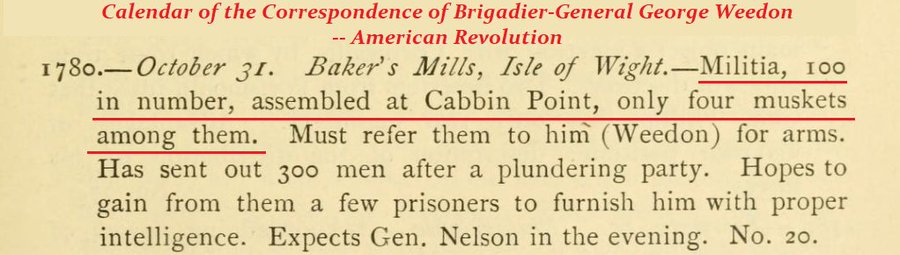
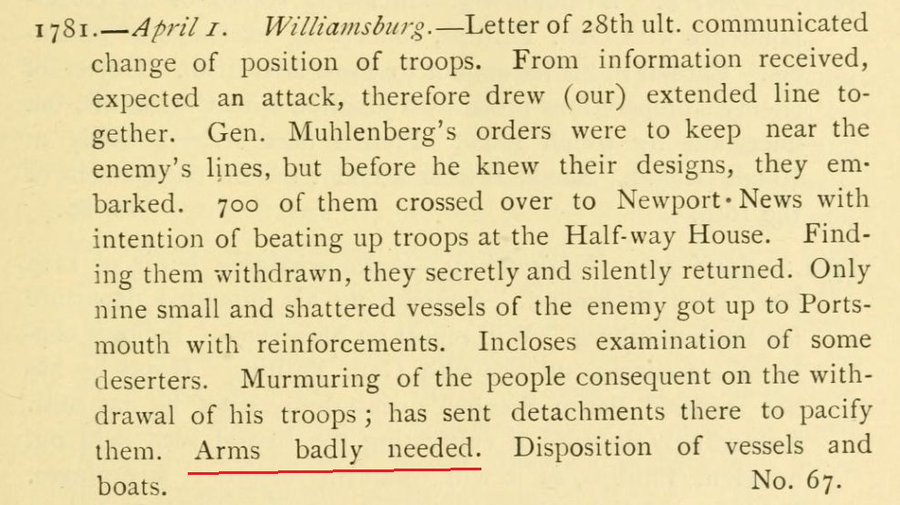
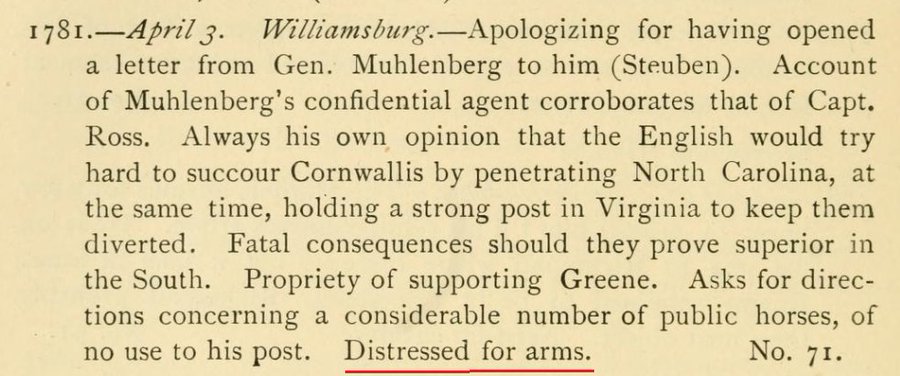
Well, here is correspondence from the Revolution which shows why.
The Continental Army couldn’t arm recruits, and recruits showed up unarmed.
Four guns for 100 men!
It’s a constant refrain. Arms needed. Cartridges and lead needed.
May 6
1536 – Incan forces under the command of Sapa Inca Manco Yupanqui, begin a near year long and ultimately failure of a siege in the attempt to retake the city of Cuzco from the Spanish Conquistadores led by Hernando Pizarro
1541 – King Henry VIII orders English language Bibles be placed in every church.
1835 – James Gordon Bennett, Sr. publishes the first issue of the New York Herald.
1861 – Arkansas secedes from the Union.
1863 – The Battle of Chancellorsville during the Civil War ends with the defeat of the Army of the Potomac by the Army of Northern Virginia.
1877 – Chief Crazy Horse of the Oglala Lakota surrenders to U.S troops at the Red Cloud Indian Agency at Fort Robinson Nebraska near the modern town of Crawford.
1882 – President Chester Arthur signs the Chinese Exclusion Act into law, prohibiting all immigration of Chinese laborers.
1889 – The Eiffel Tower is officially opened to the public at the Universal Exposition in Paris.
1915 – Boston Red Sox Pitcher, George ‘Babe’ Ruth, hits his first major league home run off New York Yankee Pitcher, Jack Warhop at the Polo Grounds field in New York City.
1935 – Under the authority of the newly enacted Federal Emergency Relief Administration, President Roosevelt issues Executive Order 7034 to create the Works Progress Administration.
1937 – The German zeppelin Hindenburg catches fire and is destroyed within 1 minute while attempting to dock at Lakehurst, New Jersey killing 36 people.
1940 – John Steinbeck is awarded the Pulitzer Prize for his novel The Grapes of Wrath.
1941 – Lowry P. Brabham pilots the Republic P-47 Thunderbolt on its maiden flight at Farmingdale, New York.
1942 – Under siege since December of the previous year, U.S. forces finally surrender Corregidor island to the Japanese.
1945 – Axis Sally – American Mildred Elizabeth Gillars – delivers her last propaganda broadcast to Allied troops.
1954 – Roger Bannister becomes the first person to run the mile in under four minutes at Oxford University’s Iffley Road Track.
1998 – Steve Jobs of Apple Inc. unveils the first iMac computer.
2010 – Using a computer controlled trading program, British financial trader Navinder Singh Sarao causes the Dow Jones Industrial Average stock market index to crash nearly 1000 points, in less than 36 minutes, before recovering by the end of the day.
2013 – 1 of 3 women, kidnapped by Ariel Castro between 2002 and 2004, manages to escape with her daughter (born in captivity) and leads Police back to rescue the other 2 women held captive in a house in Cleveland, Ohio.
Soros-backed prosecutor Kimberly Gardner resigns from St. Louis office amid scandal
A scandal-ridden prosecutor backed by billionaire George Soros announced she is resigning as the Missouri attorney general moved to have her forcibly removed from her office.
St. Louis Circuit Attorney Kimberly Gardner, the city’s top prosecutor, confirmed her resignation in a letter just days after she defiantly declared “I ain’t leaving.”
Both Republicans and Democrats across Missouri have demanded her resignation for years, accusing her office of dysfunction and mishandling cases.
Her resignation is effective June 1.
Earlier this year, Missouri Attorney General Andrew Bailey had filed a petition quo warranto to forcibly remove Gardner from her office over repeated instances where her office allegedly failed to enforce the law.
Bailey told Fox News that nearly 12,000 criminal cases have been dismissed under Gardner.
He also says more than 9,000 cases have been tossed just before going to trial, forcing judges to dismiss more than 2,000 cases due to what Bailey described as a failure to provide defendants with evidence and speedy trials.
Despite her resignation, Bailey said he still intends to move forward in his effort to remove Gardner from office.
“There is absolutely no reason for the circuit attorney to remain in office until June 1,” Bailey told Fox News in a statement. “We remain undeterred with our legal quest to forcibly remove her from office. Every day she remains puts the city of St. Louis in more danger. How many victims will there be between now and June 1? How many defendants will have their constitutional rights violated? How many cases will continue to go unprosecuted?”
Gardner refused to step down for months, blasting Bailey’s efforts a political “witch hunt” and a form of “voter suppression,” according to Fox. Gardner, the first Black female prosecutor in the city, has also accused her critics of racism and sexism.
In February, Missouri house members passed a bill that would give the governor the ability to strip the authority of any elected prosecutor to handle violent crime cases.
The bill initially targeted Gardner, but was later amended to extend to any elected prosecutors across the state following concerns singling out one prosecutor would be unconstitutional, according to the Missouri Independent.
“The most recent bill is part of a coordinated, long-standing strategy to undermine me and my efforts to make the City of St. Louis safer and fairer. Since day one of my tenure as Circuit Attorney, I have experienced attacks on my reforms, on my judgment, my integrity, on my prosecutorial discretion, on my responsibility to direct the limited resources of this office and more,” Gardner wrote in her resignation letter.
“ … I cannot be the final Circuit Attorney ever to be elected in St. Louis. You must be able to have a voice in your criminal justice system. And we must allow our office to continue to operate.
“The most powerful weapon I have to fight back against these outsiders stealing your voices and your rights is to step back. I took this job to serve the people of the City of St. Louis, and that’s still my North Star,” she wrote.
Gardner is additionally facing two contempt of court cases against her after no one from her team showed up for several high-profile prosecutions, including a murder.
Judge Michael Noble announced last week he would appoint a special prosecutor to build the a case against Gardner.
“It appears that Ms. Gardner has complete indifference and a conscious disregard for the judicial process,” Noble said, according to the St. Louis Post-Dispatch
Gardner’s office resembled a “rudderless ship of chaos,” he added.
It’s unclear if the contempt hearings will be dropped.
Several assistant prosecutors recently left Garner’s long understaffed office, according to Fox News. Her dysfunctional office had been long-plagued with personnel issues and low morale.
In her resignation letter, Gardner claimed her office faced an “onslaught” of records requests “that no office in the country could reasonably fulfill” as well as “attacks on our hard-working line attorneys designed to demoralize these public servants.
“There is no sign that the onslaught would stop for as long as I am in office,” she said.
Gardner was among the first prosecutors Democratic mega-donor Soros bankrolled in 2016 and then again during her 2020 re-election campaign, where she received 60 percent of the vote.
The controversial attorney announced last month that she will be running for a third term despite the backlash against her.
This is a corollary of: ‘Familiarity breeds contempt’
You becomes so complacent, you no longer pay attention to the details that will keep you out of trouble.
It’s bad habits one has to continually work at to eliminate.
Ex-Rep. Cawthorn fined after guilty plea over gun at airport
CHARLOTTE, N.C. (AP) — Former North Carolina U.S. Rep. Madison Cawthorn pleaded guilty Friday to a misdemeanor after his loaded gun was found last year in his carry-on luggage at Charlotte Douglas International Airport.
Mecklenburg County District Court Judge Cecilia Oseguera ordered a $250 fine but allowed Cawthorn to keep the 9 mm handgun that Transportation Security Administration agents seized at a checkpoint in April 2022, news outlets reported.
Prosecutors had wanted Cawthorn to have to relinquish the gun, but Oseguera said she saw nothing in the charge of possession of a dangerous weapon on city property that required him to give it up.
“I’m very happy and thankful that the judge gave a really clear ruling that sides with the law,” Cawthorn told reporters after the hearing.
Cawthorn, a Republican who served one term representing the 11th Congressional District in the mountains, previously admitted to having the gun at the airport and wrote on social media there was “no excuse” for his mistake.
Cawthorn also was found with an unloaded gun in 2021 while trying to get on a plane at Asheville Regional Airport. Airport police confiscated the gun but allowed him to board.
Cawthorn, from Henderson County, won election to Congress in 2020 at age 25 and became one of former President Donald Trump’s strongest supporters on Capitol Hill. He lost his 2022 GOP primary to Chuck Edwards, who went on to win the general elections.
Cawthorn told reporters Friday that he thinks he’ll return to politics one day but has no definite plans.
“I enjoy the position I’m in now,” said Cawthorn, who now has a home in Florida. “The world really is the oyster for the young.”
Unfortunate, the SCOTUS will eventually have to step in on this, but Ds are counting on it possibly taking 6 years or so to get to SCOTUS. They hope to replace Thomas and/or Alito, who will be 80 & 78 in 6 yrs
Illinois assault weapons ban back in effecthttps://t.co/1zGsmm1FsL
— John R Lott Jr. (@JohnRLottJr) May 5, 2023
On April 28, a judge in the Southern District of Illinois, in the case of Barnet v. Raoul, issued a preliminary injunction against the enforcement of the recently-passed Protect Illinois Communities Act which banned “assault weapons” and standard capacity magazines. At the beginning of that case, the court made the following statement: “… no state may enact a law that denies its citizens rights that the Constitution guarantees them. Even legislation that may enjoy the support of a majority of its citizens must fail if it violates the constitutional rights of fellow citizens.”
Simply put, the Second Amendment — the only Amendment to have the phrase “shall not be infringed” applied to it — guarantees citizens have a right to self-defense.
Across the Heller, McDonald and Bruen decisions, the Supreme Court of the United States has been crystal clear on two things: That the crux of the Second Amendment guarantees the right to self-defense, and that the Second Amendment is no longer a second-class right that is subject to an entirely different body of rules than the other Bill of Rights guarantees.
There can be, or should be, no question that any law that effectively prohibits the ability of an honest and law-abiding citizen to immediately purchase the best means of self-defense is an “infringement” to the right of self-defense. It is illogical to argue otherwise, given the wording of our Constitution.
We can speculate that a waiting period may save lives for those who are intent on immediately killing themselves; that maybe, perhaps, putting time between a purchase and taking possession will give people in crisis the time to reconsider.
On the other hand, we see, every day, violence is targeting completely innocent people. Law-abiding citizens who are under a threat of violence have a right to defend themselves, and to quote Martin Luther King: “A right delayed is a right denied.”
From my research, I have found only one court challenge to a waiting period so far, and that occurred in 2014 in California in the case of Silvester v. Harris. The case was heard in the U.S. District Court of California, which ruled the law was unconstitutional. In making that ruling, the court stated: “Defendant has identified no laws in existence at or near 1791 (founding) or 1868 (14th Amendment ratified) that imposed a waiting period of any duration between time of purchase and the time of possession of a firearm.” It further ruled: “The Court has found that the 10-day waiting periods (of Penal Code § 26815(a) and § 27540(a)) violate the Second Amendment.”
That decision was then appealed by California to the 9th Circuit, who overruled it by using a two-step means-end test and by applying intermediate scrutiny — both of which have been invalidated by Bruen when considering the Second Amendment.
In considering the constitutionality of H.230, it is exceptionally telling that Legislative Counsel remained almost completely mute. Yes, they certainly did advise both Judiciary committees that the Bruen decision was a major one, one that was raising all sorts of legal challenges across the country; yet, they completely withheld any concrete statement of constitutionality.
When the Attorney General’s office gave testimony, they opined that everything was fine. When the Defender General’s office gave testimony, they stated virtually every section of the bill had severe constitutional issues. On the one hand, we have the Attorney General indicating all is kosher. On the other, we have the Defender General’s office saying almost nothing in H.230 will pass constitutional muster. Finally, we have the Legislative Counsel whose guidance appears to be “we just don’t know.”
Three very different legal opinions, with one of them being wrong. Given that, how could this bill proceed as it did, unless the majority of the Legislature was willing to consciously ignore constitutional implications? It’s a gray area; let the courts decide; to heck with the thought something may be unconstitutional?
In creating H.230, you will note one very odd section, Section 8, Severability. Per 1 VSA § 215: “The provisions of any act are severable,” meaning if one provision of a passed bill is found invalid, the other provisions remain in effect. When 1 VSA § 215 is implied with every bill enacted, why was it felt this bill warranted that specific statute reference, the first bill I have ever seen with this section in there? There can only be one explanation: The creators of this bill were clearly not sure it was all constitutional. In fact, we know of some in the majority who believe at least some of it is not constitutional but voted for it anyway.
I fully acknowledge there is the possibility that a waiting period might, maybe, possibly force someone who is intent on killing themselves to reconsider as they wait to take possession of a firearm. The Legislature, however, must acknowledge that, while they are laser-focused on attempting to save the lives of people who are intent on killing themselves, they are, at the same time, putting other citizens in jeopardy by denying them the ability to purchase the means of self-defense in a timely manner.
It’s really that simple. Any vote for H.230 is a vote that ignores constitutional implications, it puts citizens who wish to defend themselves at risk, and it will cost the state (i.e., Vermonters) money to defend laws that will not pass constitutional muster when they are eventually challenged.
It currently appears Vermonters will have to temporarily live under the dictates of the majority in the Legislature, who wish to do nothing less than ignore the constitutional right of self-defense. For those legislators voting for H.230 and everyone else who supports it, sooner or later, they will have to live under the majority of SCOTUS, as simple logic tells us waiting periods will not pass constitutional muster.
Chris Bradley is president/executive director of Vermont Federation of Sportsmen’s Clubs, lobbyist for that organization and for Vermont State Rifle & Pistol Association.
Lawsuit challenges California’s 10-day waiting period law for gun purchases
SAN DIEGO (CNS) – Firearms advocates filed a lawsuit in San Diego federal court this week challenging California’s 10-day waiting period for gun purchases.
The lawsuit filed Monday joins a number of others filed in San Diego in recent years challenging the state’s laws governing firearm and ammunition purchases and possession.
It alleges the state’s waiting period law “prevents law-abiding people from taking possession of lawfully acquired firearms for immediate self- defense and other lawful purposes.” The complaint alleges the law is unconstitutional as it prevents law-abiding people from receiving firearms they purchased after they pass background checks confirming they are not prohibited from doing so.
The suit was filed on behalf of several San Diego County residents who are gun owners, as well as firearms advocacy groups such as San Diego County Gun Owners PAC, California Gun Rights Foundation, Firearms Policy Coalition, and the Second Amendment Foundation.
In a statement, Firearms Policy Coalition director of legal operations Bill Sack said, “Arbitrarily delaying access of life-saving and constitutionally protected tools to peaceable people is immoral and unsupported by the text, history and tradition of the second amendment in this country. This law must be struck down.”
A representative from California Attorney General Rob Bonta’s office said Monday that the lawsuit was being reviewed.
17 gun restriction bills flounder at Georgia Capitol
ATLANTA — This year, the Georgia legislature mostly ignored 17 gun restriction bills – including bills that would have limited access to guns for folks with mental health issues.
The 17 gun restriction bills were introduced by Democrats. The capitol is run by Republicans, who have expanded, not restricted, gun rights.
When police converged on the Northside Medical building in Midtown Atlanta Wednesday in an attempt to take down a mass shooter – and ordered people nearby to shelter in place – one of them was state Sen. Josh McLaurin (D-Atlanta), who was having lunch.
McLaurin said after taking stock of the mass shooting, the injuries and death, and the danger inherent in the ongoing manhunt, he took stock of the Georgia politics that he says enables gun violence.
“Frustration is the right word,” McLaurin told 11Alive Thursday. “This is a policy decision. We are choosing to live like this. There are common-sense gun safety, sensible regulations legislation that we could pass.”
In 2023, Democrats introduced bills ranging from requiring background checks and waiting periods to safe storage of firearms, to red flag laws limiting firearms for people who may have mental health issues.
Republicans didn’t allow a vote for any of them, even in committee.
Vernon Lee, a longtime capitol lobbyist and gun rights backer, said the problem isn’t an absence of gun restrictions – it’s an absence of stiff law enforcement.
“There should be swifter, stricter punishment [for gun crimes],” Lee said. “There are laws on the books (that say) these are the ramifications if you do that. Some of those ramifications have not been enforced enough to curtail gun violence.”
McLaurin said he’s heard that far too much.
“The public that want commonsense gun reform are being blocked by, again, a tiny minority of people who are characterizing any reasonable attempt at sensible legislation as repealing the second amendment. And it’s BS,” McLaurin said.
All those gun bills are still technically in play during next year’s legislative session. But by all but ignoring them this year, Republicans spoke volumes about their interest in advancing them next year.
When You Don’t Police Crime, Civilians Will
This week, the media found its latest iteration of its favorite narrative: white man harms black man.
That iteration featured a 24-year-old white Marine from Queens attempting to suppress a 30-year-old homeless, psychotic black man, Jordan Neely, via use of a suppression hold. Neely was apparently threatening people on the subway when the Marine took him down from behind, keeping him in the suppression hold for 15 minutes; Neely died shortly thereafter.
The extraordinarily inflammatory and insipid Rep. Alexandria Ocasio-Cortez, D-N.Y., immediately rushed to Twitter in order to gin up outrage: “Jordan Neely was murdered. But bc Jordan was houseless and crying for food in a time when the city is raising rents and stripping services to militarize itself while many in power demonize the poor, the murderer gets protected w/ passive headlines + no charges. It’s disgusting.”
Meanwhile, Manhattan Borough President Mark Levine tweeted, “I saw Jordan Neely perform his Michael Jackson routine many times on the A train. He always made people smile. Our broken mental health system failed him. He deserved help, not to die in a chokehold on the floor of the subway.”
So, who was Neely? A career criminal. He wasn’t just shouting threats at passengers—he had been arrested more than 40 times in the past. Those arrests ranged from drugs to disorderly conduct to fare beating. When he died, he carried an outstanding warrant for assaulting a 67-year-old woman. A bevy of people apparently report that he had attempted to shove people onto subway tracks more than once.
Why was Neely out on the streets? It was clear to everyone that he was a mentally ill psychotic man with a serious drug record, a rap sheet longer than the phone book, and an alleged history of violent incidents. The answer is that the city of New York has decided no longer to prosecute crime. To do so might raise the unpalatable spectacle of racial disparity in crime statistics—and it is apparently more important to preserve egalitarianism in arrest statistics than to take active threats off the streets.
The consequences of such idiocy are dire, for both the general public and for people like Neely. How long can the authorities in New York expect everyday citizens to experience hostile and violent encounters before taking action?
Commentator Toure tweeted, “It is normal to see loud, disturbing mental breakdowns on the NYC subway. I’m not defending that; I’m saying it’s a regular occurrence. What’s not normal is to murder people having loud, disturbing mental breakdowns.”
But short of prophecy, how can those watching such a breakdown, complete with threats against others, know who is harmless and who isn’t? Normally such questions are outsourced to law enforcement. When law enforcement is prevented from doing its job, crime rises—and citizens are forced to engage in acts of self-defense.
All of this would be perfectly obvious were Neely white and the Marine black in this case; then, the media and political class would declare the Marine a hero for protecting others on the subway car. But the narrative must be preserved—the lie that crime by minority members must be ignored for the greater good of society, lest response to such crime facilitate systemic racism.
Often, it’s innocent victims who pay the price. In the case of Jordan Neely, it was the criminal himself, who never would have died were the system rational enough to have policed him decently years ago.
Democrats’ scheme to bludgeon the Supreme Court exposed at Senate Judiciary Committee hearing
The Senate Judiciary Committee held a hearing Tuesday on “Supreme Court Ethics Reform.” The title implies that Supreme Court ethics need reform and that Congress can do the reforming.
The hearing failed to make that case.
Everyone agrees on the critical importance of public confidence in the judiciary’s impartiality and integrity, and that that confidence is on the decline. That observation, however, raises the question of what’s causing the decline.
Democrats and their allies among left-wing groups and the media, after all, have relentlessly accused the current Supreme Court of partisanship and bias, even warning certain justices not to make the “wrong” decisions in certain cases.
There was Senate Democratic Leader Chuck Schumer, D-N.Y., on the Supreme Court steps in March 2020, calling out Justices Neil Gorsuch and Brett Kavanaugh and shouting that they had “released the whirlwind” and would “pay the price” if they continue making “awful decisions.”
And there was Sen. Sheldon Whitehouse, D-R.I., and four Democratic colleagues filing a brief in a Second Amendment case that closed this way: “The Supreme Court is not well. And the people know it. Perhaps the Court can heal itself” before being forced to do so.
Or there was Whitehouse claiming, through the liberal American Constitution Society, that the GOP appointees to the court consistently deliver decisions that “advantage the big corporate and special interests that are, in turn, the political lifeblood of the Republican Party.” Not surprisingly, his methodology is itself deeply ideological, but even if he were right about the pattern, his own analysis would show that the Democratic appointees just as consistently oppose those interests. It’s funny that Whitehouse’s diatribes on this subject are always focused in one direction.
He and other Democrats were just as glaringly one-sided in Tuesday’s hearing.