Those tuning in to watch President Biden’s State of the Union address saw and heard a few things when he entered the U.S. House of Representatives to address Congress and the nation. There is a new Speaker of the House – Speaker Kevin McCarthy (R-Calif.). He was seated next to Vice President Kamala Harris, a visual reminder of the divided government. Military generals and U.S. Supreme Court justices were in attendance, along with Members of Congress and senators.
President Biden banged the usual drum demanding to renew the Assault Weapons Ban. That’s the law he along with U.S. Sen. Dianne Feinstein (D-Calif.) ushered in in 1994 and President Bill Clinton signed into law that banned the sale of Modern Sporting Rifles (MSRs). That ban expired in 2004 and the semiautomatic rifle has since become the most-popular selling centerfire rifle in America – with over 24.4 million in circulation today.
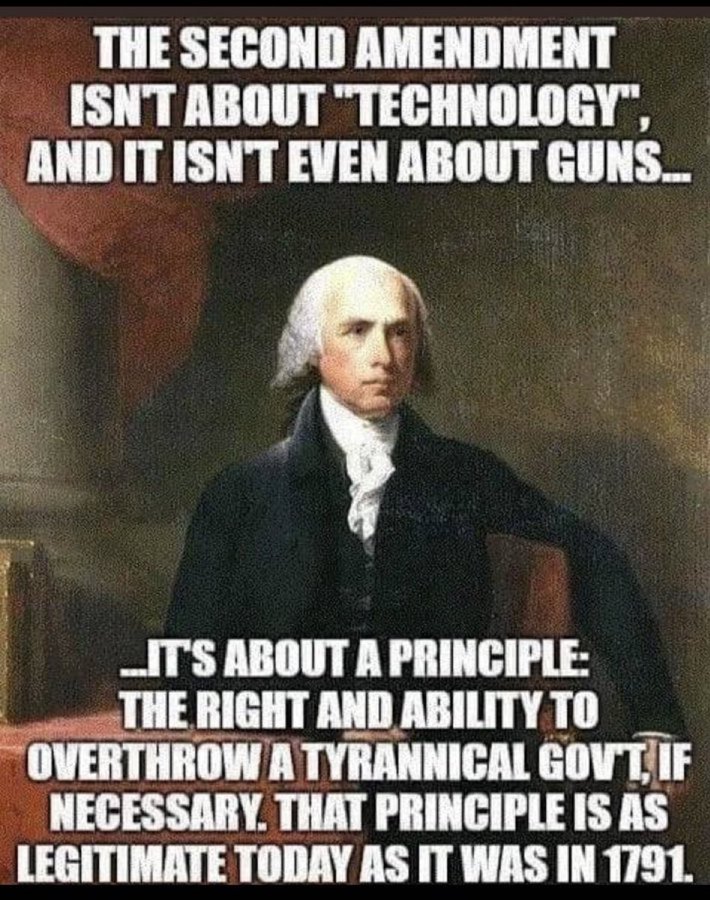
President Biden scolded Congress for not sending him legislation to renew this unconstitutional ban on these commonly-owned commonly-used rifles. Never mind that the U.S. Supreme Court made clear in the Heller, McDonald and Bruen decisions that any such ban is unconstitutional.
What President Biden didn’t tell the American public – and won’t – is what the rest of America is saying about any proposed ban. Over half the country doesn’t want it, according to a recent poll by ABC News/Washington Post.
MOUNT AIRY, N.C. — An intruder was shot in the neck during an attempted home invasion in Mount Airy Tuesday, according to police.
The Mount Airy Police Department said they received a call about a shooting around 4:19 p.m. on Andrews Street.
When police arrived, they found the homeowner, Joshua Wade Murphy, 41, standing with a shotgun in his front yard. 26-year-old Daniel Scott Laskey Brown, of Mount Airy, was lying in the front yard with a gunshot wound to his neck.
Investigators identified Brown as the suspect. They said he broke into Murphy’s home through the front door as he was armed with a gun. Once Brown came through the front door, Murphy shot him in the neck.
Brown was taken to a local hospital and is in critical condition.
After consulting with the Surry County District Attorney’s Office there will be no criminal charges issued at this time.
The Concise Oxford English Dictionary I keep by my desk defines “conniption” as “a fit of rage or hysterics.” To illustrate more clearly what a “conniption” means in modern parlance, a picture of Gavin Newsom, the Democrat Governor of California, should accompany the definition. It is he and his anti-Second Amendment colleagues in other deep blue states who are having recurring conniptions over the June 2022 Supreme Court decision commonly known as Bruen.
That decision, which arose factually in New York but applies to the entire country, declared that the Second Amendment means what it says, and that it is to be interpreted according to the historical context in which it was written and ratified in the late 18th Century.
What exactly is it that sends these public officials, who regularly profess devotion to other civil liberties protected by the Bill of Rights, up the wall?
At its core, it’s all about control.
Under the century-old New York “Sullivan Act” law that the six-member Bruen majority struck down last June, local officials had enjoyed virtually absolute control to decide which citizens were deemed worthy to be permitted to carry a concealed firearm for self-defense. That power was deemed “arbitrary” by the High Court’s majority and therefore fatally defective as a limitation on an individual’s fundamental right to “keep and bear arms” expressly guaranteed by the Second Amendment against being thus “infringed.”
For decades California, New Jersey, Hawaii, and a handful of other firearms-averse states had permitted officials to exercise similar control over citizens within their jurisdiction.
Bruen swept away such noxious power and established – finally – what should have been obvious to public officials all along; namely, that playing word games, such as forcing a citizen to show “proper cause” and a “special need” before being allowed to exercise a fundamental right guaranteed in the Bill of Rights, is not what our Founders intended and is not consistent with any reasoned and historically premised interpretation of the Second Amendment.
In clear defiance of the Supreme Court’s Bruen decision, New York’s legislature quickly passed, and Governor Kathy Hochul signed legislation that did precisely what the Supreme Court just days before had ruled unconstitutional. This left virtually every New Yorker desiring to be able to carry a firearm for self-defense still unable to do so.
Even more irksome to the likes of Newsom and other anti-gun Democrat governors and legislators, is the fact that the language and reasoning in Bruen provide valid arguments with which to successfully challenge other restrictive gun control laws, such as bans on high-capacity magazines and so-called “assault rifles.” Myriad challenges to these gun control laws are pending in courts in California and across the country.
Defending such restrictive laws against these constitutional challenges perfectly reflects Newsom’s well-known disdain for judicial decisions not comporting with his liberal philosophy.
Thankfully, most federal judges have a sounder view of judicial precedent and understand that when the United States Supreme Court speaks – especially when, as in Bruen, it does so clearly and pointedly – political and personal views must take a backseat to the Court’s decisions. Interestingly, even some Democrats in the California legislature appear to understand this.
Last Fall, for example, Newsom and his cohorts in the state legislature attempted to pass legislation similar to New York’s defiant response to Bruen, that would continue to make it virtually impossible for Californians to obtain carry permits. In what must have been a shock to Newsom, a handful of “moderate” Democrat members joined with the GOP minority and defeated the legislation – forcing the editorial board of the Los Angeles Times to blast such turncoats and join the ongoing, anti-Bruen conniption sweeping across blue states.
It is taken as an obvious given by approximately half of the United States that we are in a massive epidemic of AR-15 homicides, and that something must be done about it. This given is not only completely false, the level of falseness of it is almost incomprehensible. Let’s try and understand exactly how false it is by using simple arithmetic.
1098 – The army of the First Crusade under Bohemond of Taranto defeats a relief force under Seljuq emir Ridwan of Aleppo sent to break the siege of Antioch
1555 – Under the reign of Queen Mary I, Bishop of Gloucester John Hooper is burned at the stake for protestant heresy.
1775 – The British Parliament declares the colony of Massachusetts in rebellion.
1778 – Rhode Island becomes the fourth US state to ratify the Articles of Confederation.
1825 – After no candidate receives a majority of electoral votes in the US presidential election of 1824, the United States House of Representatives elects John Quincy Adams as President of the United States.
1861 – Jefferson Davis is elected the Provisional President of the Confederate States of America by the Confederate convention at Montgomery, Alabama.
1870 – President Ulysses S. Grant signs a joint resolution of Congress establishing the U.S. Weather Bureau.
1889 – President Grover Cleveland signs a bill elevating the United States Department of Agriculture to a Cabinet level agency.
1922 – Brazil becomes a member of the Berne Convention copyright treaty.
1942 – Year round Daylight saving time (aka War Time) is reinstated in the United States as a wartime measure to help conserve energy resources.
1943 – The Allies declare Guadalcanal secure after confirming the last of Imperial Japanese forces had been evacuated from the island.
1950 – Senator Joseph McCarthy accuses the United States Department of State of being filled with Communists. (Turns out he was right)
1964 – The Beatles make their first appearance on The Ed Sullivan Show.
1965 – The United States sends a Marine Corps MIM-23 Hawk missile battalion to South Vietnam, the first American troops deployed without an official advisory or training mission.
1971 – Apollo 14 returns to Earth, spalshing down in the south Pacific after making the 3rd manned Moon landing.
1986 – Comet 1P/Halley “Halley’s Comet”, appears in the inner Solar System for the second time in the 20th century.
2001 – Demonstrating an emergency surface south of Oahu, Hawaii, the submarine USS Greeneville collides with the Japanese fishing vessel Ehime Maru, sinking it, killing 9 of the 35 crew aboard.
2021 – The second impeachment trial of President Donald Trump begins, 20 days after he left office.
The terms “Front-Row Kids” and “Back-Row Kids,” coined by the photographer Chris Arnade, describe the divide between the educated upper middle class, who are staying ahead in today’s economy, and the less educated working class, who are doing poorly. The differences in education―and the values associated with elite schooling―have produced a divide in America that is on a par with that of race.
The judiciary, requiring a postgraduate degree, is the one branch of government that is reserved for the Front-Row Kids. Correspondingly, since the Warren era, the Supreme Court has basically served as an engine for vindicating Front-Row preferences, from allowing birth control and abortion, to marginalizing religion in the public space, to legislative apportionment and libel law, and beyond. Professor Glenn Reynolds describes this problem in detail and offers some suggestions for making things better.
While Service members living in barracks are not, those living in on post ‘private housing’ are almost always allowed to retain personal firearms. They’re supposed to kept unloaded, with the ammo stored separately, but RHIP – (Rank Hath It’s Privileges)
WASHINGTON (AP) — The intruder who breached Joint Base Andrews, the home of Air Force One, reached the residence of one of the Air Force’s top leaders before her spouse opened fire, the air base said Tuesday.
Chief Master Sergeant of the Air Force JoAnne Bass confirmed that the intruder had reached her home on Monday. The chief master sergeant is the Air Force’s top enlisted leader.
“We appreciate the outpouring of support we received after this incident. I can confirm that my husband, Rahn, was involved, and is safe, thanks to the quick response and professionalism of our Security Forces Airmen,” Bass said in a statement on Tuesday.
In a statement posted to Twitter, the air base said: “A resident discharged a firearm, security forces arrived on scene to apprehend the intruder and law enforcement is investigating the incident.”
Joint Base Andrews is home to the fleet of blue and white presidential aircraft, including Air Force One, and a frequent base for the “doomsday” 747 aircraft that can serve as the nation’s airborne nuclear command and control centers if needed.
It’s not the first time the base’s security has been breached; in February 2021 a man got through the military checkpoint onto the installation, then through additional fenced secure areas to gain access to the flight line and climb into a C-40, which is the military’s 737-equivalent aircraft used to fly government officials.
That intruder was apprehended because the “mouse ears” cap he was wearing struck an observant airman as odd.
An inspector general’s investigation found three main security failings, starting with “human error” by a gate security guard who allowed the man to drive onto the base even though he had no credentials that authorized his access.
Hours later, the man walked undetected onto the flight line by slipping through a fence designed to restrict entry. Finally, he walked onto and off a parked airplane without being challenged, even though he was not wearing a required badge authorizing access to the restricted area.
An Iowa high schooler has filed a federal lawsuit alleging that her school district and a civics teacher violated her First Amendment rights by suspending her for wearing a pro-Second Amendment t-shirt to class; a case that could one day have far-reaching implications for students across the country.
In the complaint, which is the topic of today’s Bearing Arms’ Cam & Co, the student (identified by her initials A.B.) alleges that just two days after discussing students’ rights to free speech in class, teacher Thomas Griffin “removed her from class and suspended her” for wearing a t-shirt promoting the Second Amendment, claiming it was “inappropriate”.
Griffin told his students that, although they had some right to free speech, that right was “extremely limited” when the students stepped on school property. Griffin told his students that their teacher (in this case, him) would decide what was acceptable speech in the classroom. And with respect to clothing—which was at the very core of the Tinker case—Griffin told his students that he would not allow students to wear any clothing that depicts guns, alcohol, or any other “inappropriate material.”
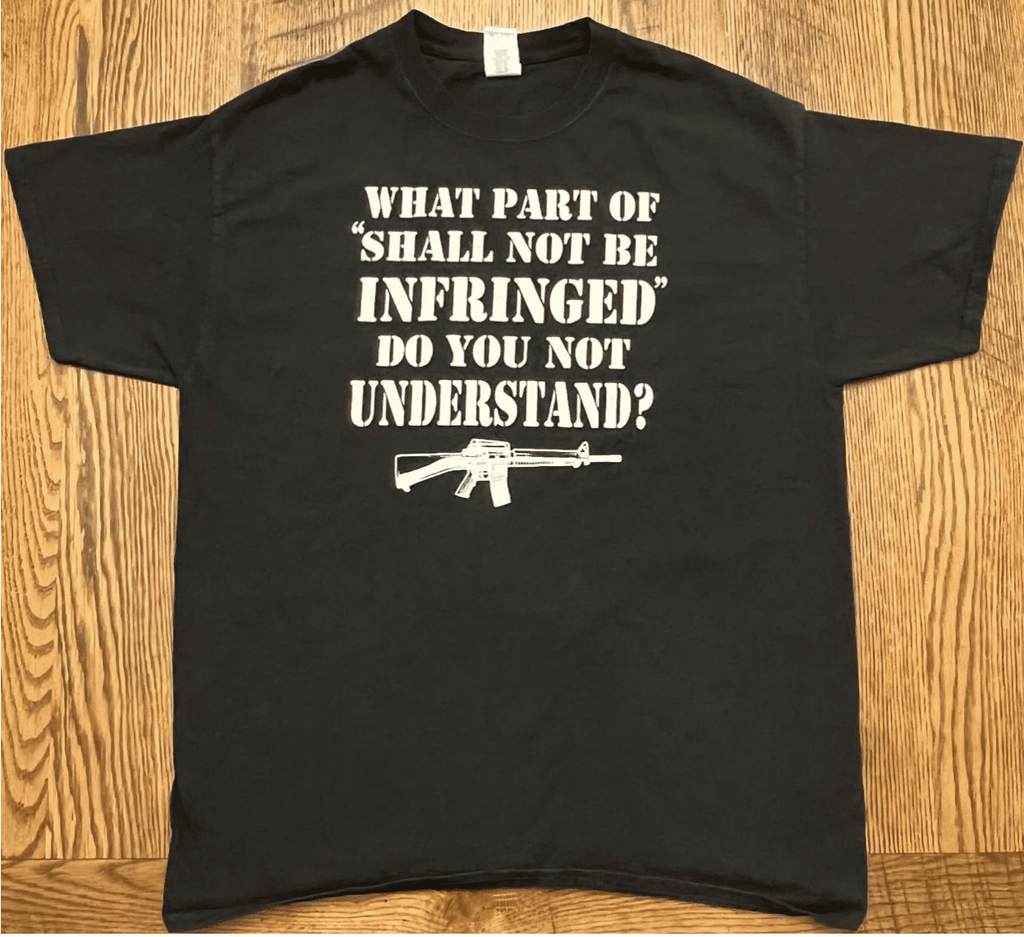
A.B. knew that Griffin was wrong about the scope of the First Amendment, so the next time she had Griffin’s government class, September 1, 2022, she wore a shirt to school that said “What part of ‘shall not be infringed’ do you not understand?” with a depiction of a rifle underneath it.
A.B. had worn the shirt to school before, with no complaints from students, teachers, or administrators. And A.B.’s brother, who graduated from Johnston High School in 2019, had worn the same shirt to school multiple times with no complaints.
Griffin, who teaches the Bill of Rights, knew that shirt was quoting the Second Amendment of the U.S. Constitution, and he knew it was a commentary on gun control efforts. Nevertheless, he claimed that the shirt violated the school’s dress code and he removed A.B. from the classroom, sending her to the school administration office.
A.B. told Griffin she had a right to wear the shirt, which was not causing any disruption in the class—other than any disruption Griffin himself created by removing A.B. from the classroom. But Griffin said she was wrong about the First Amendment and that the administration would back him up.
As you can see, there are no depictions of violence on the shirt worn by A.B., but the school administration did indeed originally stand by Griffin’s actions, suspending her after she refused to change her shirt in order to return to class.
The lawsuit alleges that later that evening, however, A.B.’s mom Janet Bristow received a call from the school district’s superintendent to apologize for their actions, as well as a similar mea culpa from Chris Billings, the Executive Director of School Leadership.
It was only in the past few decades that laws criminalizing domestic violence came to be widespread and enforced. But now, the U.S. is in danger of backtracking on that legal framework precisely because of the nation’s historical legacy of turning a blind eye to domestic violence.
On Nov. 10, 2022, a judge in the Western District of Texas struck down the federal law that prohibits access to guns for people subject to domestic violence protection orders. He did this based on a 2022 U.S. Supreme Court ruling, NYSRPA v. Bruen, which held that, to be constitutional, a firearm restriction must be analogous to laws that were in existence when the country was founded. In other words, disarming domestic abusers violates the Second Amendment because those types of laws didn’t exist at the founding of the country.
In a separate, but related, case, the 5th U.S. Circuit of Court of Appeals on Feb 1. sided with the Texas judge, ruling that the federal ban was unconstitutional. The Justice Department has indicated that it will appeal.
At present, federal law prohibits persons subject to final – rather than temporary – domestic violence protection orders from purchasing or possessing firearms. In addition, 39 states and the District of Columbia have similar prohibitions on their statutes, with many expanding the restrictions to include individuals under temporary, or ex parte, orders prior to a full hearing.
Ruling that these laws are unconstitutional will put mainly women and children in danger. More than 50% of women who are murdered are killed by intimate partners, and most of those homicides are committed with guns. A 2003 study found that when an abusive man has access to a gun, it increases the risk of intimate partner homicide by 400%.
Moreover, 68% of mass shooters have a history of domestic violence or killed an intimate partner in the mass shooting.
Enforcement of gun restrictions is spotty, with further research needed as to how systematically they are ordered and whether restricted individuals relinquish firearms they already possess. Nonetheless, research shows that firearm restrictions on domestic violence protection orders save lives. Multiple studies conclude that these laws are associated with an 8%-10% reduction in intimate partner homicide.
Specifically, there are statistically significant reductions in intimate partner homicide when the firearm restriction covers both dating partners and those subjected to temporary orders. This decrease is seen in total intimate partner homicide, not just intimate partner homicide committed with guns, nullifying the argument that abusers will use other weapons to kill.
Moreover, these laws have broad support across the country – more than 80% of respondents to two national polls in 2017 and 2019 said they favor them.
Americans – whether male or female, gun owner or non-gun owner – tend to agree that domestic abusers should not be able to purchase or possess firearms while they are subject to a domestic violence protection order. Most seem to realize that such reasonable restrictions serve the greater good of keeping families and communities safe.
A disregard for data
The ruling in Texas was based on an originalist legal argument rather than the data. Under the judge’s interpretation of the Bruen decision, because colonial law – written before a time when women could vote, let alone be protected in law from violent spouses – didn’t restrict domestic abusers’ gun rights, then it simply isn’t constitutional to do so now. In effect, the ruling, should it stand, would mean the U.S. is unable to escape the nation’s historic legal disregard for domestic violence.
It also disregards the harm that allowing domestic abusers to keep hold of guns does. Multiple studies demonstrate that domestic violence firearm restriction laws are effective and savelives.
That research shows that, should the Texas ruling stand, people who suffer abuse at the hands of an intimate partner are at greater risk of that abuse being deadly.
Lisa Geller, director of state affairs at the Johns Hopkins Center for Gun Violence Solutions at the Johns Hopkins Bloomberg School of Public Health, contributed to this article.
CLAIM: During the State of the Union Address President Joe Biden claimed mass shootings tripled after the “assault weapons” ban expired.
VERDICT: Misleading/Mostly False.
Biden said, “In the ten years the ban was law, mass shootings went down. After we let it expire, in a Republican administration, mass shootings tripled.”
It should be noted that Biden has made this claim before, in one form or another, following a high-profile shooting.
He did so on May 24, 2022, following the Uvalde elementary school attack. The Washington Post quoted him saying, “When we passed the assault weapons ban, mass shootings went down. When the law expired, mass shootings tripled.”
Ironically, the Post also called Biden’s claim into question:
Biden claimed that mass shooting deaths tripled after the law expired. He appears to be relying on a study of mass shooting data from 1981 to 2017, published in 2019 in the Journal of Trauma and Acute Care Surgery by a team led by Charles DiMaggio, a professor of surgery at New York University’s Langone Medical Center. That group found that an assault weapons ban would have prevented 314 out of 448, or 70 percent, of the mass shooting deaths during the years when the ban was not in effect. But the data used in that study has come under attack by some analysts.
…The new mass-shooting database shows that there were 31 mass shootings in the decade before the 1994 law, 31 in the 10 years the law was in force (Sept. 13, 1994 to Sept. 12, 2004) and 47 in the 10 years after it expired. As noted, some of that increase stems from population growth.
Breitbart News reported that the Department of Justice’s National Institute of Justice (NIJ) released a report in 2004, as the “assault weapons” ban was coming to an end. The information in that study dovetails perfectly with the Post’s observation, inasmuch as the NIJ researchers could not credit the “assault weapons” ban with any of the reductions in crime or shootings which were sporadically reported elsewhere.
The Washington Timesquoted University of Pennsylvania professor Christopher Koper, author of the NIJ report, saying, “We cannot clearly credit the ban with any of the nation’s recent drop in gun violence. And, indeed, there has been no discernible reduction in the lethality and injuriousness of gun violence.”
The NIJ report continued, “The ban’s effects on gun violence are likely to be small at best and perhaps too small for reliable measurement.”
The NIJ report put matters into perspective by pointing out that “assault weapons” were “rarely used in gun crimes even before the ban.”
Biden’s claim about mass shootings tripling and the sunset of the ban being causal is misleading, because no reliable connection between the end of the ban and an increase in shootings has been made.
Biden’s claim is also mostly false because the information from sources like the NIJ explicitly indicates the “assault weapons” ban cannot be credited with a drop in gun violence to begin with.
SANTA FE — A proposal to ban AR-15-style rifles in New Mexico began moving through the Roundhouse on Tuesday as Democratic legislators pursue aggressive new gun-control measures intended to address mass shootings and other crime.
On a series of party-line votes, members of a House committee advanced legislation to establish a two-week waiting period for firearm purchases and prohibit the sale and possession of certain semiautomatic rifles and handguns.
The ban would go into effect in March 2024, with some exemptions for people who already have the prohibited firearms.
Republican lawmakers and other opponents who crammed into a packed committee room to testify on the proposals said the restrictions would interfere with the rights of law-abiding citizens and do nothing to deter crime.
Supporters showed up in force, too, and a crowd filled the hallway as people waited for a seat.
U.S.A. –-(AmmoLand.com)- Seventeen U.S. Senators recently introduced legislation aimed at removing the guts of the National Firearms Act—taxation, registration and regulatory requirements—and they are calling it the Stop Harassing Owners of Rifles Today (SHORT) Act.
Sponsored by Sens. Roger Marshall (KS) John Kennedy (LA), John Barrasso (WY), John Boozman (AR), Ted Budd (NC), Mike Crapo (ID), Ted Cruz (TX), Steve Daines (MT), Cindy Hyde-Smith (MS), Mike Lee (UT), Cynthia Lummis (WY), Markwayne Mullin (OK), Rand Paul (KY), Mike Risch (ID), Mike Rounds (SD), Rick Scott (FL), John Thune (SD), and Tommy Tuberville (AL), the six-page measure may have a short life span—it probably will not get out of the Senate with Democrats in control—but it might raise a few eyebrows and some important political issues.
It’s the second go-round for this legislation. Marshall introduced it in the last Congress. But what about the issues it raises?
In a report from KIDO Radio in Boise, Crapo and Risch both took nasty swipes at the Biden administration.
“This Administration’s vendetta against lawful gun ownership is a gross violation of Constitutional rights. A federal gun registry has no place in America, yet this Administration is forcing millions of law-abiding Americans to either register these commonly owned firearms or become felons,” Risch said.
“As the Biden Administration continues to seek creative methods of advancing their anti-gun agenda, Congress must be resolute and oppose all efforts to undermine Second Amendment rights,” Crapo added. “Burdening law-abiding Americans with additional firearm restrictions is not the answer to safeguarding the public.”
We recently discussed the ruling of the United States Court of Appeals for the Fifth Circuit striking down a ban on gun ownership by individuals accused of domestic abuse. Now, U.S. District Judge Patrick Wyrick in Oklahoma City dismissed an indictment against Jared Michael Harrison for violating a federal law that makes it illegal for “unlawful users or addicts of controlled substances” to possess firearms. It is only the latest such loss for the Justice Department as the Biden Administration pushes sweeping rationales for limiting Second Amendment rights in the wake of last year’s ruling in New York State Rifle & Pistol Association v. Bruen.
Harrison was arrested by police in Lawton, Oklahoma, in May 2022 after a traffic stop where police found a loaded revolver as well as marijuana.
Under 18 U.S.C. § 922(g)(3), Congress prohibited the possession of firearms by users of substances made unlawful by the federal Controlled Substances Act. The court noted that this provision “is rarely used by prosecutors, as it accounts for only about 5% of prosecutions brought under § 922.”
The Justice Department argued that such a ban was “consistent with a longstanding historical tradition in America of disarming presumptively risky persons, namely, felons, the mentally ill, and the intoxicated.” It is similar to the broad rationale used unsuccessfully before the Fifth Circuit. Indeed, the Justice Department again tried to argue that such bans are allowed because Bruen’s described the plaintiffs in that case as “ordinary, law-abiding, and adult citizens.” It is clearly an argument that the Biden Administration wants to push in cases across the country despite the rather poor reception from the courts. I agree with these judges that the reference is being radically overblown by the Justice Department. Indeed, it cuts against the department’s credibility in arguing for Second Amendment limits.
This latest loss shows the Biden Administration pushing a post-Bruen claim that could find itself back before a skeptical Court majority. Notably, as discussed in the earlier post, a similar issue was addressed by Justice Amy Coney Barrett when she was sitting as an appellate judge. This court also relies on Barrett’s dissent in Kanter v. Barr, 919 F.3d 437, 451–53 (7th Cir. 2019) (Barrett, J., dissenting).
In September, U.S. District Judge David Counts in Midland, Texas also struck down a firearms law that banned individuals under felony indictment from buying guns.
The opinion by Judge Wyrick is very interesting in its comprehensive exploration of historical sources. It also dismantles the Justice Department’s suggestions that marijuana users are both law breakers and threats to society:
“under the United States’ own conception of the historical tradition, such restrictions would only apply to those who are both unvirtuous and dangerous. And as explained above, because the mere use of marijuana does not involve violent, forceful, or threatening conduct, a user of marijuana does not automatically fall within that group.”
I particularly liked this observation from the court about reading discretion into the amendment to bar those deemed untrustworthy by the government:
[I]t would be odd indeed for the Framers to have incorporated such a trojan horse into the Second Amendment. The purpose of enshrining a right into the Constitution is to limit the discretion of a legislature. But if the United States’ theory is correct and all a legislature must do to prohibit a group of persons from possessing arms is to declare that group “untrustworthy,” then the Second Amendment would provide virtually no limit on Congress’s discretion. The Framers weren’t perfect, but they also weren’t fools.
1250 – During the Seventh Crusade, Crusader forces under Louis IX, King of France, engage and defeat Ayyubid forces of Queen Shajar al-Durr and Sultan Baibars al-Bunduqdarin of Egypt near Al Mansurah, Egypt in the Nile River delta.
1587 – Mary Queen of Scots is executed on suspicion of having been involved in the Babington Plot to murder her cousin, Queen Elizabeth I.
1693 – The College of William & Mary in Williamsburg, Virginia, is granted a charter by King William III and Queen Mary II. (Still in operation)
1837 – Richard Johnson becomes the first Vice President of the United States chosen by the United States Senate under provisions of the 12th amendment
1879 – Canadian Engineer Sir Sandford Fleming first proposes the adoption of Universal Standard Time at a meeting of the Royal Canadian Institute.
1885 – The first government approved Japanese immigrants arrive in Hawaii.
1887 – The Dawes Act authorizes the President of the United States to survey Native American tribal land, excepting the lands of the ‘Five Civilized Tribes’ in Indian Territory (modern Oklahoma) until the Curtis Act of 1898, and divide it into individual allotments.
1904 – A surprise torpedo attack by Japanese destroyers on the Russian fleet anchored at Port Arthur, Manchuria starts the Russo-Japanese War.
1910 – The Boy Scouts of America is incorporated by William D. Boyce.
1915 – D. W. Griffith’s film The Birth of a Nation premieres in Los Angeles.
1924 – At the Nevada state prison at Carson City, Gee Jon, a member of the Hip Sing Tong becomes the first person executed by use of lethal gas for the murder of Tom Quong Kee, a member of the rival Bing Kong Tong.
1946 – The first portion of the Revised Standard Version of the Bible is published.
1965 – Shortly after takeoff from JFK airport, Eastern Air Lines Flight 663, a Douglas DC-7B crashes into the Atlantic Ocean attempting to avoid a mid-air collision with incoming Pan American Airways Flight 212, a Boeing 707, and explodes, killing all 84 passengers and crew aboard.
1974 – After 84 days in space, the all rookie crew of Skylab 4, the last crew to visit American space station Skylab, returns to Earth.
1978 – The proceedings of the Senate are broadcast on radio for the first time.
1993 – General Motors sues NBC after Dateline NBC allegedly rigs two crashes intended to demonstrate that some GM pickups can easily catch fire if hit in certain places. NBC settles the lawsuit the next day.
2013 – Two winter storm systems in the U.S. merge into a hurricane force ‘bomb cyclone’ causing a blizzard –Winter Storm Nemo – dropping up to 40 inches of snow, disrupting transportation and communications in the Northeastern States and parts of Canada and leaving over 700,000 people without electricity, resulting in the deaths of 18 people with $100,000,000 in damages
A man shot and killed a robbery suspect at a Harris County apartment complex early Tuesday morning, the sheriff’s office says.
The shooting was reported around 1:45 a.m. in the 300 block of N Vista Drive.
The Harris County Sheriff’s Office is investigating a shooting on N Vista Drive.
Based on the preliminary investigation, the sheriff’s office says they believe a man and a woman were trying to rob another man at the complex.
The man who was being robbed was able to get away, went to his truck, and got a gun, investigators say.
The sheriff’s office says, when he was confronted again by the suspects, he shot the male suspect.
The suspect was pronounced dead at the scene.
The woman and the shooter are both being questioned about the incident, authorities say. The investigation is ongoing.
Like how that State’s Attorney (More commonly called a Prosecutor for the rest of us) slyly moves the goalpost of self defense so he can slide in ‘hurt feelings’? I’ve found very few prosecutors that like the idea that they can have their hands tied, legally speaking, from exercising every bit of power they have just exactly how they want?
ROANOKE, Va. (WDBJ) – WDBJ7 has learned new details about a shooting over the weekend at a Food Lion in Northwest Roanoke. Roanoke City’s commonwealth’s attorney told WDBJ7 the suspect was released because there is a substantial argument for self defense.
Saturday night, there was a disagreement at the store on Peters Creek Road. Investigators say one man threw a punch at another man, who then took out his gun and shot several times.
He hit the person who initiated the fight and a woman who was caught in the middle. The woman’s injuries were not life-threatening, but Roanoke Police said the man’s injuries were serious.
The commonwealth’s attorney explained the store’s surveillance video will help investigators determine if this was self defense.
”That’s where it becomes a fine line; does a person have to stand there and take a beating or get beat up, or if they are armed, can they use deadly force to repel the attack?” Donald Caldwell said. “That will be a decision that we’ll have to get the actual video from the Food Lion and watch and make those determinations.”
The man who fired the gun stayed on scene and cooperated with police. Caldwell explained cooperation is rare in situations like this.
“The predicate act for using a gun has just become so low is there’s almost no bar,” Caldwell said. “Hurt feelings now, among some members of our society, justify using a gun. It is just a sad state of affairs.”
The commonwealth’s attorney also stated the man who started the fight could face charges for assault and battery.