
Another Shootist goes to his reward

In Memoriam: Ed Head
The long time Gunsite instructor and Shooting Illustrated columnist passed away after a brief illness

Ed Head

Ed Head, Shooting Illustrated field editor, retired United State Border Patrol senior firearms instructor and former operations manager, rangemaster and instructor at Gunsite Academy, died last week. He passed away surrounded by close friends and family.

Head served in the United States Air Force as a member of the branch’s military police from 1972 to 1976, specializing in nuclear weapons security and was captain of a weapons and tactics competition team. After leaving the service he joined the Border Patrol in August 1977 and assigned to a San Diego, CA, duty station. There he oversaw operations of a patrol group comprised of 19 supervisors and 160 agents at the Imperial Beach station.

He went on to complete the Firearms Instructor Training Program at the Federal Law Enforcement Training Center, where he received a distinguished Master rating and returned to California to assume firearm qualification and training duties for the Imperial Beach and Chula Vista Border Patrol stations. Later he became sector firearms instructor for the entire San Diego Border Patrol Sector—with 2,500 agents—and founded the San Diego Law Enforcement Combat Shooters Association, winning the club’s first championship. He retired from the Border Patrol in 2001.

In 1988 Head attended his first Gunsite Academy classes. There he earned an Expert rating in several courses and went on to receive the Instructor rating from the facility in 1992. From 2005 to 2010 he served as the facility’s operations manager and began teaching from the day he arrived. The last students he eagerly shared his depth of knowledge and experience with graduated in May, when his cancer forced him to withdraw from the active instructor roster.

“In addition to being an outstanding writer, Ed Head was a truly great man,” said Ed Friedman, editor in chief of Shooting Illustrated. “He served our country with distinction, both in an official capacity and by training untold thousands of law-abiding citizens to defend themselves and our Constitution. His experience as the Operations Manager at Gunsite Academy made Ed an easy choice to write our ‘Skills Check’ column, which he did for more than a decade and helped make it one of the most popular departments in the magazine. My friend Ed will be sorely missed by everyone at Shooting Illustrated and in NRA Publications.”

“Ed was a stalwart at Gunsite for decades,” Ken Campbell, Gunsite Academy CEO said. “He trained countless good people and many are still alive as a result. We have lost another great one in the training industry.”

Head is survived by his wife of 36 years, Jean. A memorial service will be held at the Canyon Bible Church, 2900 West Gunsite Road, in Paulden, AZ. Details were not finalized at press time, but will soon be available on Gunsite Academy’s website.
“Crisis of Crimes”: New Orleans Becomes Murder Capital of America

Progressives in top city leadership positions have helped transform New Orleans into the murder capital of America.

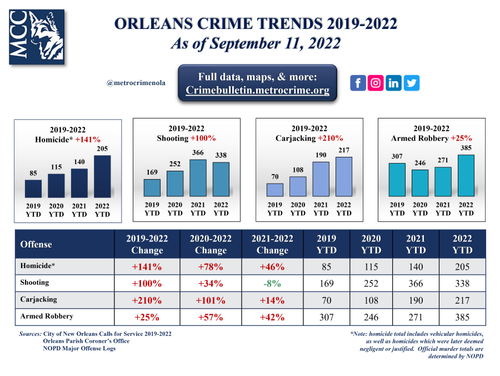
WSJ reported the Louisiana city on the Mississippi River, near the Gulf of Mexico, recorded the highest homicide rate of any major city so far this year, with 41 homicides per 100,000 residents.

Metropolitan Crime Commission Inc., a nonprofit that works on crime-reducing strategies in the city, said the homicide rate is up 141% compared with the same period in 2019. It pointed out carjackings are up 210%, shootings 100%, and armed robberies up 25%.

“The homicide rate is on pace to surpass last year’s rate, which was the worst since Hurricane Katrina in 2005,” WSJ noted. 

The city’s alarming spike in the homicide rate comes at the same time as “progressive prosecutor” Jason Williams became the district attorney of the metro area in early 2021. He promised a “more selective” approach to prosecutions that goes “beyond punishment.”

Continue reading “”

BLUF
Pelley’s reluctance to ask tough questions about Hunter is deliberate and straight out of the corporate media handbook.

The corrupt press knew Hunter was sealing deals using his dad’s name and title. They also knew that was compromising for the then-presidential candidate. That’s why when Hunter’s laptop with information indicating Joe was not as clueless about Hunter’s business as he seemed surfaced shortly before the 2020 election, the media claimed it was “Russian disinformation” and refused to cover any of the corruption.

Pelley’s refusal to make Joe answer for the Biden family business in a 2022 “60 Minutes” interview is no different than the media’s deliberate memory holing of Hunter’s depravity and the Bidens’ wheeling and dealings in 2020.

Corporate Media Enable Biden Family Corruption By Refusing To Ask Tough Questions About Hunter.

Joe Biden hasn’t had to answer tough questions about Hunter Biden and the Biden family business because the corporate media doesn’t make him.

Thanks to the complacent, corrupt corporate media, President Joe Biden has once again failed to answer questions about the Biden family business and whether his son Hunter Biden’s foreign entanglements have affected how he chooses to run the country.

The most recent side-stepping happened during a “60 Minutes” interview with CBS news anchor Scott Pelley, who claimed that if Joe seeks re-election, “Republicans are most likely to go after your son Hunter.”

“I wonder what you would like to say about your son and whether any of his troubles have caused conflicts for you or for the United States,” Pelley said.

First, Pelley’s “question” was not a question but a softball statement designed to save him from criticism for failing to raise Hunter as a topic of conversation at all. Much like the rest of his corporate media colleagues, Pelley seems to have an incessant desire to prop up the declining president instead of making him answer tough questions.

Secondly, Republicans aren’t “going after” Hunter to get to Joe. They are raising legitimate concerns about someone whose foreign business dealings and criminal dabbling, combined with his closeness to POTUS, pose a serious threat to the national security of the United States.

Continue reading “”

Joe Biden Delivers a Mess of a 60 Minutes Interview, Leaves His Handlers Scrambling

Joe Biden appeared on 60 Minutes on Sunday evening, and it was an absolute disaster of an interview. As I type this, stories are already coming out about how he blindsided officials in his administration and how his handlers are scrambling to clean up the mess.

In fact, within an hour of the interview premiering, the first clarification had already dropped regarding comments the president made about defending Taiwan from a Chinese attack. That was the second time in the last few months that the administration has had to walk back Biden’s comments on the subject.

Things didn’t get better as the topics changed. When asked about inflation, Biden gave perhaps the worst answer imaginable.

When it comes to bad economic news, there are two ways to handle it as a president. The right way is to admit the truth and then lay out a quantifiable plan for how to improve things. Americans are very forgiving of politicians who speak plainly to them. On the other hand, the wrong way is to simply pretend like everything is actually great and that anyone who doesn’t think so is an idiot. Guess which strategy Biden has chosen?

The dismissive snark about an 8.3 inflation rate that is crushing the poor and middle-class is just astonishing to witness. His skin is so thin you can see straight through it, and while I know Biden doesn’t have to live with any of the consequences of his policies, you’d think he could at least fake it a little. Besides, his excuse doesn’t even make sense. Who cares if the rate only went up “an inch” if the overall rate is still sky-high? Core inflation continues to rise, mainly driven by food and housing (including rent) prices.

Continue reading “”

NYT Poll Finds More Voters Agree with GOP on Gun Policy

A New York Times/Siena College poll conducted September 6 to 14, 2022, finds more voters agree with the Republican Party on gun policy.

The poll questioned nearly Nearly 1,400 registered voters.

When asked, “Who do you agree with more on gun policy?” voters responded 47 percent to 43 percent, in favor of Republicans over Democrats

Voters were also asked, “Who do you agree with more on crime and policing?” They responded 47 percent to 37 percent in favor of Republicans over Democrats.

The NYT/Siena College poll also asked voters whether they support “A ban on semiautomatic weapons and high-capacity magazines.” Forty-nine percent of voters said they do not support such a ban, while 46 percent said they did.

When responses were broken down among voting patterns, 74 percent of Biden voters supported banning semiautomatic weapons and “high capacity” magazines. An identical percentage of Trump voters opposed banning semiautomatic weapons and “high capacity” magazines.

When ages were taken into account, 54 percent of the youngest voters–ages 18-29–opposed a ban on semiautomatic weapons and “high capacity” magazines, while 41 percent of the youngest voters supported it.

It must have finally dawned on them that it stopped working from them politically

Biden: ‘The pandemic is over.’

President Biden declared the coronavirus pandemic “over” in an interview that aired Sunday, pointing to the return of large events and the lack of masking and other public health measures in place nationwide.

“We still have a problem with COVID. We’re still doing a lotta work on it. It’s — but the pandemic is over. if you notice, no one’s wearing masks. Everybody seems to be in pretty good shape. And so I think it’s changing. And I think this is a perfect example of it.”

The United States is still recording an average of more than 400 deaths per day from COVID-19, according to New York Times data, and more than 1 million Americans have died from the virus since the pandemic began in early 2020.

Highly contagious variants have spread throughout the globe, making it nearly impossible to fully eradicate COVID-19.

As a result, the Biden administration has focused its messaging on the importance of getting vaccinated and receiving booster shots to increase immunity, as well as the wide availability of of antiviral pills and other forms of treatment for those who contract the virus.

Biden himself contracted COVID-19 in July, but experienced only mild symptoms, according to his doctor. Officials credited his mild case to being fully vaccinated and taking the antiviral drug Paxlovid.

The U.S. and much of the world has returned to hosting large events over the past year, like the auto show, and done away with requirements that attendees wear masks or provide proof of vaccination. The U.S. still requires foreign visitors to be fully vaccinated to come to the country by plane.

The World Health Organization (WHO) still categorizes COVID-19 as a pandemic.

Dr. Anthony Fauci, Biden’s top medical adviser on the pandemic, said earlier this year the U.S. was moving “out of the pandemic phase” with COVID-19, pointing to the manageable levels of hospitalizations and deaths in the country.

Biden has in the past argued that the United States had turned a corner on the pandemic, most notably during a speech on Independence Day in 2021, when he asserted the country had the tools necessary to “declare independence” from the virus.

But in the weeks that followed, the delta variant contributed to a surge in cases and deaths. And in late 2021 into early 2022, the omicron variant again led to a spike in cases and deaths. Newly available booster shots were designed specifically to shield Americans from severe cases of the omicron variant.

In the 60 Minutes interview, Biden said the “impact on the psyche of the American people as a consequence of the pandemic is profound.”

“Think of how that has changed everything. You know, people’s attitudes about themselves, their families, about the state of the nation, about the state of their communities. And so there’s a lot of uncertainty out there, a great deal of uncertainty. And we lost a million people. A million people to COVID,” he said.

“When I got in office, when I got elected, only 2 million people had been vaccinated. I got 220 million — my point is it takes time,” he added. “We were left in a very difficult situation. It’s been a very difficult time. Very difficult.”

And he’s dead, Jim.

Mugger who died trying to rob two men with a fake gun on Staten Island was out on parole

A man who died when he tried to rob two men on a Staten Island street with a fake gun was out on parole for attempted robbery at the time.

Robert Compton, 33, pulled a phony handgun on two 33-year-old men near Pacific Ave. and St Albans Pl. in Eltingville as they walked home from a bar around 1:55 a.m. Sunday, police and sources said.

Compton allegedly approached the men and told them to “give me all your s—t,” sources said.

One of the would-be victims grabbed the fake gun and the men fought back, tussling with the mugger and restraining him.

One of the men got behind Compton, grabbed him around the neck and pulled him to the ground while the other called 911, sources said.

During the struggle, Compton fell unconscious.

“He robbed us at gunpoint,” one of the men told responding officers.

Police performed CPR on Compton before he was rushed to Staten Island University Hospital North, where he died.

The two other men were taken to the same hospital to be treated for minor injuries.

Compton had a lengthy rap sheet, including for grand larceny, robbery and assault, sources said.

He spent over four years behind bars for an attempted robbery charge and was paroled in December 2019.

A neighbor of one of Compton’s targets believed he was in the “wrong place, wrong time.”

“I’ve known him since he was a little boy,” said Richard Vitale. “He’s a stand-up guy. I heard a rumor that he took karate. He’s outgoing, he has a lot of friends.

“He gets along with everybody,” the man continued. “He’d be the last person I would think would be connected to this.”

The victims’ attorney said the men were “clearly acting in self defense.”

“Our clients, two hard working young men, were the victims of a terrifying armed robbery by a career criminal,” said Louis Gelormino. “We are grateful that the District Attorney’s Office and the NYPD conducted a complete and thorough investigation of this matter. Our prayers go out to the family of the deceased.”

The city Medical Examiner performed an autopsy on Compton’s body, but said more tests would need to be done to determine his exact cause of death.

Demand for private security is booming in Minneapolis.

In June 2020, the Minneapolis city council famously vowed to defund the police department. Though their plans fell through, the fully funded MPD is nonetheless struggling. More than 250 officers have resigned or retired since then. Earlier this year, the Minneapolis supreme court ruled that the city has a duty to staff the MPD with a minimum of 731 sworn officers, but the department is at least 100 officers short of that target. Meantime, crime has spiked, with 96 homicides in 2021—doubling the number in 2019 and tying a 1995 record.

Private security has stepped into the breach. The number of licenses approved for new private providers rose from 14 in 2019 to 27 in 2021, according to data from Minnesota’s Board of Private Detective and Protective Agent Services. Demand is exploding as businesses increasingly opt for private guards over off-duty cops.

Christopher Forest started his private security firm, Unparalleled Security, after the rioting of 2020. Today, he has 175 employees. Forest did not set out to start a private security firm, having previously worked as CEO of Minnesota’s largest valet-parking company. But after June 2020, his clients began approaching him with requests for security guards. These clients had once hired off-duty police officers for their security needs, but the MPD’s image after the George Floyd killing made that more difficult.

“I think it just had to do with the temperature in the room when you have a police officer in a venue versus an unarmed security guard,” Forest says.

Michael MacDonald, who runs a smaller private security firm called JomsVikings Protection and Security, agrees. “Stores do not want cops out in front because of the negative attention it can bring to their facilities,” says MacDonald. His license to operate was issued July 31, 2020. Today, he has 18 full-time and ten part-time employees.

High crime means that new clients, such as movie theaters, are entering the market for private security, says Richard Hodson, the chairman of Minnesota’s Board of Private Detective and Protective Agent Services. Hodson says he knows of a retired police officer who recently got a license to run his own private security firm but has had to turn down contracts because he cannot hire enough guards to staff them. Demand exceeds supply.

Businesses still fear negative publicity from taking an aggressive enforcement stance. Forest says retail clients instruct his guards not to confront shoplifters. “Retail is in a place where they do not want you to even address the person,” he says. “You are not to talk to them. You are not to approach them. You are not to ask to see the items in their bag. If they are purchasing something, you are asked to not look at the receipt. You are 100 percent visual deterrent, and that is all.”

That approach isn’t universal. MacDonald says that his guards sometimes confront shoplifters, but never aggressively. “When we zone in on the individual who is stealing, we go over there and we say, ‘Hey, man, we know you stole. Can you just put it back and then leave?’ We start with that approach. We don’t go right to the top,” he says. “I will only take a contract for a store if there is a clear understanding that we are strictly there for employee safety. We are not loss prevention.”

Should guards call police to stop crimes in progress? MacDonald’s personnel tend not to do so for shoplifting. Forest says that some of his guards who work for hotels do intervene if guests are engaging in illegal activities; in theory, they should call the police, but they usually don’t. “If it is not a life threatening situation, the police do not show up,” Forest says. “They let my guards de-escalate on their own.”

Even a nonconfrontational approach can escalate. MacDonald describes an incident that occurred in July: “A guy stole a bag of chips and shoved it down his pants. Our guy made an approach and was like, ‘You can keep the chips, but you still got to go.’ Well, the guy brandished a firearm out of his bag. So our guy pulled his firearm. And then the guy took off running. But our employee had the level of training to remember that he could still re-holster it, and he does not have to engage any further.” That incident merited a rare call to the MPD. “If it gets higher than a theft, like what happened with my employee, then the cops will actually come, because otherwise they are not coming,” says MacDonald.

Some Minneapolis residents still prefer to hire off-duty cops, whom the department makes available through what it calls the “buyback program.” The upscale Lowry neighborhood established the Minneapolis Safety Initiative for off-duty police to conduct patrols. Residents are trying to raise $210,000, suggesting a recurring contribution from their neighbors of $220/month for at least six months. The Minneapolis Safety Initiative attracted significant coverage, including criticism from some who argue that wealthier neighborhoods are purchasing scarce police hours.

Nevertheless, demand for private security is growing. MacDonald and Forest expect to see significant expansion in the year ahead. High crime and police shortages are changing the public-safety landscape in Minneapolis.

“I Surprised Myself with My Openness and Enjoyment of the Activity” (Fall 2022 Student Range Visit Reflection #2)

This is the second of several student gun range field trip reflection essays from my fall 2022 Sociology of Guns seminar (see reflection #1). The assignment to which students are responding can be found here. I am grateful to these students for their willingness to have their thoughts shared publicly.

Sociology of Guns student at the range, Fall 2022. Photo by Sandra Stroud Yamane

By Audrey Dorfman

Prior to the field trip to Veterans Range, I would classify my view of guns in the US as predominantly negative. As I had previously never directly interacted with a gun before, I only associated the use of guns with the violence seen in the media in horrific crimes like mass shootings. I did not understand the need or desire to be a gun owner. However, the experience at the range definitely altered my prior understanding of guns in the US as I surprised myself with my openness and enjoyment of the activity.

When I first arrived at the gun range and gathered with the other students in my group to wait outside the fenced area, I was initially startled by the sound of the AR-15 being fired nearby. Hearing just how loud the gun was made me realize the true power of the weapon I was about to be interacting with. While I was a little bit nervous to handle the guns, I felt mostly excited; I seemed to be the most eager in my group to volunteer to shoot first. I wanted to approach the experience with an open mind, and I think this attitude allowed me to relax and appreciate my time at the range much more.

The part of the field trip that surprised me the most was how much I truly enjoyed it. I walked away feeling a sense of exhilaration and as if I had been relieved of the day’s tension and stress. I immediately contacted my family to tell them how great of a time I had with the different types of guns – however, this unexpected enjoyment also confused me. I was wrestling with the idea of how I could have so much fun with these different guns when they are the same objects I know are used to kill people every single day.

Continue reading “”

“We’re doing things that help those of us in the anti-Trump world bond with one another and that help people in the Trump world bond with one another.”

“We’re locking in the political structures that benefit Trump…. We are in the middle of a cultural/economic/partisan/identity war between more progressive people in the metro areas and more conservative people everywhere else. To lead the right in this war, Trump doesn’t have to be honest, moral or competent; he just has to be seen taking the fight to the ‘elites.’… Trumpists tell themselves that America is being threatened by a radical left putsch that is out to take over the government and undermine the culture. The core challenge now is to show by word and deed that this is a gross exaggeration. Can Trump win again? Absolutely. I’m a DeSantis doubter…. And then once Trump is nominated, he has some chance of winning, because nobody is executing an effective strategy against him.”

David Brooks slogs along, ahead of his crowd, which is moving even more slowly, pondering the mystery, “Why Is There Still No Strategy to Defeat Donald Trump?” (NYT).

The needed “effective strategy” against Trump is “to show by word and deed” that it’s “a gross exaggeration” to think that “a radical left putsch… is out to take over the government and undermine the culture.” I’m not even persuaded that Brooks believes it’s all that much of an exaggeration to think there’s a “radical left putsch… out to take over the government and undermine the culture.” He just wants Trump defeated and hopes anti-Trumpsters execute a good strategy to take him out.

What would work on these “conservative people” who live everywhere but where everyone who needs to think up the strategy lives? Brooks doesn’t know! He doesn’t even know why all these millions of people love Trump. Does he think it’s because they haven’t yet been cajoled out of believing the “gross exaggeration”? If they haven’t abandoned this belief yet, why would it happen now or in the next 2 years?

I saw that Brooks column yesterday and passed on it, but I gave it another look this morning after Meade texted it to me, which he did because I’d posed the question, in real life here at Meadhouse, “Do you think Trump will run and win?” Meade said the column answered my question. I take it that means the answer is yes.

ADDED: The fact that Brooks talks about a “gross exaggeration” reveals that he thinks there is something true. If there weren’t something true, you’d call it a lie, not an exaggeration.

If a foreign goobermint forced this kind of education system on us, it would be considered an act of war.

Students cannot pass a basic citizenship exam: A shameful indictment of our education system.

A new semester is upon us, and as a political science professor at Suffolk Community College in New York, it’s important for me to gauge what my students already know about American government and politics.

Early on in my teaching career, I found that students came into college lacking a basic understanding of the founding of our country, the Constitution, the roles and responsibilities of our institutions, and the core American political philosophies, including concepts of liberty and freedom.

I decided the best way to measure my students’ understanding of the American government was to issue two assignments. On the first day of class, I give my students a citizenship exam asking very basic questions about our founding and our system of governance. Some of the questions include:

The overwhelming majority of students fail the exam. After twelve years of administering this exam, only 348 students have passed out of 2,176. A shameful indictment of our K-12 education system.

Even worse, the passing rate has dropped compared to when I first began giving the exam and has been stagnant over the last five years.

Sadly, this semester is no different. The pass rate for the test is 70%. Out of the approximately 175 students, only 11 of them were able to pass the exam.

For the second assignment, I provide them with Chapter 1 of the Russian Constitution, replacing Russian Federation with the United States, and Duma with Congress. It is important to note that the Russian Constitution, crafted in 1993, begins with “We the multinational people…,” and that Chapter 1 consists of 16 Articles.

Students are asked to provide a one-paragraph written response sharing their thoughts on this constitution. Realistically, their response should be one sentence: this is not the United States Constitution.

Instead, many will write how they never actually read the U.S. Constitution, which is horrifying given the number of years they have attended school prior to taking my course. Others will reference Article 7 where it explains “…guaranteed minimum wages and salaries shall be established, state support ensured to the family, maternity, paternity and childhood, to disabled persons and the elderly, the system of social services developed, state pensions, allowances and other social security guarantees shall be established,” and praise the foresight of the founding fathers.

Needless to say, when I reveal the results and my deception, the look on the students’ faces is priceless. The shock, embarrassment, and shame can be seen in their expressions. These exercises, however, have proven to be an invaluable tool to make my classes more successful, and they dramatically improve student engagement.

There are three objectives behind these assignments.

The first is to open students’ eyes to how unfamiliar they are with the country they are living. As I explain to the students, they have opinions about everything, but how can they say what the government should/should not be doing when they do not know why the government exists, the institutions within the government, and the roles and responsibilities of these institutions?

The second objective is to teach students to think critically, ask questions, be suspicious, and speak up. After I tell the students what they read, some students will respond that they found it strange that the founding fathers would be talking about minimum wage, pensions, and other 20th and 21st century issues.

My response is always the same, “Why didn’t you say anything or do a quick internet search?” Interestingly enough, they reply that since I am the professor, they trusted me, and I would know more about the subject matter than they do.

Even though they had questions, they went against their gut instincts and blindly complied with the assignment. I explain to my students the importance of questioning everything and thinking critically, regardless of who is providing them with the information.

My final objective is to get the students eager and more interested in the subject.

After the exercises, I begin to probe the students in an effort to understand how it’s gotten this bad. The overwhelming majority of students state that throughout their K-12 education, they were never required to read the U.S. Constitution. This is extremely frustrating, because by the time these students get to my course, not only should they be able to easily identify the Constitution, but it should also be seared into their minds.

The good news is that as my students progress throughout the semester, they understand the intent of government and how our system works. They gain the ability to formulate their own ideas on the issues and develop stronger arguments supported by solid evidence.

As an educator, it is not my role to indoctrinate them on what they should believe. Instead, it is my responsibility to assure they know how the American government operates, nurture their academic development, spark their intellectual curiosity, and get them to think critically about the issues.

After “The Great Shaming,” they are eager to learn.

While many criticize the younger generations, out of my nearly two-decades of experience, I am always amazed at how my students show a profound respect for one another and are much more open-minded than many would believe—far more open-minded than some of the people doing the teaching. Every semester, my students learn as much from me as I do from them, and I have little doubt the same will happen this semester.

Homeowner kills intruder in struggle in Kenosha

KENOSHA, Wis. — A homeowner shot and killed an intruder during a struggle inside their home, according to Kenosha police.

Police say they got a call around 7:20 p.m. about a man damaging cars at random and trying to break into houses near 64th Avenue and 69th Street.

They say the man did force his way into a house, where he got into a physical struggle with the homeowner, who shot and killed the intruder.

Police are not releasing any details about the man who was killed. They say there is no threat to the community.


Armed man shot, killed after breaking into Burke County home

Investigators said a man shot and killed a home intruder early Friday morning in Burke County [North Carolina].

Deputies responded to 2902 Flat Gap Road in Valdese after a report of shots fired around 3 a.m., according to a release from the Burke County Sheriff’s Office.

When deputies arrived at the scene, they found Howard Gene Cook, 37, dead at the scene, the release said.

Authorities said Cook had broken into the home and got hold of a gun there.

Cook pointed the gun at the homeowner, who also was armed, and the homeowner fired his weapon and hit Cook, the release said.

Detectives with BCSO’s criminal investigations division will finish the investigation and submit their findings to the district attorney’s office, who will decide whether there should be any charges.