Hershel ‘Woody’ Williams, Last Living World War II Medal of Honor Winner, Dead At 98.

Sad news: Hershel “Woody” Williams, the last living Medal of Honor winner from World War II, has died at age 98.

Williams was a member of the U.S. Marine Corps and served in the Battle of Iwo Jima. He was awarded the Medal of Honor on Oct. 5, 1945, from President Harry S. Truman for his “valiant devotion to duty,” the Woody Williams Foundation said.

“Today at 3:15am, Hershel Woodrow Williams, affectionately known by many as Woody went home to be with the Lord. Woody peacefully joined his beloved wife Ruby while surrounded by his family at the VA Medical Center which bears his name,” the Woody Williams Foundation wrote.

Williams, who was born in Quiet Dell, West Virginia, served for 20 years in the Marine Corps and Marine Corps Reserves and then worked for the Department of Veterans Affairs for over 30 years as a veterans service representative.

The U.S. Navy commissioned a warship called the USS Hershel “Woody” Williams in his honor in Norfolk, Virginia, in 2020.

I had previously honored Williams for my 2019 Veterans Day profile.

For conspicuous gallantry and intrepidity at the risk of his life above and beyond the call of duty as demolition sergeant serving with the 21st Marines, 3d Marine Division, in action against enemy Japanese forces on Iwo Jima, Volcano Islands, 23 February 1945.

Quick to volunteer his services when our tanks were maneuvering vainly to open a lane for the infantry through the network of reinforced concrete pillboxes, buried mines, and black volcanic sands, Cpl. Williams daringly went forward alone to attempt the reduction of devastating machinegun fire from the unyielding positions.

Covered only by 4 riflemen, he fought desperately for 4 hours under terrific enemy small-arms fire and repeatedly returned to his own lines to prepare demolition charges and obtain serviced flamethrowers, struggling back, frequently to the rear of hostile emplacements, to wipe out 1 position after another.

On 1 occasion, he daringly mounted a pillbox to insert the nozzle of his flamethrower through the air vent, killing the occupants and silencing the gun; on another he grimly charged enemy riflemen who attempted to stop him with bayonets and destroyed them with a burst of flame from his weapon.

His unyielding determination and extraordinary heroism in the face of ruthless enemy resistance were directly instrumental in neutralizing one of the most fanatically defended Japanese strong points encountered by his regiment and aided vitally in enabling his company to reach its objective.

Cpl. Williams’ aggressive fighting spirit and valiant devotion to duty throughout this fiercely contested action sustain and enhance the highest traditions of the U.S. Naval Service.

Sometime in the next decade or two, the last living World War II veteran will die, and that epoch-changing conflagration will pass out of living memory.
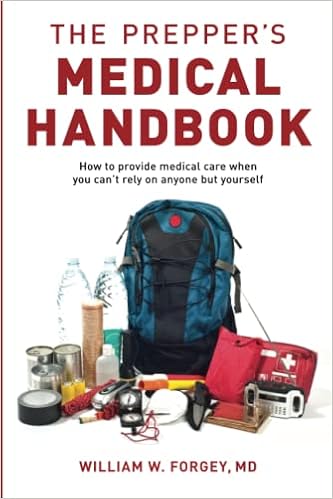
The Prepper’s Medical Handbook

The basis of adequate prepping is being prepared for both common and dire events that may occur under the worst of all possible circumstances. These circumstances might include the breakdown in normal emergency support services (such as calling 911), the lack of an ability to obtain additional supplies, and the probability that you will not be able to rely on anyone but members of your immediate group or yourself.

Prepping requires forethought with regard to food, water supplies, power, and protection – all areas of significant technical preparation. Self-reliant medical care is no exception.

This book provides the basis of prevention, identification, and long-term management of survivable medical conditions and can be performed with minimal training. It helps you identify sources of materials you will need and should stock-pile, it discusses storage issues, and directs you to sources for more complex procedures that require advanced concepts of field-expedient techniques used by trained medical persons such as surgeons, anesthesiologists, dentists, or midwifes and obstetricians.

If it’s from a Yale law professor, you can bet it’s unconstitutional


Yale law prof suggests new route to carry ban, but is it constitutional?

Short answer? Almost certainly not, based on what the Supreme Court said last week in New York State Rifle & Pistol Association vs. Bruen, but as we’ve already seen in states like New York, New Jersey, and California, anti-gun activists aren’t letting a little thing like a Supreme Court decision get in the way of their desire to disarm average, everyday Americans.

So what is Ian Ayres’ big idea? Basically, he wants to flip the current law in the vast majority of states to make concealed carry banned on private property unless the owners of that property decide to allow it.

You might be surprised to learn that when you ask someone to come and repair your dishwasher, they can legally carry a concealed weapon into your kitchen unless you expressly object. In all but three states and D.C., any visitor can, by default, carry a firearm into your home without your explicit permission. The repairman has a Second Amendment right to bear arms, but you have a right to control whether people carry guns onto your land.

A central attribute of property ownership is the right to exclude unwanted people from your land. Forty-seven states fail to adequately protect this right of landowners to control their property because they provide the wrong default rule regarding the right of invitees to bear arms. Property owners cannot make an informed choice if they don’t know they have to object (more than two-thirds of people are unaware of these default rules). And it is hard for a property owner to know that she needs to object when the objectionable firearm is concealed.

The same problem exists regarding private commercial land. All 50 states permit individuals to carry their firearms into private retail establishments by default. Private businesses must post “No Guns” signs to make their stores gun-free, and these signs must often meet strict requirements. Many retailers fear customer backlash if they post signs either restricting or permitting gun carry in their stores. So, they are inclined to stick with a state’s default rule regardless of their preferences.

If this idea sounds familiar it’s because New York Gov. Kathy Hochul has decided to implement this idea, at least when it comes to businesses, as part of plan to defy the Supreme Court and make it as difficult as possible for New Yorkers to exercise their right to armed self-defense in public.

There are two big problems with Ayers idea; one constitutional and one practical. As Ayers himself notes, every state in the union says that if you want to ban guns from commercial properties you can do so, but you must provide notice to the public in some form or fashion. 47 out of 50 states take the same view when it comes to non-commercial private property. These laws are widespread and longstanding, and there is nothing in the history or tradition of the right to keep and bear arms that supports what Ayers (and Hochul) are demanding. Given the negative implications that these policies would have on the right of the people to bear arms for self-defense in public and the fact that they have no similar analogues in American history, I don’t think there’s any way that they would be upheld by the Supreme Court.

From a practical perspective the idea is just as flawed. Ayers acknowledges that “it is hard for a property owner to know that she needs to object when the objectionable firearm is concealed,” and that wouldn’t change if all privately-owned spaces become gun-free zones by default. It would be just as difficult to determine if someone was carrying in violation of the law, but we’d also likely see far more individuals inadvertently doing so because of the reversal of the longstanding status quo. Ayers idea wouldn’t stop a single violent criminal, but would turn a lot of otherwise law-abiding citizens into accidental outlaws because they would no longer be able to legally carry in most of the places where they’ve been able to exercise their right to bear arms in the past.

Part of Ayers’ problem is that he, like many other gun control fans, still just doesn’t want to accept that the right to keep and bear arms is a real right. In his piece at The Hill, the Yale professor claims that the Second Amendment is about “individuals’ ability to defend their homes by arming themselves.” That is simply not true. The right to keep and bear arms is fundamentally about protecting yourself, not your property, and as the Supreme Court made clear last week, the right of self-defense doesn’t stop once you set foot outside your front door. If private property owners want to ban lawful carrying on their premises they can do so, but in a country with a right to keep and bear arms, the default position has historically respected that right and must continue to do so in the future.

COVID-19 vaccine updates

There have been several developments concerning COVID-19 vaccines.  To call some of them “horrifying” is a gross understatement.

First, the vaxx and fertility.

Why is there a substantial decrease in births in Germany and Switzerland (and other countries) – nine months after the beginning of covid mass vaccinations?

Do covid vaccines influence male or female fertility? … new birth data out of Germany and Switzerland raises some serious questions. Specifically, both countries recorded a consistent 10% to 15% decrease (compared to expectations) in monthly births from January to March/April 2022 (the latest available data) – that is, precisely nine months after the beginning of covid mass vaccination in the general population in April/May 2021 (see charts above and below).

How can this substantial decrease be explained? Is it due to behavioral or biological factors?. . .

Furthermore, there have been widespread and officially acknowledged reports of post-vaccination menstrual disorders (over 30,000 reports in Britain alone); official reports of vaccine adverse events including death in breastfeeding babies (over 60 reported cases in Germany alone); a still unexplained, transient increase in neonatal deaths in countries like Scotland; and reports by Austrian midwives of an increase in complications during pregnancy and delivery after covid vaccination. Meanwhile, Pfizer has never even finished its vaccine trial in pregnant women.. . .

A similar decline in births since early 2022 is visible in Britain, the Netherlands, Norway, Slovenia and Taiwan, but apparently not in California (though states that saw an initial lockdown-related decline in births may see a subsequent rebound).

There’s more at the link, including further links to the studies cited above.

Some authorities are already trying to decry such “rumors” and “falsehoods”.  Unfortunately for them, the trickle of evidence is turning into a tidal wave.  See, for example, this Twitter thread from user Jikkyleaks (original tweet is here), providing yet more links and graphics to illustrate the trend.  A brief excerpt:

This is a massive safety signal for infertility. Germany’s FIRST report of birth rates since the rollout.

Remember that the birth rate data is 9 months too late.

If the next quarter is worse, this is Children of Men scenario.

For the years 2011-2021 the average number of births is 63,911 for the Jan-Mar quarter, with a standard deviation of 1015.

The drop to 54871 for 2022 is approx 9 SD.

9 Sigma. Unicorn events.

The money people understand this.

https://seekingalpha.com/instablog/51725008-quantsb/5548386-2-3-sigma-events-are-low-probability-5-6-9-sigma-events-are-unicorns-lots-of-unicorn-events

Again, more at the link.  Nassim Taleb might call it a “black swan event” rather than a “unicorn event”, but the impact of either is no less disastrous.

Another report notes that Taiwan is experiencing an almost 25% drop in births over the same period, and rates this as no less than a 26-sigma event.  The author notes:  “This can be described as “unimaginable” in terms of the likelihood of happening due to random chance.”

Next, there’s preliminary but growing evidence that mRNA vaccines against COVID-19 may cause Creutzfeldt-Jakob or other prion diseases of the brain in some recipients.

Researchers believe the prion region from the original Wuhan COVID-19 variant’s spike protein was incorporated into mRNA vaccines and adenovirus vector vaccines — given to hundreds of millions of humans — and that it can cause a new type of rapidly progressing sporadic CJD.. . .

A French pre-print paper published in May on CJD and COVID-19 vaccination identified a new form of sporadic CJD that occurred within days of receiving a first or second dose of Pfizer or Moderna COVID-19 vaccines.. . .

Sporadic CJD occurs when a person becomes infected for no apparent reason. Once a single prion becomes infected, it will progress to other prions, and there is no treatment capable of stopping it.

More at the link.

The link between CJD and the vaxx was postulated by the late Nobel prize winner, Dr. Luc Montagnier, last year.

We’re in unknown territory and proclaim mandatory vaccines for everyone. It’s insanity. It’s vaccination insanity that I absolutely condemn. I want to say as well, that I never, never said that everyone will die from the vaccine, but that a certain amount of people who take the vaccine will suffer from it. That’s impermissible … There could side effects that affect future generations as well, maybe, but most probably from our generation in five to ten years. That’s absolutely possible. Notably, something we call neurodegenerative illness. There are sequences that resemble the prion sequences in the RNA of the coronavirus. These prions could disorder the natural proteins in the brain, modifying them to make prions.

More at the link.

Friends, if you took the Pfizer or Moderna mRNA vaccine, all I can say is, get checked out for any or all of the above problems, just in case.  If you’re fortunate enough to have missed them (at least so far), all well and good – but how will you know unless you check for yourself?  I can’t see the powers that be bothering to tell you about these issues.

Biden Admin Super-Charged Military Recruitment Crisis With ‘Woke Policies

The U.S. military under a Biden Pentagon has sacrificed meritocracy for wokeness in recent years, sending a message that discourages new applicants and worsens the recruiting crisis, an expert told The Daily Caller News Foundation.

Military recruitment in 2022 has plummeted, NBC News reported, leaving the pentagon scrambling for ways to fill the ranks of U.S. forces. Alienation of traditional families, who constitute the military’s core recruiting market, through things like diversity quotas, refusing religious exemptions and teaching critical race theory at military institutions have all contributed to a growing unwillingness to enlist, according to Center for Military Readiness President Elaine Donnelly.

The result, she said, is a loss of prestige and meritocracy in the armed forces.

“The culture of the military has been eroded by several years of social engineering and woke policies. It’s been accelerated by the current administration,” Donnelly, who has been studying social issues in the military for over 30 years, told TheDCNF.

The Biden administration’s emphasis on “woke” ideas “sends a poor message” that discourages parents and other influencers from supporting careers the all-volunteer force, according to Donnelly.

For example, one of the first things Defense Secretary Lloyd Austin did upon assuming office was announce a full stand down to investigate what Donnelly claimed were over-hyped instances of extremism in the ranks, focusing on ideologies that fall to the far right and ignoring instances of far left and Islamist extremism. “It sends a message that if your son or daughter joins the military, if they’re not of a certain skin complexion or sex, they might be investigated for extremism,” she said.

A highly competitive employment arena, decrease in the population of individuals eligible to serve and general disconnect between the Army and broader U.S. public have all contributed to the Army’s recruitment struggle, Army public affairs officer Maj. Charles M. Spears told TheDCNF. Propensity to serve, a measure of “whether an individual indicates an interest in military service” according to the Military Leadership Diversity Commission, hit 9%, the lowest since 2007, Spears said.

Donnelly compared the Biden Pentagon to Disney, who lost financial privileges in Florida partially because of its “gay agenda” and produced a LGBT-promoting film that flopped in the box office, according to the Washington Times.

“They alienated their constituency,” Donnelly explained. “When you see the U.S. military make the same mistakes and losing their audience, it becomes a matter of national security.”

The Pentagon attributed a poor recruiting environment to a “disconnected and disinterested youth market” that is unfamiliar with military service, resulting in an overreliance of military stereotypes,” Maj. Charlie Dietz, a Department of Defense spokesperson, told TheDCNF.

The Army announced a plan to in March temporarily reduce the size of the active-duty force, from 485,000 soldiers in fiscal year 2021 down to 473,000 by 2023, for “quality” considerations, Army Undersecretary Gabe Camarillo said in a press briefing.

“We made the decision to just temporarily reduce end strength, as opposed to lowering our standards,” said Camarillo.

However, recruitment standards have changed. The Army dropped the high school diploma or GED-equivalent requirement for new recruits in June, according to a statement, and relaxed tattoo guidelines, Task and Purpose reported.

Donnelly predicted the recruiting environment would get worse under the Biden administration, especially as up to 60,000 troops are up for discharge for refusal to take the COVID-19 vaccine according to The Washington Post. “What effects will these individuals have on recruiting?” she asked.

“The military belongs to everybody and is there to defend the entire country, not to enforce political agendas or teach exotic ideas that cannot be defended by science,” Donnelly said.

The specter of a shrinking military comes as the U.S. faces a growing threat from China and seeks to bolster overseas deployments as a deterrent to Russian aggression.

“It’s not the end of the all volunteer force, but it’s going into a very dark place now,” said Donnelly.

Another J6 Trump ‘Bombshell’ Outed as a Hoax!

On Tuesday, the liberal media soiled themselves over the so-called bombshell story that on January 6, 2021, President Trump grabbed the steering wheel of the presidential limo and then lunged at a Secret Service agent because he wanted to join the protesters at the Capitol.

The story came courtesy of Cassidy Hutchinson, a former aide to Trump’s chief of staff, Mark Meadows.

“So when the president had gotten into the vehicle with [Secret Service agent] Bobby [Engel], he thought that they were going up to the Capitol. And when Bobby had relayed to him, ‘We’re not, we don’t have the assets to do it, it’s not secure, we’re going back to the West Wing,’ the president had a very strong and very angry response to that.

Tony described him as being irate. The president said to him something to the effect of, ‘I’m the f—ing president, take me up to the Capitol now.’ To which Bobby responded, ‘Sir, we have to go back to the West Wing.’ He then reached up front of the vehicle to grab at the steering wheel. Mr. Engel grabbed his arm, he said, ‘Sir, you need to take your hand off the steering wheel. We’re going back to the West Wing, we’re not going to the Capitol.’ Mr. Trump then used his free hand to lunge towards Bobby Engel.”

Any reasonable person would conclude this story was dubious. The liberal media, however, not so much. CNN gleefully described it as a bombshell, yet, like so many other Trump bombshells, it appears this incident didn’t happen at all, and is yet another hoax to add to the pile of bogus anti-Trump stories.

According to Peter Alexander, the chief White House correspondent for NBC News, sources close to the Secret Service dispute the story.

“A source close to the Secret Service tells me both Bobby Engel, the lead agent, and the presidential limousine/SUV driver are prepared to testify under oath that neither man was assaulted and that Mr. Trump never lunged for the steering wheel,” Alexander tweeted Tuesday evening.


Trump’s former acting director of national intelligence, Richard Grenell, slammed the committee for allowing this testimony to go unchallenged.

“So a junior staffer was pressured by @Liz_Cheney to lie under oath,” he tweeted. “Why wasn’t there a single committee member asking her if she had proof? This performance collapsed in an hour.”

“The DC media is corrupt and sick,” he concluded.


Soon after Alexander revealed that his sources challenged the story, Hutchinson’s lawyer, Jody Hunt, quickly attempted to walk back her testimony.

“Ms. Hutchinson testified, under oath, and recounted what she was told,” Hunt tweeted. “Those with knowledge of the episode also should testify under oath.”


How many more bogus bombshells are we going to get from these hearings?

The Liberal Media’s ‘Rising Stars’ Always Seem to Crash and Burn

Those who’ve been around more than five minutes know that the mainstream media is little more than a collection of homogeneous, biased hacks that do little more than support the Current Thing(TM) being pushed by Democrats and leftist activists.

It’s great for Democrats who enjoy uncritical coverage of their nonsense, but often outlets such as The New York Times, Washington Post, CNN, MSNBC, et al. get a little too far out over their biased skis when they begin to fall in love with their latest object of obsessive attention.

Take a walk down memory lane with Townhall as we look at some of the mainstream media’s recent “rising stars” — who get treated as saviors — only to fall on their faces.

Continue reading “”

Funding Fantasy and Ignoring Evil as we Protect Our Students

Our schools are attacked by disgruntled students and former students. Our schools are also attacked by outsiders who select the school so they can murder innocent victims. We have had armed staff protecting our schools for years. We’ve learned from their vast experience so we know how to protect our children. The latest act from congress, the Bipartisan Safer Communities Act, doesn’t do that. In fact, it prohibits it, and that tells us everything.

We’d like it if every child developed a fully formed conscience. That isn’t the real world. I’ve met neglected children who were raised by parents who were physically or mentally ill. I’ve met children who were raised a neglectful addict. Some people who lack a conscience are made. That experience can turn healthy children into violent sociopaths. Mental health treatment will help some of them. The Safer Communities Act does a little to help them.

Some people who lack a conscience are born. About 3-in-a-hundred of us are psychopaths and lack empathy and sympathy with other people. Some of them are also narcissists who think the world owes them more attention. Mental health treatment doesn’t change their propensity towards violence.

The Safer Communities Act can’t change the human condition. We are broken, and some of us much more so than others.

The problem of evil has always been with us. Yes, we want to help children so they don’t want to murder their classmates. That does not solve the larger problem of protecting our schools. What should we do with the evil in the world that wants to kill our kids?

We have several-million-man-hours of experience with armed school staff who volunteered to be first responders. They trained to stop a violent threat and stop the bleeding until outside help arrives. We have never had a child killed in school by an outside attack when these defenders were there.

We have also seen what happens when the school is disarmed. We saw the police wait outside at the high school in Parkland, Florida. We again saw the police wait outside as children were being murdered in Uvalde, Texas. We’ve seen similar carnage in attacks on a gun-free zone away from school where the victims had to wait for the police to save them.

Thank god that we have dedicated police officers on campus protecting our children every day. These officers tell us that too many students will die if we wait for outside help to stop an attacker. The Safer Communities Act ignores their advice. The Safer Communities Act explicitly prohibits funding to arm or to train armed school staff. That tells us everything about the legislation and the politicians who proposed it.

These politicians need public violence so they can hold a press conference and appear concerned. Expressing that faux-concern is more important to the politicians than really protecting our kids.

One way to stop narcisists from attacking our schools is to stop electing them to public office. Until then, work with your local school board.

Democrats Hate Every Second Amendment Victory Because It Challenges Their Monopoly On Power

Democrats hate the Second Amendment for the same reasons they hate free speech and fair elections: They want a monopoly on violence, words, and power.

When the U.S. Supreme Court struck down New York’s gun licensing scheme as unconstitutional last week, outraged leftists freaked out and started calling for the end of the judicial branch as we know it.

“It has become necessary to dissolve the Supreme Court of the United States,” far-left sports commentator Keith Olbermann tweeted. Other verified Twitter users claimed that, as a result of the ruling affirming Americans’ Second Amendment rights, the highest court in the land is “illegitimate,” “thoroughly corrupt,” and “mass shooters” wearing robes.

The law was accurately ruled unconstitutional, plain and simple, but that’s not good enough for leftists who despise the fact that Americans can and will defend themselves.

Why do Democrats despise the Second Amendment so much that they want to effectively banish a branch of the government over it? Because it strips them of their ability to control everything and accumulate power.

Continue reading “”

‘unauthorized’… My foot.


Massive Trove of Gun Owners’ Private Information Leaked by California Attorney General

California gun owners have been put at risk by the Attorney General’s office after a new dashboard leaked their personal information.

The California Department of Justice’s 2022 Firearms Dashboard Portal went live on Monday with publicly-accessible files that include identifying information for those who have concealed carry permits. The leaked information includes the person’s full name, race, home address, date of birth, and date their permit was issued. The data also shows the type of permit issued, indicating if the permit holder is a member of law enforcement or a judge.

The Reload reviewed a copy of the Lost Angeles County database and found 244 judge permits listed in the database. The files included the home addresses, full names, and dates of birth for all of them. The same was true for seven custodial officers, 63 people with a place of employment permit, and 420 reserve officers.

2,891 people in Los Angeles County with standard licenses also had their information compromised by the leak, though the database appears to include some duplicate entries as well.

A video reviewed by The Reload shows the databases with detailed information were initially available for download via a button on the website’s mapping feature. They appeared to have been removed from public access by Tuesday afternoon and replaced with spreadsheets without the individualized identifying information.

The office of Attorney General Rob Bonta (D.) confirmed private information had been exposed and said they are examining the situation.

“We are investigating an exposure of individuals’ personal information connected to the DOJ Firearms Dashboard,” a spokesperson for the office told The Reload. “Any unauthorized release of personal information is unacceptable. We are working swiftly to address this situation and will provide additional information as soon as possible.”

The California Rifle & Pistol Association (CRPA) slammed the leak and said it was looking into potential legal action against the state.

“Vindictive sore loser bureaucrats have endangered people’s lives and invited conflict by illegally releasing confidential private information,” Chuck Michel, CRPA President, told The Reload. “CRPA is working with several legislators and sheriffs to determine the extent of the damage caused by DOJ’s doxing of law abiding gun owners. Litigation is likely.”

The Reload is not publishing the leaked data in order to protect the privacy of those affected by the leaks. However, posts across social media indicate many others were able to obtain the documents during the time they were live on the state’s website. There are also several social media posts that indicate similar identifying information from the state’s dealer record of sales database and its “assault weapons” registry were part of the leak, though The Reload was unable to review copies of those databases.

The leak comes just over a year after California moved to provide detailed personal information of all gun owners in the state to educational institutions across the country despite objections over concerns about data security and individual privacy. It also comes as a similar policy to California’s restrictive gun carry law was invalidated by the Supreme Court, which will likely result in many more Californians being added to the same database the state just leaked.

In a press release announcing the leaky dashboard, Bonta said the goal was “increasing public trust between law enforcement and the communities we serve.” He said the dashboard was about ensuring transparency to “better understand the role and potential dangers of firearms.”

Instead, the leaked private information of gun owners is likely to increase the risk criminals will target their homes for burglaries–something the state’s dashboard reports happened 145,377 times in 2020 alone.

One Unconstitutional Law Implicates Many Gun-Control Regulations

Laws can be interpreted many ways. We seek guidance from the court to know what is legal and what is not. The US Supreme Court has largely ignored the right to bear arms compared to the number of decisions the court has rendered in other areas. We don’t have enough decisions to draw a clear map of where our rights begin and end. The court recently issued an opinion on the right to bear arms in public. This case redefined the legal landscape and gave us a few rules to go by. Let’s look at the unanswered questions to see if we may draw further conclusions.

The recent ruling said that states may require carry permits, but they must issue them to ordinary people who are not criminals. Ordinary people must be able to carry a personal firearm in ordinary places where people congregate. Licensing cannot be excessively delayed or expensive.

Now we want to apply this ruling to other situations. We first look to the text of the Bill of Rights. Based on the text, are the actions in question covered by the Second Amendment. When in doubt as to the scope or applicability, we then consider the history of use when the Bill of Rights was ratified. We are to draw analogies from that period to the present day.

There are no tiered level of examination or scrutiny. If the law in question materially limits the right to bear arms then, with remarkably few exceptions, the law is an infringement on the right to bear arms and unconstitutional.

Continue reading “”

Former Idaho AG doesn’t know how rights work

When something is your right, it means it cannot just be taken away. Not unless you break the law and your rights are removed as punishment. If something can be taken, it is a privilege, and privileges can be removed anytime if whoever grants them decides to stop granting them.

This isn’t exactly high-level constitutional law stuff, either. This is a basic understanding the Founding Fathers had from the get-go. It’s why they fought a war against the most powerful nation on Earth. Having their rights respected was worth the risk.

Yet, for former Idaho Attorney General Jim Jones, rights don’t really work like that, apparently. That’s based on his writing over at The Hill.

Two groups of conservatives made contradictory decisions last week on whether there should be a balance between the safety of the American public and the rights of a small, but very vocal, minority. A group of 15 Senate Republicans broke with their party and voted for a modest gun safety bill. At the same time, the GOP-appointed majority on the U.S. Supreme Court made sure that there will be more guns in public places. The Senate’s action will save lives; the court’s action will likely add to the tally of gun deaths.

The six Republican-appointed members of the Supreme Court struck down a century-old New York law requiring a showing of “proper cause” to obtain a license to carry a concealed handgun. Although the ruling was an immediate blow to public safety, the longer-term effect of the decision will pose an even greater safety threat.

The court departed from a consensus view developed by lower courts over the last decade that allowed gun rights to be limited by concerns over public safety. Instead, it focused the inquiry solely on whether a restriction is based on “history or tradition.” If a similar historical analogue for a gun limitation cannot be found, it may well be unconstitutional, without regard to the effect on public safety.…

More than anything else, our governmental entities and public servants must understand that private rights ought to give way to the public good. We don’t believe a person’s First Amendment rights extend to falsely yelling “fire” in a crowded theater. Second Amendment rights must also yield when they infringe upon the paramount right of the people to be safe in public places.

Uh…no.

Not only no, but hell no.

Of course, Jones invokes the old canard of yelling fire in a crowded theater, as most who try to justify an infringement on our gun rights tend to do, but you’d think a former attorney general would understand that this was a hypothetical presented by a justice during a case and that decision was ultimately overturned in part by Brandenberg v. Ohio. That case found that speech could only be regulated if it were likely to cause imminent lawless action.

Plus, let’s understand that if we take Jones’s word that private rights ought to give way to the public good, then the question becomes, where do we draw the line? It’s clear that Jones favors restricting our right to keep and bear arms as a means of trying to ensure public safety, but what else is on the table?

Can we seize his home so we can house the homeless? Can we seize his car so it can be used for public transportation? Can we lock Jones in chains and make him do road work for no reason other than we simply need the road to be built?

Where would such a line be?

The problem here is that the line would be subjective. What’s “far enough” for Jones wouldn’t be far enough for someone else. There are those who actually do support things not unlike the examples mentioned above, after all.

The way you deal with this is to draw a line with objective criteria. These are your personal rights, and they shouldn’t be infringed upon simply because someone thinks it’s good for the public. The truth is, the smallest minority is the individual. Empower them, and everyone is equally empowered.

Our gun rights aren’t up for debate. First of all, we don’t buy the idea that gun control yields any of the benefits Jones seems to believe. Yet even if we did, rights don’t work that way.

 And thank God for that.

Comment O’ The Day

“If rights are this absolute, however, then we cannot afford to recognize very many if government is to function.”

Now, that’s hardly true, or rather, it depends on the nature of the rights, and what you mean by government “functioning”.

For instance, for most of the nation’s history we got by with essentially zero in the way of regulation of what sorts of guns one could own. They were still selling anti-material rifles mail order when I was a child! People brought guns on airliners, and I mean in their carry on bags. You could send your minor children to buy ammo at the corner hardware store. And yet, we somehow had a government. That’s how much of a right to keep and bear arms still permitted a government to function.

We also survived having basically nothing in the way of drug laws for most of our history. Coca Cola had cocaine in it! And yet, we somehow had a government. You could have a right to ingest anything you damned well pleased, and still have a functioning government.

When you get down to it, for most of the nation’s history we had Grover Norquist’s ideal government: Small enough you could have drowned it in a bathtub. I think people generally don’t understand that: The amount of government we had for most of our history would be dismissed as anarchy today, and things worked.

Barnett has internalized the legitimacy of a degree of government intrusion on our lives that would have completely horrified Americans for the majority of our history.


Preliminary Thoughts on NYSRPA v. Bruen
A minor impact on gun laws but a potentially momentous shift in constitutional method

My contribution to a symposium on New York State Rifle & Pistol Association v. Bruen is now up on SCOTUSBlog. It is pithily entitled: A minor impact on gun laws but a potentially momentous shift in constitutional method. In it, I describe the extensive “shall issue” process I underwent to obtain my concealed carry license in DC for the many who have no idea what this process entails.

I had to pay an application fee of $75. I had to submit my application in person at the Metropolitan Police Department headquarters and be photographed and fingerprinted at an additional cost of $35. I had to pass a federal background check. I had to enroll in and pay for an approved firearms training course, which included 16 hours of classroom study of D.C. gun laws as well as the law governing the use of deadly force, plus another two hours of range instruction. In 2018, the course cost $250 plus $20 for the range fee. The monetary cost of the license amounted to $380. This was in addition to the $125 tax I paid to D.C. on the purchase of my handgun, which brought the total regulatory cost to $505. Since the course took 18 hours to complete, I took it on a Saturday and a Sunday so as not to lose two days of work.

There being no gun ranges in the District of Columbia, my course was taught in Virginia. The instructor was African American, and most of the other students in the course were members of underrepresented groups, which is unsurprising given the demographics of D.C. Since it is doubtful that any other Georgetown professor has a concealed-carry license, I suppose I too was a member of an underrepresented group.

Every two years, I must renew the license. If I miss renewing within the 30-day window before my permit expires, I have to start all over. So, two years later, I had to pay another $75 fee and complete a recertification class consisting of four hours of training, and two hours of range training from an MPD-certified firearms training instructor, which cost $160. I can afford all this, of course, though I cannot say the same for all other citizens of D.C.

This is the type of regulatory regime that, in Bruen, the court said it was not questioning: “[N]othing in our analysis should be interpreted to suggest the unconstitutionality of the 43 States’ ‘shall-issue’ licensing regimes.”

I then discuss my effort to understand Justice Thomas’s “text and history” alternative to the “tiers of scrutiny” doctrine that has dominated constitutional law since the 1950s. I explain why am still not sure I completely understand how it is supposed to work. The essay is long and I cannot truly summarize it my uncertainties and reservations, so you may wish to click through to read it here. Here is a taste:

There is, however, an even more fundamental question raised by Thomas’ text-and-history approach. It seems to assume that, once we use history to identify the “outer contours” of a constitutional right, then any such right bars not only prohibitions on its exercise but also trumps any statutory regulation of it. Prior to the New Deal, however, rights were not viewed as trumps on the regulatory power of government. Instead, the existence of a right barred the complete deprivation of it — that is, a prohibition — and statutes were “strictly” or “equitably” construed to avoid this result. And the existence of a right also required that a regulation be within the power of a legislature to enact. At the federal level, this meant a power delegated to Congress by the Constitution. At the state  level, this meant what is called the state’s “police power.” While broad, the state police power was not unlimited….

Thomas seems to want to limit the original scope of a constitutional right by his historical inquiry. And then the right, so limited, may not be restricted in any way. If rights are this absolute, however, then we cannot afford to recognize very many if government is to function. This would explain Thomas’ apparent movement toward an “enumerated rights only” view of constitutional rights (though he has not yet committed himself to this view). But viewing rights as absolute in this way is quite modern and ahistorical, and its invocation in a purportedly originalist opinion is therefore surprising.

I do conclude with a tentatively proposed alternative:

Perhaps a better approach would have been to distinguish between prohibiting and regulating the exercise of a right. Any prohibition of the exercise of a constitutional right is per se unconstitutional. In contrast, a regulation of how a right may be exercised is permissible, provided the ends of such a regulation are within the legislative power of Congress or a state.

Under this distinction, because the “special need for self-protection” that was required by the New York system was “distinguishable from that of the general community,” the law amounted to a prohibition on ordinary citizens exercising their constitutional right to bear arms outside the home. Not only was this the scheme’s effect; it was also its intention.

By contrast, D.C.’s “shall issue” regime provides a means by which every “law-abiding” (per the background check) citizen of D.C. can obtain a permit, so it is not a prohibition of the exercise of a constitutional right. Unlike the New York law, it is a “regulation” because it proscribes the manner of exercising the right.

It may not always be easy to distinguish a prohibition of a right from a mere regulation of its exercise. For example, is a ban on a particular class of firearms a prohibition or merely a regulation of the manner by which the right to keep and bear arms may be exercised? However, at the extremes it can be quite obvious, as I think it is with New York’s law and the D.C. and Chicago gun bans the court held to be unconstitutional in Heller and McDonald v. City of Chicago. (Even after Heller, D.C. still regulates the types of firearms that can be kept in the home or carried concealed outside.)

Rather than use modern tiers of scrutiny, when considering the appropriate regulation of constitutional rights, we should look instead to the type of eyes-open arbitrariness or rationality review that preceded the adoption of modern tiers of scrutiny. This is not, I should stress, the same as the modern eyes-closed rational basis scrutiny, which the court today considers its default approach under its tiers-of-scrutiny doctrine. (See Dobbs. “A law regulating abortion, like other health and welfare laws, … must be sustained if there is a rational basis on which the legislature could have thought that it would serve legitimate state interests.”)

I put the sentence above in bold because I realize how prohibitions can be characterized as regulations and vice versa. But at the extremes there is surely a difference between telling someone they cannot do something and telling them how they must do it.

Such are my preliminary thoughts on the reasoning of Bruen, whose outcome I applaud. I look forward to benefiting from the thoughts of others about the text and history approach before reaching any final verdict on its merits.